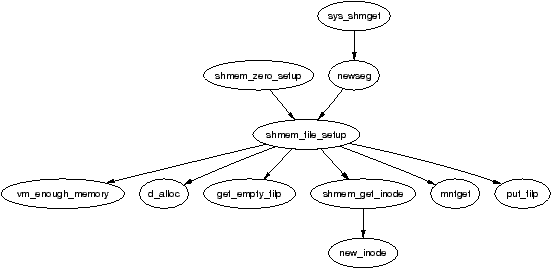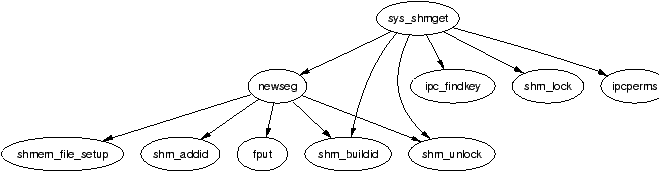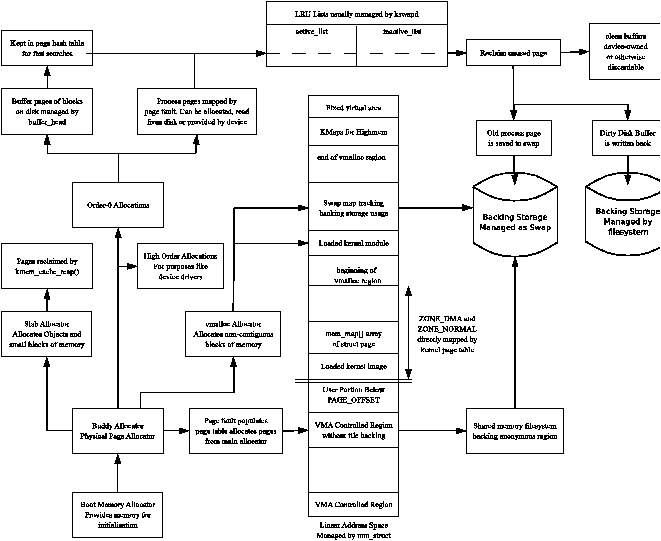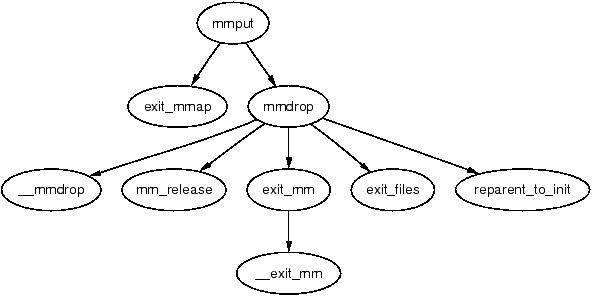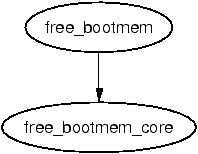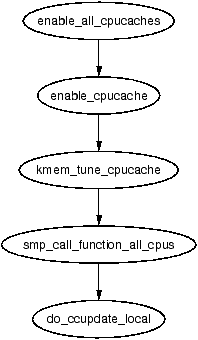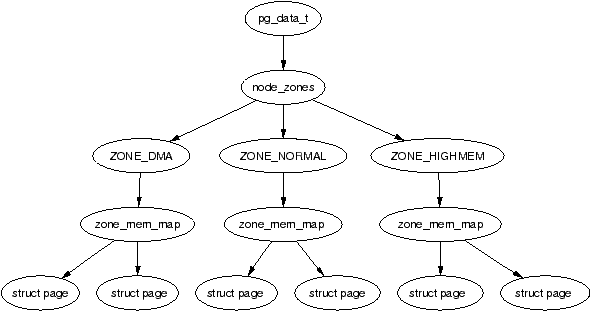
| Figure 2.1: Relationship Between Nodes, Zones and Pages |
ctoc
Linux is developed with a stronger practical emphasis than a theoretical one. When new algorithms or changes to existing implementations are suggested, it is common to request code to match the argument. Many of the algorithms used in the Virtual Memory (VM) system were designed by theorists but the implementations have now diverged from the theory considerably. In part, Linux does follow the traditional development cycle of design to implementation but it is more common for changes to be made in reaction to how the system behaved in the “real-world” and intuitive decisions by developers.
This means that the VM performs well in practice but there is very little VM specific documentation available except for a few incomplete overviews in a small number of websites, except the web site containing an earlier draft of this book of course! This has lead to the situation where the VM is fully understood only by a small number of core developers. New developers looking for information on how it functions are generally told to read the source and little or no information is available on the theoretical basis for the implementation. This requires that even a casual observer invest a large amount of time to read the code and study the field of Memory Management.
This book, gives a detailed tour of the Linux VM as implemented in 2.4.22 and gives a solid introduction of what to expect in 2.6. As well as discussing the implementation, the theory it is is based on will also be introduced. This is not intended to be a memory management theory book but it is often much simpler to understand why the VM is implemented in a particular fashion if the underlying basis is known in advance.
To complement the description, the appendix includes a detailed code commentary on a significant percentage of the VM. This should drastically reduce the amount of time a developer or researcher needs to invest in understanding what is happening inside the Linux VM. As VM implementations tend to follow similar code patterns even between major versions. This means that with a solid understanding of the 2.4 VM, the later 2.5 development VMs and the final 2.6 release will be decipherable in a number of weeks.
Anyone interested in how the VM, a core kernel subsystem, works will find answers to many of their questions in this book. The VM, more than any other subsystem, affects the overall performance of the operating system. It is also one of the most poorly understood and badly documented subsystem in Linux, partially because there is, quite literally, so much of it. It is very difficult to isolate and understand individual parts of the code without first having a strong conceptual model of the whole VM, so this book intends to give a detailed description of what to expect without before going to the source.
This material should be of prime interest to new developers interested in adapting the VM to their needs and to readers who simply would like to know how the VM works. It also will benefit other subsystem developers who want to get the most from the VM when they interact with it and operating systems researchers looking for details on how memory management is implemented in a modern operating system. For others, who are just curious to learn more about a subsystem that is the focus of so much discussion, they will find an easy to read description of the VM functionality that covers all the details without the need to plough through source code.
However, it is assumed that the reader has read at least one general operating system book or one general Linux kernel orientated book and has a general knowledge of C before tackling this book. While every effort is made to make the material approachable, some prior knowledge of general operating systems is assumed.
In chapter 1, we go into detail on how the source code may be managed and deciphered. Three tools will be introduced that are used for the analysis, easy browsing and management of code. The main tools are the Linux Cross Referencing (LXR) tool which allows source code to be browsed as a web page and CodeViz for generating call graphs which was developed while researching this book. The last tool, PatchSet is for managing kernels and the application of patches. Applying patches manually can be time consuming and the use of version control software such as CVS (http://www.cvshome.org/) or BitKeeper (http://www.bitmover.com) are not always an option. With this tool, a simple specification file determines what source to use, what patches to apply and what kernel configuration to use.
In the subsequent chapters, each part of the Linux VM implementation will be discussed in detail, such as how memory is described in an architecture independent manner, how processes manage their memory, how the specific allocators work and so on. Each will refer to the papers that describe closest the behaviour of Linux as well as covering in depth the implementation, the functions used and their call graphs so the reader will have a clear view of how the code is structured. At the end of each chapter, there will be a “What's New” section which introduces what to expect in the 2.6 VM.
The appendices are a code commentary of a significant percentage of the VM. It gives a line by line description of some of the more complex aspects of the VM. The style of the VM tends to be reasonably consistent, even between major releases of the kernel so an in-depth understanding of the 2.4 VM will be an invaluable aid to understanding the 2.6 kernel when it is released.
At the time of writing, 2.6.0-test4 has just been released so 2.6.0-final is due “any month now” which means December 2003 or early 2004. Fortunately the 2.6 VM, in most ways, is still quite recognisable in comparison to 2.4. However, there is some new material and concepts in 2.6 and it would be pity to ignore them so to address this, hence the “What's New in 2.6” sections. To some extent, these sections presume you have read the rest of the book so only glance at them during the first reading. If you decide to start reading 2.5 and 2.6 VM code, the basic description of what to expect from the “Whats New” sections should greatly aid your understanding. It is important to note that the sections are based on the 2.6.0-test4 kernel which should not change change significantly before 2.6. As they are still subject to change though, you should still treat the “What's New” sections as guidelines rather than definite facts.
A companion CD is included with this book which is intended to be used on systems with GNU/Linux installed. Mount the CD on /cdrom as followed;
root@joshua:/$ mount /dev/cdrom /cdrom -o exec
A copy of Apache 1.3.27 (http://www.apache.org/) has been built and configured to run but it requires the CD be mounted on /cdrom/. To start it, run the script /cdrom/start_server. If there are no errors, the output should look like:
mel@joshua:~$ /cdrom/start_server
Starting CodeViz Server: done
Starting Apache Server:  done

The URL to access is http://localhost:10080/
If the server starts successfully, point your browser to http://localhost:10080 to avail of the CDs web services. Some features included with the CD are:
To shutdown the server, run the script /cdrom/stop_server and the CD may then be unmounted.
The conventions used in this document are simple. New concepts that are introduced as well as URLs are in italicised font. Binaries and package names are are in bold. Structures, field names, compile time defines and variables are in a constant-width font. At times when talking about a field in a structure, both the structure and field name will be included like page→list for example. Filenames are in a constant-width font but include files have angle brackets around them like <linux/mm.h> and may be found in the include/ directory of the kernel source.
The compilation of this book was not a trivial task. This book was researched and developed in the open and it would be remiss of me not to mention some of the people who helped me at various intervals. If there is anyone I missed, I apologise now.
First, I would like to thank John O'Gorman who tragically passed away while the material for this book was being researched. It was his experience and guidance that largely inspired the format and quality of this book.
Secondly, I would like to thank Mark L. Taub from Prentice Hall PTR for giving me the opportunity to publish this book. It has being a rewarding experience and it made trawling through all the code worthwhile. Massive thanks go to my reviewers who provided clear and detailed feedback long after I thought I had finished writing. Finally, on the publishers front, I would like to thank Bruce Perens for allowing me to publish under the Bruce Peren's Open Book Series (http://www.perens.com/Books).
With the technical research, a number of people provided invaluable insight. Abhishek Nayani, was a source of encouragement and enthusiasm early in the research. Ingo Oeser kindly provided invaluable assistance early on with a detailed explanation on how data is copied from userspace to kernel space including some valuable historical context. He also kindly offered to help me if I felt I ever got lost in the twisty maze of kernel code. Scott Kaplan made numerous corrections to a number of systems from non-contiguous memory allocation, to page replacement policy. Jonathon Corbet provided the most detailed account of the history of the kernel development with the kernel page he writes for Linux Weekly News. Zack Brown, the chief behind Kernel Traffic, is the sole reason I did not drown in kernel related mail. IBM, as part of the Equinox Project, provided an xSeries 350 which was invaluable for running my own test kernels on machines larger than what I previously had access to. Finally, Patrick Healy was crucial to ensuring that this book was consistent and approachable to people who are familiar, but not experts, on Linux or memory management.
A number of people helped with smaller technical issues and general inconsistencies where material was not covered in sufficient depth. They are Muli Ben-Yehuda, Parag Sharma, Matthew Dobson, Roger Luethi, Brian Lowe and Scott Crosby. All of them sent corrections and queries on differnet parts of the document which ensured too much prior knowledge was assumed.
Carl Spalletta sent a number of queries and corrections to every aspect of the book in its earlier online form. Steve Greenland sent a large number of grammar corrections. Philipp Marek went above and beyond being helpful sending over 90 separate corrections and queries on various aspects. Long after I thought I was finished, Aris Sotiropoulos sent a large number of small corrections and suggestions. The last person, whose name I cannot remember but is an editor for a magazine sent me over 140 corrections against an early version to the document. You know who you are, thanks.
Eleven people sent a few corrections, though small, were still missed by several of my own checks. They are Marek Januszewski, Amit Shah, Adrian Stanciu, Andy Isaacson, Jean Francois Martinez, Glen Kaukola, Wolfgang Oertl, Michael Babcock, Kirk True, Chuck Luciano and David Wilson.
On the development of VM Regress, there were nine people who helped me keep it together. Danny Faught and Paul Larson both sent me a number of bug reports and helped ensure it worked with a variety of different kernels. Cliff White, from the OSDL labs ensured that VM Regress would have a wider application than my own test box. Dave Olien, also associated with the OSDL labs was responsible for updating VM Regress to work with 2.5.64 and later kernels. Albert Cahalan sent all the information I needed to make it function against later proc utilities. Finally, Andrew Morton, Rik van Riel and Scott Kaplan all provided insight on what direction the tool should be developed to be both valid and useful.
The last long list are people who sent me encouragement and thanks at various intervals. They are Martin Bligh, Paul Rolland, Mohamed Ghouse, Samuel Chessman, Ersin Er, Mark Hoy, Michael Martin, Martin Gallwey, Ravi Parimi, Daniel Codt, Adnan Shafi, Xiong Quanren, Dave Airlie, Der Herr Hofrat, Ida Hallgren, Manu Anand, Eugene Teo, Diego Calleja and Ed Cashin. Thanks, the encouragement was heartening.
In conclusion, I would like to thank a few people without whom, I would not have completed this. I would like to thank my parents who kept me going long after I should have been earning enough money to support myself. I would like to thank my girlfriend Karen, who patiently listened to rants, tech babble, angsting over the book and made sure I was the person with the best toys. Kudos to friends who dragged me away from the computer periodically and kept me relatively sane, including Daren who is cooking me dinner as I write this. Finally, I would like to thank the thousands of hackers that have contributed to GNU, the Linux kernel and other Free Software projects over the years who without I would not have an excellent system to write about. It was an inspiration to me to see such dedication when I first started programming on my own PC 6 years ago after finally figuring out that Linux was not an application for Windows used for reading email.
Linux is a relatively new operating system that has begun to enjoy a lot of attention from the business, academic and free software worlds. As the operating system matures, its feature set, capabilities and performance grow but so, out of necessity does its size and complexity. The table in Figure ?? shows the size of the kernel source code in bytes and lines of code of the mm/ part of the kernel tree. This does not include the machine dependent code or any of the buffer management code and does not even pretend to be an accurate metric for complexity but still serves as a small indicator.
Version Release Date Total Size Size of mm/ Line count 1.0 March 13th, 1992 5.9MiB 96KiB 3109 1.2.13 February 8th, 1995 11MiB 136KiB 4531 2.0.39 January 9th 2001 35MiB 204KiB 6792 2.2.22 September 16th, 2002 93MiB 292KiB 9554 2.4.22 August 25th, 2003 181MiB 436KiB 15724 2.6.0-test4 August 22nd, 2003 261MiB 604KiB 21714
Table 1.1: Kernel size as an indicator of complexity
As is the habit of open source developers in general, new developers asking questions are sometimes told to refer directly to the source with the “polite” acronym RTFS1 or else are referred to the kernel newbies mailing list (http://www.kernelnewbies.org). With the Linux Virtual Memory (VM) manager, this used to be a suitable response as the time required to understand the VM could be measured in weeks and the books available devoted enough time to the memory management chapters to make the relatively small amount of code easy to navigate.
The books that describe the operating system such as Understanding the Linux Kernel [BC00] [BC03], tend to cover the entire kernel rather than one topic with the notable exception of device drivers [RC01]. These books, particularly Understanding the Linux Kernel, provide invaluable insight into kernel internals but they miss the details which are specific to the VM and not of general interest. For example, it is detailed in this book why ZONE_NORMAL is exactly 896MiB and exactly how per-cpu caches are implemented. Other aspects of the VM, such as the boot memory allocator and the virtual memory filesystem which are not of general kernel interest are also covered by this book.
Increasingly, to get a comprehensive view on how the kernel functions, one is required to read through the source code line by line. This book tackles the VM specifically so that this investment of time to understand it will be measured in weeks and not months. The details which are missed by the main part of the book will be caught by the code commentary.
In this chapter, there will be in informal introduction to the basics of acquiring information on an open source project and some methods for managing, browsing and comprehending the code. If you do not intend to be reading the actual source, you may skip to Chapter 2.
One of the largest initial obstacles to understanding code is deciding where to start and how to easily manage, browse and get an overview of the overall code structure. If requested on mailing lists, people will provide some suggestions on how to proceed but a comprehensive methodology is rarely offered aside from suggestions to keep reading the source until it makes sense. In the following sections, some useful rules of thumb for open source code comprehension will be introduced and specifically on how they may be applied to the kernel.
With any open source project, the first step is to download the source and read the installation documentation. By convention, the source will have a README or INSTALL file at the top-level of the source tree [FF02]. In fact, some automated build tools such as automake require the install file to exist. These files will contain instructions for configuring and installing the package or will give a reference to where more information may be found. Linux is no exception as it includes a README which describes how the kernel may be configured and built.
The second step is to build the software. In earlier days, the requirement for many projects was to edit the Makefile by hand but this is rarely the case now. Free software usually uses at least autoconf2 to automate testing of the build environment and automake3 to simplify the creation of Makefiles so building is often as simple as:
mel@joshua: project $ ./configure && make
Some older projects, such as the Linux kernel, use their own configuration tools and some large projects such as the Apache webserver have numerous configuration options but usually the configure script is the starting point. In the case of the kernel, the configuration is handled by the Makefiles and supporting tools. The simplest means of configuration is to:
mel@joshua: linux-2.4.22 $ make config
This asks a long series of questions on what type of kernel should be built. Once all the questions have been answered, compiling the kernel is simply:
mel@joshua: linux-2.4.22 $ make bzImage && make modules
A comprehensive guide on configuring and compiling a kernel is available with the Kernel HOWTO4 and will not be covered in detail with this book. For now, we will presume you have one fully built kernel and it is time to begin figuring out how the new kernel actually works.
Open Source projects will usually have a home page, especially since free project hosting sites such as http://www.sourceforge.net are available. The home site will contain links to available documentation and instructions on how to join the mailing list, if one is available. Some sort of documentation will always exist, even if it is as minimal as a simple README file, so read whatever is available. If the project is old and reasonably large, the web site will probably feature a Frequently Asked Questions (FAQ).
Next, join the development mailing list and lurk, which means to subscribe to a mailing list and read it without posting. Mailing lists are the preferred form of developer communication followed by, to a lesser extent, Internet Relay Chat (IRC) and online newgroups, commonly referred to as UseNet. As mailing lists often contain discussions on implementation details, it is important to read at least the previous months archives to get a feel for the developer community and current activity. The mailing list archives should be the first place to search if you have a question or query on the implementation that is not covered by available documentation. If you have a question to ask the developers, take time to research the questions and ask it the “Right Way” [RM01]. While there are people who will answer “obvious” questions, it will not do your credibility any favours to be constantly asking questions that were answered a week previously or are clearly documented.
Now, how does all this apply to Linux? First, the documentation. There is a README at the top of the source tree and a wealth of information is available in the Documentation/ directory. There also is a number of books on UNIX design [Vah96], Linux specifically [BC00] and of course this book to explain what to expect in the code.
ne of the best online sources of information available on kernel development is the “Kernel Page” in the weekly edition of Linux Weekly News (http://www.lwn.net). It also reports on a wide range of Linux related topics and is worth a regular read. The kernel does not have a home web site as such but the closest equivalent is http://www.kernelnewbies.org which is a vast source of information on the kernel that is invaluable to new and experienced people alike.
here is a FAQ available for the Linux Kernel Mailing List (LKML) at http://www.tux.org/lkml/ that covers questions, ranging from the kernel development process to how to join the list itself. The list is archived at many sites but a common choice to reference is http://marc.theaimsgroup.com/?l=linux-kernel. Be aware that the mailing list is very high volume list which can be a very daunting read but a weekly summary is provided by the Kernel Traffic site at http://kt.zork.net/kernel-traffic/.
The sites and sources mentioned so far contain general kernel information but there are memory management specific sources. There is a Linux-MM web site at http://www.linux-mm.org which contains links to memory management specific documentation and a linux-mm mailing list. The list is relatively light in comparison to the main list and is archived at http://mail.nl.linux.org/linux-mm/.
The last site that to consult is the Kernel Trap site at http://www.kerneltrap.org. The site contains many useful articles on kernels in general. It is not specific to Linux but it does contain many Linux related articles and interviews with kernel developers.
As is clear, there is a vast amount of information that is available that may be consulted before resorting to the code. With enough experience, it will eventually be faster to consult the source directly but when getting started, check other sources of information first.
The mainline or stock kernel is principally distributed as a compressed tape archive (.tar.bz) file which is available from your nearest kernel source repository, in Ireland's case ftp://ftp.ie.kernel.org/. The stock kernel is always considered to be the one released by the tree maintainer. For example, at time of writing, the stock kernels for 2.2.x are those released by Alan Cox5, for 2.4.x by Marcelo Tosatti and for 2.5.x by Linus Torvalds. At each release, the full tar file is available as well as a smaller patch which contains the differences between the two releases. Patching is the preferred method of upgrading because of bandwidth considerations. Contributions made to the kernel are almost always in the form of patches which are unified diffs generated by the GNU tool diff.
Sending patches to the mailing list initially sounds clumsy but it is remarkable efficient in the kernel development environment. The principal advantage of patches is that it is much easier to read what changes have been made than to compare two full versions of a file side by side. A developer familiar with the code can easily see what impact the changes will have and if it should be merged. In addition, it is very easy to quote the email that includes the patch and request more information about it.
At various intervals, individual influential developers may have their own version of the kernel distributed as a large patch to the main tree. These subtrees generally contain features or cleanups which have not been merged to the mainstream yet or are still being tested. Two notable subtrees is the -rmap tree maintained by Rik Van Riel, a long time influential VM developer and the -mm tree maintained by Andrew Morton, the current maintainer of the stock development VM. The -rmap tree contains a large set of features that for various reasons are not available in the mainline. It is heavily influenced by the FreeBSD VM and has a number of significant differences to the stock VM. The -mm tree is quite different to -rmap in that it is a testing tree with patches that are being tested before merging into the stock kernel.
In more recent times, some developers have started using a source code control system called BitKeeper (http://www.bitmover.com), a proprietary version control system that was designed with the Linux as the principal consideration. BitKeeper allows developers to have their own distributed version of the tree and other users may “pull” sets of patches called changesets from each others trees. This distributed nature is a very important distinction from traditional version control software which depends on a central server.
BitKeeper allows comments to be associated with each patch which is displayed as part of the release information for each kernel. For Linux, this means that the email that originally submitted the patch is preserved making the progress of kernel development and the meaning of different patches a lot more transparent. On release, a list of the patch titles from each developer is announced as well as a detailed list of all patches included.
As BitKeeper is a proprietary product, email and patches are still considered the only method for generating discussion on code changes. In fact, some patches will not be considered for acceptance unless there is first some discussion on the main mailing list as code quality is considered to be directly related to the amount of peer review [Ray02]. As the BitKeeper maintained source tree is exported in formats accessible to open source tools like CVS, patches are still the preferred means of discussion. It means that no developer is required to use BitKeeper for making contributions to the kernel but the tool is still something that developers should be aware of.
The two tools for creating and applying patches are diff and patch, both of which are GNU utilities available from the GNU website6. diff is used to generate patches and patch is used to apply them. While the tools have numerous options, there is a “preferred usage”.
Patches generated with diff should always be unified diff, include the C function that the change affects and be generated from one directory above the kernel source root. A unified diff include more information that just the differences between two lines. It begins with a two line header with the names and creation date of the two files that diff is comparing. After that, the “diff” will consist of one or more “hunks”. The beginning of each hunk is marked with a line beginning with @@ which includes the starting line in the source code and how many lines there is before and after the hunk is applied. The hunk includes “context” lines which show lines above and below the changes to aid a human reader. Each line begins with a +, - or blank. If the mark is +, the line is added. If a -, the line is removed and a blank is to leave the line alone as it is there just to provide context. The reasoning behind generating from one directory above the kernel root is that it is easy to see quickly what version the patch has been applied against and it makes the scripting of applying patches easier if each patch is generated the same way.
Let us take for example, a very simple change has been made to mm/page_alloc.c which adds a small piece of commentary. The patch is generated as follows. Note that this command should be all one one line minus the backslashes.
mel@joshua: kernels/ $ diff -up                    \
                linux-2.4.22-clean/mm/page_alloc.c \
                linux-2.4.22-mel/mm/page_alloc.c   > example.patch
This generates a unified context diff (-u switch) between two files and places the patch in example.patch as shown in Figure 1.2.1. It also displays the name of the affected C function.
--- linux-2.4.22-clean/mm/page_alloc.c Thu Sep  4 03:53:15 2003
+++ linux-2.4.22-mel/mm/page_alloc.c Thu Sep  3 03:54:07 2003
@@ -76,8 +76,23 @@
  * triggers coalescing into a block of larger size.
  *
  * -- wli
+ *
+ *  There is a brief explanation of how a buddy algorithm works at
+ *  http://www.memorymanagement.org/articles/alloc.html . A better idea
+ *  is to read the explanation from a book like UNIX Internals by
+ *  Uresh Vahalia
+ *
  */

+/**
+ *
+ * __free_pages_ok - Returns pages to the buddy allocator
+ * @page: The first page of the block to be freed
+ * @order: 2^order number of pages are freed
+ *
+ * This function returns the pages allocated by __alloc_pages and tries to
+ * merge buddies if possible. Do not call directly, use free_pages()
+ **/
 static void FASTCALL(__free_pages_ok (struct page *page, unsigned int order));
 static void __free_pages_ok (struct page *page, unsigned int order)
 {
Figure 1.1: Example Patch
From this patch, it is clear even at a casual glance what files are affected (page_alloc.c), what line it starts at (76) and the new lines added are clearly marked with a + . In a patch, there may be several “hunks” which are marked with a line starting with @@ . Each hunk will be treated separately during patch application.
Broadly speaking, patches come in two varieties; plain text such as the one above which are sent to the mailing list and compressed patches that are compressed with either gzip (.gz extension) or bzip2 (.bz2 extension). It is usually safe to assume that patches were generated one directory above the root of the kernel source tree. This means that while the patch is generated one directory above, it may be applied with the option -p1 while the current directory is the kernel source tree root. Broadly speaking, this means a plain text patch to a clean tree can be easily applied as follows:
mel@joshua: kernels/ $ cd linux-2.4.22-clean/
mel@joshua: linux-2.4.22-clean/ $ patch -p1 < ../example.patch
patching file mm/page_alloc.c
mel@joshua: linux-2.4.22-clean/ $
To apply a compressed patch, it is a simple extension to just decompress the patch to standard out (stdout) first.
mel@joshua: linux-2.4.22-mel/ $ gzip -dc ../example.patch.gz | patch -p1
If a hunk can be applied but the line numbers are different, the hunk number and the number of lines needed to offset will be output. These are generally safe warnings and may be ignored. If there are slight differences in the context, it will be applied and the level of “fuzziness” will be printed which should be double checked. If a hunk fails to apply, it will be saved to filename.c.rej and the original file will be saved to filename.c.orig and have to be applied manually.
The untarring of sources, management of patches and building of kernels is initially interesting but quickly palls. To cut down on the tedium of patch management, a simple tool was developed while writing this book called PatchSet which is designed the easily manage the kernel source and patches eliminating a large amount of the tedium. It is fully documented and freely available from http://www.csn.ul.ie/∼mel/projects/patchset/ and on the companion CD.
Downloading kernels and patches in itself is quite tedious and scripts are provided to make the task simpler. First, the configuration file etc/patchset.conf should be edited and the KERNEL_MIRROR parameter updated for your local http://www.kernel.org/ mirror. Once that is done, use the script download to download patches and kernel sources. A simple use of the script is as follows
mel@joshua: patchset/ $ download 2.4.18
# Will download the 2.4.18 kernel source

mel@joshua: patchset/ $ download -p 2.4.19
# Will download a patch for 2.4.19

mel@joshua: patchset/ $ download -p -b 2.4.20
# Will download a bzip2 patch for 2.4.20
Once the relevant sources or patches have been downloaded, it is time to configure a kernel build.
Files called set configuration files are used to specify what kernel source tar to use, what patches to apply, what kernel configuration (generated by make config) to use and what the resulting kernel is to be called. A sample specification file to build kernel 2.4.20-rmap15f is;
linux-2.4.18.tar.gz
2.4.20-rmap15f
config_generic

1 patch-2.4.19.gz
1 patch-2.4.20.bz2
1 2.4.20-rmap15f
This first line says to unpack a source tree starting with linux-2.4.18.tar.gz. The second line specifies that the kernel will be called 2.4.20-rmap15f. 2.4.20 was selected for this example as rmap patches against a later stable release were not available at the time of writing. To check for updated rmap patches, see http://surriel.com/patches/. The third line specifies which kernel .config file to use for compiling the kernel. Each line after that has two parts. The first part says what patch depth to use i.e. what number to use with the -p switch to patch. As discussed earlier in Section 1.2.1, this is usually 1 for applying patches while in the source directory. The second is the name of the patch stored in the patches directory. The above example will apply two patches to update the kernel from 2.4.18 to 2.4.20 before building the 2.4.20-rmap15f kernel tree.
If the kernel configuration file required is very simple, then use the createset script to generate a set file for you. It simply takes a kernel version as a parameter and guesses how to build it based on available sources and patches.
mel@joshua: patchset/ $ createset 2.4.20
The package comes with three scripts. The first script, called make-kernel.sh, will unpack the kernel to the kernels/ directory and build it if requested. If the target distribution is Debian, it can also create Debian packages for easy installation by specifying the -d switch. The second, called make-gengraph.sh, will unpack the kernel but instead of building an installable kernel, it will generate the files required to use CodeViz, discussed in the next section, for creating call graphs. The last, called make-lxr.sh, will install a kernel for use with LXR.
Ultimately, you will need to see the difference between files in two trees or generate a “diff“ of changes you have made yourself. Three small scripts are provided to make this task easier. The first is setclean which sets the source tree to compare from. The second is setworking to set the path of the kernel tree you are comparing against or working on. The third is difftree which will generate diffs against files or directories in the two trees. To generate the diff shown in Figure 1.2.1, the following would have worked;
mel@joshua: patchset/ $ setclean linux-2.4.22-clean
mel@joshua: patchset/ $ setworking linux-2.4.22-mel
mel@joshua: patchset/ $ difftree mm/page_alloc.c
The generated diff is a unified diff with the C function context included and complies with the recommended usage of diff. Two additional scripts are available which are very useful when tracking changes between two trees. They are diffstruct and difffunc. These are for printing out the differences between individual structures and functions. When used first, the -f switch must be used to record what source file the structure or function is declared in but it is only needed the first time.
When code is small and manageable, it is not particularly difficult to browse through the code as operations are clustered together in the same file and there is not much coupling between modules. The kernel unfortunately does not always exhibit this behaviour. Functions of interest may be spread across multiple files or contained as inline functions in headers. To complicate matters, files of interest may be buried beneath architecture specific directories making tracking them down time consuming.
One solution for easy code browsing is ctags(http://ctags.sourceforge.net/) which generates tag files from a set of source files. These tags can be used to jump to the C file and line where the identifier is declared with editors such as Vi and Emacs. In the event there is multiple instances of the same tag, such as with multiple functions with the same name, the correct one may be selected from a list. This method works best when one is editing the code as it allows very fast navigation through the code to be confined to one terminal window.
A more friendly browsing method is available with the Linux Cross-Referencing (LXR) tool hosted at http://lxr.linux.no/. This tool provides the ability to represent source code as browsable web pages. Identifiers such as global variables, macros and functions become hyperlinks. When clicked, the location where it is defined is displayed along with every file and line referencing the definition. This makes code navigation very convenient and is almost essential when reading the code for the first time.
The tool is very simple to install and and browsable version of the kernel 2.4.22 source is available on the CD included with this book. All code extracts throughout the book are based on the output of LXR so that the line numbers would be clearly visible in excerpts.
As separate modules share code across multiple C files, it can be difficult to see what functions are affected by a given code path without tracing through all the code manually. For a large or deep code path, this can be extremely time consuming to answer what should be a simple question.
One simple, but effective tool to use is CodeViz which is a call graph generator and is included with the CD. It uses a modified compiler for either C or C++ to collect information necessary to generate the graph. The tool is hosted at http://www.csn.ul.ie/∼mel/projects/codeviz/.
During compilation with the modified compiler, files with a .cdep extension are generated for each C file. This .cdep file contains all function declarations and calls made in the C file. These files are distilled with a program called genfull to generate a full call graph of the entire source code which can be rendered with dot, part of the GraphViz project hosted at http://www.graphviz.org/.
In the kernel compiled for the computer this book was written on, there were a total of 40,165 entries in the full.graph file generated by genfull. This call graph is essentially useless on its own because of its size so a second tool is provided called gengraph. This program, at basic usage, takes the name of one or more functions as an argument and generates postscript file with the call graph of the requested function as the root node. The postscript file may be viewed with ghostview or gv.
The generated graphs can be to unnecessary depth or show functions that the user is not interested in, therefore there are three limiting options to graph generation. The first is limit by depth where functions that are greater than N levels deep in a call chain are ignored. The second is to totally ignore a function so it will not appear on the call graph or any of the functions they call. The last is to display a function, but not traverse it which is convenient when the function is covered on a separate call graph or is a known API whose implementation is not currently of interest.
All call graphs shown in these documents are generated with the CodeViz tool as it is often much easier to understand a subsystem at first glance when a call graph is available. It has been tested with a number of other open source projects based on C and has wider application than just the kernel.
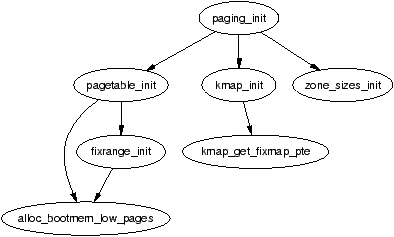
If both PatchSet and CodeViz are installed, the first call graph in this book shown in Figure 3.4 can be generated and viewed with the following set of commands. For brevity, the output of the commands is omitted:
mel@joshua: patchset $ download 2.4.22
mel@joshua: patchset $ createset 2.4.22
mel@joshua: patchset $ make-gengraph.sh 2.4.22
mel@joshua: patchset $ cd kernels/linux-2.4.22
mel@joshua: linux-2.4.22 $ gengraph -t -s "alloc_bootmem_low_pages \
                                   zone_sizes_init" -f paging_init
mel@joshua: linux-2.4.22 $ gv paging_init.ps
When a new developer or researcher asks how to start reading the code, they are often recommended to start with the initialisation code and work from there. This may not be the best approach for everyone as initialisation is quite architecture dependent and requires detailed hardware knowledge to decipher it. It also gives very little information on how a subsystem like the VM works as it is during the late stages of initialisation that memory is set up in the way the running system sees it.
The best starting point to understanding the VM is this book and the code commentary. It describes a VM that is reasonably comprehensive without being overly complicated. Later VMs are more complex but are essentially extensions of the one described here.
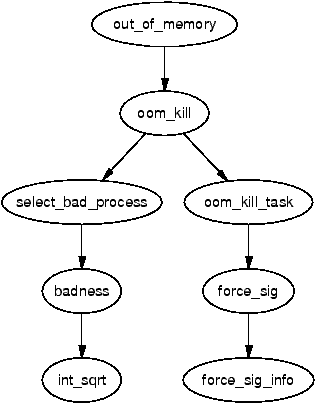
For when the code has to be approached afresh with a later VM, it is always best to start in an isolated region that has the minimum number of dependencies. In the case of the VM, the best starting point is the Out Of Memory (OOM) manager in mm/oom_kill.c. It is a very gentle introduction to one corner of the VM where a process is selected to be killed in the event that memory in the system is low. It is because it touches so many different aspects of the VM that is covered last in this book! The second subsystem to then examine is the non-contiguous memory allocator located in mm/vmalloc.c and discussed in Chapter 7 as it is reasonably contained within one file. The third system should be physical page allocator located in mm/page_alloc.c and discussed in Chapter 6 for similar reasons. The fourth system of interest is the creation of VMAs and memory areas for processes discussed in Chapter 4. Between these systems, they have the bulk of the code patterns that are prevalent throughout the rest of the kernel code making the deciphering of more complex systems such as the page replacement policy or the buffer IO much easier to comprehend.
The second recommendation that is given by experienced developers is to benchmark and test the VM. There are many benchmark programs available but commonly used ones are ConTest(http://members.optusnet.com.au/ckolivas/contest/), SPEC(http://www.specbench.org/), lmbench(http://www.bitmover.com/lmbench/ and dbench(http://freshmeat.net/projects/dbench/). For many purposes, these benchmarks will fit the requirements.
Unfortunately it is difficult to test just the VM accurately and benchmarking it is frequently based on timing a task such as a kernel compile. A tool called VM Regress is available at http://www.csn.ul.ie/∼mel/vmregress/ that lays the foundation required to build a fully fledged testing, regression and benchmarking tool for the VM. It uses a combination of kernel modules and userspace tools to test small parts of the VM in a reproducible manner and has one benchmark for testing the page replacement policy using a large reference string. It is intended as a framework for the development of a testing utility and has a number of Perl libraries and helper kernel modules to do much of the work but is still in the early stages of development so use with care.
There are two files, SubmittingPatches and CodingStyle, in the Documentation/ directory which cover the important basics. However, there is very little documentation describing how to get patches merged. This section will give a brief introduction on how, broadly speaking, patches are managed.
First and foremost, the coding style of the kernel needs to be adhered to as having a style inconsistent with the main kernel will be a barrier to getting merged regardless of the technical merit. Once a patch has been developed, the first problem is to decide where to send it. Kernel development has a definite, if non-apparent, hierarchy of who handles patches and how to get them submitted. As an example, we'll take the case of 2.5.x development.
The first check to make is if the patch is very small or trivial. If it is, post it to the main kernel mailing list. If there is no bad reaction, it can be fed to what is called the Trivial Patch Monkey7. The trivial patch monkey is exactly what it sounds like, it takes small patches and feeds them en-masse to the correct people. This is best suited for documentation, commentary or one-liner patches.
Patches are managed through what could be loosely called a set of rings with Linus in the very middle having the final say on what gets accepted into the main tree. Linus, with rare exceptions, accepts patches only from who he refers to as his “lieutenants”, a group of around 10 people who he trusts to “feed” him correct code. An example lieutenant is Andrew Morton, the VM maintainer at time of writing. Any change to the VM has to be accepted by Andrew before it will get to Linus. These people are generally maintainers of a particular system but sometimes will “feed” him patches from another subsystem if they feel it is important enough.
Each of the lieutenants are active developers on different subsystems. Just like Linus, they have a small set of developers they trust to be knowledgeable about the patch they are sending but will also pick up patches which affect their subsystem more readily. Depending on the subsystem, the list of people they trust will be heavily influenced by the list of maintainers in the MAINTAINERS file. The second major area of influence will be from the subsystem specific mailing list if there is one. The VM does not have a list of maintainers but it does have a mailing list8.
The maintainers and lieutenants are crucial to the acceptance of patches. Linus, broadly speaking, does not appear to wish to be convinced with argument alone on the merit for a significant patch but prefers to hear it from one of his lieutenants, which is understandable considering the volume of patches that exists.
In summary, a new patch should be emailed to the subsystem mailing list cc'd to the main list to generate discussion. If there is no reaction, it should be sent to the maintainer for that area of code if there is one and to the lieutenant if there is not. Once it has been picked up by a maintainer or lieutenant, chances are it will be merged. The important key is that patches and ideas must be released early and often so developers have a chance to look at it while it is still manageable. There are notable cases where massive patches merging with the main tree because there were long periods of silence with little or no discussion. A recent example of this is the Linux Kernel Crash Dump project which still has not been merged into the main stream because there has not enough favorable feedback from lieutenants or strong support from vendors.
Linux is available for a wide range of architectures so there needs to be an architecture-independent way of describing memory. This chapter describes the structures used to keep account of memory banks, pages and the flags that affect VM behaviour.
The first principal concept prevalent in the VM is Non-Uniform Memory Access (NUMA). With large scale machines, memory may be arranged into banks that incur a different cost to access depending on the “distance” from the processor. For example, there might be a bank of memory assigned to each CPU or a bank of memory very suitable for DMA near device cards.
Each bank is called a node and the concept is represented under Linux by a struct pglist_data even if the architecture is UMA. This struct is always referenced to by it's typedef pg_data_t. Every node in the system is kept on a NULL terminated list called pgdat_list and each node is linked to the next with the field pg_data_t→node_next. For UMA architectures like PC desktops, only one static pg_data_t structure called contig_page_data is used. Nodes will be discussed further in Section 2.1.
Each node is divided up into a number of blocks called zones which represent ranges within memory. Zones should not be confused with zone based allocators as they are unrelated. A zone is described by a struct zone_struct, typedeffed to zone_t and each one is of type ZONE_DMA, ZONE_NORMAL or ZONE_HIGHMEM. Each zone type suitable a different type of usage. ZONE_DMA is memory in the lower physical memory ranges which certain ISA devices require. Memory within ZONE_NORMAL is directly mapped by the kernel into the upper region of the linear address space which is discussed further in Section 4.1. ZONE_HIGHMEM is the remaining available memory in the system and is not directly mapped by the kernel.
| ZONE_DMA | First 16MiB of memory |
| ZONE_NORMAL | 16MiB - 896MiB |
| ZONE_HIGHMEM | 896 MiB - End |
It is important to note that many kernel operations can only take place using ZONE_NORMAL so it is the most performance critical zone. Zones are discussed further in Section 2.2. Each physical page frame is represented by a struct page and all the structs are kept in a global mem_map array which is usually stored at the beginning of ZONE_NORMAL or just after the area reserved for the loaded kernel image in low memory machines. struct pages are discussed in detail in Section 2.4 and the global mem_map array is discussed in detail in Section 3.7. The basic relationship between all these structs is illustrated in Figure 2.1.
Figure 2.1: Relationship Between Nodes, Zones and Pages
As the amount of memory directly accessible by the kernel (ZONE_NORMAL) is limited in size, Linux supports the concept of High Memory which is discussed further in Section 2.5. This chapter will discuss how nodes, zones and pages are represented before introducing high memory management.
As we have mentioned, each node in memory is described by a pg_data_t which is a typedef for a struct pglist_data. When allocating a page, Linux uses a node-local allocation policy to allocate memory from the node closest to the running CPU. As processes tend to run on the same CPU, it is likely the memory from the current node will be used. The struct is declared as follows in <linux/mmzone.h>:
129 typedef struct pglist_data {
130     zone_t node_zones[MAX_NR_ZONES];
131     zonelist_t node_zonelists[GFP_ZONEMASK+1];
132     int nr_zones;
133     struct page *node_mem_map;
134     unsigned long *valid_addr_bitmap;
135     struct bootmem_data *bdata;
136     unsigned long node_start_paddr;
137     unsigned long node_start_mapnr;
138     unsigned long node_size;
139     int node_id;
140     struct pglist_data *node_next;
141 } pg_data_t;
We now briefly describe each of these fields:
All nodes in the system are maintained on a list called pgdat_list. The nodes are placed on this list as they are initialised by the init_bootmem_core() function, described later in Section 5.2.1. Up until late 2.4 kernels (> 2.4.18), blocks of code that traversed the list looked something like:
    pg_data_t * pgdat;
    pgdat = pgdat_list;
    do {
          /* do something with pgdata_t */
          ...
    } while ((pgdat = pgdat->node_next));
In more recent kernels, a macro for_each_pgdat(), which is trivially defined as a for loop, is provided to improve code readability.
Zones are described by a struct zone_struct and is usually referred to by it's typedef zone_t. It keeps track of information like page usage statistics, free area information and locks. It is declared as follows in <linux/mmzone.h>:
37 typedef struct zone_struct {
41     spinlock_t        lock;
42     unsigned long     free_pages;
43     unsigned long     pages_min, pages_low, pages_high;
44     int               need_balance;
45
49     free_area_t       free_area[MAX_ORDER];
50
76     wait_queue_head_t * wait_table;
77     unsigned long     wait_table_size;
78     unsigned long     wait_table_shift;
79
83     struct pglist_data *zone_pgdat;
84     struct page        *zone_mem_map;
85     unsigned long      zone_start_paddr;
86     unsigned long      zone_start_mapnr;
87
91     char               *name;
92     unsigned long      size;
93 } zone_t;
This is a brief explanation of each field in the struct.
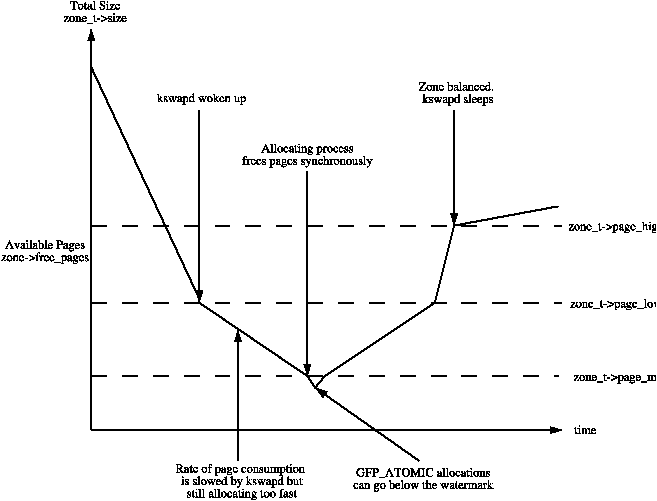
When available memory in the system is low, the pageout daemon kswapd is woken up to start freeing pages (see Chapter 10). If the pressure is high, the process will free up memory synchronously, sometimes referred to as the direct-reclaim path. The parameters affecting pageout behaviour are similar to those by FreeBSD [McK96] and Solaris [MM01].
Each zone has three watermarks called pages_low, pages_min and pages_high which help track how much pressure a zone is under. The relationship between them is illustrated in Figure 2.2. The number of pages for pages_min is calculated in the function free_area_init_core() during memory init and is based on a ratio to the size of the zone in pages. It is calculated initially as ZoneSizeInPages / 128. The lowest value it will be is 20 pages (80K on a x86) and the highest possible value is 255 pages (1MiB on a x86).
Figure 2.2: Zone Watermarks
Whatever the pageout parameters are called in each operating system, the meaning is the same, it helps determine how hard the pageout daemon or processes work to free up pages.
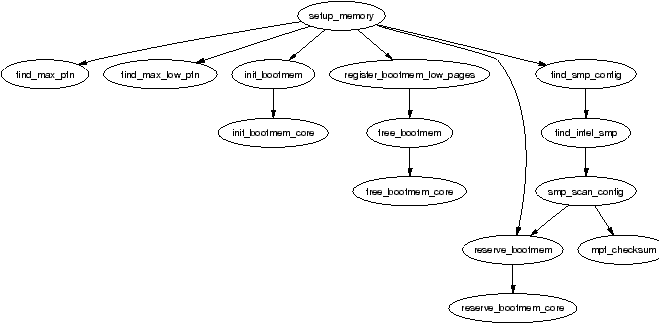
Figure 2.3: Call Graph: setup_memory()
The PFN is an offset, counted in pages, within the physical memory map. The first PFN usable by the system, min_low_pfn is located at the beginning of the first page after _end which is the end of the loaded kernel image. The value is stored as a file scope variable in mm/bootmem.c for use with the boot memory allocator.
How the last page frame in the system, max_pfn, is calculated is quite architecture specific. In the x86 case, the function find_max_pfn() reads through the whole e820 map for the highest page frame. The value is also stored as a file scope variable in mm/bootmem.c. The e820 is a table provided by the BIOS describing what physical memory is available, reserved or non-existent.
The value of max_low_pfn is calculated on the x86 with find_max_low_pfn() and it marks the end of ZONE_NORMAL. This is the physical memory directly accessible by the kernel and is related to the kernel/userspace split in the linear address space marked by PAGE_OFFSET. The value, with the others, is stored in mm/bootmem.c. Note that in low memory machines, the max_pfn will be the same as the max_low_pfn.
With the three variables min_low_pfn, max_low_pfn and max_pfn, it is straightforward to calculate the start and end of high memory and place them as file scope variables in arch/i386/mm/init.c as highstart_pfn and highend_pfn. The values are used later to initialise the high memory pages for the physical page allocator as we will much later in Section 5.5.
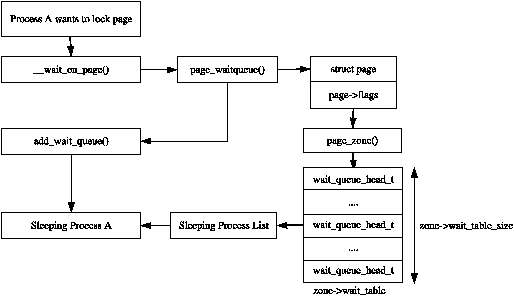
When IO is being performed on a page, such are during page-in or page-out, it is locked to prevent accessing it with inconsistent data. Processes wishing to use it have to join a wait queue before it can be accessed by calling wait_on_page(). When the IO is completed, the page will be unlocked with UnlockPage() and any process waiting on the queue will be woken up. Each page could have a wait queue but it would be very expensive in terms of memory to have so many separate queues so instead, the wait queue is stored in the zone_t.
It is possible to have just one wait queue in the zone but that would mean that all processes waiting on any page in a zone would be woken up when one was unlocked. This would cause a serious thundering herd problem. Instead, a hash table of wait queues is stored in zone_t→wait_table. In the event of a hash collision, processes may still be woken unnecessarily but collisions are not expected to occur frequently.
Figure 2.4: Sleeping On a Locked Page
The table is allocated during free_area_init_core(). The size of the table is calculated by wait_table_size() and stored in the zone_t→wait_table_size. The maximum size it will be is 4096 wait queues. For smaller tables, the size of the table is the minimum power of 2 required to store NoPages / PAGES_PER_WAITQUEUE number of queues, where NoPages is the number of pages in the zone and PAGE_PER_WAITQUEUE is defined to be 256. In other words, the size of the table is calculated as the integer component of the following equation:
wait_table_size = log2((NoPages * 2) / PAGES_PER_WAITQUEUE - 1)
The field zone_t→wait_table_shift is calculated as the number of bits a page address must be shifted right to return an index within the table. The function page_waitqueue() is responsible for returning which wait queue to use for a page in a zone. It uses a simple multiplicative hashing algorithm based on the virtual address of the struct page being hashed.
It works by simply multiplying the address by GOLDEN_RATIO_PRIME and shifting the result zone_t→wait_table_shift bits right to index the result within the hash table. GOLDEN_RATIO_PRIME[Lev00] is the largest prime that is closest to the golden ratio[Knu68] of the largest integer that may be represented by the architecture.
The zones are initialised after the kernel page tables have been fully setup by paging_init(). Page table initialisation is covered in Section 3.6. Predictably, each architecture performs this task differently but the objective is always the same, to determine what parameters to send to either free_area_init() for UMA architectures or free_area_init_node() for NUMA. The only parameter required for UMA is zones_size. The full list of parameters:
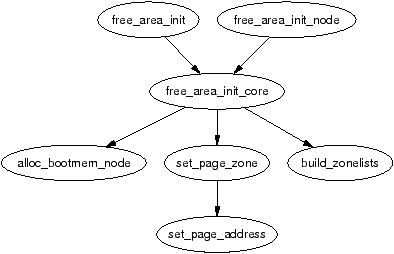
It is the core function free_area_init_core() which is responsible for filling in each zone_t with the relevant information and the allocation of the mem_map array for the node. Note that information on what pages are free for the zones is not determined at this point. That information is not known until the boot memory allocator is being retired which will be discussed much later in Chapter 5.
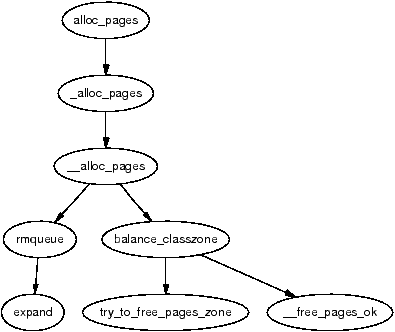
The mem_map area is created during system startup in one of two fashions. On NUMA systems, the global mem_map is treated as a virtual array starting at PAGE_OFFSET. free_area_init_node() is called for each active node in the system which allocates the portion of this array for the node being initialised. On UMA systems, free_area_init() is uses contig_page_data as the node and the global mem_map as the “local” mem_map for this node. The callgraph for both functions is shown in Figure 2.5.
Figure 2.5: Call Graph: free_area_init()
The core function free_area_init_core() allocates a local lmem_map for the node being initialised. The memory for the array is allocated from the boot memory allocator with alloc_bootmem_node() (see Chapter 5). With UMA architectures, this newly allocated memory becomes the global mem_map but it is slightly different for NUMA.
NUMA architectures allocate the memory for lmem_map within their own memory node. The global mem_map never gets explicitly allocated but instead is set to PAGE_OFFSET where it is treated as a virtual array. The address of the local map is stored in pg_data_t→node_mem_map which exists somewhere within the virtual mem_map. For each zone that exists in the node, the address within the virtual mem_map for the zone is stored in zone_t→zone_mem_map. All the rest of the code then treats mem_map as a real array as only valid regions within it will be used by nodes.
Every physical page frame in the system has an associated struct page which is used to keep track of its status. In the 2.2 kernel [BC00], this structure resembled it's equivalent in System V [GC94] but like the other UNIX variants, the structure changed considerably. It is declared as follows in <linux/mm.h>:
152 typedef struct page {
153     struct list_head list;
154     struct address_space *mapping;
155     unsigned long index;
156     struct page *next_hash;
158     atomic_t count;
159     unsigned long flags;
161     struct list_head lru;
163     struct page **pprev_hash;
164     struct buffer_head * buffers;
175
176 #if defined(CONFIG_HIGHMEM) || defined(WANT_PAGE_VIRTUAL)
177     void *virtual;
179 #endif /* CONFIG_HIGMEM || WANT_PAGE_VIRTUAL */
180 } mem_map_t;
Here is a brief description of each of the fields:
The type mem_map_t is a typedef for struct page so it can be easily referred to within the mem_map array.
Bit name Description PG_active This bit is set if a page is on the active_list LRU and cleared when it is removed. It marks a page as being hot PG_arch_1 Quoting directly from the code: PG_arch_1 is an architecture specific page state bit. The generic code guarantees that this bit is cleared for a page when it first is entered into the page cache. This allows an architecture to defer the flushing of the D-Cache (See Section 3.9) until the page is mapped by a process PG_checked Only used by the Ext2 filesystem PG_dirty This indicates if a page needs to be flushed to disk. When a page is written to that is backed by disk, it is not flushed immediately, this bit is needed to ensure a dirty page is not freed before it is written out PG_error If an error occurs during disk I/O, this bit is set PG_fs_1 Bit reserved for a filesystem to use for it's own purposes. Currently, only NFS uses it to indicate if a page is in sync with the remote server or not PG_highmem Pages in high memory cannot be mapped permanently by the kernel. Pages that are in high memory are flagged with this bit during mem_init() PG_launder This bit is important only to the page replacement policy. When the VM wants to swap out a page, it will set this bit and call the writepage() function. When scanning, if it encounters a page with this bit and PG_locked set, it will wait for the I/O to complete PG_locked This bit is set when the page must be locked in memory for disk I/O. When I/O starts, this bit is set and released when it completes PG_lru If a page is on either the active_list or the inactive_list, this bit will be set PG_referenced If a page is mapped and it is referenced through the mapping, index hash table, this bit is set. It is used during page replacement for moving the page around the LRU lists PG_reserved This is set for pages that can never be swapped out. It is set by the boot memory allocator (See Chapter 5) for pages allocated during system startup. Later it is used to flag empty pages or ones that do not even exist PG_slab This will flag a page as being used by the slab allocator PG_skip Used by some architectures to skip over parts of the address space with no backing physical memory PG_unused This bit is literally unused PG_uptodate When a page is read from disk without error, this bit will be set.
Table 2.1: Flags Describing Page Status
Table 2.2: Macros For Testing, Setting and Clearing page→flags Status Bits
Up until as recently as kernel 2.4.18, a struct page stored a reference to its zone with page→zone which was later considered wasteful, as even such a small pointer consumes a lot of memory when thousands of struct pages exist. In more recent kernels, the zone field has been removed and instead the top ZONE_SHIFT (8 in the x86) bits of the page→flags are used to determine the zone a page belongs to. First a zone_table of zones is set up. It is declared in mm/page_alloc.c as:
33 zone_t *zone_table[MAX_NR_ZONES*MAX_NR_NODES];
34 EXPORT_SYMBOL(zone_table);
MAX_NR_ZONES is the maximum number of zones that can be in a node, i.e. 3. MAX_NR_NODES is the maximum number of nodes that may exist. The function EXPORT_SYMBOL() makes zone_table accessible to loadable modules. This table is treated like a multi-dimensional array. During free_area_init_core(), all the pages in a node are initialised. First it sets the value for the table
733 zone_table[nid * MAX_NR_ZONES + j] = zone;
Where nid is the node ID, j is the zone index and zone is the zone_t struct. For each page, the function set_page_zone() is called as
788 set_page_zone(page, nid * MAX_NR_ZONES + j);
The parameter, page, is the page whose zone is being set. So, clearly the index in the zone_table is stored in the page.
As the addresses space usable by the kernel (ZONE_NORMAL) is limited in size, the kernel has support for the concept of High Memory. Two thresholds of high memory exist on 32-bit x86 systems, one at 4GiB and a second at 64GiB. The 4GiB limit is related to the amount of memory that may be addressed by a 32-bit physical address. To access memory between the range of 1GiB and 4GiB, the kernel temporarily maps pages from high memory into ZONE_NORMAL with kmap(). This is discussed further in Chapter 9.
The second limit at 64GiB is related to Physical Address Extension (PAE) which is an Intel invention to allow more RAM to be used with 32 bit systems. It makes 4 extra bits available for the addressing of memory, allowing up to 236 bytes (64GiB) of memory to be addressed.
PAE allows a processor to address up to 64GiB in theory but, in practice, processes in Linux still cannot access that much RAM as the virtual address space is still only 4GiB. This has led to some disappointment from users who have tried to malloc() all their RAM with one process.
Secondly, PAE does not allow the kernel itself to have this much RAM available. The struct page used to describe each page frame still requires 44 bytes and this uses kernel virtual address space in ZONE_NORMAL. That means that to describe 1GiB of memory, approximately 11MiB of kernel memory is required. Thus, with 16GiB, 176MiB of memory is consumed, putting significant pressure on ZONE_NORMAL. This does not sound too bad until other structures are taken into account which use ZONE_NORMAL. Even very small structures such as Page Table Entries (PTEs) require about 16MiB in the worst case. This makes 16GiB about the practical limit for available physical memory Linux on an x86. If more memory needs to be accessed, the advice given is simple and straightforward, buy a 64 bit machine.
At first glance, there has not been many changes made to how memory is described but the seemingly minor changes are wide reaching. The node descriptor pg_data_t has a few new fields which are as follows:
The node_size field has been removed and replaced instead with two fields. The change was introduced to recognise the fact that nodes may have “holes” in them where there is no physical memory backing the address.
Even at first glance, zones look very different. They are no longer called zone_t but instead referred to as simply struct zone. The second major difference is the LRU lists. As we'll see in Chapter 10, kernel 2.4 has a global list of pages that determine the order pages are freed or paged out. These lists are now stored in the struct zone. The relevant fields are:
Three other fields are new but they are related to the dimensions of the zone. They are:
The next addition is struct per_cpu_pageset which is used to maintain lists of pages for each CPU to reduce spinlock contention. The zone→pageset field is a NR_CPU sized array of struct per_cpu_pageset where NR_CPU is the compiled upper limit of number of CPUs in the system. The per-cpu struct is discussed further at the end of the section.
The last addition to struct zone is the inclusion of padding of zeros in the struct. Development of the 2.6 VM recognised that some spinlocks are very heavily contended and are frequently acquired. As it is known that some locks are almost always acquired in pairs, an effort should be made to ensure they use different cache lines which is a common cache programming trick [Sea00]. These padding in the struct zone are marked with the ZONE_PADDING() macro and are used to ensure the zone→lock, zone→lru_lock and zone→pageset fields use different cache lines.
The first noticeable change is that the ordering of fields has been changed so that related items are likely to be in the same cache line. The fields are essentially the same except for two additions. The first is a new union used to create a PTE chain. PTE chains are are related to page table management so will be discussed at the end of Chapter 3. The second addition is of page→private field which contains private information specific to the mapping. For example, the field is used to store a pointer to a buffer_head if the page is a buffer page. This means that the page→buffers field has also been removed. The last important change is that page→virtual is no longer necessary for high memory support and will only exist if the architecture specifically requests it. How high memory pages are supported is discussed further in Chapter 9.
In 2.4, only one subsystem actively tries to maintain per-cpu lists for any object and that is the Slab Allocator, discussed in Chapter 8. In 2.6, the concept is much more wide-spread and there is a formalised concept of hot and cold pages.
The struct per_cpu_pageset, declared in <linux/mmzone.h> has one one field which is an array with two elements of type per_cpu_pages. The zeroth element of this array is for hot pages and the first element is for cold pages where hot and cold determines how “active” the page is currently in the cache. When it is known for a fact that the pages are not to be referenced soon, such as with IO readahead, they will be allocated as cold pages.
The struct per_cpu_pages maintains a count of the number of pages currently in the list, a high and low watermark which determine when the set should be refilled or pages freed in bulk, a variable which determines how many pages should be allocated in one block and finally, the actual list head of pages.
To build upon the per-cpu page lists, there is also a per-cpu page accounting mechanism. There is a struct page_state that holds a number of accounting variables such as the pgalloc field which tracks the number of pages allocated to this CPU and pswpin which tracks the number of swap readins. The struct is heavily commented in <linux/page-flags.h>. A single function mod_page_state() is provided for updating fields in the page_state for the running CPU and three helper macros are provided called inc_page_state(), dec_page_state() and sub_page_state().
Linux layers the machine independent/dependent layer in an unusual manner in comparison to other operating systems [CP99]. Other operating systems have objects which manage the underlying physical pages such as the pmap object in BSD. Linux instead maintains the concept of a three-level page table in the architecture independent code even if the underlying architecture does not support it. While this is conceptually easy to understand, it also means that the distinction between different types of pages is very blurry and page types are identified by their flags or what lists they exist on rather than the objects they belong to.
Architectures that manage their Memory Management Unit (MMU) differently are expected to emulate the three-level page tables. For example, on the x86 without PAE enabled, only two page table levels are available. The Page Middle Directory (PMD) is defined to be of size 1 and “folds back” directly onto the Page Global Directory (PGD) which is optimised out at compile time. Unfortunately, for architectures that do not manage their cache or Translation Lookaside Buffer (TLB) automatically, hooks for machine dependent have to be explicitly left in the code for when the TLB and CPU caches need to be altered and flushed even if they are null operations on some architectures like the x86. These hooks are discussed further in Section 3.8.
This chapter will begin by describing how the page table is arranged and what types are used to describe the three separate levels of the page table followed by how a virtual address is broken up into its component parts for navigating the table. Once covered, it will be discussed how the lowest level entry, the Page Table Entry (PTE) and what bits are used by the hardware. After that, the macros used for navigating a page table, setting and checking attributes will be discussed before talking about how the page table is populated and how pages are allocated and freed for the use with page tables. The initialisation stage is then discussed which shows how the page tables are initialised during boot strapping. Finally, we will cover how the TLB and CPU caches are utilised.
Each process a pointer (mm_struct→pgd) to its own Page Global Directory (PGD) which is a physical page frame. This frame contains an array of type pgd_t which is an architecture specific type defined in <asm/page.h>. The page tables are loaded differently depending on the architecture. On the x86, the process page table is loaded by copying mm_struct→pgd into the cr3 register which has the side effect of flushing the TLB. In fact this is how the function __flush_tlb() is implemented in the architecture dependent code.
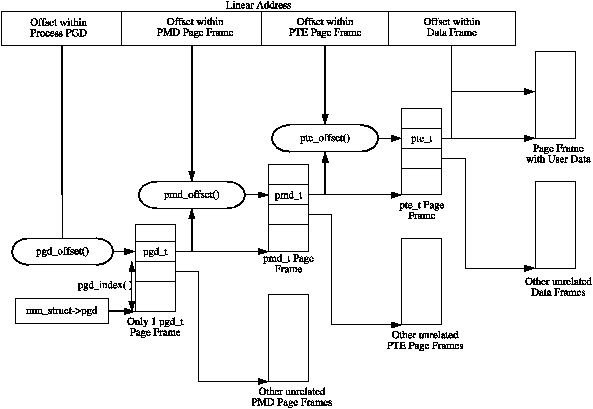
Each active entry in the PGD table points to a page frame containing an array of Page Middle Directory (PMD) entries of type pmd_t which in turn points to page frames containing Page Table Entries (PTE) of type pte_t, which finally points to page frames containing the actual user data. In the event the page has been swapped out to backing storage, the swap entry is stored in the PTE and used by do_swap_page() during page fault to find the swap entry containing the page data. The page table layout is illustrated in Figure 3.1.
Figure 3.1: Page Table Layout
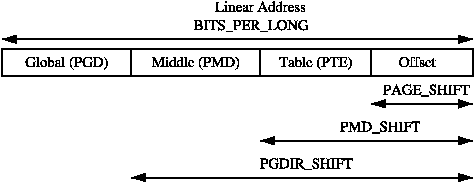
Any given linear address may be broken up into parts to yield offsets within these three page table levels and an offset within the actual page. To help break up the linear address into its component parts, a number of macros are provided in triplets for each page table level, namely a SHIFT, a SIZE and a MASK macro. The SHIFT macros specifies the length in bits that are mapped by each level of the page tables as illustrated in Figure 3.2.
Figure 3.2: Linear Address Bit Size Macros
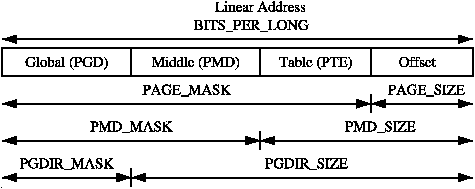
The MASK values can be ANDd with a linear address to mask out all the upper bits and is frequently used to determine if a linear address is aligned to a given level within the page table. The SIZE macros reveal how many bytes are addressed by each entry at each level. The relationship between the SIZE and MASK macros is illustrated in Figure 3.3.
Figure 3.3: Linear Address Size and Mask Macros
For the calculation of each of the triplets, only SHIFT is important as the other two are calculated based on it. For example, the three macros for page level on the x86 are:
  5 #define PAGE_SHIFT      12
  6 #define PAGE_SIZE       (1UL << PAGE_SHIFT)
  7 #define PAGE_MASK       (~(PAGE_SIZE-1))
PAGE_SHIFT is the length in bits of the offset part of the linear address space which is 12 bits on the x86. The size of a page is easily calculated as 2PAGE_SHIFT which is the equivalent of the code above. Finally the mask is calculated as the negation of the bits which make up the PAGE_SIZE - 1. If a page needs to be aligned on a page boundary, PAGE_ALIGN() is used. This macro adds PAGE_SIZE - 1 to the address before simply ANDing it with the PAGE_MASK to zero out the page offset bits.
PMD_SHIFT is the number of bits in the linear address which are mapped by the second level part of the table. The PMD_SIZE and PMD_MASK are calculated in a similar way to the page level macros.
PGDIR_SHIFT is the number of bits which are mapped by the top, or first level, of the page table. The PGDIR_SIZE and PGDIR_MASK are calculated in the same manner as above.
The last three macros of importance are the PTRS_PER_x which determine the number of entries in each level of the page table. PTRS_PER_PGD is the number of pointers in the PGD, 1024 on an x86 without PAE. PTRS_PER_PMD is for the PMD, 1 on the x86 without PAE and PTRS_PER_PTE is for the lowest level, 1024 on the x86.
As mentioned, each entry is described by the structs pte_t, pmd_t and pgd_t for PTEs, PMDs and PGDs respectively. Even though these are often just unsigned integers, they are defined as structs for two reasons. The first is for type protection so that they will not be used inappropriately. The second is for features like PAE on the x86 where an additional 4 bits is used for addressing more than 4GiB of memory. To store the protection bits, pgprot_t is defined which holds the relevant flags and is usually stored in the lower bits of a page table entry.
For type casting, 4 macros are provided in asm/page.h, which takes the above types and returns the relevant part of the structs. They are pte_val(), pmd_val(), pgd_val() and pgprot_val(). To reverse the type casting, 4 more macros are provided __pte(), __pmd(), __pgd() and __pgprot().
Where exactly the protection bits are stored is architecture dependent. For illustration purposes, we will examine the case of an x86 architecture without PAE enabled but the same principles apply across architectures. On an x86 with no PAE, the pte_t is simply a 32 bit integer within a struct. Each pte_t points to an address of a page frame and all the addresses pointed to are guaranteed to be page aligned. Therefore, there are PAGE_SHIFT (12) bits in that 32 bit value that are free for status bits of the page table entry. A number of the protection and status bits are listed in Table ?? but what bits exist and what they mean varies between architectures.
Table 3.1: Page Table Entry Protection and Status Bits
These bits are self-explanatory except for the _PAGE_PROTNONE which we will discuss further. On the x86 with Pentium III and higher, this bit is called the Page Attribute Table (PAT) while earlier architectures such as the Pentium II had this bit reserved. The PAT bit is used to indicate the size of the page the PTE is referencing. In a PGD entry, this same bit is instead called the Page Size Exception (PSE) bit so obviously these bits are meant to be used in conjunction.
As Linux does not use the PSE bit for user pages, the PAT bit is free in the PTE for other purposes. There is a requirement for having a page resident in memory but inaccessible to the userspace process such as when a region is protected with mprotect() with the PROT_NONE flag. When the region is to be protected, the _PAGE_PRESENT bit is cleared and the _PAGE_PROTNONE bit is set. The macro pte_present() checks if either of these bits are set and so the kernel itself knows the PTE is present, just inaccessible to userspace which is a subtle, but important point. As the hardware bit _PAGE_PRESENT is clear, a page fault will occur if the page is accessed so Linux can enforce the protection while still knowing the page is resident if it needs to swap it out or the process exits.
Macros are defined in <asm/pgtable.h> which are important for the navigation and examination of page table entries. To navigate the page directories, three macros are provided which break up a linear address space into its component parts. pgd_offset() takes an address and the mm_struct for the process and returns the PGD entry that covers the requested address. pmd_offset() takes a PGD entry and an address and returns the relevant PMD. pte_offset() takes a PMD and returns the relevant PTE. The remainder of the linear address provided is the offset within the page. The relationship between these fields is illustrated in Figure 3.1.
The second round of macros determine if the page table entries are present or may be used.
There are many parts of the VM which are littered with page table walk code and it is important to recognise it. A very simple example of a page table walk is the function follow_page() in mm/memory.c. The following is an excerpt from that function, the parts unrelated to the page table walk are omitted:
407         pgd_t *pgd;
408         pmd_t *pmd;
409         pte_t *ptep, pte;
410
411         pgd = pgd_offset(mm, address);
412         if (pgd_none(*pgd) || pgd_bad(*pgd))
413                 goto out;
414
415         pmd = pmd_offset(pgd, address);
416         if (pmd_none(*pmd) || pmd_bad(*pmd))
417                 goto out;
418
419         ptep = pte_offset(pmd, address);
420         if (!ptep)
421                 goto out;
422
423         pte = *ptep;
It simply uses the three offset macros to navigate the page tables and the _none() and _bad() macros to make sure it is looking at a valid page table.
The third set of macros examine and set the permissions of an entry. The permissions determine what a userspace process can and cannot do with a particular page. For example, the kernel page table entries are never readable by a userspace process.
The fourth set of macros examine and set the state of an entry. There are only two bits that are important in Linux, the dirty bit and the accessed bit. To check these bits, the macros pte_dirty() and pte_young() macros are used. To set the bits, the macros pte_mkdirty() and pte_mkyoung() are used. To clear them, the macros pte_mkclean() and pte_old() are available.
This set of functions and macros deal with the mapping of addresses and pages to PTEs and the setting of the individual entries.
The macro mk_pte() takes a struct page and protection bits and combines them together to form the pte_t that needs to be inserted into the page table. A similar macro mk_pte_phys() exists which takes a physical page address as a parameter.
The macro pte_page() returns the struct page which corresponds to the PTE entry. pmd_page() returns the struct page containing the set of PTEs.
The macro set_pte() takes a pte_t such as that returned by mk_pte() and places it within the processes page tables. pte_clear() is the reverse operation. An additional function is provided called ptep_get_and_clear() which clears an entry from the process page table and returns the pte_t. This is important when some modification needs to be made to either the PTE protection or the struct page itself.
The last set of functions deal with the allocation and freeing of page tables. Page tables, as stated, are physical pages containing an array of entries and the allocation and freeing of physical pages is a relatively expensive operation, both in terms of time and the fact that interrupts are disabled during page allocation. The allocation and deletion of page tables, at any of the three levels, is a very frequent operation so it is important the operation is as quick as possible.
Hence the pages used for the page tables are cached in a number of different lists called quicklists. Each architecture implements these caches differently but the principles used are the same. For example, not all architectures cache PGDs because the allocation and freeing of them only happens during process creation and exit. As both of these are very expensive operations, the allocation of another page is negligible.
PGDs, PMDs and PTEs have two sets of functions each for the allocation and freeing of page tables. The allocation functions are pgd_alloc(), pmd_alloc() and pte_alloc() respectively and the free functions are, predictably enough, called pgd_free(), pmd_free() and pte_free().
Broadly speaking, the three implement caching with the use of three caches called pgd_quicklist, pmd_quicklist and pte_quicklist. Architectures implement these three lists in different ways but one method is through the use of a LIFO type structure. Ordinarily, a page table entry contains points to other pages containing page tables or data. While cached, the first element of the list is used to point to the next free page table. During allocation, one page is popped off the list and during free, one is placed as the new head of the list. A count is kept of how many pages are used in the cache.
The quick allocation function from the pgd_quicklist is not externally defined outside of the architecture although get_pgd_fast() is a common choice for the function name. The cached allocation function for PMDs and PTEs are publicly defined as pmd_alloc_one_fast() and pte_alloc_one_fast().
If a page is not available from the cache, a page will be allocated using the physical page allocator (see Chapter 6). The functions for the three levels of page tables are get_pgd_slow(), pmd_alloc_one() and pte_alloc_one().
Obviously a large number of pages may exist on these caches and so there is a mechanism in place for pruning them. Each time the caches grow or shrink, a counter is incremented or decremented and it has a high and low watermark. check_pgt_cache() is called in two places to check these watermarks. When the high watermark is reached, entries from the cache will be freed until the cache size returns to the low watermark. The function is called after clear_page_tables() when a large number of page tables are potentially reached and is also called by the system idle task.
When the system first starts, paging is not enabled as page tables do not magically initialise themselves. Each architecture implements this differently so only the x86 case will be discussed. The page table initialisation is divided into two phases. The bootstrap phase sets up page tables for just 8MiB so the paging unit can be enabled. The second phase initialises the rest of the page tables. We discuss both of these phases below.
The assembler function startup_32() is responsible for enabling the paging unit in arch/i386/kernel/head.S. While all normal kernel code in vmlinuz is compiled with the base address at PAGE_OFFSET + 1MiB, the kernel is actually loaded beginning at the first megabyte (0x00100000) of memory. The first megabyte is used by some devices for communication with the BIOS and is skipped. The bootstrap code in this file treats 1MiB as its base address by subtracting __PAGE_OFFSET from any address until the paging unit is enabled so before the paging unit is enabled, a page table mapping has to be established which translates the 8MiB of physical memory to the virtual address PAGE_OFFSET.
Initialisation begins with statically defining at compile time an array called swapper_pg_dir which is placed using linker directives at 0x00101000. It then establishes page table entries for 2 pages, pg0 and pg1. If the processor supports the Page Size Extension (PSE) bit, it will be set so that pages will be translated are 4MiB pages, not 4KiB as is the normal case. The first pointers to pg0 and pg1 are placed to cover the region 1-9MiB the second pointers to pg0 and pg1 are placed at PAGE_OFFSET+1MiB. This means that when paging is enabled, they will map to the correct pages using either physical or virtual addressing for just the kernel image. The rest of the kernel page tables will be initialised by paging_init().
Once this mapping has been established, the paging unit is turned on by setting a bit in the cr0 register and a jump takes places immediately to ensure the Instruction Pointer (EIP register) is correct.
The function responsible for finalising the page tables is called paging_init(). The call graph for this function on the x86 can be seen on Figure 3.4.
Figure 3.4: Call Graph: paging_init()
The function first calls pagetable_init() to initialise the page tables necessary to reference all physical memory in ZONE_DMA and ZONE_NORMAL. Remember that high memory in ZONE_HIGHMEM cannot be directly referenced and mappings are set up for it temporarily. For each pgd_t used by the kernel, the boot memory allocator (see Chapter 5) is called to allocate a page for the PMDs and the PSE bit will be set if available to use 4MiB TLB entries instead of 4KiB. If the PSE bit is not supported, a page for PTEs will be allocated for each pmd_t. If the CPU supports the PGE flag, it also will be set so that the page table entry will be global and visible to all processes.
Next, pagetable_init() calls fixrange_init() to setup the fixed address space mappings at the end of the virtual address space starting at FIXADDR_START. These mappings are used for purposes such as the local APIC and the atomic kmappings between FIX_KMAP_BEGIN and FIX_KMAP_END required by kmap_atomic(). Finally, the function calls fixrange_init() to initialise the page table entries required for normal high memory mappings with kmap().
Once pagetable_init() returns, the page tables for kernel space are now full initialised so the static PGD (swapper_pg_dir) is loaded into the CR3 register so that the static table is now being used by the paging unit.
The next task of the paging_init() is responsible for calling kmap_init() to initialise each of the PTEs with the PAGE_KERNEL protection flags. The final task is to call zone_sizes_init() which initialises all the zone structures used.
There is a requirement for Linux to have a fast method of mapping virtual addresses to physical addresses and for mapping struct pages to their physical address. Linux achieves this by knowing where, in both virtual and physical memory, the global mem_map array is as the global array has pointers to all struct pages representing physical memory in the system. All architectures achieve this with very similar mechanisms but for illustration purposes, we will only examine the x86 carefully. This section will first discuss how physical addresses are mapped to kernel virtual addresses and then what this means to the mem_map array.
As we saw in Section 3.6, Linux sets up a direct mapping from the physical address 0 to the virtual address PAGE_OFFSET at 3GiB on the x86. This means that any virtual address can be translated to the physical address by simply subtracting PAGE_OFFSET which is essentially what the function virt_to_phys() with the macro __pa() does:
/* from <asm-i386/page.h> */
132 #define __pa(x)                 ((unsigned long)(x)-PAGE_OFFSET)

/* from <asm-i386/io.h> */
 76 static inline unsigned long virt_to_phys(volatile void * address)
 77 {
 78         return __pa(address);
 79 }
Obviously the reverse operation involves simply adding PAGE_OFFSET which is carried out by the function phys_to_virt() with the macro __va(). Next we see how this helps the mapping of struct pages to physical addresses.
As we saw in Section 3.6.1, the kernel image is located at the physical address 1MiB, which of course translates to the virtual address PAGE_OFFSET + 0x00100000 and a virtual region totaling about 8MiB is reserved for the image which is the region that can be addressed by two PGDs. This would imply that the first available memory to use is located at 0xC0800000 but that is not the case. Linux tries to reserve the first 16MiB of memory for ZONE_DMA so first virtual area used for kernel allocations is actually 0xC1000000. This is where the global mem_map is usually located. ZONE_DMA will be still get used, but only when absolutely necessary.
Physical addresses are translated to struct pages by treating them as an index into the mem_map array. Shifting a physical address PAGE_SHIFT bits to the right will treat it as a PFN from physical address 0 which is also an index within the mem_map array. This is exactly what the macro virt_to_page() does which is declared as follows in <asm-i386/page.h>:
#define virt_to_page(kaddr) (mem_map + (__pa(kaddr) >> PAGE_SHIFT))
The macro virt_to_page() takes the virtual address kaddr, converts it to the physical address with __pa(), converts it into an array index by bit shifting it right PAGE_SHIFT bits and indexing into the mem_map by simply adding them together. No macro is available for converting struct pages to physical addresses but at this stage, it should be obvious to see how it could be calculated.
Initially, when the processor needs to map a virtual address to a physical address, it must traverse the full page directory searching for the PTE of interest. This would normally imply that each assembly instruction that references memory actually requires several separate memory references for the page table traversal [Tan01]. To avoid this considerable overhead, architectures take advantage of the fact that most processes exhibit a locality of reference or, in other words, large numbers of memory references tend to be for a small number of pages. They take advantage of this reference locality by providing a Translation Lookaside Buffer (TLB) which is a small associative memory that caches virtual to physical page table resolutions.
Linux assumes that the most architectures support some type of TLB although the architecture independent code does not cares how it works. Instead, architecture dependant hooks are dispersed throughout the VM code at points where it is known that some hardware with a TLB would need to perform a TLB related operation. For example, when the page tables have been updated, such as after a page fault has completed, the processor may need to be update the TLB for that virtual address mapping.
Not all architectures require these type of operations but because some do, the hooks have to exist. If the architecture does not require the operation to be performed, the function for that TLB operation will a null operation that is optimised out at compile time.
A quite large list of TLB API hooks, most of which are declared in <asm/pgtable.h>, are listed in Tables 3.2 and ?? and the APIs are quite well documented in the kernel source by Documentation/cachetlb.txt [Mil00]. It is possible to have just one TLB flush function but as both TLB flushes and TLB refills are very expensive operations, unnecessary TLB flushes should be avoided if at all possible. For example, when context switching, Linux will avoid loading new page tables using Lazy TLB Flushing, discussed further in Section 4.3.
This flushes the entire TLB on all processors running in the system making it the most expensive TLB flush operation. After it completes, all modifications to the page tables will be visible globally. This is required after the kernel page tables, which are global in nature, have been modified such as after vfree() (See Chapter 7) completes or after the PKMap is flushed (See Chapter 9). This flushes all TLB entries related to the userspace portion (i.e. below PAGE_OFFSET) for the requested mm context. In some architectures, such as MIPS, this will need to be performed for all processors but usually it is confined to the local processor. This is only called when an operation has been performed that affects the entire address space, such as after all the address mapping have been duplicated with dup_mmap() for fork or after all memory mappings have been deleted with exit_mmap(). void flush_tlb_range(struct mm_struct *mm, unsigned long start, unsigned long end) As the name indicates, this flushes all entries within the requested userspace range for the mm context. This is used after a new region has been moved or changeh as during mremap() which moves regions or mprotect() which changes the permissions. The function is also indirectly used during unmapping a region with munmap() which calls tlb_finish_mmu() which tries to use flush_tlb_range() intelligently. This API is provided for architectures that can remove ranges of TLB entries quickly rather than iterating with flush_tlb_page().
Table 3.2: Translation Lookaside Buffer Flush API
Table 3.3: Translation Lookaside Buffer Flush API (cont)
As Linux manages the CPU Cache in a very similar fashion to the TLB, this section covers how Linux utilises and manages the CPU cache. CPU caches, like TLB caches, take advantage of the fact that programs tend to exhibit a locality of reference [Sea00] [CS98]. To avoid having to fetch data from main memory for each reference, the CPU will instead cache very small amounts of data in the CPU cache. Frequently, there is two levels called the Level 1 and Level 2 CPU caches. The Level 2 CPU caches are larger but slower than the L1 cache but Linux only concerns itself with the Level 1 or L1 cache.
CPU caches are organised into lines. Each line is typically quite small, usually 32 bytes and each line is aligned to it's boundary size. In other words, a cache line of 32 bytes will be aligned on a 32 byte address. With Linux, the size of the line is L1_CACHE_BYTES which is defined by each architecture.
How addresses are mapped to cache lines vary between architectures but the mappings come under three headings, direct mapping, associative mapping and set associative mapping. Direct mapping is the simpliest approach where each block of memory maps to only one possible cache line. With associative mapping, any block of memory can map to any cache line. Set associative mapping is a hybrid approach where any block of memory can may to any line but only within a subset of the available lines. Regardless of the mapping scheme, they each have one thing in common, addresses that are close together and aligned to the cache size are likely to use different lines. Hence Linux employs simple tricks to try and maximise cache usage
If the CPU references an address that is not in the cache, a cache missccurs and the data is fetched from main memory. The cost of cache misses is quite high as a reference to cache can typically be performed in less than 10ns where a reference to main memory typically will cost between 100ns and 200ns. The basic objective is then to have as many cache hits and as few cache misses as possible.
Just as some architectures do not automatically manage their TLBs, some do not automatically manage their CPU caches. The hooks are placed in locations where the virtual to physical mapping changes, such as during a page table update. The CPU cache flushes should always take place first as some CPUs require a virtual to physical mapping to exist when the virtual address is being flushed from the cache. The three operations that require proper ordering are important is listed in Table 3.4.
Flushing Full MM Flushing Range Flushing Page flush_cache_mm() flush_cache_range() flush_cache_page() Change all page tables Change page table range Change single PTE flush_tlb_mm() flush_tlb_range() flush_tlb_page()
Table 3.4: Cache and TLB Flush Ordering
The API used for flushing the caches are declared in <asm/pgtable.h> and are listed in Tables 3.5. In many respects, it is very similar to the TLB flushing API.
This flushes the entire CPU cache system making it the most severe flush operation to use. It is used when changes to the kernel page tables, which are global in nature, are to be performed. void flush_cache_mm(struct mm_struct mm) This flushes all entires related to the address space. On completion, no cache lines will be associated with mm. void flush_cache_range(struct mm_struct *mm, unsigned long start, unsigned long end) This flushes lines related to a range of addresses in the address space. Like it's TLB equivilant, it is provided in case the architecture has an efficent way of flushing ranges instead of flushing each individual page. void flush_cache_page(struct vm_area_struct *vma, unsigned long vmaddr) This is for flushing a single page sized region. The VMA is supplied as the mm_struct is easily accessible via vma→vm_mm. Additionally, by testing for the VM_EXEC flag, the architecture will know if the region is executable for caches that separate the instructions and data caches. VMAs are described further in Chapter 4.
Table 3.5: CPU Cache Flush API
It does not end there though. A second set of interfaces is required to avoid virtual aliasing problems. The problem is that some CPUs select lines based on the virtual address meaning that one physical address can exist on multiple lines leading to cache coherency problems. Architectures with this problem may try and ensure that shared mappings will only use addresses as a stop-gap measure. However, a proper API to address is problem is also supplied which is listed in Table 3.6.
Table 3.6: CPU D-Cache and I-Cache Flush API
Most of the mechanics for page table management are essentially the same for 2.6 but the changes that have been introduced are quite wide reaching and the implementations in-depth.
A new file has been introduced called mm/nommu.c. This source file contains replacement code for functions that assume the existence of a MMU like mmap() for example. This is to support architectures, usually microcontrollers, that have no MMU. Much of the work in this area was developed by the uCLinux Project (http://www.uclinux.org).
The most significant and important change to page table management is the introduction of Reverse Mapping (rmap). Referring to it as “rmap” is deliberate as it is the common usage of the “acronym” and should not be confused with the -rmap tree developed by Rik van Riel which has many more alterations to the stock VM than just the reverse mapping.
In a single sentence, rmap grants the ability to locate all PTEs which map a particular page given just the struct page. In 2.4, the only way to find all PTEs which map a shared page, such as a memory mapped shared library, is to linearaly search all page tables belonging to all processes. This is far too expensive and Linux tries to avoid the problem by using the swap cache (see Section 11.4). This means that with many shared pages, Linux may have to swap out entire processes regardless of the page age and usage patterns. 2.6 instead has a PTE chain associated with every struct page which may be traversed to remove a page from all page tables that reference it. This way, pages in the LRU can be swapped out in an intelligent manner without resorting to swapping entire processes.
As might be imagined by the reader, the implementation of this simple concept is a little involved. The first step in understanding the implementation is the union pte that is a field in struct page. This has union has two fields, a pointer to a struct pte_chain called chain and a pte_addr_t called direct. The union is an optisation whereby direct is used to save memory if there is only one PTE mapping the entry, otherwise a chain is used. The type pte_addr_t varies between architectures but whatever its type, it can be used to locate a PTE, so we will treat it as a pte_t for simplicity.
The struct pte_chain is a little more complex. The struct itself is very simple but it is compact with overloaded fields and a lot of development effort has been spent on making it small and efficient. Fortunately, this does not make it indecipherable.
First, it is the responsibility of the slab allocator to allocate and manage struct pte_chains as it is this type of task the slab allocator is best at. Each struct pte_chain can hold up to NRPTE pointers to PTE structures. Once that many PTEs have been filled, a struct pte_chain is allocated and added to the chain.
The struct pte_chain has two fields. The first is unsigned long next_and_idx which has two purposes. When next_and_idx is ANDed with NRPTE, it returns the number of PTEs currently in this struct pte_chain indicating where the next free slot is. When next_and_idx is ANDed with the negation of NRPTE (i.e. ∼NRPTE), a pointer to the next struct pte_chain in the chain is returned1. This is basically how a PTE chain is implemented.
To give a taste of the rmap intricacies, we'll give an example of what happens when a new PTE needs to map a page. The basic process is to have the caller allocate a new pte_chain with pte_chain_alloc(). This allocated chain is passed with the struct page and the PTE to page_add_rmap(). If the existing PTE chain associated with the page has slots available, it will be used and the pte_chain allocated by the caller returned. If no slots were available, the allocated pte_chain will be added to the chain and NULL returned.
There is a quite substantial API associated with rmap, for tasks such as creating chains and adding and removing PTEs to a chain, but a full listing is beyond the scope of this section. Fortunately, the API is confined to mm/rmap.c and the functions are heavily commented so their purpose is clear.
There are two main benefits, both related to pageout, with the introduction of reverse mapping. The first is with the setup and tear-down of pagetables. As will be seen in Section 11.4, pages being paged out are placed in a swap cache and information is written into the PTE necessary to find the page again. This can lead to multiple minor faults as pages are put into the swap cache and then faulted again by a process. With rmap, the setup and removal of PTEs is atomic. The second major benefit is when pages need to paged out, finding all PTEs referencing the pages is a simple operation but impractical with 2.4, hence the swap cache.
Reverse mapping is not without its cost though. The first, and obvious one, is the additional space requirements for the PTE chains. Arguably, the second is a CPU cost associated with reverse mapping but it has not been proved to be significant. What is important to note though is that reverse mapping is only a benefit when pageouts are frequent. If the machines workload does not result in much pageout or memory is ample, reverse mapping is all cost with little or no benefit. At the time of writing, the merits and downsides to rmap is still the subject of a number of discussions.
The reverse mapping required for each page can have very expensive space requirements. To compound the problem, many of the reverse mapped pages in a VMA will be essentially identical. One way of addressing this is to reverse map based on the VMAs rather than individual pages. That is, instead of having a reverse mapping for each page, all the VMAs which map a particular page would be traversed and unmap the page from each. Note that objects in this case refers to the VMAs, not an object in the object-orientated sense of the word2. At the time of writing, this feature has not been merged yet and was last seen in kernel 2.5.68-mm1 but there is a strong incentive to have it available if the problems with it can be resolved. For the very curious, the patch for just file/device backed objrmap at this release is available 3 but it is only for the very very curious reader.
There are two tasks that require all PTEs that map a page to be traversed. The first task is page_referenced() which checks all PTEs that map a page to see if the page has been referenced recently. The second task is when a page needs to be unmapped from all processes with try_to_unmap(). To complicate matters further, there are two types of mappings that must be reverse mapped, those that are backed by a file or device and those that are anonymous. In both cases, the basic objective is to traverse all VMAs which map a particular page and then walk the page table for that VMA to get the PTE. The only difference is how it is implemented. The case where it is backed by some sort of file is the easiest case and was implemented first so we'll deal with it first. For the purposes of illustrating the implementation, we'll discuss how page_referenced() is implemented.
page_referenced() calls page_referenced_obj() which is the top level function for finding all PTEs within VMAs that map the page. As the page is mapped for a file or device, page→mapping contains a pointer to a valid address_space. The address_space has two linked lists which contain all VMAs which use the mapping with the address_space→i_mmap and address_space→i_mmap_shared fields. For every VMA that is on these linked lists, page_referenced_obj_one() is called with the VMA and the page as parameters. The function page_referenced_obj_one() first checks if the page is in an address managed by this VMA and if so, traverses the page tables of the mm_struct using the VMA (vma→vm_mm) until it finds the PTE mapping the page for that mm_struct.
Anonymous page tracking is a lot trickier and was implented in a number of stages. It only made a very brief appearance and was removed again in 2.5.65-mm4 as it conflicted with a number of other changes. The first stage in the implementation was to use page→mapping and page→index fields to track mm_struct and address pairs. These fields previously had been used to store a pointer to swapper_space and a pointer to the swp_entry_t (See Chapter 11). Exactly how it is addressed is beyond the scope of this section but the summary is that swp_entry_t is stored in page→private
try_to_unmap_obj() works in a similar fashion but obviously, all the PTEs that reference a page with this method can do so without needing to reverse map the individual pages. There is a serious search complexity problem that is preventing it being merged. The scenario that describes the problem is as follows;
Take a case where 100 processes have 100 VMAs mapping a single file. To unmap a single page in this case with object-based reverse mapping would require 10,000 VMAs to be searched, most of which are totally unnecessary. With page based reverse mapping, only 100 pte_chain slots need to be examined, one for each process. An optimisation was introduced to order VMAs in the address_space by virtual address but the search for a single page is still far too expensive for object-based reverse mapping to be merged.
In 2.4, page table entries exist in ZONE_NORMAL as the kernel needs to be able to address them directly during a page table walk. This was acceptable until it was found that, with high memory machines, ZONE_NORMAL was being consumed by the third level page table PTEs. The obvious answer is to move PTEs to high memory which is exactly what 2.6 does.
As we will see in Chapter 9, addressing information in high memory is far from free, so moving PTEs to high memory is a compile time configuration option. In short, the problem is that the kernel must map pages from high memory into the lower address space before it can be used but there is a very limited number of slots available for these mappings introducing a troublesome bottleneck. However, for applications with a large number of PTEs, there is little other option. At time of writing, a proposal has been made for having a User Kernel Virtual Area (UKVA) which would be a region in kernel space private to each process but it is unclear if it will be merged for 2.6 or not.
To take the possibility of high memory mapping into account, the macro pte_offset() from 2.4 has been replaced with pte_offset_map() in 2.6. If PTEs are in low memory, this will behave the same as pte_offset() and return the address of the PTE. If the PTE is in high memory, it will first be mapped into low memory with kmap_atomic() so it can be used by the kernel. This PTE must be unmapped as quickly as possible with pte_unmap().
In programming terms, this means that page table walk code looks slightly different. In particular, to find the PTE for a given address, the code now reads as (taken from mm/memory.c);
640         ptep = pte_offset_map(pmd, address);
641         if (!ptep)
642                 goto out;
643
644         pte = *ptep;
645         pte_unmap(ptep);
Additionally, the PTE allocation API has changed. Instead of pte_alloc(), there is now a pte_alloc_kernel() for use with kernel PTE mappings and pte_alloc_map() for userspace mapping. The principal difference between them is that pte_alloc_kernel() will never use high memory for the PTE.
In memory management terms, the overhead of having to map the PTE from high memory should not be ignored. Only one PTE may be mapped per CPU at a time, although a second may be mapped with pte_offset_map_nested(). This introduces a penalty when all PTEs need to be examined, such as during zap_page_range() when all PTEs in a given range need to be unmapped.
At time of writing, a patch has been submitted which places PMDs in high memory using essentially the same mechanism and API changes. It is likely that it will be merged.
Most modern architectures support more than one page size. For example, on many x86 architectures, there is an option to use 4KiB pages or 4MiB pages. Traditionally, Linux only used large pages for mapping the actual kernel image and no where else. As TLB slots are a scarce resource, it is desirable to be able to take advantages of the large pages especially on machines with large amounts of physical memory.
In 2.6, Linux allows processes to use “huge pages”, the size of which is determined by HPAGE_SIZE. The number of available huge pages is determined by the system administrator by using the /proc/sys/vm/nr_hugepages proc interface which ultimatly uses the function set_hugetlb_mem_size(). As the success of the allocation depends on the availability of physically contiguous memory, the allocation should be made during system startup.
The root of the implementation is a Huge TLB Filesystem (hugetlbfs) which is a pseudo-filesystem implemented in fs/hugetlbfs/inode.c. Basically, each file in this filesystem is backed by a huge page. During initialisation, init_hugetlbfs_fs() registers the file system and mounts it as an internal filesystem with kern_mount().
There are two ways that huge pages may be accessed by a process. The first is by using shmget() to setup a shared region backed by huge pages and the second is the call mmap() on a file opened in the huge page filesystem.
When a shared memory region should be backed by huge pages, the process should call shmget() and pass SHM_HUGETLB as one of the flags. This results in hugetlb_zero_setup() being called which creates a new file in the root of the internal hugetlb filesystem. A file is created in the root of the internal filesystem. The name of the file is determined by an atomic counter called hugetlbfs_counter which is incremented every time a shared region is setup.
To create a file backed by huge pages, a filesystem of type hugetlbfs must first be mounted by the system administrator. Instructions on how to perform this task are detailed in Documentation/vm/hugetlbpage.txt. Once the filesystem is mounted, files can be created as normal with the system call open(). When mmap() is called on the open file, the file_operations struct hugetlbfs_file_operations ensures that hugetlbfs_file_mmap() is called to setup the region properly.
Huge TLB pages have their own function for the management of page tables, address space operations and filesystem operations. The names of the functions for page table management can all be seen in <linux/hugetlb.h> and they are named very similar to their “normal” page equivalents. The implementation of the hugetlb functions are located near their normal page equivalents so are easy to find.
The changes here are minimal. The API function flush_page_to_ram() has being totally removed and a new API flush_dcache_range() has been introduced.
One of the principal advantages of virtual memory is that each process has its own virtual address space, which is mapped to physical memory by the operating system. In this chapter we will discuss the process address space and how Linux manages it.
Zero pageThe kernel treats the userspace portion of the address space very differently to the kernel portion. For example, allocations for the kernel are satisfied immediately and are visible globally no matter what process is on the CPU. vmalloc() is partially an exception as a minor page fault will occur to sync the process page tables with the reference page tables, but the page will still be allocated immediately upon request. With a process, space is simply reserved in the linear address space by pointing a page table entry to a read-only globally visible page filled with zeros. On writing, a page fault is triggered which results in a new page being allocated, filled with zeros, placed in the page table entry and marked writable. It is filled with zeros so that the new page will appear exactly the same as the global zero-filled page.
The userspace portion is not trusted or presumed to be constant. After each context switch, the userspace portion of the linear address space can potentially change except when a Lazy TLB switch is used as discussed later in Section 4.3. As a result of this, the kernel must be prepared to catch all exception and addressing errors raised from userspace. This is discussed in Section 4.5.
This chapter begins with how the linear address space is broken up and what the purpose of each section is. We then cover the structures maintained to describe each process, how they are allocated, initialised and then destroyed. Next, we will cover how individual regions within the process space are created and all the various functions associated with them. That will bring us to exception handling related to the process address space, page faulting and the various cases that occur to satisfy a page fault. Finally, we will cover how the kernel safely copies information to and from userspace.
From a user perspective, the address space is a flat linear address space but predictably, the kernel's perspective is very different. The address space is split into two parts, the userspace part which potentially changes with each full context switch and the kernel address space which remains constant. The location of the split is determined by the value of PAGE_OFFSET which is at 0xC0000000 on the x86. This means that 3GiB is available for the process to use while the remaining 1GiB is always mapped by the kernel. The linear virtual address space as the kernel sees it is illustrated in Figure ??.
Figure 4.1: Kernel Address Space
8MiB (the amount of memory addressed by two PGDs) is reserved at PAGE_OFFSET for loading the kernel image to run. 8MiB is simply a reasonable amount of space to reserve for the purposes of loading the kernel image. The kernel image is placed in this reserved space during kernel page tables initialisation as discussed in Section 3.6.1. Somewhere shortly after the image, the mem_map for UMA architectures, as discussed in Chapter 2, is stored. The location of the array is usually at the 16MiB mark to avoid using ZONE_DMA but not always. With NUMA architectures, portions of the virtual mem_map will be scattered throughout this region and where they are actually located is architecture dependent.
The region between PAGE_OFFSET and VMALLOC_START - VMALLOC_OFFSET is the physical memory map and the size of the region depends on the amount of available RAM. As we saw in Section 3.6, page table entries exist to map physical memory to the virtual address range beginning at PAGE_OFFSET. Between the physical memory map and the vmalloc address space, there is a gap of space VMALLOC_OFFSET in size, which on the x86 is 8MiB, to guard against out of bounds errors. For illustration, on a x86 with 32MiB of RAM, VMALLOC_START will be located at PAGE_OFFSET + 0x02000000 + 0x00800000.
In low memory systems, the remaining amount of the virtual address space, minus a 2 page gap, is used by vmalloc() for representing non-contiguous memory allocations in a contiguous virtual address space. In high-memory systems, the vmalloc area extends as far as PKMAP_BASE minus the two page gap and two extra regions are introduced. The first, which begins at PKMAP_BASE, is an area reserved for the mapping of high memory pages into low memory with kmap() as discussed in Chapter 9. The second is for fixed virtual address mappings which extends from FIXADDR_START to FIXADDR_TOP. Fixed virtual addresses are needed for subsystems that need to know the virtual address at compile time such as the Advanced Programmable Interrupt Controller (APIC). FIXADDR_TOP is statically defined to be 0xFFFFE000 on the x86 which is one page before the end of the virtual address space. The size of the fixed mapping region is calculated at compile time in __FIXADDR_SIZE and used to index back from FIXADDR_TOP to give the start of the region FIXADDR_START
The region required for vmalloc(), kmap() and the fixed virtual address mapping is what limits the size of ZONE_NORMAL. As the running kernel needs these functions, a region of at least VMALLOC_RESERVE will be reserved at the top of the address space. VMALLOC_RESERVE is architecture specific but on the x86, it is defined as 128MiB. This is why ZONE_NORMAL is generally referred to being only 896MiB in size; it is the 1GiB of the upper potion of the linear address space minus the minimum 128MiB that is reserved for the vmalloc region.
The address space usable by the process is managed by a high level mm_struct which is roughly analogous to the vmspace struct in BSD [McK96].
Each address space consists of a number of page-aligned regions of memory that are in use. They never overlap and represent a set of addresses which contain pages that are related to each other in terms of protection and purpose. These regions are represented by a struct vm_area_struct and are roughly analogous to the vm_map_entry struct in BSD. For clarity, a region may represent the process heap for use with malloc(), a memory mapped file such as a shared library or a block of anonymous memory allocated with mmap(). The pages for this region may still have to be allocated, be active and resident or have been paged out.
If a region is backed by a file, its vm_file field will be set. By traversing vm_file→f_dentry→d_inode→i_mapping, the associated address_space for the region may be obtained. The address_space has all the filesystem specific information required to perform page-based operations on disk.
The relationship between the different address space related structures is illustraed in 4.2. A number of system calls are provided which affect the address space and regions. These are listed in Table ??.
Figure 4.2: Data Structures related to the Address Space
System Call Description fork() Creates a new process with a new address space. All the pages are marked COW and are shared between the two processes until a page fault occurs to make private copies clone() clone() allows a new process to be created that shares parts of its context with its parent and is how threading is implemented in Linux. clone() without the CLONE_VM set will create a new address space which is essentially the same as fork() mmap() mmap() creates a new region within the process linear address space mremap() Remaps or resizes a region of memory. If the virtual address space is not available for the mapping, the region may be moved unless the move is forbidden by the caller. munmap() This destroys part or all of a region. If the region been unmapped is in the middle of an existing region, the existing region is split into two separate regions shmat() This attaches a shared memory segment to a process address space shmdt() Removes a shared memory segment from an address space execve() This loads a new executable file replacing the current address space exit() Destroys an address space and all regions
Table 4.1: System Calls Related to Memory Regions
The process address space is described by the mm_struct struct meaning that only one exists for each process and is shared between userspace threads. In fact, threads are identified in the task list by finding all task_structs which have pointers to the same mm_struct.
A unique mm_struct is not needed for kernel threads as they will never page fault or access the userspace portion. The only exception is page faulting within the vmalloc space. The page fault handling code treats this as a special case and updates the current page table with information in the the master page table. As a mm_struct is not needed for kernel threads, the task_struct→mm field for kernel threads is always NULL. For some tasks such as the boot idle task, the mm_struct is never setup but for kernel threads, a call to daemonize() will call exit_mm() to decrement the usage counter.
As TLB flushes are extremely expensive, especially with architectures such as the PPC, a technique called lazy TLB is employed which avoids unnecessary TLB flushes by processes which do not access the userspace page tables as the kernel portion of the address space is always visible. The call to switch_mm(), which results in a TLB flush, is avoided by “borrowing” the mm_struct used by the previous task and placing it in task_struct→active_mm. This technique has made large improvements to context switches times.
When entering lazy TLB, the function enter_lazy_tlb() is called to ensure that a mm_struct is not shared between processors in SMP machines, making it a NULL operation on UP machines. The second time use of lazy TLB is during process exit when start_lazy_tlb() is used briefly while the process is waiting to be reaped by the parent.
The struct has two reference counts called mm_users and mm_count for two types of “users”. mm_users is a reference count of processes accessing the userspace portion of for this mm_struct, such as the page tables and file mappings. Threads and the swap_out() code for instance will increment this count making sure a mm_struct is not destroyed early. When it drops to 0, exit_mmap() will delete all mappings and tear down the page tables before decrementing the mm_count.
mm_count is a reference count of the “anonymous users” for the mm_struct initialised at 1 for the “real” user. An anonymous user is one that does not necessarily care about the userspace portion and is just borrowing the mm_struct. Example users are kernel threads which use lazy TLB switching. When this count drops to 0, the mm_struct can be safely destroyed. Both reference counts exist because anonymous users need the mm_struct to exist even if the userspace mappings get destroyed and there is no point delaying the teardown of the page tables.
The mm_struct is defined in <linux/sched.h> as follows:
206 struct mm_struct {
207     struct vm_area_struct * mmap;
208     rb_root_t mm_rb;
209     struct vm_area_struct * mmap_cache;
210     pgd_t * pgd;
211     atomic_t mm_users;
212     atomic_t mm_count;
213     int map_count;
214     struct rw_semaphore mmap_sem;
215     spinlock_t page_table_lock;
216
217     struct list_head mmlist;
221
222     unsigned long start_code, end_code, start_data, end_data;
223     unsigned long start_brk, brk, start_stack;
224     unsigned long arg_start, arg_end, env_start, env_end;
225     unsigned long rss, total_vm, locked_vm;
226     unsigned long def_flags;
227     unsigned long cpu_vm_mask;
228     unsigned long swap_address;
229
230     unsigned dumpable:1;
231
232     /* Architecture-specific MM context */
233     mm_context_t context;
234 };
The meaning of each of the field in this sizeable struct is as follows:
There are a small number of functions for dealing with mm_structs. They are described in Table ??.
Table 4.2: Functions related to memory region descriptors
Two functions are provided to allocate a mm_struct. To be slightly confusing, they are essentially the same but with small important differences. allocate_mm() is just a preprocessor macro which allocates a mm_struct from the slab allocator (see Chapter 8). mm_alloc() allocates from slab and then calls mm_init() to initialise it.
The initial mm_struct in the system is called init_mm() and is statically initialised at compile time using the macro INIT_MM().
238 #define INIT_MM(name) \
239 {                                                       \
240     mm_rb:          RB_ROOT,                            \
241     pgd:            swapper_pg_dir,                     \
242     mm_users:       ATOMIC_INIT(2),                     \
243     mm_count:       ATOMIC_INIT(1),                     \
244     mmap_sem:       __RWSEM_INITIALIZER(name.mmap_sem), \
245     page_table_lock: SPIN_LOCK_UNLOCKED,                \
246     mmlist:         LIST_HEAD_INIT(name.mmlist),        \
247 }
Once it is established, new mm_structs are created using their parent mm_struct as a template. The function responsible for the copy operation is copy_mm() and it uses init_mm() to initialise process specific fields.
While a new user increments the usage count with atomic_inc(&mm->mm_users), it is decremented with a call to mmput(). If the mm_users count reaches zero, all the mapped regions are destroyed with exit_mmap() and the page tables destroyed as there is no longer any users of the userspace portions. The mm_count count is decremented with mmdrop() as all the users of the page tables and VMAs are counted as one mm_struct user. When mm_count reaches zero, the mm_struct will be destroyed.
The full address space of a process is rarely used, only sparse regions are. Each region is represented by a vm_area_struct which never overlap and represent a set of addresses with the same protection and purpose. Examples of a region include a read-only shared library loaded into the address space or the process heap. A full list of mapped regions a process has may be viewed via the proc interface at /proc/PID/maps where PID is the process ID of the process that is to be examined.
The region may have a number of different structures associated with it as illustrated in Figure 4.2. At the top, there is the vm_area_struct which on its own is enough to represent anonymous memory.
If the region is backed by a file, the struct file is available through the vm_file field which has a pointer to the struct inode. The inode is used to get the struct address_space which has all the private information about the file including a set of pointers to filesystem functions which perform the filesystem specific operations such as reading and writing pages to disk.
The struct vm_area_struct is declared as follows in <linux/mm.h>:
 44 struct vm_area_struct {
 45     struct mm_struct * vm_mm;
 46     unsigned long vm_start;
 47     unsigned long vm_end;
 49
 50     /* linked list of VM areas per task, sorted by address */
 51     struct vm_area_struct *vm_next;
 52
 53     pgprot_t vm_page_prot;
 54     unsigned long vm_flags;
 55
 56     rb_node_t vm_rb;
 57
 63     struct vm_area_struct *vm_next_share;
 64     struct vm_area_struct **vm_pprev_share;
 65
 66     /* Function pointers to deal with this struct. */
 67     struct vm_operations_struct * vm_ops;
 68
 69     /* Information about our backing store: */
 70     unsigned long vm_pgoff;
 72     struct file * vm_file;
 73     unsigned long vm_raend;
 74     void * vm_private_data;
 75 };
Protection Flags Flags Description VM_READ Pages may be read VM_WRITE Pages may be written VM_EXEC Pages may be executed VM_SHARED Pages may be shared VM_DONTCOPY VMA will not be copied on fork VM_DONTEXPAND Prevents a region being resized. Flag is unused
madvise() Flags VM_SEQ_READ A hint that pages will be accessed sequentially VM_RAND_READ A hint stating that readahead in the region is useless
Figure 4.3: Memory Region Flags
All the regions are linked together on a linked list ordered by address via the vm_next field. When searching for a free area, it is a simple matter of traversing the list but a frequent operation is to search for the VMA for a particular address such as during page faulting for example. In this case, the red-black tree is traversed as it has O(logN) search time on average. The tree is ordered so that lower addresses than the current node are on the left leaf and higher addresses are on the right.
There are three operations which a VMA may support called open(), close() and nopage(). It supports these with a vm_operations_struct in the VMA called vma→vm_ops. The struct contains three function pointers and is declared as follows in <linux/mm.h>:
133 struct vm_operations_struct {
134     void (*open)(struct vm_area_struct * area);
135     void (*close)(struct vm_area_struct * area);
136     struct page * (*nopage)(struct vm_area_struct * area,
                                unsigned long address,
                                int unused);
137 };
The open() and close() functions are will be called every time a region is created or deleted. These functions are only used by a small number of devices, one filesystem and System V shared regions which need to perform additional operations when regions are opened or closed. For example, the System V open() callback will increment the number of VMAs using a shared segment (shp→shm_nattch).
The main operation of interest is the nopage() callback. This callback is used during a page-fault by do_no_page(). The callback is responsible for locating the page in the page cache or allocating a page and populating it with the required data before returning it.
Most files that are mapped will use a generic vm_operations_struct() called generic_file_vm_ops. It registers only a nopage() function called filemap_nopage(). This nopage() function will either locating the page in the page cache or read the information from disk. The struct is declared as follows in mm/filemap.c:
2243 static struct vm_operations_struct generic_file_vm_ops = {
2244     nopage:         filemap_nopage,
2245 };
In the event the region is backed by a file, the vm_file leads to an associated address_space as shown in Figure 4.2. The struct contains information of relevance to the filesystem such as the number of dirty pages which must be flushed to disk. It is declared as follows in <linux/fs.h>:
406 struct address_space {
407     struct list_head        clean_pages;
408     struct list_head        dirty_pages;
409     struct list_head        locked_pages;
410     unsigned long           nrpages;
411     struct address_space_operations *a_ops;
412     struct inode            *host;
413     struct vm_area_struct   *i_mmap;
414     struct vm_area_struct   *i_mmap_shared;
415     spinlock_t              i_shared_lock;
416     int                     gfp_mask;
417 };
A brief description of each field is as follows:
Periodically the memory manager will need to flush information to disk. The memory manager does not know and does not care how information is written to disk, so the a_ops struct is used to call the relevant functions. It is declared as follows in <linux/fs.h>:
385 struct address_space_operations {
386     int (*writepage)(struct page *);
387     int (*readpage)(struct file *, struct page *);
388     int (*sync_page)(struct page *);
389     /*
390      * ext3 requires that a successful prepare_write() call be
391      * followed by a commit_write() call - they must be balanced
392      */
393     int (*prepare_write)(struct file *, struct page *,
                             unsigned, unsigned);
394     int (*commit_write)(struct file *, struct page *,
                             unsigned, unsigned);
395     /* Unfortunately this kludge is needed for FIBMAP.
         * Don't use it */
396     int (*bmap)(struct address_space *, long);
397     int (*flushpage) (struct page *, unsigned long);
398     int (*releasepage) (struct page *, int);
399 #define KERNEL_HAS_O_DIRECT
400     int (*direct_IO)(int, struct inode *, struct kiobuf *,
                         unsigned long, int);
401 #define KERNEL_HAS_DIRECT_FILEIO
402     int (*direct_fileIO)(int, struct file *, struct kiobuf *,
                             unsigned long, int);
403     void (*removepage)(struct page *);
404 };
These fields are all function pointers which are described as follows;
The system call mmap() is provided for creating new memory regions within a process. For the x86, the function calls sys_mmap2() which calls do_mmap2() directly with the same parameters. do_mmap2() is responsible for acquiring the parameters needed by do_mmap_pgoff(), which is the principle function for creating new areas for all architectures.
do_mmap2() first clears the MAP_DENYWRITE and MAP_EXECUTABLE bits from the flags parameter as they are ignored by Linux, which is confirmed by the mmap() manual page. If a file is being mapped, do_mmap2() will look up the struct file based on the file descriptor passed as a parameter and acquire the mm_struct→mmap_sem semaphore before calling do_mmap_pgoff().
Figure 4.4: Call Graph: sys_mmap2()
do_mmap_pgoff() begins by performing some basic sanity checks. It first checks the appropriate filesystem or device functions are available if a file or device is being mapped. It then ensures the size of the mapping is page aligned and that it does not attempt to create a mapping in the kernel portion of the address space. It then makes sure the size of the mapping does not overflow the range of pgoff and finally that the process does not have too many mapped regions already.
This rest of the function is large but broadly speaking it takes the following steps:
A common operation is to find the VMA a particular address belongs to, such as during operations like page faulting, and the function responsible for this is find_vma(). The function find_vma() and other API functions affecting memory regions are listed in Table 4.3.
It first checks the mmap_cache field which caches the result of the last call to find_vma() as it is quite likely the same region will be needed a few times in succession. If it is not the desired region, the red-black tree stored in the mm_rb field is traversed. If the desired address is not contained within any VMA, the function will return the VMA closest to the requested address so it is important callers double check to ensure the returned VMA contains the desired address.
A second function called find_vma_prev() is provided which is functionally the same as find_vma() except that it also returns a pointer to the VMA preceding the desired VMA which is required as the list is a singly linked list. find_vma_prev() is rarely used but notably, it is used when two VMAs are being compared to determine if they may be merged. It is also used when removing a memory region so that the singly linked list may be updated.
The last function of note for searching VMAs is find_vma_intersection() which is used to find a VMA which overlaps a given address range. The most notable use of this is during a call to do_brk() when a region is growing up. It is important to ensure that the growing region will not overlap an old region.
Table 4.3: Memory Region VMA API
When a new area is to be memory mapped, a free region has to be found that is large enough to contain the new mapping. The function responsible for finding a free area is get_unmapped_area().
As the call graph in Figure 4.5 indicates, there is little work involved with finding an unmapped area. The function is passed a number of parameters. A struct file is passed representing the file or device to be mapped as well as pgoff which is the offset within the file that is been mapped. The requested address for the mapping is passed as well as its length. The last parameter is the protection flags for the area.
Figure 4.5: Call Graph: get_unmapped_area()
If a device is being mapped, such as a video card, the associated
f_op→get_unmapped_area() is used. This is because devices or files may have additional requirements for mapping that generic code can not be aware of, such as the address having to be aligned to a particular virtual address.
If there are no special requirements, the architecture specific function
arch_get_unmapped_area() is called. Not all architectures provide their own function. For those that don't, there is a generic version provided in mm/mmap.c.
The principal function for inserting a new memory region is insert_vm_struct() whose call graph can be seen in Figure 4.6. It is a very simple function which first calls find_vma_prepare() to find the appropriate VMAs the new region is to be inserted between and the correct nodes within the red-black tree. It then calls __vma_link() to do the work of linking in the new VMA.
Figure 4.6: Call Graph: insert_vm_struct()
The function insert_vm_struct() is rarely used as it does not increase the map_count field. Instead, the function commonly used is __insert_vm_struct() which performs the same tasks except that it increments map_count.
Two varieties of linking functions are provided, vma_link() and __vma_link(). vma_link() is intended for use when no locks are held. It will acquire all the necessary locks, including locking the file if the VMA is a file mapping before calling __vma_link() which places the VMA in the relevant lists.
It is important to note that many functions do not use the insert_vm_struct() functions but instead prefer to call find_vma_prepare() themselves followed by a later vma_link() to avoid having to traverse the tree multiple times.
The linking in __vma_link() consists of three stages which are contained in three separate functions. __vma_link_list() inserts the VMA into the linear, singly linked list. If it is the first mapping in the address space (i.e. prev is NULL), it will become the red-black tree root node. The second stage is linking the node into the red-black tree with __vma_link_rb(). The final stage is fixing up the file share mapping with __vma_link_file() which basically inserts the VMA into the linked list of VMAs via the vm_pprev_share and vm_next_share fields.
Linux used to have a function called merge_segments() [Hac02] which was responsible for merging adjacent regions of memory together if the file and permissions matched. The objective was to remove the number of VMAs required, especially as many operations resulted in a number of mappings been created such as calls to sys_mprotect(). This was an expensive operation as it could result in large portions of the mappings been traversed and was later removed as applications, especially those with many mappings, spent a long time in merge_segments().
The equivalent function which exists now is called vma_merge() and it is only used in two places. The first is user is sys_mmap() which calls it if an anonymous region is being mapped, as anonymous regions are frequently mergable. The second time is during do_brk() which is expanding one region into a newly allocated one where the two regions should be merged. Rather than merging two regions, the function vma_merge() checks if an existing region may be expanded to satisfy the new allocation negating the need to create a new region. A region may be expanded if there are no file or device mappings and the permissions of the two areas are the same.
Regions are merged elsewhere, although no function is explicitly called to perform the merging. The first is during a call to sys_mprotect() during the fixup of areas where the two regions will be merged if the two sets of permissions are the same after the permissions in the affected region change. The second is during a call to move_vma() when it is likely that similar regions will be located beside each other.
mremap() is a system call provided to grow or shrink an existing memory mapping. This is implemented by the function sys_mremap() which may move a memory region if it is growing or it would overlap another region and MREMAP_FIXED is not specified in the flags. The call graph is illustrated in Figure 4.7.
Figure 4.7: Call Graph: sys_mremap()
If a region is to be moved, do_mremap() first calls get_unmapped_area() to find a region large enough to contain the new resized mapping and then calls move_vma() to move the old VMA to the new location. See Figure 4.8 for the call graph to move_vma().
Figure 4.8: Call Graph: move_vma()
First move_vma() checks if the new location may be merged with the VMAs adjacent to the new location. If they can not be merged, a new VMA is allocated literally one PTE at a time. Next move_page_tables() is called(see Figure 4.9 for its call graph) which copies all the page table entries from the old mapping to the new one. While there may be better ways to move the page tables, this method makes error recovery trivial as backtracking is relatively straight forward.
Figure 4.9: Call Graph: move_page_tables()
The contents of the pages are not copied. Instead, zap_page_range() is called to swap out or remove all the pages from the old mapping and the normal page fault handling code will swap the pages back in from backing storage or from files or will call the device specific do_nopage() function.
Figure 4.10: Call Graph: sys_mlock()
Linux can lock pages from an address range into memory via the system call mlock() which is implemented by sys_mlock() whose call graph is shown in Figure 4.10. At a high level, the function is simple; it creates a VMA for the address range to be locked, sets the VM_LOCKED flag on it and forces all the pages to be present with make_pages_present(). A second system call mlockall() which maps to sys_mlockall() is also provided which is a simple extension to do the same work as sys_mlock() except for every VMA on the calling process. Both functions rely on the core function do_mlock() to perform the real work of finding the affected VMAs and deciding what function is needed to fix up the regions as described later.
There are some limitations to what memory may be locked. The address range must be page aligned as VMAs are page aligned. This is addressed by simply rounding the range up to the nearest page aligned range. The second proviso is that the process limit RLIMIT_MLOCK imposed by the system administrator may not be exceeded. The last proviso is that each process may only lock half of physical memory at a time. This is a bit non-functional as there is nothing to stop a process forking a number of times and each child locking a portion but as only root processes are allowed to lock pages, it does not make much difference. It is safe to presume that a root process is trusted and knows what it is doing. If it does not, the system administrator with the resulting broken system probably deserves it and gets to keep both parts of it.
The system calls munlock() and munlockall() provide the corollary for the locking functions and map to sys_munlock() and sys_munlockall() respectively. The functions are much simpler than the locking functions as they do not have to make numerous checks. They both rely on the same do_mmap() function to fix up the regions.
When locking or unlocking, VMAs will be affected in one of four ways, each of which must be fixed up by mlock_fixup(). The locking may affect the whole VMA in which case mlock_fixup_all() is called. The second condition, handled by mlock_fixup_start(), is where the start of the region is locked, requiring that a new VMA be allocated to map the new area. The third condition, handled by mlock_fixup_end(), is predictably enough where the end of the region is locked. Finally, mlock_fixup_middle() handles the case where the middle of a region is mapped requiring two new VMAs to be allocated.
It is interesting to note that VMAs created as a result of locking are never merged, even when unlocked. It is presumed that processes which lock regions will need to lock the same regions over and over again and it is not worth the processor power to constantly merge and split regions.
The function responsible for deleting memory regions, or parts thereof, is do_munmap(). It is a relatively simple operation in comparison to the other memory region related operations and is basically divided up into three parts. The first is to fix up the red-black tree for the region that is about to be unmapped. The second is to release the pages and PTEs related to the region to be unmapped and the third is to fix up the regions if a hole has been generated.
Figure 4.11: Call Graph: do_munmap()
To ensure the red-black tree is ordered correctly, all VMAs to be affected by the unmap are placed on a linked list called free and then deleted from the red-black tree with rb_erase(). The regions if they still exist will be added with their new addresses later during the fixup.
Next the linked list VMAs on free is walked through and checked to ensure it is not a partial unmapping. Even if a region is just to be partially unmapped, remove_shared_vm_struct() is still called to remove the shared file mapping. Again, if this is a partial unmapping, it will be recreated during fixup. zap_page_range() is called to remove all the pages associated with the region about to be unmapped before unmap_fixup() is called to handle partial unmappings.
Lastly free_pgtables() is called to try and free up all the page table entries associated with the unmapped region. It is important to note that the page table entry freeing is not exhaustive. It will only unmap full PGD directories and their entries so for example, if only half a PGD was used for the mapping, no page table entries will be freed. This is because a finer grained freeing of page table entries would be too expensive to free up data structures that are both small and likely to be used again.
During process exit, it is necessary to unmap all VMAs associated with a mm_struct. The function responsible is exit_mmap(). It is a very simply function which flushes the CPU cache before walking through the linked list of VMAs, unmapping each of them in turn and freeing up the associated pages before flushing the TLB and deleting the page table entries. It is covered in detail in the Code Commentary.
A very important part of VM is how kernel address space exceptions that are not bugs are caught1. This section does not cover the exceptions that are raised with errors such as divide by zero, we are only concerned with the exception raised as the result of a page fault. There are two situations where a bad reference may occur. The first is where a process sends an invalid pointer to the kernel via a system call which the kernel must be able to safely trap as the only check made initially is that the address is below PAGE_OFFSET. The second is where the kernel uses copy_from_user() or copy_to_user() to read or write data from userspace.
At compile time, the linker creates an exception table in the __ex_table section of the kernel code segment which starts at __start___ex_table and ends at __stop___ex_table. Each entry is of type exception_table_entry which is a pair consisting of an execution point and a fixup routine. When an exception occurs that the page fault handler cannot manage, it calls search_exception_table() to see if a fixup routine has been provided for an error at the faulting instruction. If module support is compiled, each modules exception table will also be searched.
If the address of the current exception is found in the table, the corresponding location of the fixup code is returned and executed. We will see in Section 4.7 how this is used to trap bad reads and writes to userspace.
Pages in the process linear address space are not necessarily resident in memory. For example, allocations made on behalf of a process are not satisfied immediately as the space is just reserved within the vm_area_struct. Other examples of non-resident pages include the page having been swapped out to backing storage or writing a read-only page.
Linux, like most operating systems, has a Demand Fetch policy as its fetch policy for dealing with pages that are not resident. This states that the page is only fetched from backing storage when the hardware raises a page fault exception which the operating system traps and allocates a page. The characteristics of backing storage imply that some sort of page prefetching policy would result in less page faults [MM87] but Linux is fairly primitive in this respect. When a page is paged in from swap space, a number of pages after it, up to 2page_cluster are read in by swapin_readahead() and placed in the swap cache. Unfortunately there is only a chance that pages likely to be used soon will be adjacent in the swap area making it a poor prepaging policy. Linux would likely benefit from a prepaging policy that adapts to program behaviour [KMC02].
There are two types of page fault, major and minor faults. Major page faults occur when data has to be read from disk which is an expensive operation, else the fault is referred to as a minor, or soft page fault. Linux maintains statistics on the number of these types of page faults with the task_struct→maj_flt and task_struct→min_flt fields respectively.
The page fault handler in Linux is expected to recognise and act on a number of different types of page faults listed in Table 4.4 which will be discussed in detail later in this chapter.
Table 4.4: Reasons For Page Faulting
Each architecture registers an architecture-specific function for the handling of page faults. While the name of this function is arbitrary, a common choice is do_page_fault() whose call graph for the x86 is shown in Figure 4.12.
Figure 4.12: Call Graph: do_page_fault()
This function is provided with a wealth of information such as the address of the fault, whether the page was simply not found or was a protection error, whether it was a read or write fault and whether it is a fault from user or kernel space. It is responsible for determining which type of fault has occurred and how it should be handled by the architecture-independent code. The flow chart, in Figure 4.13, shows broadly speaking what this function does. In the figure, identifiers with a colon after them corresponds to the label as shown in the code.
Figure 4.13: do_page_fault() Flow Diagram
handle_mm_fault() is the architecture independent top level function for faulting in a page from backing storage, performing COW and so on. If it returns 1, it was a minor fault, 2 was a major fault, 0 sends a SIGBUS error and any other value invokes the out of memory handler.
Once the exception handler has decided the fault is a valid page fault in a valid memory region, the architecture-independent function handle_mm_fault(), whose call graph is shown in Figure 4.14, takes over. It allocates the required page table entries if they do not already exist and calls handle_pte_fault().
Based on the properties of the PTE, one of the handler functions shown in Figure 4.14 will be used. The first stage of the decision is to check if the PTE is marked not present or if it has been allocated with which is checked by pte_present() and pte_none(). If no PTE has been allocated (pte_none() returned true), do_no_page() is called which handles Demand Allocation. Otherwise it is a page that has been swapped out to disk and do_swap_page() performs Demand Paging. There is a rare exception where swapped out pages belonging to a virtual file are handled by do_no_page(). This particular case is covered in Section 12.4.
Figure 4.14: Call Graph: handle_mm_fault()
The second option is if the page is being written to. If the PTE is write protected, then do_wp_page() is called as the page is a Copy-On-Write (COW) page. A COW page is one which is shared between multiple processes(usually a parent and child) until a write occurs after which a private copy is made for the writing process. A COW page is recognised because the VMA for the region is marked writable even though the individual PTE is not. If it is not a COW page, the page is simply marked dirty as it has been written to.
The last option is if the page has been read and is present but a fault still occurred. This can occur with some architectures that do not have a three level page table. In this case, the PTE is simply established and marked young.
When a process accesses a page for the very first time, the page has to be allocated and possibly filled with data by the do_no_page() function. If the vm_operations_struct associated with the parent VMA (vma→vm_ops) provides a nopage() function, it is called. This is of importance to a memory mapped device such as a video card which needs to allocate the page and supply data on access or to a mapped file which must retrieve its data from backing storage. We will first discuss the case where the faulting page is anonymous as this is the simpliest case.
If vm_area_struct→vm_ops field is not filled or a nopage() function is not supplied, the function do_anonymous_page() is called to handle an anonymous access. There are only two cases to handle, first time read and first time write. As it is an anonymous page, the first read is an easy case as no data exists. In this case, the system-wide empty_zero_page, which is just a page of zeros, is mapped for the PTE and the PTE is write protected. The write protection is set so that another page fault will occur if the process writes to the page. On the x86, the global zero-filled page is zerod out in the function mem_init().
Figure 4.15: Call Graph: do_no_page()
If this is the first write to the page alloc_page() is called to allocate a free page (see Chapter 6) and is zero filled by clear_user_highpage(). Assuming the page was successfully allocated, the Resident Set Size (RSS) field in the mm_struct will be incremented; flush_page_to_ram() is called as required when a page has been inserted into a userspace process by some architectures to ensure cache coherency. The page is then inserted on the LRU lists so it may be reclaimed later by the page reclaiming code. Finally the page table entries for the process are updated for the new mapping.
If backed by a file or device, a nopage() function will be provided within the VMAs vm_operations_struct. In the file-backed case, the function filemap_nopage() is frequently the nopage() function for allocating a page and reading a page-sized amount of data from disk. Pages backed by a virtual file, such as those provided by shmfs, will use the function shmem_nopage() (See Chapter 12). Each device driver provides a different nopage() whose internals are unimportant to us here as long as it returns a valid struct page to use.
On return of the page, a check is made to ensure a page was successfully allocated and appropriate errors returned if not. A check is then made to see if an early COW break should take place. An early COW break will take place if the fault is a write to the page and the VM_SHARED flag is not included in the managing VMA. An early break is a case of allocating a new page and copying the data across before reducing the reference count to the page returned by the nopage() function.
In either case, a check is then made with pte_none() to ensure there is not a PTE already in the page table that is about to be used. It is possible with SMP that two faults would occur for the same page at close to the same time and as the spinlocks are not held for the full duration of the fault, this check has to be made at the last instant. If there has been no race, the PTE is assigned, statistics updated and the architecture hooks for cache coherency called.
When a page is swapped out to backing storage, the function do_swap_page() is responsible for reading the page back in, with the exception of virtual files which are covered in Section 12. The information needed to find it is stored within the PTE itself. The information within the PTE is enough to find the page in swap. As pages may be shared between multiple processes, they can not always be swapped out immediately. Instead, when a page is swapped out, it is placed within the swap cache.
Figure 4.16: Call Graph: do_swap_page()
A shared page can not be swapped out immediately because there is no way of mapping a struct page to the PTEs of each process it is shared between. Searching the page tables of all processes is simply far too expensive. It is worth noting that the late 2.5.x kernels and 2.4.x with a custom patch have what is called Reverse Mapping (RMAP) which is discussed at the end of the chapter.
With the swap cache existing, it is possible that when a fault occurs it still exists in the swap cache. If it is, the reference count to the page is simply increased and it is placed within the process page tables again and registers as a minor page fault.
If the page exists only on disk swapin_readahead() is called which reads in the requested page and a number of pages after it. The number of pages read in is determined by the variable page_cluster defined in mm/swap.c. On low memory machines with less than 16MiB of RAM, it is initialised as 2 or 3 otherwise. The number of pages read in is 2page_cluster unless a bad or empty swap entry is encountered. This works on the premise that a seek is the most expensive operation in time so once the seek has completed, the succeeding pages should also be read in.
Once upon time, the full parent address space was duplicated for a child when a process forked. This was an extremely expensive operation as it is possible a significant percentage of the process would have to be swapped in from backing storage. To avoid this considerable overhead, a technique called Copy-On-Write (COW) is employed.
Figure 4.17: Call Graph: do_wp_page()
During fork, the PTEs of the two processes are made read-only so that when a write occurs there will be a page fault. Linux recognises a COW page because even though the PTE is write protected, the controlling VMA shows the region is writable. It uses the function do_wp_page() to handle it by making a copy of the page and assigning it to the writing process. If necessary, a new swap slot will be reserved for the page. With this method, only the page table entries have to be copied during a fork.
It is not safe to access memory in the process address space directly as there is no way to quickly check if the page addressed is resident or not. Linux relies on the MMU to raise exceptions when the address is invalid and have the Page Fault Exception handler catch the exception and fix it up. In the x86 case, assembler is provided by the __copy_user() to trap exceptions where the address is totally useless. The location of the fixup code is found when the function search_exception_table() is called. Linux provides an ample API (mainly macros) for copying data to and from the user address space safely as shown in Table 4.5.
Table 4.5: Accessing Process Address Space API
All the macros map on to assembler functions which all follow similar patterns of implementation so for illustration purposes, we'll just trace how copy_from_user() is implemented on the x86.
If the size of the copy is known at compile time, copy_from_user() calls __constant_copy_from_user() else __generic_copy_from_user() is used. If the size is known, there are different assembler optimisations to copy data in 1, 2 or 4 byte strides otherwise the distinction between the two copy functions is not important.
The generic copy function eventually calls the function __copy_user_zeroing() in <asm-i386/uaccess.h> which has three important parts. The first part is the assembler for the actual copying of size number of bytes from userspace. If any page is not resident, a page fault will occur and if the address is valid, it will get swapped in as normal. The second part is “fixup” code and the third part is the __ex_table mapping the instructions from the first part to the fixup code in the second part.
These pairings, as described in Section 4.5, copy the location of the copy instructions and the location of the fixup code the kernel exception handle table by the linker. If an invalid address is read, the function do_page_fault() will fall through, call search_exception_table() and find the EIP where the faulty read took place and jump to the fixup code which copies zeros into the remaining kernel space, fixes up registers and returns. In this manner, the kernel can safely access userspace with no expensive checks and letting the MMU hardware handle the exceptions.
All the other functions that access userspace follow a similar pattern.
The linear address space remains essentially the same as 2.4 with no modifications that cannot be easily recognised. The main change is the addition of a new page usable from userspace that has been entered into the fixed address virtual mappings. On the x86, this page is located at 0xFFFFF000 and called the vsyscall page. Code is located at this page which provides the optimal method for entering kernel-space from userspace. A userspace program now should use call 0xFFFFF000 instead of the traditional int 0x80 when entering kernel space.
This struct has not changed significantly. The first change is the addition of a free_area_cache field which is initialised as TASK_UNMAPPED_BASE. This field is used to remember where the first hole is in the linear address space to improve search times. A small number of fields have been added at the end of the struct which are related to core dumping and beyond the scope of this book.
This struct also has not changed significantly. The main differences is that the vm_next_share and vm_pprev_share has been replaced with a proper linked list with a new field called simply shared. The vm_raend has been removed altogether as file readahead is implemented very differently in 2.6. Readahead is mainly managed by a struct file_ra_state struct stored in struct file→f_ra. How readahead is implemented is described in a lot of detail in mm/readahead.c.
The first change is relatively minor. The gfp_mask field has been replaced with a flags field where the first __GFP_BITS_SHIFT bits are used as the gfp_mask and accessed with mapping_gfp_mask(). The remaining bits are used to store the status of asynchronous IO. The two flags that may be set are AS_EIO to indicate an IO error and AS_ENOSPC to indicate the filesystem ran out of space during an asynchronous write.
This struct has a number of significant additions, mainly related to the page cache and file readahead. As the fields are quite unique, we'll introduce them in detail:
Most of the changes to this struct initially look quite simple but are actually quite involved. The changed fields are:
The operation of mmap() has two important changes. The first is that it is possible for security modules to register a callback. This callback is called security_file_mmap() which looks up a security_ops struct for the relevant function. By default, this will be a NULL operation.
The second is that there is much stricter address space accounting code in place. vm_area_structs which are to be accounted will have the VM_ACCOUNT flag set, which will be all userspace mappings. When userspace regions are created or destroyed, the functions vm_acct_memory() and vm_unacct_memory() update the variable vm_committed_space. This gives the kernel a much better view of how much memory has been committed to userspace.
One limitation that exists for the 2.4.x kernels is that the kernel has only 1GiB of virtual address space available which is visible to all processes. At time of writing, a patch has been developed by Ingo Molnar2 which allows the kernel to optionally have it's own full 4GiB address space. The patches are available from http://redhat.com/ mingo/4g-patches/ and are included in the -mm test trees but it is unclear if it will be merged into the mainstream or not.
This feature is intended for 32 bit systems that have very large amounts (> 16GiB) of RAM. The traditional 3/1 split adequately supports up to 1GiB of RAM. After that, high-memory support allows larger amounts to be supported by temporarily mapping high-memory pages but with more RAM, this forms a significant bottleneck. For example, as the amount of physical RAM approached the 60GiB range, almost the entire of low memory is consumed by mem_map. By giving the kernel it's own 4GiB virtual address space, it is much easier to support the memory but the serious penalty is that there is a per-syscall TLB flush which heavily impacts performance.
With the patch, there is only a small 16MiB region of memory shared between userspace and kernelspace which is used to store the GDT, IDT, TSS, LDT, vsyscall page and the kernel stack. The code for doing the actual switch between the pagetables is then contained in the trampoline code for entering/existing kernelspace. There are a few changes made to the core core such as the removal of direct pointers for accessing userspace buffers but, by and large, the core kernel is unaffected by this patch.
In 2.4, a VMA backed by a file is populated in a linear fashion. This can be optionally changed in 2.6 with the introduction of the MAP_POPULATE flag to mmap() and the new system call remap_file_pages(), implemented by sys_remap_file_pages(). This system call allows arbitrary pages in an existing VMA to be remapped to an arbitrary location on the backing file by manipulating the page tables.
On page-out, the non-linear address for the file is encoded within the PTE so that it can be installed again correctly on page fault. How it is encoded is architecture specific so two macros are defined called pgoff_to_pte() and pte_to_pgoff() for the task.
This feature is largely of benefit to applications with a large number of mappings such as database servers and virtualising applications such as emulators. It was introduced for a number of reasons. First, VMAs are per-process and can have considerable space requirements, especially for applications with a large number of mappings. Second, the search get_unmapped_area() uses for finding a free area in the virtual address space is a linear search which is very expensive for large numbers of mappings. Third, non-linear mappings will prefault most of the pages into memory where as normal mappings may cause a major fault for each page although can be avoided by using the new flag MAP_POPULATE flag with mmap() or my using mlock(). The last reason is to avoid sparse mappings which, at worst case, would require one VMA for every file page mapped.
However, this feature is not without some serious drawbacks. The first is that the system calls truncate() and mincore() are broken with respect to non-linear mappings. Both system calls depend depend on vm_area_struct→vm_pgoff which is meaningless for non-linear mappings. If a file mapped by a non-linear mapping is truncated, the pages that exists within the VMA will still remain. It has been proposed that the proper solution is to leave the pages in memory but make them anonymous but at the time of writing, no solution has been implemented.
The second major drawback is TLB invalidations. Each remapped page will require that the MMU be told the remapping took place with flush_icache_page() but the more important penalty is with the call to flush_tlb_page(). Some processors are able to invalidate just the TLB entries related to the page but other processors implement this by flushing the entire TLB. If re-mappings are frequent, the performance will degrade due to increased TLB misses and the overhead of constantly entering kernel space. In some ways, these penalties are the worst as the impact is heavily processor dependant.
It is currently unclear what the future of this feature, if it remains, will be. At the time of writing, there is still on-going arguments on how the issues with the feature will be fixed but it is likely that non-linear mappings are going to be treated very differently to normal mappings with respect to pageout, truncation and the reverse mapping of pages. As the main user of this feature is likely to be databases, this special treatment is not likely to be a problem.
The changes to the page faulting routines are more cosmetic than anything else other than the necessary changes to support reverse mapping and PTEs in high memory. The main cosmetic change is that the page faulting routines return self explanatory compile time definitions rather than magic numbers. The possible return values for handle_mm_fault() are VM_FAULT_MINOR, VM_FAULT_MAJOR, VM_FAULT_SIGBUS and VM_FAULT_OOM.
It is impractical to statically initialise all the core kernel memory structures at compile time as there are simply far too many permutations of hardware configurations. Yet to set up even the basic structures requires memory as even the physical page allocator, discussed in the next chapter, needs to allocate memory to initialise itself. But how can the physical page allocator allocate memory to initialise itself?
To address this, a specialised allocator called the Boot Memory Allocator is used. It is based on the most basic of allocators, a First Fit allocator which uses a bitmap to represent memory [Tan01] instead of linked lists of free blocks. If a bit is 1, the page is allocated and 0 if unallocated. To satisfy allocations of sizes smaller than a page, the allocator records the Page Frame Number (PFN) of the last allocation and the offset the allocation ended at. Subsequent small allocations are “merged” together and stored on the same page.
The reader may ask why this allocator is not used for the running system. One compelling reason is that although the first fit allocator does not suffer badly from fragmentation [JW98], memory frequently has to linearly searched to satisfy an allocation. As this is examining bitmaps, it gets very expensive, especially as the first fit algorithm tends to leave many small free blocks at the beginning of physical memory which still get scanned for large allocations, thus making the process very wasteful [WJNB95].
Table 5.1: Boot Memory Allocator API for UMA Architectures
There are two very similar but distinct APIs for the allocator. One is for UMA architectures, listed in Table ?? and the other is for NUMA, listed in Table ??. The principle difference is that the NUMA API must be supplied with the node affected by the operation but as the callers of these APIs exist in the architecture dependant layer, it is not a significant problem.
This chapter will begin with a description of the structure the allocator uses to describe the physical memory available for each node. We will then illustrate how the limits of physical memory and the sizes of each zone are discovered before talking about how the information is used to initialised the boot memory allocator structures. The allocation and free routines will then be discussed before finally talking about how the boot memory allocator is retired.
Table 5.2: Boot Memory Allocator API for NUMA Architectures
A bootmem_data struct exists for each node of memory in the system. It contains the information needed for the boot memory allocator to allocate memory for a node such as the bitmap representing allocated pages and where the memory is located. It is declared as follows in <linux/bootmem.h>:
 25 typedef struct bootmem_data {
 26     unsigned long node_boot_start;
 27     unsigned long node_low_pfn;
 28     void *node_bootmem_map;
 29     unsigned long last_offset;
 30     unsigned long last_pos;
 31 } bootmem_data_t;
The fields of this struct are as follows:
Each architecture is required to supply a setup_arch() function which, among other tasks, is responsible for acquiring the necessary parameters to initialise the boot memory allocator.
Each architecture has its own function to get the necessary parameters. On the x86, it is called setup_memory(), as discussed in Section 2.2.2, but on other architectures such as MIPS or Sparc, it is called bootmem_init() or the case of the PPC, do_init_bootmem(). Regardless of the architecture, the tasks are essentially the same. The parameters it calculates are:
Once the limits of usable physical memory are discovered by setup_memory(), one of two boot memory initialisation functions is selected and provided with the start and end PFN for the node to be initialised. init_bootmem(), which initialises contig_page_data, is used by UMA architectures, while init_bootmem_node() is for NUMA to initialise a specified node. Both function are trivial and rely on init_bootmem_core() to do the real work.
The first task of the core function is to insert this pgdat_data_t into the pgdat_list as at the end of this function, the node is ready for use. It then records the starting and end address for this node in its associated bootmem_data_t and allocates the bitmap representing page allocations. The size in bytes, hence the division by 8, of the bitmap required is calculated as:
mapsize = ((end_pfn - start_pfn) + 7) / 8
The bitmap in stored at the physical address pointed to by
bootmem_data_t→node_boot_start and the virtual address to the map is placed in bootmem_data_t→node_bootmem_map. As there is no architecture independent way to detect “holes” in memory, the entire bitmap is initialised to 1, effectively marking all pages allocated. It is up to the architecture dependent code to set the bits of usable pages to 0 although, in reality, the Sparc architecture is the only one which uses this bitmap. In the case of the x86, the function register_bootmem_low_pages() reads through the e820 map and calls free_bootmem() for each usable page to set the bit to 0 before using reserve_bootmem() to reserve the pages needed by the actual bitmap.
The reserve_bootmem() function may be used to reserve pages for use by the caller but is very cumbersome to use for general allocations. There are four functions provided for easy allocations on UMA architectures called alloc_bootmem(), alloc_bootmem_low(), alloc_bootmem_pages() and alloc_bootmem_low_pages() which are fully described in Table ??. All of these macros call __alloc_bootmem() with different parameters. The call graph for these functions is shown in in Figure 5.1.
Figure 5.1: Call Graph: alloc_bootmem()
Similar functions exist for NUMA which take the node as an additional parameter, as listed in Table ??. They are called alloc_bootmem_node(), alloc_bootmem_pages_node() and alloc_bootmem_low_pages_node(). All of these macros call __alloc_bootmem_node() with different parameters.
The parameters to either __alloc_bootmem() and __alloc_bootmem_node() are essentially the same. They are
The core function for all the allocation APIs is __alloc_bootmem_core(). It is a large function but with simple steps that can be broken down. The function linearly scans memory starting from the goal address for a block of memory large enough to satisfy the allocation. With the API, this address will either be 0 for DMA-friendly allocations or MAX_DMA_ADDRESS otherwise.
The clever part, and the main bulk of the function, deals with deciding if this new allocation can be merged with the previous one. It may be merged if the following conditions hold:
Regardless of whether the allocations may be merged or not, the pos and offset fields will be updated to show the last page used for allocating and how much of the last page was used. If the last page was fully used, the offset is 0.
In contrast to the allocation functions, only two free function are provided which are free_bootmem() for UMA and free_bootmem_node() for NUMA. They both call free_bootmem_core() with the only difference being that a pgdat is supplied with NUMA.
The core function is relatively simple in comparison to the rest of the allocator. For each full page affected by the free, the corresponding bit in the bitmap is set to 0. If it already was 0, BUG() is called to show a double-free occured. BUG() is used when an unrecoverable error due to a kernel bug occurs. It terminates the running process and causes a kernel oops which shows a stack trace and debugging information that a developer can use to fix the bug.
An important restriction with the free functions is that only full pages may be freed. It is never recorded when a page is partially allocated so if only partially freed, the full page remains reserved. This is not as major a problem as it appears as the allocations always persist for the lifetime of the system; However, it is still an important restriction for developers during boot time.
Late in the bootstrapping process, the function start_kernel() is called which knows it is safe to remove the boot allocator and all its associated data structures. Each architecture is required to provide a function mem_init() that is responsible for destroying the boot memory allocator and its associated structures.
Figure 5.2: Call Graph: mem_init()
The purpose of the function is quite simple. It is responsible for calculating the dimensions of low and high memory and printing out an informational message to the user as well as performing final initialisations of the hardware if necessary. On the x86, the principal function of concern for the VM is the free_pages_init().
This function first tells the boot memory allocator to retire itself by calling free_all_bootmem() for UMA architectures or free_all_bootmem_node() for NUMA. Both call the core function free_all_bootmem_core() with different parameters. The core function is simple in principle and performs the following tasks:
At this stage, the buddy allocator now has control of all the pages in low memory which leaves only the high memory pages. After free_all_bootmem() returns, it first counts the number of reserved pages for accounting purposes. The remainder of the free_pages_init() function is responsible for the high memory pages. However, at this point, it should be clear how the global mem_map array is allocated, initialised and the pages given to the main allocator. The basic flow used to initialise pages in low memory in a single node system is shown in Figure 5.3.
Figure 5.3: Initialising mem_map and the Main Physical Page Allocator
Once free_all_bootmem() returns, all the pages in ZONE_NORMAL have been given to the buddy allocator. To initialise the high memory pages, free_pages_init() calls one_highpage_init() for every page between highstart_pfn and highend_pfn. one_highpage_init() simple clears the PG_reserved flag, sets the PG_highmem flag, sets the count to 1 and calls __free_pages() to release it to the buddy allocator in the same manner free_all_bootmem_core() did.
At this point, the boot memory allocator is no longer required and the buddy allocator is the main physical page allocator for the system. An interesting feature to note is that not only is the data for the boot allocator removed but also all code that was used to bootstrap the system. All initilisation function that are required only during system start-up are marked __init such as the following;
321 unsigned long __init free_all_bootmem (void)
All of these functions are placed together in the .init section by the linker. On the x86, the function free_initmem() walks through all pages from __init_begin to __init_end and frees up the pages to the buddy allocator. With this method, Linux can free up a considerable amount of memory that is used by bootstrapping code that is no longer required. For example, 27 pages were freed while booting the kernel running on the machine this document is composed on.
The boot memory allocator has not changed significantly since 2.4 and is mainly concerned with optimisations and some minor NUMA related modifications. The first optimisation is the addition of a last_success field to the bootmem_data_t struct. As the name suggests, it keeps track of the location of the last successful allocation to reduce search times. If an address is freed before last_success, it will be changed to the freed location.
The second optimisation is also related to the linear search. When searching for a free page, 2.4 test every bit which is expensive. 2.6 instead tests if a block of BITS_PER_LONG is all ones. If it's not, it will test each of the bits individually in that block. To help the linear search, nodes are ordered in order of their physical addresses by init_bootmem().
The last change is related to NUMA and contiguous architectures. Contiguous architectures now define their own init_bootmem() function and any architecture can optionally define their own reserve_bootmem() function.
This chapter describes how physical pages are managed and allocated in Linux. The principal algorithmm used is the Binary Buddy Allocator, devised by Knowlton [Kno65] and further described by Knuth [Knu68]. It is has been shown to be extremely fast in comparison to other allocators [KB85].
This is an allocation scheme which combines a normal power-of-two allocator with free buffer coalescing [Vah96] and the basic concept behind it is quite simple. Memory is broken up into large blocks of pages where each block is a power of two number of pages. If a block of the desired size is not available, a large block is broken up in half and the two blocks are buddies to each other. One half is used for the allocation and the other is free. The blocks are continuously halved as necessary until a block of the desired size is available. When a block is later freed, the buddy is examined and the two coalesced if it is free.
This chapter will begin with describing how Linux remembers what blocks of memory are free. After that the methods for allocating and freeing pages will be discussed in details. The subsequent section will cover the flags which affect the allocator behaviour and finally the problem of fragmentation and how the allocator handles it will be covered.
As stated, the allocator maintains blocks of free pages where each block is a power of two number of pages. The exponent for the power of two sized block is referred to as the order. An array of free_area_t structs are maintained for each order that points to a linked list of blocks of pages that are free as indicated by Figure 6.1.
Figure 6.1: Free page block management
Hence, the 0th element of the array will point to a list of free page blocks of size 20 or 1 page, the 1st element will be a list of 21 (2) pages up to 2MAX_ORDER−1 number of pages, where the MAX_ORDER is currently defined as 10. This eliminates the chance that a larger block will be split to satisfy a request where a smaller block would have sufficed. The page blocks are maintained on a linear linked list via page→list.
Each zone has a free_area_t struct array called free_area[MAX_ORDER]. It is declared in <linux/mm.h> as follows:
 22 typedef struct free_area_struct {
 23         struct list_head        free_list;
 24         unsigned long           *map;
 25 } free_area_t;
The fields in this struct are simply:
Linux saves memory by only using one bit instead of two to represent each pair of buddies. Each time a buddy is allocated or freed, the bit representing the pair of buddies is toggled so that the bit is zero if the pair of pages are both free or both full and 1 if only one buddy is in use. To toggle the correct bit, the macro MARK_USED() in page_alloc.c is used which is declared as follows:
164 #define MARK_USED(index, order, area) \
165         __change_bit((index) >> (1+(order)), (area)->map)
index is the index of the page within the global mem_map array. By shifting it right by 1+order bits, the bit within map representing the pair of buddies is revealed.
Linux provides a quite sizable API for the allocation of page frames. All of them take a gfp_mask as a parameter which is a set of flags that determine how the allocator will behave. The flags are discussed in Section 6.4.
The allocation API functions all use the core function __alloc_pages() but the APIs exist so that the correct node and zone will be chosen. Different users will require different zones such as ZONE_DMA for certain device drivers or ZONE_NORMAL for disk buffers and callers should not have to be aware of what node is being used. A full list of page allocation APIs are listed in Table 6.1.
Table 6.1: Physical Pages Allocation API
Allocations are always for a specified order, 0 in the case where a single page is required. If a free block cannot be found of the requested order, a higher order block is split into two buddies. One is allocated and the other is placed on the free list for the lower order. Figure 6.2 shows where a 24 block is split and how the buddies are added to the free lists until a block for the process is available.
Figure 6.2: Allocating physical pages
When the block is later freed, the buddy will be checked. If both are free, they are merged to form a higher order block and placed on the higher free list where its buddy is checked and so on. If the buddy is not free, the freed block is added to the free list at the current order. During these list manipulations, interrupts have to be disabled to prevent an interrupt handler manipulating the lists while a process has them in an inconsistent state. This is achieved by using an interrupt safe spinlock.
The second decision to make is which memory node or pg_data_t to use. Linux uses a node-local allocation policy which aims to use the memory bank associated with the CPU running the page allocating process. Here, the function _alloc_pages() is what is important as this function is different depending on whether the kernel is built for a UMA (function in mm/page_alloc.c) or NUMA (function in mm/numa.c) machine.
Regardless of which API is used, __alloc_pages() in mm/page_alloc.c is the heart of the allocator. This function, which is never called directly, examines the selected zone and checks if it is suitable to allocate from based on the number of available pages. If the zone is not suitable, the allocator may fall back to other zones. The order of zones to fall back on are decided at boot time by the function build_zonelists() but generally ZONE_HIGHMEM will fall back to ZONE_NORMAL and that in turn will fall back to ZONE_DMA. If number of free pages reaches the pages_low watermark, it will wake kswapd to begin freeing up pages from zones and if memory is extremely tight, the caller will do the work of kswapd itself.
Figure 6.3: Call Graph: alloc_pages()
Once the zone has finally been decided on, the function rmqueue() is called to allocate the block of pages or split higher level blocks if one of the appropriate size is not available.
The API for the freeing of pages is a lot simpler and exists to help remember the order of the block to free as one disadvantage of a buddy allocator is that the caller has to remember the size of the original allocation. The API for freeing is listed in Table 6.2.
Table 6.2: Physical Pages Free API
The principal function for freeing pages is __free_pages_ok() and it should not be called directly. Instead the function __free_pages() is provided which performs simple checks first as indicated in Figure 6.4.
Figure 6.4: Call Graph: __free_pages()
When a buddy is freed, Linux tries to coalesce the buddies together immediately if possible. This is not optimal as the worst case scenario will have many coalitions followed by the immediate splitting of the same blocks [Vah96].
To detect if the buddies can be merged or not, Linux checks the bit corresponding to the affected pair of buddies in free_area→map. As one buddy has just been freed by this function, it is obviously known that at least one buddy is free. If the bit in the map is 0 after toggling, we know that the other buddy must also be free because if the bit is 0, it means both buddies are either both free or both allocated. If both are free, they may be merged.
Calculating the address of the buddy is a well known concept [Knu68]. As the allocations are always in blocks of size 2k, the address of the block, or at least its offset within zone_mem_map will also be a power of 2k. The end result is that there will always be at least k number of zeros to the right of the address. To get the address of the buddy, the kth bit from the right is examined. If it is 0, then the buddy will have this bit flipped. To get this bit, Linux creates a mask which is calculated as
mask = ( 0 << k)
The mask we are interested in is
imask = 1 + mask
Linux takes a shortcut in calculating this by noting that
imask = -mask = 1 + mask
Once the buddy is merged, it is removed for the free list and the newly coalesced pair moves to the next higher order to see if it may also be merged.
A persistent concept through the whole VM is the Get Free Page (GFP) flags. These flags determine how the allocator and kswapd will behave for the allocation and freeing of pages. For example, an interrupt handler may not sleep so it will not have the __GFP_WAIT flag set as this flag indicates the caller may sleep. There are three sets of GFP flags, all defined in <linux/mm.h>.
The first of the three is the set of zone modifiers listed in Table 6.3. These flags indicate that the caller must try to allocate from a particular zone. The reader will note there is not a zone modifier for ZONE_NORMAL. This is because the zone modifier flag is used as an offset within an array and 0 implicitly means allocate from ZONE_NORMAL.
Flag Description __GFP_DMA Allocate from ZONE_DMA if possible __GFP_HIGHMEM Allocate from ZONE_HIGHMEM if possible GFP_DMA Alias for __GFP_DMA
Table 6.3: Low Level GFP Flags Affecting Zone Allocation
The next flags are action modifiers listed in Table 6.4. They change the behaviour of the VM and what the calling process may do. The low level flags on their own are too primitive to be easily used.
Table 6.4: Low Level GFP Flags Affecting Allocator behaviour
It is difficult to know what the correct combinations are for each instance so a few high level combinations are defined and listed in Table 6.5. For clarity the __GFP_ is removed from the table combinations so, the __GFP_HIGH flag will read as HIGH below. The combinations to form the high level flags are listed in Table 6.6 To help understand this, take GFP_ATOMIC as an example. It has only the __GFP_HIGH flag set. This means it is high priority, will use emergency pools (if they exist) but will not sleep, perform IO or access the filesystem. This flag would be used by an interrupt handler for example.
Table 6.5: Low Level GFP Flag Combinations For High Level Use
Table 6.6: High Level GFP Flags Affecting Allocator Behaviour
A process may also set flags in the task_struct which affects allocator behaviour. The full list of process flags are defined in <linux/sched.h> but only the ones affecting VM behaviour are listed in Table 6.7.
Flag Description PF_MEMALLOC This flags the process as a memory allocator. kswapd sets this flag and it is set for any process that is about to be killed by the Out Of Memory (OOM) killer which is discussed in Chapter 13. It tells the buddy allocator to ignore zone watermarks and assign the pages if at all possible PF_MEMDIE This is set by the OOM killer and functions the same as the PF_MEMALLOC flag by telling the page allocator to give pages if at all possible as the process is about to die PF_FREE_PAGES Set when the buddy allocator calls try_to_free_pages() itself to indicate that free pages should be reserved for the calling process in __free_pages_ok() instead of returning to the free lists
Table 6.7: Process Flags Affecting Allocator behaviour
One important problem that must be addressed with any allocator is the problem of internal and external fragmentation. External fragmentation is the inability to service a request because the available memory exists only in small blocks. Internal fragmentation is defined as the wasted space where a large block had to be assigned to service a small request. In Linux, external fragmentation is not a serious problem as large requests for contiguous pages are rare and usually vmalloc() (see Chapter 7) is sufficient to service the request. The lists of free blocks ensure that large blocks do not have to be split unnecessarily.
Internal fragmentation is the single most serious failing of the binary buddy system. While fragmentation is expected to be in the region of 28% [WJNB95], it has been shown that it can be in the region of 60%, in comparison to just 1% with the first fit allocator [JW98]. It has also been shown that using variations of the buddy system will not help the situation significantly [PN77]. To address this problem, Linux uses a slab allocator [Bon94] to carve up pages into small blocks of memory for allocation [Tan01] which is discussed further in Chapter 8. With this combination of allocators, the kernel can ensure that the amount of memory wasted due to internal fragmentation is kept to a minimum.
The first noticeable difference seems cosmetic at first. The function alloc_pages() is now a macro and defined in <linux/gfp.h> instead of a function defined in <linux/mm.h>. The new layout is still very recognisable and the main difference is a subtle but important one. In 2.4, there was specific code dedicated to selecting the correct node to allocate from based on the running CPU but 2.6 removes this distinction between NUMA and UMA architectures.
In 2.6, the function alloc_pages() calls numa_node_id() to return the logical ID of the node associated with the current running CPU. This NID is passed to _alloc_pages() which calls NODE_DATA() with the NID as a parameter. On UMA architectures, this will unconditionally result in contig_page_data being returned but NUMA architectures instead set up an array which NODE_DATA() uses NID as an offset into. In other words, architectures are responsible for setting up a CPU ID to NUMA memory node mapping. This is effectively still a node-local allocation policy as is used in 2.4 but it is a lot more clearly defined.
The most important addition to the page allocation is the addition of the per-cpu lists, first discussed in Section 2.6.
In 2.4, a page allocation requires an interrupt safe spinlock to be held while the allocation takes place. In 2.6, pages are allocated from a struct per_cpu_pageset by buffered_rmqueue(). If the low watermark (per_cpu_pageset→low) has not been reached, the pages will be allocated from the pageset with no requirement for a spinlock to be held. Once the low watermark is reached, a large number of pages will be allocated in bulk with the interrupt safe spinlock held, added to the per-cpu list and then one returned to the caller.
Higher order allocations, which are relatively rare, still require the interrupt safe spinlock to be held and there will be no delay in the splits or coalescing. With 0 order allocations, splits will be delayed until the low watermark is reached in the per-cpu set and coalescing will be delayed until the high watermark is reached.
However, strictly speaking, this is not a lazy buddy algorithm [BL89]. While pagesets introduce a merging delay for order-0 allocations, it is a side-effect rather than an intended feature and there is no method available to drain the pagesets and merge the buddies. In other words, despite the per-cpu and new accounting code which bulks up the amount of code in mm/page_alloc.c, the core of the buddy algorithm remains the same as it was in 2.4.
The implication of this change is straight forward; the number of times the spinlock protecting the buddy lists must be acquired is reduced. Higher order allocations are relatively rare in Linux so the optimisation is for the common case. This change will be noticeable on large number of CPU machines but will make little difference to single CPUs. There are a few issues with pagesets but they are not recognised as a serious problem. The first issue is that high order allocations may fail if the pagesets hold order-0 pages that would normally be merged into higher order contiguous blocks. The second is that an order-0 allocation may fail if memory is low, the current CPU pageset is empty and other CPU's pagesets are full, as no mechanism exists for reclaiming pages from “remote” pagesets. The last potential problem is that buddies of newly freed pages could exist in other pagesets leading to possible fragmentation problems.
Two new API function have been introduced for the freeing of pages called free_hot_page() and free_cold_page(). Predictably, the determine if the freed pages are placed on the hot or cold lists in the per-cpu pagesets. However, while the free_cold_page() is exported and available for use, it is actually never called.
Order-0 page frees from __free_pages() and frees resuling from page cache releases by __page_cache_release() are placed on the hot list where as higher order allocations are freed immediately with __free_pages_ok(). Order-0 are usually related to userspace and are the most common type of allocation and free. By keeping them local to the CPU lock contention will be reduced as most allocations will also be of order-0.
Eventually, lists of pages must be passed to free_pages_bulk() or the pageset lists would hold all free pages. This free_pages_bulk() function takes a list of page block allocations, the order of each block and the count number of blocks to free from the list. There are two principal cases where this is used. The first is higher order frees passed to __free_pages_ok(). In this case, the page block is placed on a linked list, of the specified order and a count of 1. The second case is where the high watermark is reached in the pageset for the running CPU. In this case, the pageset is passed, with an order of 0 and a count of pageset→batch.
Once the core function __free_pages_bulk() is reached, the mechanisms for freeing pages is to the buddy lists is very similar to 2.4.
There are still only three zones, so the zone modifiers remain the same but three new GFP flags have been added that affect how hard the VM will work, or not work, to satisfy a request. The flags are:
At time of writing, they are not heavily used but they have just been introduced and are likely to be used more over time. The __GFP_REPEAT flag in particular is likely to be heavily used as blocks of code which implement this flags behaviour exist throughout the kernel.
The next GFP flag that has been introduced is an allocation modifier called __GFP_COLD which is used to ensure that cold pages are allocated from the per-cpu lists. From the perspective of the VM, the only user of this flag is the function page_cache_alloc_cold() which is mainly used during IO readahead. Usually page allocations will be taken from the hot pages list.
The last new flag is __GFP_NO_GROW. This is an internal flag used only be the slab allocator (discussed in Chapter 8) which aliases the flag to SLAB_NO_GROW. It is used to indicate when new slabs should never be allocated for a particular cache. In reality, the GFP flag has just been introduced to complement the old SLAB_NO_GROW flag which is currently unused in the main kernel.
It is preferable when dealing with large amounts of memory to use physically contiguous pages in memory both for cache related and memory access latency reasons. Unfortunately, due to external fragmentation problems with the buddy allocator, this is not always possible. Linux provides a mechanism via vmalloc() where non-contiguous physically memory can be used that is contiguous in virtual memory.
An area is reserved in the virtual address space between VMALLOC_START and VMALLOC_END. The location of VMALLOC_START depends on the amount of available physical memory but the region will always be at least VMALLOC_RESERVE in size, which on the x86 is 128MiB. The exact size of the region is discussed in Section 4.1.
The page tables in this region are adjusted as necessary to point to physical pages which are allocated with the normal physical page allocator. This means that allocation must be a multiple of the hardware page size. As allocations require altering the kernel page tables, there is a limitation on how much memory can be mapped with vmalloc() as only the virtual addresses space between VMALLOC_START and VMALLOC_END is available. As a result, it is used sparingly in the core kernel. In 2.4.22, it is only used for storing the swap map information (see Chapter 11) and for loading kernel modules into memory.
This small chapter begins with a description of how the kernel tracks which areas in the vmalloc address space are used and how regions are allocated and freed.
The vmalloc address space is managed with a resource map allocator [Vah96]. The struct vm_struct is responsible for storing the base,size pairs. It is defined in <linux/vmalloc.h> as:
 14 struct vm_struct {
 15         unsigned long flags;
 16         void * addr;
 17         unsigned long size;
 18         struct vm_struct * next;
 19 };
A fully-fledged VMA could have been used but it contains extra information that does not apply to vmalloc areas and would be wasteful. Here is a brief description of the fields in this small struct.
As is clear, the areas are linked together via the next field and are ordered by address for simple searches. Each area is separated by at least one page to protect against overruns. This is illustrated by the gaps in Figure 7.1.
Figure 7.1: vmalloc Address Space
When the kernel wishes to allocate a new area, the vm_struct list is searched linearly by the function get_vm_area(). Space for the struct is allocated with kmalloc(). When the virtual area is used for remapping an area for IO (commonly referred to as ioremapping), this function will be called directly to map the requested area.
Figure 7.2: Call Graph: vmalloc()
The functions vmalloc(), vmalloc_dma() and vmalloc_32() are provided to allocate a memory area that is contiguous in virtual address space. They all take a single parameter size which is rounded up to the next page alignment. They all return a linear address for the new allocated area.
Table 7.1: Non-Contiguous Memory Allocation API
As is clear from the call graph shown in Figure 7.2, there are two steps to allocating the area. The first step taken by get_vm_area() is to find a region large enough to store the request. It searches through a linear linked list of vm_structs and returns a new struct describing the allocated region.
The second step is to allocate the necessary PGD entries with vmalloc_area_pages(), PMD entries with alloc_area_pmd() and PTE entries with alloc_area_pte() before finally allocating the page with alloc_page().
The page table updated by vmalloc() is not the current process but the reference page table stored at init_mm→pgd. This means that a process accessing the vmalloc area will cause a page fault exception as its page tables are not pointing to the correct area. There is a special case in the page fault handling code which knows that the fault occured in the vmalloc area and updates the current process page tables using information from the master page table. How the use of vmalloc() relates to the buddy allocator and page faulting is illustrated in Figure 7.3.
Figure 7.3: Relationship between vmalloc(), alloc_page() and Page Faulting
The function vfree() is responsible for freeing a virtual area. It linearly searches the list of vm_structs looking for the desired region and then calls vmfree_area_pages() on the region of memory to be freed.
Figure 7.4: Call Graph: vfree()
` vmfree_area_pages() is the exact opposite of vmalloc_area_pages(). It walks the page tables freeing up the page table entries and associated pages for the region.
Free a region of memory allocated with vmalloc(), vmalloc_dma() or vmalloc_32()
Table 7.2: Non-Contiguous Memory Free API
Non-contiguous memory allocation remains essentially the same in 2.6. The main difference is a slightly different internal API which affects when the pages are allocated. In 2.4, vmalloc_area_pages() is responsible for beginning a page table walk and then allocating pages when the PTE is reached in the function alloc_area_pte(). In 2.6, all the pages are allocated in advance by __vmalloc() and placed in an array which is passed to map_vm_area() for insertion into the kernel page tables.
The get_vm_area() API has changed very slightly. When called, it behaves the same as previously as it searches the entire vmalloc virtual address space for a free area. However, a caller can search just a subset of the vmalloc address space by calling __get_vm_area() directly and specifying the range. This is only used by the ARM architecture when loading modules.
The last significant change is the introduction of a new interface vmap() for the insertion of an array of pages in the vmalloc address space and is only used by the sound subsystem core. This interface was backported to 2.4.22 but it is totally unused. It is either the result of an accidental backport or was merged to ease the application of vendor-specific patches that require vmap().
In this chapter, the general-purpose allocator is described. It is a slab allocator which is very similar in many respects to the general kernel allocator used in Solaris [MM01]. Linux's implementation is heavily based on the first slab allocator paper by Bonwick [Bon94] with many improvements that bear a close resemblance to those described in his later paper [BA01]. We will begin with a quick overview of the allocator followed by a description of the different structures used before giving an in-depth tour of each task the allocator is responsible for.
The basic idea behind the slab allocator is to have caches of commonly used objects kept in an initialised state available for use by the kernel. Without an object based allocator, the kernel will spend much of its time allocating, initialising and freeing the same object. The slab allocator aims to to cache the freed object so that the basic structure is preserved between uses [Bon94].
The slab allocator consists of a variable number of caches that are linked together on a doubly linked circular list called a cache chain. A cache, in the context of the slab allocator, is a manager for a number of objects of a particular type like the mm_struct or fs_cache cache and is managed by a struct kmem_cache_s discussed in detail later. The caches are linked via the next field in the cache struct.
Each cache maintains blocks of contiguous pages in memory called slabs which are carved up into small chunks for the data structures and objects the cache manages. The relationship between these different structures is illustrated in Figure 8.1.
Figure 8.1: Layout of the Slab Allocator
The slab allocator has three principle aims:
To help eliminate internal fragmentation normally caused by a binary buddy allocator, two sets of caches of small memory buffers ranging from 25 (32) bytes to 217 (131072) bytes are maintained. One cache set is suitable for use with DMA devices. These caches are called size-N and size-N(DMA) where N is the size of the allocation, and a function kmalloc() (see Section 8.4.1) is provided for allocating them. With this, the single greatest problem with the low level page allocator is addressed. The sizes caches are discussed in further detail in Section ??.
The second task of the slab allocator is to maintain caches of commonly used objects. For many structures used in the kernel, the time needed to initialise an object is comparable to, or exceeds, the cost of allocating space for it. When a new slab is created, a number of objects are packed into it and initialised using a constructor if available. When an object is freed, it is left in its initialised state so that object allocation will be quick.
The final task of the slab allocator is hardware cache utilization. If there is space left over after objects are packed into a slab, the remaining space is used to color the slab. Slab coloring is a scheme which attempts to have objects in different slabs use different lines in the cache. By placing objects at a different starting offset within the slab, it is likely that objects will use different lines in the CPU cache helping ensure that objects from the same slab cache will be unlikely to flush each other. With this scheme, space that would otherwise be wasted fulfills a new function. Figure ?? shows how a page allocated from the buddy allocator is used to store objects that using coloring to align the objects to the L1 CPU cache.
Figure 8.2: Slab page containing Objects Aligned to L1 CPU Cache
Linux does not attempt to color page allocations based on their physical address [Kes91], or order where objects are placed such as those described for data [GAV95] or code segments [HK97] but the scheme used does help improve cache line usage. Cache colouring is further discussed in Section 8.1.5. On an SMP system, a further step is taken to help cache utilization where each cache has a small array of objects reserved for each CPU. This is discussed further in Section 8.5.
The slab allocator provides the additional option of slab debugging if the option is set at compile time with CONFIG_SLAB_DEBUG. Two debugging features are providing called red zoning and object poisoning. With red zoning, a marker is placed at either end of the object. If this mark is disturbed, the allocator knows the object where a buffer overflow occured and reports it. Poisoning an object will fill it with a predefined bit pattern(defined 0x5A in mm/slab.c) at slab creation and after a free. At allocation, this pattern is examined and if it is changed, the allocator knows that the object was used before it was allocated and flags it.
The small, but powerful, API which the allocator exports is listed in Table 8.1.
Table 8.1: Slab Allocator API for caches
One cache exists for each type of object that is to be cached. For a full list of caches available on a running system, run cat /proc/slabinfo . This file gives some basic information on the caches. An excerpt from the output of this file looks like;
slabinfo - version: 1.1 (SMP)
kmem_cache            80     80    248    5    5    1 :  252  126
urb_priv               0      0     64    0    0    1 :  252  126
tcp_bind_bucket       15    226     32    2    2    1 :  252  126
inode_cache         5714   5992    512  856  856    1 :  124   62
dentry_cache        5160   5160    128  172  172    1 :  252  126
mm_struct            240    240    160   10   10    1 :  252  126
vm_area_struct      3911   4480     96  112  112    1 :  252  126
size-64(DMA)           0      0     64    0    0    1 :  252  126
size-64              432   1357     64   23   23    1 :  252  126
size-32(DMA)          17    113     32    1    1    1 :  252  126
size-32              850   2712     32   24   24    1 :  252  126
Each of the column fields correspond to a field in the struct kmem_cache_s structure. The columns listed in the excerpt above are:
If SMP is enabled like in the example excerpt, two more columns will be displayed after a colon. They refer to the per CPU cache described in Section 8.5. The columns are:
To speed allocation and freeing of objects and slabs they are arranged into three lists; slabs_full, slabs_partial and slabs_free. slabs_full has all its objects in use. slabs_partial has free objects in it and so is a prime candidate for allocation of objects. slabs_free has no allocated objects and so is a prime candidate for slab destruction.
All information describing a cache is stored in a struct kmem_cache_s declared in mm/slab.c. This is an extremely large struct and so will be described in parts.
190 struct kmem_cache_s {
193     struct list_head        slabs_full;
194     struct list_head        slabs_partial;
195     struct list_head        slabs_free;
196     unsigned int            objsize;
197     unsigned int            flags;
198     unsigned int            num;
199     spinlock_t              spinlock;
200 #ifdef CONFIG_SMP
201     unsigned int            batchcount;
202 #endif
203
Most of these fields are of interest when allocating or freeing objects.
206     unsigned int            gfporder;
209     unsigned int            gfpflags;
210
211     size_t                  colour;
212     unsigned int            colour_off;
213     unsigned int            colour_next;
214     kmem_cache_t            *slabp_cache;
215     unsigned int            growing;
216     unsigned int            dflags;
217
219     void (*ctor)(void *, kmem_cache_t *, unsigned long);
222     void (*dtor)(void *, kmem_cache_t *, unsigned long);
223
224     unsigned long           failures;
225
This block deals with fields of interest when allocating or freeing slabs from the cache.
227     char                    name[CACHE_NAMELEN];
228     struct list_head        next;
These are set during cache creation
229 #ifdef CONFIG_SMP
231     cpucache_t              *cpudata[NR_CPUS];
232 #endif
233 #if STATS
234     unsigned long           num_active;
235     unsigned long           num_allocations;
236     unsigned long           high_mark;
237     unsigned long           grown;
238     unsigned long           reaped;
239     unsigned long           errors;
240 #ifdef CONFIG_SMP
241     atomic_t                allochit;
242     atomic_t                allocmiss;
243     atomic_t                freehit;
244     atomic_t                freemiss;
245 #endif
246 #endif
247 };
These figures are only available if the CONFIG_SLAB_DEBUG option is set during compile time. They are all beancounters and not of general interest. The statistics for /proc/slabinfo are calculated when the proc entry is read by another process by examining every slab used by each cache rather than relying on these fields to be available.
A number of flags are set at cache creation time that remain the same for the lifetime of the cache. They affect how the slab is structured and how objects are stored within it. All the flags are stored in a bitmask in the flags field of the cache descriptor. The full list of possible flags that may be used are declared in <linux/slab.h>.
There are three principle sets. The first set is internal flags which are set only by the slab allocator and are listed in Table 8.2. The only relevant flag in the set is the CFGS_OFF_SLAB flag which determines where the slab descriptor is stored.
Flag Description CFGS_OFF_SLAB Indicates that the slab managers for this cache are kept off-slab. This is discussed further in Section 8.2.1 CFLGS_OPTIMIZE This flag is only ever set and never used
Table 8.2: Internal cache static flags
The second set are set by the cache creator and they determine how the allocator treats the slab and how objects are stored. They are listed in Table 8.3.
Table 8.3: Cache static flags set by caller
The last flags are only available if the compile option CONFIG_SLAB_DEBUG is set. They determine what additional checks will be made to slabs and objects and are primarily of interest only when new caches are being developed.
Table 8.4: Cache static debug flags
To prevent callers using the wrong flags a CREATE_MASK is defined in mm/slab.c consisting of all the allowable flags. When a cache is being created, the requested flags are compared against the CREATE_MASK and reported as a bug if invalid flags are used.
The dflags field has only one flag, DFLGS_GROWN, but it is important. The flag is set during kmem_cache_grow() so that kmem_cache_reap() will be unlikely to choose the cache for reaping. When the function does find a cache with this flag set, it skips the cache and removes the flag.
These flags correspond to the GFP page flag options for allocating pages for slabs. Callers sometimes call with either SLAB_* or GFP_* flags, but they really should use only SLAB_* flags. They correspond directly to the flags described in Section 6.4 so will not be discussed in detail here. It is presumed the existence of these flags are for clarity and in case the slab allocator needed to behave differently in response to a particular flag but in reality, there is no difference.
Table 8.5: Cache Allocation Flags
A very small number of flags may be passed to constructor and destructor functions which are listed in Table 8.6.
Table 8.6: Cache Constructor Flags
To utilise hardware cache better, the slab allocator will offset objects in different slabs by different amounts depending on the amount of space left over in the slab. The offset is in units of BYTES_PER_WORD unless SLAB_HWCACHE_ALIGN is set in which case it is aligned to blocks of L1_CACHE_BYTES for alignment to the L1 hardware cache.
During cache creation, it is calculated how many objects can fit on a slab (see Section 8.2.7) and how many bytes would be wasted. Based on wastage, two figures are calculated for the cache descriptor
With the objects offset, they will use different lines on the associative hardware cache. Therefore, objects from slabs are less likely to overwrite each other in memory.
The result of this is best explained by an example. Let us say that s_mem (the address of the first object) on the slab is 0 for convenience, that 100 bytes are wasted on the slab and alignment is to be at 32 bytes to the L1 Hardware Cache on a Pentium II.
In this scenario, the first slab created will have its objects start at 0. The second will start at 32, the third at 64, the fourth at 96 and the fifth will start back at 0. With this, objects from each of the slabs will not hit the same hardware cache line on the CPU. The value of colour is 3 and colour_off is 32.
The function kmem_cache_create() is responsible for creating new caches and adding them to the cache chain. The tasks that are taken to create a cache are
Figure 8.3 shows the call graph relevant to the creation of a cache; each function is fully described in the Code Commentary.
Figure 8.3: Call Graph: kmem_cache_create()
When a slab is freed, it is placed on the slabs_free list for future use. Caches do not automatically shrink themselves so when kswapd notices that memory is tight, it calls kmem_cache_reap() to free some memory. This function is responsible for selecting a cache that will be required to shrink its memory usage. It is worth noting that cache reaping does not take into account what memory node or zone is under pressure. This means that with a NUMA or high memory machine, it is possible the kernel will spend a lot of time freeing memory from regions that are under no memory pressure but this is not a problem for architectures like the x86 which has only one bank of memory.
Figure 8.4: Call Graph: kmem_cache_reap()
The call graph in Figure 8.4 is deceptively simple as the task of selecting the proper cache to reap is quite long. In the event that there are numerous caches in the system, only REAP_SCANLEN(currently defined as 10) caches are examined in each call. The last cache to be scanned is stored in the variable clock_searchp so as not to examine the same caches repeatedly. For each scanned cache, the reaper does the following
When a cache is selected to shrink itself, the steps it takes are simple and brutal
Linux is nothing, if not subtle.
Figure 8.5: Call Graph: kmem_cache_shrink()
Two varieties of shrink functions are provided with confusingly similar names. kmem_cache_shrink() removes all slabs from slabs_free and returns the number of pages freed as a result. This is the principal function exported for use by the slab allocator users.
Figure 8.6: Call Graph: __kmem_cache_shrink()
The second function __kmem_cache_shrink() frees all slabs from slabs_free and then verifies that slabs_partial and slabs_full are empty. This is for internal use only and is important during cache destruction when it doesn't matter how many pages are freed, just that the cache is empty.
When a module is unloaded, it is responsible for destroying any cache with the function kmem_cache_destroy(). It is important that the cache is properly destroyed as two caches of the same human-readable name are not allowed to exist. Core kernel code often does not bother to destroy its caches as their existence persists for the life of the system. The steps taken to destroy a cache are
Figure 8.7: Call Graph: kmem_cache_destroy()
This section will describe how a slab is structured and managed. The struct which describes it is much simpler than the cache descriptor, but how the slab is arranged is considerably more complex. It is declared as follows:
typedef struct slab_s {
    struct list_head        list;
    unsigned long           colouroff;
    void                    *s_mem;
    unsigned int            inuse;
    kmem_bufctl_t           free;
} slab_t;
The fields in this simple struct are as follows:
The reader will note that given the slab manager or an object within the slab, there does not appear to be an obvious way to determine what slab or cache they belong to. This is addressed by using the list field in the struct page that makes up the cache. SET_PAGE_CACHE() and SET_PAGE_SLAB() use the next and prev fields on the page→list to track what cache and slab an object belongs to. To get the descriptors from the page, the macros GET_PAGE_CACHE() and GET_PAGE_SLAB() are available. This set of relationships is illustrated in Figure 8.8.
Figure 8.8: Page to Cache and Slab Relationship
The last issue is where the slab management struct is kept. Slab managers are kept either on (CFLGS_OFF_SLAB set in the static flags) or off-slab. Where they are placed are determined by the size of the object during cache creation. It is important to note that in 8.8, the struct slab_t could be stored at the beginning of the page frame although the figure implies the struct slab_ is seperate from the page frame.
If the objects are larger than a threshold (512 bytes on x86), CFGS_OFF_SLAB is set in the cache flags and the slab descriptor is kept off-slab in one of the sizes cache (see Section 8.4). The selected sizes cache is large enough to contain the struct slab_t and kmem_cache_slabmgmt() allocates from it as necessary. This limits the number of objects that can be stored on the slab because there is limited space for the bufctls but that is unimportant as the objects are large and so there should not be many stored in a single slab.
Figure 8.9: Slab With Descriptor On-Slab
Alternatively, the slab manager is reserved at the beginning of the slab. When stored on-slab, enough space is kept at the beginning of the slab to store both the slab_t and the kmem_bufctl_t which is an array of unsigned integers. The array is responsible for tracking the index of the next free object that is available for use which is discussed further in Section 8.2.3. The actual objects are stored after the kmem_bufctl_t array.
Figure ?? should help clarify what a slab with the descriptor on-slab looks like and Figure ?? illustrates how a cache uses a sizes cache to store the slab descriptor when the descriptor is kept off-slab.
Figure 8.10: Slab With Descriptor Off-Slab
Figure 8.11: Call Graph: kmem_cache_grow()
At this point, we have seen how the cache is created, but on creation, it is an empty cache with empty lists for its slab_full, slab_partial and slabs_free. New slabs are allocated to a cache by calling the function kmem_cache_grow(). This is frequently called “cache growing” and occurs when no objects are left in the slabs_partial list and there are no slabs in slabs_free. The tasks it fulfills are
The slab allocator has got to have a quick and simple means of tracking where free objects are on the partially filled slabs. It achieves this by using an array of unsigned integers called kmem_bufctl_t that is associated with each slab manager as obviously it is up to the slab manager to know where its free objects are.
Historically, and according to the paper describing the slab allocator [Bon94], kmem_bufctl_t was a linked list of objects. In Linux 2.2.x, this struct was a union of three items, a pointer to the next free object, a pointer to the slab manager and a pointer to the object. Which it was depended on the state of the object.
Today, the slab and cache an object belongs to is determined by the struct page and kmem_bufctl_t is simply an integer array of object indices. The number of elements in the array is the same as the number of objects on the slab.
141 typedef unsigned int kmem_bufctl_t;
As the array is kept after the slab descriptor and there is no pointer to the first element directly, a helper macro slab_bufctl() is provided.
163 #define slab_bufctl(slabp) \
164         ((kmem_bufctl_t *)(((slab_t*)slabp)+1))
This seemingly cryptic macro is quite simple when broken down. The parameter slabp is a pointer to the slab manager. The expression ((slab_t*)slabp)+1 casts slabp to a slab_t struct and adds 1 to it. This will give a pointer to a slab_t which is actually the beginning of the kmem_bufctl_t array. (kmem_bufctl_t *) casts the slab_t pointer to the required type. The results in blocks of code that contain slab_bufctl(slabp)[i]. Translated, that says “take a pointer to a slab descriptor, offset it with slab_bufctl() to the beginning of the kmem_bufctl_t array and return the ith element of the array”.
The index to the next free object in the slab is stored in slab_t→free eliminating the need for a linked list to track free objects. When objects are allocated or freed, this pointer is updated based on information in the kmem_bufctl_t array.
When a cache is grown, all the objects and the kmem_bufctl_t array on the slab are initialised. The array is filled with the index of each object beginning with 1 and ending with the marker BUFCTL_END. For a slab with 5 objects, the elements of the array would look like Figure 8.12.
Figure 8.12: Initialised kmem_bufctl_t Array
The value 0 is stored in slab_t→free as the 0th object is the first free object to be used. The idea is that for a given object n, the index of the next free object will be stored in kmem_bufctl_t[n]. Looking at the array above, the next object free after 0 is 1. After 1, there are two and so on. As the array is used, this arrangement will make the array act as a LIFO for free objects.
When allocating an object, kmem_cache_alloc() performs the “real” work of updating the kmem_bufctl_t() array by calling kmem_cache_alloc_one_tail(). The field slab_t→free has the index of the first free object. The index of the next free object is at kmem_bufctl_t[slab_t→free]. In code terms, this looks like
1253     objp = slabp->s_mem + slabp->free*cachep->objsize;
1254     slabp->free=slab_bufctl(slabp)[slabp->free];
The field slabp→s_mem is a pointer to the first object on the slab. slabp→free is the index of the object to allocate and it has to be multiplied by the size of an object.
The index of the next free object is stored at kmem_bufctl_t[slabp→free]. There is no pointer directly to the array hence the helper macro slab_bufctl() is used. Note that the kmem_bufctl_t array is not changed during allocations but that the elements that are unallocated are unreachable. For example, after two allocations, index 0 and 1 of the kmem_bufctl_t array are not pointed to by any other element.
The kmem_bufctl_t list is only updated when an object is freed in the function kmem_cache_free_one(). The array is updated with this block of code:
1451     unsigned int objnr = (objp-slabp->s_mem)/cachep->objsize;
1452
1453     slab_bufctl(slabp)[objnr] = slabp->free;
1454     slabp->free = objnr;
The pointer objp is the object about to be freed and objnr is its index. kmem_bufctl_t[objnr] is updated to point to the current value of slabp→free, effectively placing the object pointed to by free on the pseudo linked list. slabp→free is updated to the object being freed so that it will be the next one allocated.
During cache creation, the function kmem_cache_estimate() is called to calculate how many objects may be stored on a single slab taking into account whether the slab descriptor must be stored on-slab or off-slab and the size of each kmem_bufctl_t needed to track if an object is free or not. It returns the number of objects that may be stored and how many bytes are wasted. The number of wasted bytes is important if cache colouring is to be used.
The calculation is quite basic and takes the following steps
When a cache is being shrunk or destroyed, the slabs will be deleted. As the objects may have destructors, these must be called, so the tasks of this function are:
The call graph at Figure 8.13 is very simple.
Figure 8.13: Call Graph: kmem_slab_destroy()
This section will cover how objects are managed. At this point, most of the really hard work has been completed by either the cache or slab managers.
When a slab is created, all the objects in it are put in an initialised state. If a constructor is available, it is called for each object and it is expected that objects are left in an initialised state upon free. Conceptually the initialisation is very simple, cycle through all objects and call the constructor and initialise the kmem_bufctl for it. The function kmem_cache_init_objs() is responsible for initialising the objects.
The function kmem_cache_alloc() is responsible for allocating one object to the caller which behaves slightly different in the UP and SMP cases. Figure 8.14 shows the basic call graph that is used to allocate an object in the SMP case.
Figure 8.14: Call Graph: kmem_cache_alloc()
There are four basic steps. The first step (kmem_cache_alloc_head()) covers basic checking to make sure the allocation is allowable. The second step is to select which slabs list to allocate from. This will be one of slabs_partial or slabs_free. If there are no slabs in slabs_free, the cache is grown (see Section 8.2.2) to create a new slab in slabs_free. The final step is to allocate the object from the selected slab.
The SMP case takes one further step. Before allocating one object, it will check to see if there is one available from the per-CPU cache and will use it if there is. If there is not, it will allocate batchcount number of objects in bulk and place them in its per-cpu cache. See Section 8.5 for more information on the per-cpu caches.
kmem_cache_free() is used to free objects and it has a relatively simple task. Just like kmem_cache_alloc(), it behaves differently in the UP and SMP cases. The principal difference between the two cases is that in the UP case, the object is returned directly to the slab but with the SMP case, the object is returned to the per-cpu cache. In both cases, the destructor for the object will be called if one is available. The destructor is responsible for returning the object to the initialised state.
Figure 8.15: Call Graph: kmem_cache_free()
Linux keeps two sets of caches for small memory allocations for which the physical page allocator is unsuitable. One set is for use with DMA and the other is suitable for normal use. The human readable names for these caches are size-N cache and size-N(DMA) cache which are viewable from /proc/slabinfo. Information for each sized cache is stored in a struct cache_sizes, typedeffed to cache_sizes_t, which is defined in mm/slab.c as:
331 typedef struct cache_sizes {
332     size_t           cs_size;
333     kmem_cache_t    *cs_cachep;
334     kmem_cache_t    *cs_dmacachep;
335 } cache_sizes_t;
The fields in this struct are described as follows:
As there are a limited number of these caches that exist, a static array called cache_sizes is initialised at compile time beginning with 32 bytes on a 4KiB machine and 64 for greater page sizes.
337 static cache_sizes_t cache_sizes[] = {
338 #if PAGE_SIZE == 4096
339     {    32,        NULL, NULL},
340 #endif
341     {    64,        NULL, NULL},
342     {   128,        NULL, NULL},
343     {   256,        NULL, NULL},
344     {   512,        NULL, NULL},
345     {  1024,        NULL, NULL},
346     {  2048,        NULL, NULL},
347     {  4096,        NULL, NULL},
348     {  8192,        NULL, NULL},
349     { 16384,        NULL, NULL},
350     { 32768,        NULL, NULL},
351     { 65536,        NULL, NULL},
352     {131072,        NULL, NULL},
353     {     0,        NULL, NULL}
As is obvious, this is a static array that is zero terminated consisting of buffers of succeeding powers of 2 from 25 to 217 . An array now exists that describes each sized cache which must be initialised with caches at system startup.
With the existence of the sizes cache, the slab allocator is able to offer a new allocator function, kmalloc() for use when small memory buffers are required. When a request is received, the appropriate sizes cache is selected and an object assigned from it. The call graph on Figure 8.16 is therefore very simple as all the hard work is in cache allocation.
Figure 8.16: Call Graph: kmalloc()
Just as there is a kmalloc() function to allocate small memory objects for use, there is a kfree() for freeing it. As with kmalloc(), the real work takes place during object freeing (See Section 8.3.3) so the call graph in Figure 8.17 is very simple.
Figure 8.17: Call Graph: kfree()
One of the tasks the slab allocator is dedicated to is improved hardware cache utilization. An aim of high performance computing [CS98] in general is to use data on the same CPU for as long as possible. Linux achieves this by trying to keep objects in the same CPU cache with a Per-CPU object cache, simply called a cpucache for each CPU in the system.
When allocating or freeing objects, they are placed in the cpucache. When there are no objects free, a batch of objects is placed into the pool. When the pool gets too large, half of them are removed and placed in the global cache. This way the hardware cache will be used for as long as possible on the same CPU.
The second major benefit of this method is that spinlocks do not have to be held when accessing the CPU pool as we are guaranteed another CPU won't access the local data. This is important because without the caches, the spinlock would have to be acquired for every allocation and free which is unnecessarily expensive.
Each cache descriptor has a pointer to an array of cpucaches, described in the cache descriptor as
231 cpucache_t *cpudata[NR_CPUS];
This structure is very simple
173 typedef struct cpucache_s {
174     unsigned int avail;
175     unsigned int limit;
176 } cpucache_t;
The fields are as follows:
A helper macro cc_data() is provided to give the cpucache for a given cache and processor. It is defined as
180 #define cc_data(cachep) \
181         ((cachep)->cpudata[smp_processor_id()])
This will take a given cache descriptor (cachep) and return a pointer from the cpucache array (cpudata). The index needed is the ID of the current processor, smp_processor_id().
Pointers to objects on the cpucache are placed immediately after the cpucache_t struct. This is very similar to how objects are stored after a slab descriptor.
To prevent fragmentation, objects are always added or removed from the end of the array. To add an object (obj) to the CPU cache (cc), the following block of code is used
cc_entry(cc)[cc->avail++] = obj;
To remove an object
obj = cc_entry(cc)[--cc->avail];
There is a helper macro called cc_entry() which gives a pointer to the first object in the cpucache. It is defined as
178 #define cc_entry(cpucache) \
179         ((void **)(((cpucache_t*)(cpucache))+1))
This takes a pointer to a cpucache, increments the value by the size of the cpucache_t descriptor giving the first object in the cache.
When a cache is created, its CPU cache has to be enabled and memory allocated for it using kmalloc(). The function enable_cpucache() is responsible for deciding what size to make the cache and calling kmem_tune_cpucache() to allocate memory for it.
Obviously a CPU cache cannot exist until after the various sizes caches have been enabled so a global variable g_cpucache_up is used to prevent CPU caches being enabled prematurely. The function enable_all_cpucaches() cycles through all caches in the cache chain and enables their cpucache.
Once the CPU cache has been setup, it can be accessed without locking as a CPU will never access the wrong cpucache so it is guaranteed safe access to it.
When the per-cpu caches have been created or changed, each CPU is signalled via an IPI. It is not sufficient to change all the values in the cache descriptor as that would lead to cache coherency issues and spinlocks would have to used to protect the CPU caches. Instead a ccupdate_t struct is populated with all the information each CPU needs and each CPU swaps the new data with the old information in the cache descriptor. The struct for storing the new cpucache information is defined as follows
868 typedef struct ccupdate_struct_s
869 {
870     kmem_cache_t *cachep;
871     cpucache_t *new[NR_CPUS];
872 } ccupdate_struct_t;
cachep is the cache being updated and new is the array of the cpucache descriptors for each CPU on the system. The function smp_function_all_cpus() is used to get each CPU to call the do_ccupdate_local() function which swaps the information from ccupdate_struct_t with the information in the cache descriptor.
Once the information has been swapped, the old data can be deleted.
When a cache is being shrunk, its first step is to drain the cpucaches of any objects they might have by calling drain_cpu_caches(). This is so that the slab allocator will have a clearer view of what slabs can be freed or not. This is important because if just one object in a slab is placed in a per-cpu cache, that whole slab cannot be freed. If the system is tight on memory, saving a few milliseconds on allocations has a low priority.
Here we will describe how the slab allocator initialises itself. When the slab allocator creates a new cache, it allocates the kmem_cache_t from the cache_cache or kmem_cache cache. This is an obvious chicken and egg problem so the cache_cache has to be statically initialised as
357 static kmem_cache_t cache_cache = {
358     slabs_full:     LIST_HEAD_INIT(cache_cache.slabs_full),
359     slabs_partial:  LIST_HEAD_INIT(cache_cache.slabs_partial),
360     slabs_free:     LIST_HEAD_INIT(cache_cache.slabs_free),
361     objsize:        sizeof(kmem_cache_t),
362     flags:          SLAB_NO_REAP,
363     spinlock:       SPIN_LOCK_UNLOCKED,
364     colour_off:     L1_CACHE_BYTES,
365     name:           "kmem_cache",
366 };
This code statically initialised the kmem_cache_t struct as follows:
That statically defines all the fields that can be calculated at compile time. To initialise the rest of the struct, kmem_cache_init() is called from start_kernel().
The slab allocator does not come with pages attached, it must ask the physical page allocator for its pages. Two APIs are provided for this task called kmem_getpages() and kmem_freepages(). They are basically wrappers around the buddy allocators API so that slab flags will be taken into account for allocations. For allocations, the default flags are taken from cachep→gfpflags and the order is taken from cachep→gfporder where cachep is the cache requesting the pages. When freeing the pages, PageClearSlab() will be called for every page being freed before calling free_pages().
The first obvious change is that the version of the /proc/slabinfo format has changed from 1.1 to 2.0 and is a lot friendlier to read. The most helpful change is that the fields now have a header negating the need to memorise what each column means.
The principal algorithms and ideas remain the same and there is no major algorithm shakeups but the implementation is quite different. Particularly, there is a greater emphasis on the use of per-cpu objects and the avoidance of locking. Secondly, there is a lot more debugging code mixed in so keep an eye out for #ifdef DEBUG blocks of code as they can be ignored when reading the code first. Lastly, some changes are purely cosmetic with function name changes but very similar behavior. For example, kmem_cache_estimate() is now called cache_estimate() even though they are identical in every other respect.
The changes to the kmem_cache_s are minimal. First, the elements are reordered to have commonly used elements, such as the per-cpu related data, at the beginning of the struct (see Section 3.9 to for the reasoning). Secondly, the slab lists (e.g. slabs_full) and statistics related to them have been moved to a separate struct kmem_list3. Comments and the unusual use of macros indicate that there is a plan to make the structure per-node.
The flags in 2.4 still exist and their usage is the same. CFLGS_OPTIMIZE no longer exists but its usage in 2.4 was non-existent. Two new flags have been introduced which are:
This is one of the most interesting changes made to the slab allocator. kmem_cache_reap() no longer exists as it is very indiscriminate in how it shrinks caches when the cache user could have made a far superior selection. Users of caches can now register a “shrink cache” callback with set_shrinker() for the intelligent aging and shrinking of slabs. This simple function populates a struct shrinker with a pointer to the callback and a “seeks” weight which indicates how difficult it is to recreate an object before placing it in a linked list called shrinker_list.
During page reclaim, the function shrink_slab() is called which steps through the full shrinker_list and calls each shrinker callback twice. The first call passes 0 as a parameter which indicates that the callback should return how many pages it expects it could free if it was called properly. A basic heuristic is applied to determine if it is worth the cost of using the callback. If it is, it is called a second time with a parameter indicating how many objects to free.
How this mechanism accounts for the number of pages is a little tricky. Each task struct has a field called reclaim_state. When the slab allocator frees pages, this field is updated with the number of pages that is freed. Before calling shrink_slab(), this field is set to 0 and then read again after shrink_cache returns to determine how many pages were freed.
The rest of the changes are essentially cosmetic. For example, the slab descriptor is now called struct slab instead of slab_t which is consistent with the general trend of moving away from typedefs. Per-cpu caches remain essentially the same except the structs and APIs have new names. The same type of points applies to most of the rest of the 2.6 slab allocator implementation.
The kernel may only directly address memory for which it has set up a page table entry. In the most common case, the user/kernel address space split of 3GiB/1GiB implies that at best only 896MiB of memory may be directly accessed at any given time on a 32-bit machine as explained in Section 4.1. On 64-bit hardware, this is not really an issue as there is more than enough virtual address space. It is highly unlikely there will be machines running 2.4 kernels with more than terabytes of RAM.
There are many high end 32-bit machines that have more than 1GiB of memory and the inconveniently located memory cannot be simply ignored. The solution Linux uses is to temporarily map pages from high memory into the lower page tables. This will be discussed in Section 9.2.
High memory and IO have a related problem which must be addressed, as not all devices are able to address high memory or all the memory available to the CPU. This may be the case if the CPU has PAE extensions enabled, the device is limited to addresses the size of a signed 32-bit integer (2GiB) or a 32-bit device is being used on a 64-bit architecture. Asking the device to write to memory will fail at best and possibly disrupt the kernel at worst. The solution to this problem is to use a bounce buffer and this will be discussed in Section 9.4.
This chapter begins with a brief description of how the Persistent Kernel Map (PKMap) address space is managed before talking about how pages are mapped and unmapped from high memory. The subsequent section will deal with the case where the mapping must be atomic before discussing bounce buffers in depth. Finally we will talk about how emergency pools are used for when memory is very tight.
Space is reserved at the top of the kernel page tables from PKMAP_BASE to FIXADDR_START for a PKMap. The size of the space reserved varies slightly. On the x86, PKMAP_BASE is at 0xFE000000 and the address of FIXADDR_START is a compile time constant that varies with configure options but is typically only a few pages located near the end of the linear address space. This means that there is slightly below 32MiB of page table space for mapping pages from high memory into usable space.
For mapping pages, a single page set of PTEs is stored at the beginning of the PKMap area to allow 1024 high pages to be mapped into low memory for short periods with the function kmap() and unmapped with kunmap(). The pool seems very small but the page is only mapped by kmap() for a very short time. Comments in the code indicate that there was a plan to allocate contiguous page table entries to expand this area but it has remained just that, comments in the code, so a large portion of the PKMap is unused.
The page table entry for use with kmap() is called pkmap_page_table which is located at PKMAP_BASE and set up during system initialisation. On the x86, this takes place at the end of the pagetable_init() function. The pages for the PGD and PMD entries are allocated by the boot memory allocator to ensure they exist.
The current state of the page table entries is managed by a simple array called called pkmap_count which has LAST_PKMAP entries in it. On an x86 system without PAE, this is 1024 and with PAE, it is 512. More accurately, albeit not expressed in code, the LAST_PKMAP variable is equivalent to PTRS_PER_PTE.
Each element is not exactly a reference count but it is very close. If the entry is 0, the page is free and has not been used since the last TLB flush. If it is 1, the slot is unused but a page is still mapped there waiting for a TLB flush. Flushes are delayed until every slot has been used at least once as a global flush is required for all CPUs when the global page tables are modified and is extremely expensive. Any higher value is a reference count of n-1 users of the page.
The API for mapping pages from high memory is described in Table 9.1. The main function for mapping a page is kmap(). For users that do not wish to block, kmap_nonblock() is available and interrupt users have kmap_atomic(). The kmap pool is quite small so it is important that users of kmap() call kunmap() as quickly as possible because the pressure on this small window grows incrementally worse as the size of high memory grows in comparison to low memory.
Figure 9.1: Call Graph: kmap()
The kmap() function itself is fairly simple. It first checks to make sure an interrupt is not calling this function(as it may sleep) and calls out_of_line_bug() if true. An interrupt handler calling BUG() would panic the system so out_of_line_bug() prints out bug information and exits cleanly. The second check is that the page is below highmem_start_page as pages below this mark are already visible and do not need to be mapped.
It then checks if the page is already in low memory and simply returns the address if it is. This way, users that need kmap() may use it unconditionally knowing that if it is already a low memory page, the function is still safe. If it is a high page to be mapped, kmap_high() is called to begin the real work.
The kmap_high() function begins with checking the page→virtual field which is set if the page is already mapped. If it is NULL, map_new_virtual() provides a mapping for the page.
Creating a new virtual mapping with map_new_virtual() is a simple case of linearly scanning pkmap_count. The scan starts at last_pkmap_nr instead of 0 to prevent searching over the same areas repeatedly between kmap()s. When last_pkmap_nr wraps around to 0, flush_all_zero_pkmaps() is called to set all entries from 1 to 0 before flushing the TLB.
If, after another scan, an entry is still not found, the process sleeps on the pkmap_map_wait wait queue until it is woken up after the next kunmap().
Once a mapping has been created, the corresponding entry in the pkmap_count array is incremented and the virtual address in low memory returned.
void * kmap(struct page *page) Takes a struct page from high memory and maps it into low memory. The address returned is the virtual address of the mapping void * kmap_nonblock(struct page *page) This is the same as kmap() except it will not block if no slots are available and will instead return NULL. This is not the same as kmap_atomic() which uses specially reserved slots void * kmap_atomic(struct page *page, enum km_type type) There are slots maintained in the map for atomic use by interrupts (see Section 9.3). Their use is heavily discouraged and callers of this function may not sleep or schedule. This function will map a page from high memory atomically for a specific purpose
Table 9.1: High Memory Mapping API
The API for unmapping pages from high memory is described in Table 9.2. The kunmap() function, like its complement, performs two checks. The first is an identical check to kmap() for usage from interrupt context. The second is that the page is below highmem_start_page. If it is, the page already exists in low memory and needs no further handling. Once established that it is a page to be unmapped, kunmap_high() is called to perform the unmapping.
Figure 9.2: Call Graph: kunmap()
The kunmap_high() is simple in principle. It decrements the corresponding element for this page in pkmap_count. If it reaches 1 (remember this means no more users but a TLB flush is required), any process waiting on the pkmap_map_wait is woken up as a slot is now available. The page is not unmapped from the page tables then as that would require a TLB flush. It is delayed until flush_all_zero_pkmaps() is called.
Table 9.2: High Memory Unmapping API
The use of kmap_atomic() is discouraged but slots are reserved for each CPU for when they are necessary, such as when bounce buffers, are used by devices from interrupt. There are a varying number of different requirements an architecture has for atomic high memory mapping which are enumerated by km_type. The total number of uses is KM_TYPE_NR. On the x86, there are a total of six different uses for atomic kmaps.
There are KM_TYPE_NR entries per processor are reserved at boot time for atomic mapping at the location FIX_KMAP_BEGIN and ending at FIX_KMAP_END. Obviously a user of an atomic kmap may not sleep or exit before calling kunmap_atomic() as the next process on the processor may try to use the same entry and fail.
The function kmap_atomic() has the very simple task of mapping the requested page to the slot set aside in the page tables for the requested type of operation and processor. The function kunmap_atomic() is interesting as it will only clear the PTE with pte_clear() if debugging is enabled. It is considered unnecessary to bother unmapping atomic pages as the next call to kmap_atomic() will simply replace it making TLB flushes unnecessary.
Bounce buffers are required for devices that cannot access the full range of memory available to the CPU. An obvious example of this is when a device does not address with as many bits as the CPU, such as 32-bit devices on 64-bit architectures or recent Intel processors with PAE enabled.
The basic concept is very simple. A bounce buffer resides in memory low enough for a device to copy from and write data to. It is then copied to the desired user page in high memory. This additional copy is undesirable, but unavoidable. Pages are allocated in low memory which are used as buffer pages for DMA to and from the device. This is then copied by the kernel to the buffer page in high memory when IO completes so the bounce buffer acts as a type of bridge. There is significant overhead to this operation as at the very least it involves copying a full page but it is insignificant in comparison to swapping out pages in low memory.
Blocks, typically around 1KiB are packed into pages and managed by a struct buffer_head allocated by the slab allocator. Users of buffer heads have the option of registering a callback function. This function is stored in buffer_head→b_end_io() and called when IO completes. It is this mechanism that bounce buffers uses to have data copied out of the bounce buffers. The callback registered is the function bounce_end_io_write().
Any other feature of buffer heads or how they are used by the block layer is beyond the scope of this document and more the concern of the IO layer.
The creation of a bounce buffer is a simple affair which is started by the create_bounce() function. The principle is very simple, create a new buffer using a provided buffer head as a template. The function takes two parameters which are a read/write parameter (rw) and the template buffer head to use (bh_orig).
Figure 9.3: Call Graph: create_bounce()
A page is allocated for the buffer itself with the function alloc_bounce_page() which is a wrapper around alloc_page() with one important addition. If the allocation is unsuccessful, there is an emergency pool of pages and buffer heads available for bounce buffers. This is discussed further in Section 9.5.
The buffer head is, predictably enough, allocated with alloc_bounce_bh() which, similar in principle to alloc_bounce_page(), calls the slab allocator for a buffer_head and uses the emergency pool if one cannot be allocated. Additionally, bdflush is woken up to start flushing dirty buffers out to disk so that buffers are more likely to be freed soon.
Once the page and buffer_head have been allocated, information is copied from the template buffer_head into the new one. Since part of this operation may use kmap_atomic(), bounce buffers are only created with the IRQ safe io_request_lock held. The IO completion callbacks are changed to be either bounce_end_io_write() or bounce_end_io_read() depending on whether this is a read or write buffer so the data will be copied to and from high memory.
The most important aspect of the allocations to note is that the GFP flags specify that no IO operations involving high memory may be used. This is specified with SLAB_NOHIGHIO to the slab allocator and GFP_NOHIGHIO to the buddy allocator. This is important as bounce buffers are used for IO operations with high memory. If the allocator tries to perform high memory IO, it will recurse and eventually crash.
Figure 9.4: Call Graph: bounce_end_io_read/write()
Data is copied via the bounce buffer differently depending on whether it is a read or write buffer. If the buffer is for writes to the device, the buffer is populated with the data from high memory during bounce buffer creation with the function copy_from_high_bh(). The callback function bounce_end_io_write() will complete the IO later when the device is ready for the data.
If the buffer is for reading from the device, no data transfer may take place until the device is ready. When it is, the interrupt handler for the device calls the callback function bounce_end_io_read() which copies the data to high memory with copy_to_high_bh_irq().
In either case the buffer head and page may be reclaimed by bounce_end_io() once the IO has completed and the IO completion function for the template buffer_head() is called. If the emergency pools are not full, the resources are added to the pools otherwise they are freed back to the respective allocators.
Two emergency pools of buffer_heads and pages are maintained for the express use by bounce buffers. If memory is too tight for allocations, failing to complete IO requests is going to compound the situation as buffers from high memory cannot be freed until low memory is available. This leads to processes halting, thus preventing the possibility of them freeing up their own memory.
The pools are initialised by init_emergency_pool() to contain POOL_SIZE entries each which is currently defined as 32. The pages are linked via the page→list field on a list headed by emergency_pages. Figure 9.5 illustrates how pages are stored on emergency pools and acquired when necessary.
The buffer_heads are very similar as they linked via the buffer_head→inode_buffers on a list headed by emergency_bhs. The number of entries left on the pages and buffer lists are recorded by two counters nr_emergency_pages and nr_emergency_bhs respectively and the two lists are protected by the emergency_lock spinlock.
Figure 9.5: Acquiring Pages from Emergency Pools
In 2.4, the high memory manager was the only subsystem that maintained emergency pools of pages. In 2.6, memory pools are implemented as a generic concept when a minimum amount of “stuff” needs to be reserved for when memory is tight. “Stuff” in this case can be any type of object such as pages in the case of the high memory manager or, more frequently, some object managed by the slab allocator. Pools are initialised with mempool_create() which takes a number of arguments. They are the minimum number of objects that should be reserved (min_nr), an allocator function for the object type (alloc_fn()), a free function (free_fn()) and optional private data that is passed to the allocate and free functions.
The memory pool API provides two generic allocate and free functions called mempool_alloc_slab() and mempool_free_slab(). When the generic functions are used, the private data is the slab cache that objects are to be allocated and freed from.
In the case of the high memory manager, two pools of pages are created. On page pool is for normal use and the second page pool is for use with ISA devices that must allocate from ZONE_DMA. The allocate function is page_pool_alloc() and the private data parameter passed indicates the GFP flags to use. The free function is page_pool_free(). The memory pools replace the emergency pool code that exists in 2.4.
To allocate or free objects from the memory pool, the memory pool API functions mempool_alloc() and mempool_free() are provided. Memory pools are destroyed with mempool_destroy().
In 2.4, the field page→virtual was used to store the address of the page within the pkmap_count array. Due to the number of struct pages that exist in a high memory system, this is a very large penalty to pay for the relatively small number of pages that need to be mapped into ZONE_NORMAL. 2.6 still has this pkmap_count array but it is managed very differently.
In 2.6, a hash table called page_address_htable is created. This table is hashed based on the address of the struct page and the list is used to locate struct page_address_slot. This struct has two fields of interest, a struct page and a virtual address. When the kernel needs to find the virtual address used by a mapped page, it is located by traversing through this hash bucket. How the page is actually mapped into lower memory is essentially the same as 2.4 except now page→virtual is no longer required.
The last major change is that the struct bio is now used instead of the struct buffer_head when performing IO. How bio structures work is beyond the scope of this book. However, the principle reason that bio structures were introduced is so that IO could be performed in blocks of whatever size the underlying device supports. In 2.4, all IO had to be broken up into page sized chunks regardless of the transfer rate of the underlying device.
A running system will eventually use all available page frames for purposes like disk buffers, dentries, inode entries, process pages and so on. Linux needs to select old pages which can be freed and invalidated for new uses before physical memory is exhausted. This chapter will focus exclusively on how Linux implements its page replacement policy and how different types of pages are invalidated.
The methods Linux uses to select pages are rather empirical in nature and the theory behind the approach is based on multiple different ideas. It has been shown to work well in practice and adjustments are made based on user feedback and benchmarks. The basics of the page replacement policy is the first item of discussion in this Chapter.
The second topic of discussion is the Page cache. All data that is read from disk is stored in the page cache to reduce the amount of disk IO that must be performed. Strictly speaking, this is not directly related to page frame reclamation, but the LRU lists and page cache are closely related. The relevant section will focus on how pages are added to the page cache and quickly located.
This will being us to the third topic, the LRU lists. With the exception of the slab allocator, all pages in use by the system are stored on LRU lists and linked together via page→lru so they can be easily scanned for replacement. The slab pages are not stored on the LRU lists as it is considerably more difficult to age a page based on the objects used by the slab. The section will focus on how pages move through the LRU lists before they are reclaimed.
From there, we'll cover how pages belonging to other caches, such as the dcache, and the slab allocator are reclaimed before talking about how process-mapped pages are removed. Process mapped pages are not easily swappable as there is no way to map struct pages to PTEs except to search every page table which is far too expensive. If the page cache has a large number of process-mapped pages in it, process page tables will be walked and pages swapped out by swap_out() until enough pages have been freed but this will still have trouble with shared pages. If a page is shared, a swap entry is allocated, the PTE filled with the necessary information to find the page in swap again and the reference count decremented. Only when the count reaches zero will the page be freed. Pages like this are considered to be in the Swap cache.
Finally, this chaper will cover the page replacement daemon kswapd, how it is implemented and what it's responsibilities are.
During discussions the page replacement policy is frequently said to be a Least Recently Used (LRU)-based algorithm but this is not strictly speaking true as the lists are not strictly maintained in LRU order. The LRU in Linux consists of two lists called the active_list and inactive_list. The objective is for the active_list to contain the working set [Den70] of all processes and the inactive_list to contain reclaim canditates. As all reclaimable pages are contained in just two lists and pages belonging to any process may be reclaimed, rather than just those belonging to a faulting process, the replacement policy is a global one.
The lists resemble a simplified LRU 2Q [JS94] where two lists called Am and A1 are maintained. With LRU 2Q, pages when first allocated are placed on a FIFO queue called A1. If they are referenced while on that queue, they are placed in a normal LRU managed list called Am. This is roughly analogous to using lru_cache_add() to place pages on a queue called inactive_list (A1) and using mark_page_accessed() to get moved to the active_list (Am). The algorithm describes how the size of the two lists have to be tuned but Linux takes a simpler approach by using refill_inactive() to move pages from the bottom of active_list to inactive_list to keep active_list about two thirds the size of the total page cache. Figure ?? illustrates how the two lists are structured, how pages are added and how pages move between the lists with refill_inactive().
Figure 10.1: Page Cache LRU Lists
The lists described for 2Q presumes Am is an LRU list but the list in Linux closer resembles a Clock algorithm [Car84] where the hand-spread is the size of the active list. When pages reach the bottom of the list, the referenced flag is checked, if it is set, it is moved back to the top of the list and the next page checked. If it is cleared, it is moved to the inactive_list.
The Move-To-Front heuristic means that the lists behave in an LRU-like manner but there are too many differences between the Linux replacement policy and LRU to consider it a stack algorithm [MM87]. Even if we ignore the problem of analysing multi-programmed systems [CD80] and the fact the memory size for each process is not fixed , the policy does not satisfy the inclusion property as the location of pages in the lists depend heavily upon the size of the lists as opposed to the time of last reference. Neither is the list priority ordered as that would require list updates with every reference. As a final nail in the stack algorithm coffin, the lists are almost ignored when paging out from processes as pageout decisions are related to their location in the virtual address space of the process rather than the location within the page lists.
In summary, the algorithm does exhibit LRU-like behaviour and it has been shown by benchmarks to perform well in practice. There are only two cases where the algorithm is likely to behave really badly. The first is if the candidates for reclamation are principally anonymous pages. In this case, Linux will keep examining a large number of pages before linearly scanning process page tables searching for pages to reclaim but this situation is fortunately rare.
The second situation is where there is a single process with many file backed resident pages in the inactive_list that are being written to frequently. Processes and kswapd may go into a loop of constantly “laundering” these pages and placing them at the top of the inactive_list without freeing anything. In this case, few pages are moved from the active_list to inactive_list as the ratio between the two lists sizes remains not change significantly.
The page cache is a set of data structures which contain pages that are backed by regular files, block devices or swap. There are basically four types of pages that exist in the cache:
The principal reason for the existance of this cache is to eliminate unnecessary disk reads. Pages read from disk are stored in a page hash table which is hashed on the struct address_space and the offset which is always searched before the disk is accessed. An API is provided that is responsible for manipulating the page cache which is listed in Table 10.1.
Table 10.1: Page Cache API
There is a requirement that pages in the page cache be quickly located. To facilitate this, pages are inserted into a table page_hash_table and the fields page→next_hash and page→pprev_hash are used to handle collisions.
The table is declared as follows in mm/filemap.c:
 45 atomic_t page_cache_size = ATOMIC_INIT(0);
 46 unsigned int page_hash_bits;
 47 struct page **page_hash_table;
The table is allocated during system initialisation by page_cache_init() which takes the number of physical pages in the system as a parameter. The desired size of the table (htable_size) is enough to hold pointers to every struct page in the system and is calculated by
htable_size = num_physpages * sizeof(struct page *)
To allocate a table, the system begins with an order allocation large enough to contain the entire table. It calculates this value by starting at 0 and incrementing it until 2order > htable_size. This may be roughly expressed as the integer component of the following simple equation.
order = log2(num_physpages * 2 - 1)
An attempt is made to allocate this order of pages with __get_free_pages(). If the allocation fails, lower orders will be tried and if no allocation is satisfied, the system panics.
The value of page_hash_bits is based on the size of the table for use with the hashing function _page_hashfn(). The value is calculated by successive divides by two but in real terms, this is equivalent to:
page_hash_bits = log2( (PAGE_SIZE * 2^order) / (sizeof(struct page *)) )
This makes the table a power-of-two hash table which negates the need to use a modulus which is a common choice for hashing functions.
The inode queue is part of the struct address_space introduced in Section 4.4.2. The struct contains three lists: clean_pages is a list of clean pages associated with the inode; dirty_pages which have been written to since the list sync to disk; and locked_pages which are those currently locked. These three lists in combination are considered to be the inode queue for a given mapping and the page→list field is used to link pages on it. Pages are added to the inode queue with add_page_to_inode_queue() which places pages on the clean_pages lists and removed with remove_page_from_inode_queue().
Pages read from a file or block device are generally added to the page cache to avoid further disk IO. Most filesystems use the high level function generic_file_read() as their file_operations→read(). The shared memory filesystem, which is covered in Chatper 12, is one noteworthy exception but, in general, filesystems perform their operations through the page cache. For the purposes of this section, we'll illustrate how generic_file_read() operates and how it adds pages to the page cache.
For normal IO1, generic_file_read() begins with a few basic checks before calling do_generic_file_read(). This searches the page cache, by calling __find_page_nolock() with the pagecache_lock held, to see if the page already exists in it. If it does not, a new page is allocated with page_cache_alloc(), which is a simple wrapper around alloc_pages(), and added to the page cache with __add_to_page_cache(). Once a page frame is present in the page cache, generic_file_readahead() is called which uses page_cache_read() to read the page from disk. It reads the page using mapping→a_ops→readpage(), where mapping is the address_space managing the file. readpage() is the filesystem specific function used to read a page on disk.
Figure 10.2: Call Graph: generic_file_read()
Anonymous pages are added to the swap cache when they are unmapped from a process, which will be discussed further in Section 11.4. Until an attempt is made to swap them out, they have no address_space acting as a mapping or any offset within a file leaving nothing to hash them into the page cache with. Note that these pages still exist on the LRU lists however. Once in the swap cache, the only real difference between anonymous pages and file backed pages is that anonymous pages will use swapper_space as their struct address_space.
Shared memory pages are added during one of two cases. The first is during shmem_getpage_locked() which is called when a page has to be either fetched from swap or allocated as it is the first reference. The second is when the swapout code calls shmem_unuse(). This occurs when a swap area is being deactivated and a page, backed by swap space, is found that does not appear to belong to any process. The inodes related to shared memory are exhaustively searched until the correct page is found. In both cases, the page is added with add_to_page_cache().
Figure 10.3: Call Graph: add_to_page_cache()
As stated in Section 10.1, the LRU lists consist of two lists called active_list and inactive_list. They are declared in mm/page_alloc.c and are protected by the pagemap_lru_lock spinlock. They, broadly speaking, store the “hot” and “cold” pages respectively, or in other words, the active_list contains all the working sets in the system and inactive_list contains reclaim canditates. The API which deals with the LRU lists that is listed in Table 10.2.
Table 10.2: LRU List API
When caches are being shrunk, pages are moved from the active_list to the inactive_list by the function refill_inactive(). It takes as a parameter the number of pages to move, which is calculated in shrink_caches() as a ratio depending on nr_pages, the number of pages in active_list and the number of pages in inactive_list. The number of pages to move is calculated as
nr_pages * nr_active_pages / ((nr_inactive_pages + 1) * 2)
This keeps the active_list about two thirds the size of the inactive_list and the number of pages to move is determined as a ratio based on how many pages we desire to swap out (nr_pages).
Pages are taken from the end of the active_list. If the PG_referenced flag is set, it is cleared and the page is put back at top of the active_list as it has been recently used and is still “hot”. This is sometimes referred to as rotating the list. If the flag is cleared, it is moved to the inactive_list and the PG_referenced flag set so that it will be quickly promoted to the active_list if necessary.
The function shrink_cache() is the part of the replacement algorithm which takes pages from the inactive_list and decides how they should be swapped out. The two starting parameters which determine how much work will be performed are nr_pages and priority. nr_pages starts out as SWAP_CLUSTER_MAX, currently defined as 32 in mm/vmscan.c. The variable priority starts as DEF_PRIORITY, currently defined as 6 in mm/vmscan.c.
Two parameters, max_scan and max_mapped determine how much work the function will do and are affected by the priority. Each time the function shrink_caches() is called without enough pages being freed, the priority will be decreased until the highest priority 1 is reached.
The variable max_scan is the maximum number of pages will be scanned by this function and is simply calculated as
max_scan = nr_inactive_pages / priority
where nr_inactive_pages is the number of pages in the inactive_list. This means that at lowest priority 6, at most one sixth of the pages in the inactive_list will be scanned and at highest priority, all of them will be.
The second parameter is max_mapped which determines how many process pages are allowed to exist in the page cache before whole processes will be swapped out. This is calculated as the minimum of either one tenth of max_scan or
nr_pages << (10 - priority)
In other words, at lowest priority, the maximum number of mapped pages allowed is either one tenth of max_scan or 16 times the number of pages to swap out (nr_pages) whichever is the lower number. At high priority, it is either one tenth of max_scan or 512 times the number of pages to swap out.
From there, the function is basically a very large for-loop which scans at most max_scan pages to free up nr_pages pages from the end of the inactive_list or until the inactive_list is empty. After each page, it checks to see whether it should reschedule itself so that the swapper does not monopolise the CPU.
For each type of page found on the list, it makes a different decision on what to do. The different page types and actions taken are handled in this order:
Page is mapped by a process. This jumps to the page_mapped label which we will meet again in a later case. The max_mapped count is decremented. If it reaches 0, the page tables of processes will be linearly searched and swapped out by the function swap_out()
Page is locked and the PG_launder bit is set. The page is locked for IO so could be skipped over. However, if the PG_launder bit is set, it means that this is the second time the page has been found locked so it is better to wait until the IO completes and get rid of it. A reference to the page is taken with page_cache_get() so that the page will not be freed prematurely and wait_on_page() is called which sleeps until the IO is complete. Once it is completed, the reference count is decremented with page_cache_release(). When the count reaches zero, the page will be reclaimed.
Page is dirty, is unmapped by all processes, has no buffers and belongs to a device or file mapping. As the page belongs to a file or device mapping, it has a valid writepage() function available via page→mapping→a_ops→writepage. The PG_dirty bit is cleared and the PG_launder bit is set as it is about to start IO. A reference is taken for the page with page_cache_get() before calling the writepage() function to synchronise the page with the backing file before dropping the reference with page_cache_release(). Be aware that this case will also synchronise anonymous pages that are part of the swap cache with the backing storage as swap cache pages use swapper_space as a page→mapping. The page remains on the LRU. When it is found again, it will be simply freed if the IO has completed and the page will be reclaimed. If the IO has not completed, the kernel will wait for the IO to complete as described in the previous case.
Page has buffers associated with data on disk. A reference is taken to the page and an attempt is made to free the pages with try_to_release_page(). If it succeeds and is an anonymous page (no page→mapping, the page is removed from the LRU and page_cache_released() called to decrement the usage count. There is only one case where an anonymous page has associated buffers and that is when it is backed by a swap file as the page needs to be written out in block-sized chunk. If, on the other hand, it is backed by a file or device, the reference is simply dropped and the page will be freed as usual when the count reaches 0.
Page is anonymous and is mapped by more than one process. The LRU is unlocked and the page is unlocked before dropping into the same page_mapped label that was encountered in the first case. In other words, the max_mapped count is decremented and swap_out called when, or if, it reaches 0.
Page has no process referencing it. This is the final case that is “fallen” into rather than explicitly checked for. If the page is in the swap cache, it is removed from it as the page is now sychronised with the backing storage and has no process referencing it. If it was part of a file, it is removed from the inode queue, deleted from the page cache and freed.
The function responsible for shrinking the various caches is shrink_caches() which takes a few simple steps to free up some memory. The maximum number of pages that will be written to disk in any given pass is nr_pages which is initialised by try_to_free_pages_zone() to be SWAP_CLUSTER_MAX. The limitation is there so that if kswapd schedules a large number of pages to be written to disk, it will sleep occasionally to allow the IO to take place. As pages are freed, nr_pages is decremented to keep count.
The amount of work that will be performed also depends on the priority initialised by try_to_free_pages_zone() to be DEF_PRIORITY. For each pass that does not free up enough pages, the priority is decremented for the highest priority been 1.
The function first calls kmem_cache_reap() (see Section 8.1.7) which selects a slab cache to shrink. If nr_pages number of pages are freed, the work is complete and the function returns otherwise it will try to free nr_pages from other caches.
If other caches are to be affected, refill_inactive() will move pages from the active_list to the inactive_list before shrinking the page cache by reclaiming pages at the end of the inactive_list with shrink_cache().
Finally, it shrinks three special caches, the dcache (shrink_dcache_memory()), the icache (shrink_icache_memory()) and the dqcache (shrink_dqcache_memory()). These objects are quite small in themselves but a cascading effect allows a lot more pages to be freed in the form of buffer and disk caches.
Figure 10.4: Call Graph: shrink_caches()
When max_mapped pages have been found in the page cache, swap_out() is called to start swapping out process pages. Starting from the mm_struct pointed to by swap_mm and the address mm→swap_address, the page tables are searched forward until nr_pages have been freed.
Figure 10.5: Call Graph: swap_out()
All process mapped pages are examined regardless of where they are in the lists or when they were last referenced but pages which are part of the active_list or have been recently referenced will be skipped over. The examination of hot pages is a bit costly but insignificant in comparison to linearly searching all processes for the PTEs that reference a particular struct page.
Once it has been decided to swap out pages from a process, an attempt will be made to swap out at least SWAP_CLUSTER_MAX number of pages and the full list of mm_structs will only be examined once to avoid constant looping when no pages are available. Writing out the pages in bulk increases the chance that pages close together in the process address space will be written out to adjacent slots on disk.
The marker swap_mm is initialised to point to init_mm and the swap_address is initialised to 0 the first time it is used. A task has been fully searched when the swap_address is equal to TASK_SIZE. Once a task has been selected to swap pages from, the reference count to the mm_struct is incremented so that it will not be freed early and swap_out_mm() is called with the selected mm_struct as a parameter. This function walks each VMA the process holds and calls swap_out_vma() for it. This is to avoid having to walk the entire page table which will be largely sparse. swap_out_pgd() and swap_out_pmd() walk the page tables for given VMA until finally try_to_swap_out() is called on the actual page and PTE.
The function try_to_swap_out() first checks to make sure that the page is not part of the active_list, has been recently referenced or belongs to a zone that we are not interested in. Once it has been established this is a page to be swapped out, it is removed from the process page tables. The newly removed PTE is then checked to see if it is dirty. If it is, the struct page flags will be updated to match so that it will get synchronised with the backing storage. If the page is already a part of the swap cache, the RSS is simply updated and the reference to the page is dropped, otherwise the process is added to the swap cache. How pages are added to the swap cache and synchronised with backing storage is discussed in Chapter 11.
During system startup, a kernel thread called kswapd is started from kswapd_init() which continuously executes the function kswapd() in mm/vmscan.c which usually sleeps. This daemon is responsible for reclaiming pages when memory is running low. Historically, kswapd used to wake up every 10 seconds but now it is only woken by the physical page allocator when the pages_low number of free pages in a zone is reached (see Section 2.2.1).
Figure 10.6: Call Graph: kswapd()
It is this daemon that performs most of the tasks needed to maintain the page cache correctly, shrink slab caches and swap out processes if necessary. Unlike swapout daemons such, as Solaris [MM01], which are woken up with increasing frequency as there is memory pressure, kswapd keeps freeing pages until the pages_high watermark is reached. Under extreme memory pressure, processes will do the work of kswapd synchronously by calling balance_classzone() which calls try_to_free_pages_zone(). As shown in Figure 10.6, it is at try_to_free_pages_zone() where the physical page allocator synchonously performs the same task as kswapd when the zone is under heavy pressure.
When kswapd is woken up, it performs the following:
As stated in Section 2.6, there is now a kswapd for every memory node in the system. These daemons are still started from kswapd() and they all execute the same code except their work is confined to their local node. The main changes to the implementation of kswapd are related to the kswapd-per-node change.
The basic operation of kswapd remains the same. Once woken, it calls balance_pgdat() for the pgdat it is responsible for. balance_pgdat() has two modes of operation. When called with nr_pages == 0, it will continually try to free pages from each zone in the local pgdat until pages_high is reached. When nr_pages is specified, it will try and free either nr_pages or MAX_CLUSTER_MAX * 8, whichever is the smaller number of pages.
The two main functions called by balance_pgdat() to free pages are shrink_slab() and shrink_zone(). shrink_slab() was covered in Section 8.8 so will not be repeated here. The function shrink_zone() is called to free a number of pages based on how urgent it is to free pages. This function behaves very similar to how 2.4 works. refill_inactive_zone() will move a number of pages from zone→active_list to zone→inactive_list. Remember as covered in Section 2.6, that LRU lists are now per-zone and not global as they are in 2.4. shrink_cache() is called to remove pages from the LRU and reclaim pages.
In 2.4, the pageout priority determined how many pages would be scanned. In 2.6, there is a decaying average that is updated by zone_adj_pressure(). This adjusts the zone→pressure field to indicate how many pages should be scanned for replacement. When more pages are required, this will be pushed up towards the highest value of DEF_PRIORITY << 10 and then decays over time. The value of this average affects how many pages will be scanned in a zone for replacement. The objective is to have page replacement start working and slow gracefully rather than act in a bursty nature.
In 2.4, a spinlock would be acquired when removing pages from the LRU list. This made the lock very heavily contended so, to relieve contention, operations involving the LRU lists take place via struct pagevec structures. This allows pages to be added or removed from the LRU lists in batches of up to PAGEVEC_SIZE numbers of pages.
To illustrate, when refill_inactive_zone() and shrink_cache() are removing pages, they acquire the zone→lru_lock lock, remove large blocks of pages and store them on a temporary list. Once the list of pages to remove is assembled, shrink_list() is called to perform the actual freeing of pages which can now perform most of it's task without needing the zone→lru_lock spinlock.
When adding the pages back, a new page vector struct is initialised with pagevec_init(). Pages are added to the vector with pagevec_add() and then committed to being placed on the LRU list in bulk with pagevec_release().
There is a sizable API associated with pagevec structs which can be seen in <linux/pagevec.h> with most of the implementation in mm/swap.c.
Just as Linux uses free memory for purposes such as buffering data from disk, there eventually is a need to free up private or anonymous pages used by a process. These pages, unlike those backed by a file on disk, cannot be simply discarded to be read in later. Instead they have to be carefully copied to backing storage, sometimes called the swap area. This chapter details how Linux uses and manages its backing storage.
Strictly speaking, Linux does not swap as “swapping” refers to coping an entire process address space to disk and “paging” to copying out individual pages. Linux actually implements paging as modern hardware supports it, but traditionally has called it swapping in discussions and documentation. To be consistent with the Linux usage of the word, we too will refer to it as swapping.
There are two principle reasons that the existence of swap space is desirable. First, it expands the amount of memory a process may use. Virtual memory and swap space allows a large process to run even if the process is only partially resident. As “old” pages may be swapped out, the amount of memory addressed may easily exceed RAM as demand paging will ensure the pages are reloaded if necessary.
The casual reader1 may think that with a sufficient amount of memory, swap is unnecessary but this brings us to the second reason. A significant number of the pages referenced by a process early in its life may only be used for initialisation and then never used again. It is better to swap out those pages and create more disk buffers than leave them resident and unused.
It is important to note that swap is not without its drawbacks and the most important one is the most obvious one; Disk is slow, very very slow. If processes are frequently addressing a large amount of memory, no amount of swap or expensive high-performance disks will make it run within a reasonable time, only more RAM will help. This is why it is very important that the correct page be swapped out as discussed in Chapter 10, but also that related pages be stored close together in the swap space so they are likely to be swapped in at the same time while reading ahead. We will start with how Linux describes a swap area.
This chapter begins with describing the structures Linux maintains about each active swap area in the system and how the swap area information is organised on disk. We then cover how Linux remembers how to find pages in the swap after they have been paged out and how swap slots are allocated. After that the Swap Cache is discussed which is important for shared pages. At that point, there is enough information to begin understanding how swap areas are activated and deactivated, how pages are paged in and paged out and finally how the swap area is read and written to.
Each active swap area, be it a file or partition, has a struct swap_info_struct describing the area. All the structs in the running system are stored in a statically declared array called swap_info which holds MAX_SWAPFILES, which is statically defined as 32, entries. This means that at most 32 swap areas can exist on a running system. The swap_info_struct is declared as follows in <linux/swap.h>:
 64 struct swap_info_struct {
 65     unsigned int flags;
 66     kdev_t swap_device;
 67     spinlock_t sdev_lock;
 68     struct dentry * swap_file;
 69     struct vfsmount *swap_vfsmnt;
 70     unsigned short * swap_map;
 71     unsigned int lowest_bit;
 72     unsigned int highest_bit;
 73     unsigned int cluster_next;
 74     unsigned int cluster_nr;
 75     int prio;
 76     int pages;
 77     unsigned long max;
 78     int next;
 79 };
Here is a small description of each of the fields in this quite sizable struct.
The areas, though stored in an array, are also kept in a pseudo list called swap_list which is a very simple type declared as follows in <linux/swap.h>:
153 struct swap_list_t {
154     int head;    /* head of priority-ordered swapfile list */
155     int next;    /* swapfile to be used next */
156 };
The field swap_list_t→head is the swap area of the highest priority swap area in use and swap_list_t→next is the next swap area that should be used. This is so areas may be arranged in order of priority when searching for a suitable area but still looked up quickly in the array when necessary.
Each swap area is divided up into a number of page sized slots on disk which means that each slot is 4096 bytes on the x86 for example. The first slot is always reserved as it contains information about the swap area that should not be overwritten. The first 1 KiB of the swap area is used to store a disk label for the partition that can be picked up by userspace tools. The remaining space is used for information about the swap area which is filled when the swap area is created with the system program mkswap. The information is used to fill in a union swap_header which is declared as follows in <linux/swap.h>:
 25 union swap_header {
 26     struct
 27     {
 28         char reserved[PAGE_SIZE - 10];
 29         char magic[10];
 30     } magic;
 31     struct
 32     {
 33         char     bootbits[1024];
 34         unsigned int version;
 35         unsigned int last_page;
 36         unsigned int nr_badpages;
 37         unsigned int padding[125];
 38         unsigned int badpages[1];
 39     } info;
 40 };
A description of each of the fields follows
MAX_SWAP_BADPAGES is a compile time constant which varies if the struct changes but it is 637 entries in its current form as given by the simple equation;
MAX_SWAP_BADPAGES = (PAGE_SIZE - 1024 - 512 - 10) / sizeof(long)
Where 1024 is the size of the bootblock, 512 is the size of the padding and 10 is the size of the magic string identifing the format of the swap file.
When a page is swapped out, Linux uses the corresponding PTE to store enough information to locate the page on disk again. Obviously a PTE is not large enough in itself to store precisely where on disk the page is located, but it is more than enough to store an index into the swap_info array and an offset within the swap_map and this is precisely what Linux does.
Each PTE, regardless of architecture, is large enough to store a swp_entry_t which is declared as follows in <linux/shmem_fs.h>
 16 typedef struct {
 17     unsigned long val;
 18 } swp_entry_t;
Two macros are provided for the translation of PTEs to swap entries and vice versa. They are pte_to_swp_entry() and swp_entry_to_pte() respectively.
Each architecture has to be able to determine if a PTE is present or swapped out. For illustration, we will show how this is implemented on the x86. In the swp_entry_t, two bits are always kept free. On the x86, Bit 0 is reserved for the _PAGE_PRESENT flag and Bit 7 is reserved for _PAGE_PROTNONE. The requirement for both bits is explained in Section 3.2. Bits 1-6 are for the type which is the index within the swap_info array and are returned by the SWP_TYPE() macro.
Bits 8-31 are used are to store the offset within the swap_map from the swp_entry_t. On the x86, this means 24 bits are available, “limiting” the size of the swap area to 64GiB. The macro SWP_OFFSET() is used to extract the offset.
To encode a type and offset into a swp_entry_t, the macro SWP_ENTRY() is available which simply performs the relevant bit shifting operations. The relationship between all these macros is illustrated in Figure 11.1.
Figure 11.1: Storing Swap Entry Information in swp_entry_t
It should be noted that the six bits for “type” should allow up to 64 swap areas to exist in a 32 bit architecture instead of the MAX_SWAPFILES restriction of 32. The restriction is due to the consumption of the vmalloc address space. If a swap area is the maximum possible size then 32MiB is required for the swap_map (224 * sizeof(short)); remember that each page uses one short for the reference count. For just MAX_SWAPFILES maximum number of swap areas to exist, 1GiB of virtual malloc space is required which is simply impossible because of the user/kernel linear address space split.
This would imply supporting 64 swap areas is not worth the additional complexity but there are cases where a large number of swap areas would be desirable even if the overall swap available does not increase. Some modern machines2 have many separate disks which between them can create a large number of separate block devices. In this case, it is desirable to create a large number of small swap areas which are evenly distributed across all disks. This would allow a high degree of parallelism in the page swapping behaviour which is important for swap intensive applications.
All page sized slots are tracked by the array swap_info_struct→swap_map which is of type unsigned short. Each entry is a reference count of the number of users of the slot which happens in the case of a shared page and is 0 when free. If the entry is SWAP_MAP_MAX, the page is permanently reserved for that slot. It is unlikely, if not impossible, for this condition to occur but it exists to ensure the reference count does not overflow. If the entry is SWAP_MAP_BAD, the slot is unusable.
Figure 11.2: Call Graph: get_swap_page()
The task of finding and allocating a swap entry is divided into two major tasks. The first performed by the high level function get_swap_page(). Starting with swap_list→next, it searches swap areas for a suitable slot. Once a slot has been found, it records what the next swap area to be used will be and returns the allocated entry.
The task of searching the map is the responsibility of scan_swap_map(). In principle, it is very simple as it linearly scan the array for a free slot and return. Predictably, the implementation is a bit more thorough.
Linux attempts to organise pages into clusters on disk of size SWAPFILE_CLUSTER. It allocates SWAPFILE_CLUSTER number of pages sequentially in swap keeping count of the number of sequentially allocated pages in swap_info_struct→cluster_nr and records the current offset in swap_info_struct→cluster_next. Once a sequential block has been allocated, it searches for a block of free entries of size SWAPFILE_CLUSTER. If a block large enough can be found, it will be used as another cluster sized sequence.
If no free clusters large enough can be found in the swap area, a simple first-free search starting from swap_info_struct→lowest_bit is performed. The aim is to have pages swapped out at the same time close together on the premise that pages swapped out together are related. This premise, which seems strange at first glance, is quite solid when it is considered that the page replacement algorithm will use swap space most when linearly scanning the process address space swapping out pages. Without scanning for large free blocks and using them, it is likely that the scanning would degenerate to first-free searches and never improve. With it, processes exiting are likely to free up large blocks of slots.
Pages that are shared between many processes can not be easily swapped out because, as mentioned, there is no quick way to map a struct page to every PTE that references it. This leads to the race condition where a page is present for one PTE and swapped out for another gets updated without being synced to disk thereby losing the update.
To address this problem, shared pages that have a reserved slot in backing storage are considered to be part of the swap cache. The swap cache is purely conceptual as it is simply a specialisation of the page cache. The first principal difference between pages in the swap cache rather than the page cache is that pages in the swap cache always use swapper_space as their address_space in page→mapping. The second difference is that pages are added to the swap cache with add_to_swap_cache() instead of add_to_page_cache().
Figure 11.3: Call Graph: add_to_swap_cache()
Anonymous pages are not part of the swap cache until an attempt is made to swap them out. The variable swapper_space is declared as follows in swap_state.c:
 39 struct address_space swapper_space = {
 40     LIST_HEAD_INIT(swapper_space.clean_pages),
 41     LIST_HEAD_INIT(swapper_space.dirty_pages),
 42     LIST_HEAD_INIT(swapper_space.locked_pages),
 43     0,
 44     &swap_aops,
 45 };
A page is identified as being part of the swap cache once the page→mapping field has been set to swapper_space which is tested by the PageSwapCache() macro. Linux uses the exact same code for keeping pages between swap and memory in sync as it uses for keeping file-backed pages and memory in sync as they both share the page cache code, the differences are just in the functions used.
The address space for backing storage, swapper_space uses swap_ops for it's address_space→a_ops. The page→index field is then used to store the swp_entry_t structure instead of a file offset which is it's normal purpose. The address_space_operations struct swap_aops is declared as follows in swap_state.c:
 34 static struct address_space_operations swap_aops = {
 35     writepage: swap_writepage,
 36     sync_page: block_sync_page,
 37 };
When a page is being added to the swap cache, a slot is allocated with get_swap_page(), added to the page cache with add_to_swap_cache() and then marked dirty. When the page is next laundered, it will actually be written to backing storage on disk as the normal page cache would operate. This process is illustrated in Figure 11.4.
Figure 11.4: Adding a Page to the Swap Cache
Subsequent swapping of the page from shared PTEs results in a call to swap_duplicate() which simply increments the reference to the slot in the swap_map. If the PTE is marked dirty by the hardware as a result of a write, the bit is cleared and the struct page is marked dirty with set_page_dirty() so that the on-disk copy will be synced before the page is dropped. This ensures that until all references to the page have been dropped, a check will be made to ensure the data on disk matches the data in the page frame.
When the reference count to the page finally reaches 0, the page is eligible to be dropped from the page cache and the swap map count will have the count of the number of PTEs the on-disk slot belongs to so that the slot will not be freed prematurely. It is laundered and finally dropped with the same LRU aging and logic described in Chapter 10.
If, on the other hand, a page fault occurs for a page that is “swapped out”, the logic in do_swap_page() will check to see if the page exists in the swap cache by calling lookup_swap_cache(). If it does, the PTE is updated to point to the page frame, the page reference count incremented and the swap slot decremented with swap_free().
This function allocates a slot in a swap_map by searching active swap areas. This is covered in greater detail in Section 11.3 but included here as it is principally used in conjunction with the swap cache int add_to_swap_cache(struct page *page, swp_entry_t entry) This function adds a page to the swap cache. It first checks if it already exists by calling swap_duplicate() and if not, is adds it to the swap cache via the normal page cache interface function add_to_page_cache_unique() struct page * lookup_swap_cache(swp_entry_t entry) This searches the swap cache and returns the struct page corresponding to the supplied entry. It works by searching the normal page cache based on swapper_space and the swap_map offset int swap_duplicate(swp_entry_t entry) This function verifies a swap entry is valid and if so, increments its swap map count void swap_free(swp_entry_t entry) The complement function to swap_duplicate(). It decrements the relevant counter in the swap_map. When the count reaches zero, the slot is effectively free
Table 11.1: Swap Cache API
The principal function used when reading in pages is read_swap_cache_async() which is mainly called during page faulting. The function begins be searching the swap cache with find_get_page(). Normally, swap cache searches are performed by lookup_swap_cache() but that function updates statistics on the number of searches performed and as the cache may need to be searched multiple times, find_get_page() is used instead.
Figure 11.5: Call Graph: read_swap_cache_async()
The page can already exist in the swap cache if another process has the same page mapped or multiple processes are faulting on the same page at the same time. If the page does not exist in the swap cache, one must be allocated and filled with data from backing storage.
Once the page is allocated with alloc_page(), it is added to the swap cache with add_to_swap_cache() as swap cache operations may only be performed on pages in the swap cache. If the page cannot be added to the swap cache, the swap cache will be searched again to make sure another process has not put the data in the swap cache already.
To read information from backing storage, rw_swap_page() is called which is discussed in Section 11.7. Once the function completes, page_cache_release() is called to drop the reference to the page taken by find_get_page().
When any page is being written to disk, the address_space→a_ops is consulted to find the appropriate write-out function. In the case of backing storage, the address_space is swapper_space and the swap operations are contained in swap_aops. The struct swap_aops registers swap_writepage() as it's write-out function.
Figure 11.6: Call Graph: sys_writepage()
The function swap_writepage() behaves differently depending on whether the writing process is the last user of the swap cache page or not. It knows this by calling remove_exclusive_swap_page() which checks if there is any other processes using the page. This is a simple case of examining the page count with the pagecache_lock held. If no other process is mapping the page, it is removed from the swap cache and freed.
If remove_exclusive_swap_page() removed the page from the swap cache and freed it swap_writepage() will unlock the page as it is no longer in use. If it still exists in the swap cache, rw_swap_page() is called to write the data to the backing storage.
The top-level function for reading and writing to the swap area is rw_swap_page(). This function ensures that all operations are performed through the swap cache to prevent lost updates. rw_swap_page_base() is the core function which performs the real work.
It begins by checking if the operation is a read. If it is, it clears the uptodate flag with ClearPageUptodate() as the page is obviously not up to date if IO is required to fill it with data. This flag will be set again if the page is successfully read from disk. It then calls get_swaphandle_info() to acquire the device for the swap partition of the inode for the swap file. These are required by the block layer which will be performing the actual IO.
The core function can work with either swap partition or files as it uses the block layer function brw_page() to perform the actual disk IO. If the swap area is a file, bmap() is used to fill a local array with a list of all blocks in the filesystem which contain the page data. Remember that filesystems may have their own method of storing files and disk and it is not as simple as the swap partition where information may be written directly to disk. If the backing storage is a partition, then only one page-sized block requires IO and as there is no filesystem involved, bmap() is unnecessary.
Once it is known what blocks must be read or written, a normal block IO operation takes place with brw_page(). All IO that is performed is asynchronous so the function returns quickly. Once the IO is complete, the block layer will unlock the page and any waiting process will wake up.
As it has now been covered what swap areas are, how they are represented and how pages are tracked, it is time to see how they all tie together to activate an area. Activating an area is conceptually quite simple; Open the file, load the header information from disk, populate a swap_info_struct and add it to the swap list.
The function responsible for the activation of a swap area is sys_swapon() and it takes two parameters, the path to the special file for the swap area and a set of flags. While swap is been activated, the Big Kernel Lock (BKL) is held which prevents any application entering kernel space while this operation is been performed. The function is quite large but can be broken down into the following simple steps;
At the end of the function, the BKL is released and the system now has a new swap area available for paging to.
In comparison to activating a swap area, deactivation is incredibly expensive. The principal problem is that the area cannot be simply removed, every page that is swapped out must now be swapped back in again. Just as there is no quick way of mapping a struct page to every PTE that references it, there is no quick way to map a swap entry to a PTE either. This requires that all process page tables be traversed to find PTEs which reference the swap area to be deactivated and swap them in. This of course means that swap deactivation will fail if the physical memory is not available.
The function responsible for deactivating an area is, predictably enough, called sys_swapoff(). This function is mainly concerned with updating the swap_info_struct. The major task of paging in each paged-out page is the responsibility of try_to_unuse() which is extremely expensive. For each slot used in the swap_map, the page tables for processes have to be traversed searching for it. In the worst case, all page tables belonging to all mm_structs may have to be traversed. Therefore, the tasks taken for deactivating an area are broadly speaking;
The most important addition to the struct swap_info_struct is the addition of a linked list called extent_list and a cache field called curr_swap_extent for the implementation of extents.
Extents, which are represented by a struct swap_extent, map a contiguous range of pages in the swap area into a contiguous range of disk blocks. These extents are setup at swapon time by the function setup_swap_extents(). For block devices, there will only be one swap extent and it will not improve performance but the extent it setup so that swap areas backed by block devices or regular files can be treated the same.
It can make a large difference with swap files which will have multiple extents representing ranges of pages clustered together in blocks. When searching for the page at a particular offset, the extent list will be traversed. To improve search times, the last extent that was searched will be cached in swap_extent→curr_swap_extent.
Sharing a region region of memory backed by a file or device is simply a case of calling mmap() with the MAP_SHARED flag. However, there are two important cases where an anonymous region needs to be shared between processes. The first is when mmap() with MAP_SHARED but no file backing. These regions will be shared between a parent and child process after a fork() is executed. The second is when a region is explicitly setting them up with shmget() and attached to the virtual address space with shmat().
When pages within a VMA are backed by a file on disk, the interface used is straight-forward. To read a page during a page fault, the required nopage() function is found vm_area_struct→vm_ops. To write a page to backing storage, the appropriate writepage() function is found in the address_space_operations via inode→i_mapping→a_ops or alternatively via page→mapping→a_ops. When normal file operations are taking place such as mmap(), read() and write(), the struct file_operations with the appropriate functions is found via inode→i_fop and so on. These relationships were illustrated in Figure 4.2.
This is a very clean interface that is conceptually easy to understand but it does not help anonymous pages as there is no file backing. To keep this nice interface, Linux creates an artifical file-backing for anonymous pages using a RAM-based filesystem where each VMA is backed by a “file” in this filesystem. Every inode in the filesystem is placed on a linked list called shmem_inodes so that they may always be easily located. This allows the same file-based interface to be used without treating anonymous pages as a special case.
The filesystem comes in two variations called shm and tmpfs. They both share core functionality and mainly differ in what they are used for. shm is for use by the kernel for creating file backings for anonymous pages and for backing regions created by shmget(). This filesystem is mounted by kern_mount() so that it is mounted internally and not visible to users. tmpfs is a temporary filesystem that may be optionally mounted on /tmp/ to have a fast RAM-based temporary filesystem. A secondary use for tmpfs is to mount it on /dev/shm/. Processes that mmap() files in the tmpfs filesystem will be able to share information between them as an alternative to System V IPC mechanisms. Regardless of the type of use, tmpfs must be explicitly mounted by the system administrator.
This chapter begins with a description of how the virtual filesystem is implemented. From there we will discuss how shared regions are setup and destroyed before talking about how the tools are used to implement System V IPC mechanisms.
The virtual filesystem is initialised by the function init_tmpfs() during either system start or when the module is begin loaded. This function registers the two filesystems, tmpfs and shm, mounts shm as an internal filesystem with kern_mount(). It then calculates the maximum number of blocks and inodes that can exist in the filesystems. As part of the registration, the function shmem_read_super() is used as a callback to populate a struct super_block with more information about the filesystems such as making the block size equal to the page size.
Figure 12.1: Call Graph: init_tmpfs()
Every inode created in the filesystem will have a struct shmem_inode_info associated with it which contains private information specific to the filesystem. The function SHMEM_I() takes an inode as a parameter and returns a pointer to a struct of this type. It is declared as follows in <linux/shmem_fs.h>:
 20 struct shmem_inode_info {
 21     spinlock_t              lock;
 22     unsigned long           next_index;
 23     swp_entry_t             i_direct[SHMEM_NR_DIRECT];
 24     void                  **i_indirect;
 25     unsigned long           swapped;
 26     unsigned long           flags;
 27     struct list_head        list;
 28     struct inode           *inode;
 29 };
The fields are:
Different structs contain pointers for shmem specific functions. In all cases, tmpfs and shm share the same structs.
For faulting in pages and writing them to backing storage, two structs called shmem_aops and shmem_vm_ops of type struct address_space_operations and struct vm_operations_struct respectively are declared.
The address space operations struct shmem_aops contains pointers to a small number of functions of which the most important one is shmem_writepage() which is called when a page is moved from the page cache to the swap cache. shmem_removepage() is called when a page is removed from the page cache so that the block can be reclaimed. shmem_readpage() is not used by tmpfs but is provided so that the sendfile() system call my be used with tmpfs files. shmem_prepare_write() and shmem_commit_write() are also unused, but are provided so that tmpfs can be used with the loopback device. shmem_aops is declared as follows in mm/shmem.c
1500 static struct address_space_operations shmem_aops = {
1501     removepage:     shmem_removepage,
1502     writepage:      shmem_writepage,
1503 #ifdef CONFIG_TMPFS
1504     readpage:       shmem_readpage,
1505     prepare_write:  shmem_prepare_write,
1506     commit_write:   shmem_commit_write,
1507 #endif
1508 };
Anonymous VMAs use shmem_vm_ops as it's vm_operations_struct so that shmem_nopage() is called when a new page is being faulted in. It is declared as follows:
1426 static struct vm_operations_struct shmem_vm_ops = {
1427     nopage: shmem_nopage,
1428 };
To perform operations on files and inodes, two structs, file_operations and inode_operations are required. The file_operations, called shmem_file_operations, provides functions which implement mmap(), read(), write() and fsync(). It is declared as follows:
1510 static struct file_operations shmem_file_operations = {
1511     mmap:           shmem_mmap,
1512 #ifdef CONFIG_TMPFS
1513     read:           shmem_file_read,
1514     write:          shmem_file_write,
1515     fsync:          shmem_sync_file,
1516 #endif
1517 };
Three sets of inode_operations are provided. The first is shmem_inode_operations which is used for file inodes. The second, called shmem_dir_inode_operations is for directories. The last pair, called shmem_symlink_inline_operations and shmem_symlink_inode_operations is for use with symbolic links.
The two file operations supported are truncate() and setattr() which are stored in a struct inode_operations called shmem_inode_operations. shmem_truncate() is used to truncate a file. shmem_notify_change() is called when the file attributes change. This allows, amoung other things, to allows a file to be grown with truncate() and use the global zero page as the data page. shmem_inode_operations is declared as follows:
1519 static struct inode_operations shmem_inode_operations = {
1520         truncate:       shmem_truncate,
1521         setattr:        shmem_notify_change,
1522 };
The directory inode_operations provides functions such as create(), link() and mkdir(). They are declared as follows:
1524 static struct inode_operations shmem_dir_inode_operations = {
1525 #ifdef CONFIG_TMPFS
1526     create:         shmem_create,
1527     lookup:         shmem_lookup,
1528     link:           shmem_link,
1529     unlink:         shmem_unlink,
1530     symlink:        shmem_symlink,
1531     mkdir:          shmem_mkdir,
1532     rmdir:          shmem_rmdir,
1533     mknod:          shmem_mknod,
1534     rename:         shmem_rename,
1535 #endif
1536 };
The last pair of operations are for use with symlinks. They are declared as:
1354 static struct inode_operations shmem_symlink_inline_operations = {
1355         readlink:       shmem_readlink_inline,
1356         follow_link:    shmem_follow_link_inline,
1357 };
1358
1359 static struct inode_operations shmem_symlink_inode_operations = {
1360         truncate:       shmem_truncate,
1361         readlink:       shmem_readlink,
1362         follow_link:    shmem_follow_link,
1363 };
The difference between the two readlink() and follow_link() functions is related to where the link information is stored. A symlink inode does not require the private inode information struct shmem_inode_information. If the length of the symbolic link name is smaller than this struct, the space in the inode is used to store the name and shmem_symlink_inline_operations becomes the inode operations struct. Otherwise a page is allocated with shmem_getpage(), the symbolic link is copied to it and shmem_symlink_inode_operations is used. The second struct includes a truncate() function so that the page will be reclaimed when the file is deleted.
These various structs ensure that the shmem equivalent of inode related operations will be used when regions are backed by virtual files. When they are used, the majority of the VM sees no difference between pages backed by a real file and ones backed by virtual files.
As tmpfs is mounted as a proper filesystem that is visible to the user, it must support directory inode operations such as open(), mkdir() and link(). Pointers to functions which implement these for tmpfs are provided in shmem_dir_inode_operations which was shown in Section 12.2.
The implementations of most of these functions are quite small and, at some level, they are all interconnected as can be seen from Figure 12.2. All of them share the same basic principal of performing some work with inodes in the virtual filesystem and the majority of the inode fields are filled in by shmem_get_inode().
Figure 12.2: Call Graph: shmem_create()
When creating a new file, the top-level function called is shmem_create(). This small function calls shmem_mknod() with the S_IFREG flag added so that a regular file will be created. shmem_mknod() is little more than a wrapper around the shmem_get_inode() which, predictably, creates a new inode and fills in the struct fields. The three fields of principal interest that are filled are the inode→i_mapping→a_ops, inode→i_op and inode→i_fop fields. Once the inode has been created, shmem_mknod() updates the directory inode size and mtime statistics before instantiating the new inode.
Files are created differently in shm even though the filesystems are essentially identical in functionality. How these files are created is covered later in Section 12.7.
When a page fault occurs, do_no_page() will call vma→vm_ops→nopage if it exists. In the case of the virtual filesystem, this means the function shmem_nopage(), whose call graph is shown in Figure 12.3, will be called when a page fault occurs.
Figure 12.3: Call Graph: shmem_nopage()
The core function in this case is shmem_getpage() which is responsible for either allocating a new page or finding it in swap. This overloading of fault types is unusual as do_swap_page() is normally responsible for locating pages that have been moved to the swap cache or backing storage using information encoded within the PTE. In this case, pages backed by virtual files have their PTE set to 0 when they are moved to the swap cache. The inode's private filesystem data stores direct and indirect block information which is used to locate the pages later. This operation is very similar in many respects to normal page faulting.
When a page has been swapped out, a swp_entry_t will contain information needed to locate the page again. Instead of using the PTEs for this task, the information is stored within the filesystem-specific private information in the inode.
When faulting, the function called to locate the swap entry is shmem_alloc_entry(). It's basic task is to perform basic checks and ensure that shmem_inode_info→next_index always points to the page index at the end of the virtual file. It's principal task is to call shmem_swp_entry() which searches for the swap vector within the inode information with shmem_swp_entry() and allocate new pages as necessary to store swap vectors.
The first SHMEM_NR_DIRECT entries are stored in inode→i_direct. This means that for the x86, files that are smaller than 64KiB (SHMEM_NR_DIRECT * PAGE_SIZE) will not need to use indirect blocks. Larger files must use indirect blocks starting with the one located at inode→i_indirect.
Figure 12.4: Traversing Indirect Blocks in a Virtual File
The initial indirect block (inode→i_indirect) is broken into two halves. The first half contains pointers to doubly indirect blocks and the second half contains pointers to triply indirect blocks. The doubly indirect blocks are pages containing swap vectors (swp_entry_t). The triple indirect blocks contain pointers to pages which in turn are filled with swap vectors. The relationship between the different levels of indirect blocks is illustrated in Figure 12.4. The relationship means that the maximum number of pages in a virtual file (SHMEM_MAX_INDEX) is defined as follows in mm/shmem.c:
 44 #define SHMEM_MAX_INDEX  (
         SHMEM_NR_DIRECT +
         (ENTRIES_PER_PAGEPAGE/2) *
         (ENTRIES_PER_PAGE+1))
The function shmem_writepage() is the registered function in the filesystems address_space_operations for writing pages to swap. The function is responsible for simply moving the page from the page cache to the swap cache. This is implemented with a few simple steps:
Four operations, mmap(), read(), write() and fsync() are supported with virtual files. Pointers to the functions are stored in shmem_file_operations which was shown in Section 12.2.
There is little that is unusual in the implementation of these operations and they are covered in detail in the Code Commentary. The mmap() operation is implemented by shmem_mmap() and it simply updates the VMA that is managing the mapped region. read(), implemented by shmem_read(), performs the operation of copying bytes from the virtual file to a userspace buffer, faulting in pages as necessary. write(), implemented by shmem_write() is essentially the same. The fsync() operation is implemented by shmem_file_sync() but is essentially a NULL operation as it performs no task and simply returns 0 for success. As the files only exist in RAM, they do not need to be synchronised with any disk.
The most complex operation that is supported for inodes is truncation and involves four distinct stages. The first, in shmem_truncate() will truncate the a partial page at the end of the file and continually calls shmem_truncate_indirect() until the file is truncated to the proper size. Each call to shmem_truncate_indirect() will only process one indirect block at each pass which is why it may need to be called multiple times.
The second stage, in shmem_truncate_indirect(), understands both doubly and triply indirect blocks. It finds the next indirect block that needs to be truncated. This indirect block, which is passed to the third stage, will contain pointers to pages which in turn contain swap vectors.
The third stage in shmem_truncate_direct() works with pages that contain swap vectors. It selects a range that needs to be truncated and passes the range to the last stage shmem_swp_free(). The last stage frees entries with free_swap_and_cache() which frees both the swap entry and the page containing data.
The linking and unlinking of files is very simple as most of the work is performed by the filesystem layer. To link a file, the directory inode size is incremented, the ctime and mtime of the affected inodes is updated and the number of links to the inode being linked to is incremented. A reference to the new dentry is then taken with dget() before instantiating the new dentry with d_instantiate(). Unlinking updates the same inode statistics before decrementing the reference to the dentry with dput(). dput() will also call iput() which will clear up the inode when it's reference count hits zero.
Creating a directory will use shmem_mkdir() to perform the task. It simply uses shmem_mknod() with the S_IFDIR flag before incrementing the parent directory inode's i_nlink counter. The function shmem_rmdir() will delete a directory by first ensuring it is empty with shmem_empty(). If it is, the function then decrementing the parent directory inode's i_nlink count and calls shmem_unlink() to remove the requested directory.
A shared region is backed by a file created in shm. There are two cases where a new file will be created, during the setup of a shared region with shmget() and when an anonymous region is setup with mmap() with the MAP_SHARED flag. Both functions use the core function shmem_file_setup() to create a file.
Figure 12.5: Call Graph: shmem_zero_setup()
As the filesystem is internal, the names of the files created do not have to be unique as the files are always located by inode, not name. Therefore, shmem_zero_setup() always says to create a file called dev/zero which is how it shows up in the file /proc/pid/maps. Files created by shmget() are called SYSVNN where the NN is the key that is passed as a parameter to shmget().
The core function shmem_file_setup() simply creates a new dentry and inode, fills in the relevant fields and instantiates them.
The full internals of the IPC implementation is beyond the scope of this book. This section will focus just on the implementations of shmget() and shmat() and how they are affected by the VM. The system call shmget() is implemented by sys_shmget(). It performs basic checks to the parameters and sets up the IPC related data structures. To create the segment, it calls newseg(). This is the function that creates the file in shmfs with shmem_file_setup() as discussed in the previous section.
Figure 12.6: Call Graph: sys_shmget()
The system call shmat() is implemented by sys_shmat(). There is little remarkable about the function. It acquires the appropriate descriptor and makes sure all the parameters are valid before calling do_mmap() to map the shared region into the process address space. There are only two points of note in the function.
The first is that it is responsible for ensuring that VMAs will not overlap if the caller specifies the address. The second is that the shp→shm_nattch counter is maintained by a vm_operations_struct() called shm_vm_ops. It registers open() and close() callbacks called shm_open() and shm_close() respectively. The shm_close() callback is also responsible for destroyed shared regions if the SHM_DEST flag is specified and the shm_nattch counter reaches zero.
The core concept and functionality of the filesystem remains the same and the changes are either optimisations or extensions to the filesystem's functionality. If the reader understands the 2.4 implementation well, the 2.6 implementation will not present much trouble1.
A new fields have been added to the shmem_inode_info called alloced. The alloced field stores how many data pages are allocated to the file which had to be calculated on the fly in 2.4 based on inode→i_blocks. It both saves a few clock cycles on a common operation as well as making the code a bit more readable.
The flags field now uses the VM_ACCOUNT flag as well as the VM_LOCKED flag. The VM_ACCOUNT, always set, means that the VM will carefully account for the amount of memory used to make sure that allocations will not fail.
Extensions to the file operations are the ability to seek with the system call _llseek(), implemented by generic_file_llseek() and to use sendfile() with virtual files, implemented by shmem_file_sendfile(). An extension has been added to the VMA operations to allow non-linear mappings, implemented by shmem_populate().
The last major change is that the filesystem is responsible for the allocation and destruction of it's own inodes which are two new callbacks in struct super_operations. It is simply implemented by the creation of a slab cache called shmem_inode_cache. A constructor function init_once() is registered for the slab allocator to use for initialising each new inode.
The last aspect of the VM we are going to discuss is the Out Of Memory (OOM) manager. This intentionally is a very short chapter as it has one simple task; check if there is enough available memory to satisfy, verify that the system is truely out of memory and if so, select a process to kill. This is a controversial part of the VM and it has been suggested that it be removed on many occasions. Regardless of whether it exists in the latest kernel, it still is a useful system to examine as it touches off a number of other subsystems.
For certain operations, such as expaning the heap with brk() or remapping an address space with mremap(), the system will check if there is enough available memory to satisfy a request. Note that this is separate to the out_of_memory() path that is covered in the next section. This path is used to avoid the system being in a state of OOM if at all possible.
When checking available memory, the number of required pages is passed as a parameter to vm_enough_memory(). Unless the system administrator has specified that the system should overcommit memory, the mount of available memory will be checked. To determine how many pages are potentially available, Linux sums up the following bits of data:
If the total number of pages added here is sufficient for the request, vm_enough_memory() returns true to the caller. If false is returned, the caller knows that the memory is not available and usually decides to return -ENOMEM to userspace.
When the machine is low on memory, old page frames will be reclaimed (see Chapter 10) but despite reclaiming pages is may find that it was unable to free enough pages to satisfy a request even when scanning at highest priority. If it does fail to free page frames, out_of_memory() is called to see if the system is out of memory and needs to kill a process.
Figure 13.1: Call Graph: out_of_memory()
Unfortunately, it is possible that the system is not out memory and simply needs to wait for IO to complete or for pages to be swapped to backing storage. This is unfortunate, not because the system has memory, but because the function is being called unnecessarily opening the possibly of processes being unnecessarily killed. Before deciding to kill a process, it goes through the following checklist.
It is only if the above tests are passed that oom_kill() is called to select a process to kill.
The function select_bad_process() is responsible for choosing a process to kill. It decides by stepping through each running task and calculating how suitable it is for killing with the function badness(). The badness is calculated as follows, note that the square roots are integer approximations calculated with int_sqrt();
badness_for_task = total_vm_for_task / (sqrt(cpu_time_in_seconds) *
sqrt(sqrt(cpu_time_in_minutes)))
This has been chosen to select a process that is using a large amount of memory but is not that long lived. Processes which have been running a long time are unlikely to be the cause of memory shortage so this calculation is likely to select a process that uses a lot of memory but has not been running long. If the process is a root process or has CAP_SYS_ADMIN capabilities, the points are divided by four as it is assumed that root privilege processes are well behaved. Similarly, if it has CAP_SYS_RAWIO capabilities (access to raw devices) privileges, the points are further divided by 4 as it is undesirable to kill a process that has direct access to hardware.
Once a task is selected, the list is walked again and each process that shares the same mm_struct as the selected process (i.e. they are threads) is sent a signal. If the process has CAP_SYS_RAWIO capabilities, a SIGTERM is sent to give the process a chance of exiting cleanly, otherwise a SIGKILL is sent.
Yes, thats it, out of memory management touches a lot of subsystems otherwise, there is not much to it.
The majority of OOM management remains essentially the same for 2.6 except for the introduction of VM accounted objects. These are VMAs that are flagged with the VM_ACCOUNT flag, first mentioned in Section 4.8. Additional checks will be made to ensure there is memory available when performing operations on VMAs with this flag set. The principal incentive for this complexity is to avoid the need of an OOM killer.
Some regions which always have the VM_ACCOUNT flag set are the process stack, the process heap, regions mmap()ed with MAP_SHARED, private regions that are writable and regions set up shmget(). In other words, most userspace mappings have the VM_ACCOUNT flag set.
Linux accounts for the amount of memory that is committed to these VMAs with vm_acct_memory() which increments a variable called committed_space. When the VMA is freed, the committed space is decremented with vm_unacct_memory(). This is a fairly simple mechanism, but it allows Linux to remember how much memory it has already committed to userspace when deciding if it should commit more.
The checks are performed by calling security_vm_enough_memory() which introduces us to another new feature. 2.6 has a feature available which allows security related kernel modules to override certain kernel functions. The full list of hooks available is stored in a struct security_operations called security_ops. There are a number of dummy, or default, functions that may be used which are all listed in security/dummy.c but the majority do nothing except return. If there are no security modules loaded, the security_operations struct used is called dummy_security_ops which uses all the default function.
By default, security_vm_enough_memory() calls dummy_vm_enough_memory() which is declared in security/dummy.c and is very similar to 2.4's vm_enough_memory() function. The new version adds the following pieces of information together to determine available memory:
These pages, minus a 3% reserve for root processes, is the total amount of memory that is available for the request. If the memory is available, it makes a check to ensure the total amount of committed memory does not exceed the allowed threshold. The allowed threshold is TotalRam * (OverCommitRatio/100) + TotalSwapPage, where OverCommitRatio is set by the system administrator. If the total amount of committed space is not too high, 1 will be returned so that the allocation can proceed.
Make no mistake, memory management is a large, complex and time consuming field to research and difficult to apply to practical implementations. As it is very difficult to model how systems behave in real multi-programmed systems [CD80], developers often rely on intuition to guide them and examination of virtual memory algorithms depends on simulations of specific workloads. Simulations are necessary as modeling how scheduling, paging behaviour and multiple processes interact presents a considerable challenge. Page replacement policies, a field that has been the focus of considerable amounts of research, is a good example as it is only ever shown to work well for specified workloads. The problem of adjusting algorithms and policies to different workloads is addressed by having administrators tune systems as much as by research and algorithms.
The Linux kernel is also large, complex and fully understood by a relatively small core group of people. It's development is the result of contributions of thousands of programmers with a varying range of specialties, backgrounds and spare time. The first implementations are developed based on the all-important foundation that theory provides. Contributors built upon this framework with changes based on real world observations.
It has been asserted on the Linux Memory Management mailing list that the VM is poorly documented and difficult to pick up as “the implementation is a nightmare to follow”1 and the lack of documentation on practical VMs is not just confined to Linux. Matt Dillon, one of the principal developers of the FreeBSD VM2 and considered a “VM Guru” stated in an interview3 that documentation can be “hard to come by”. One of the principal difficulties with deciphering the implementation is the fact the developer must have a background in memory management theory to see why implementation decisions were made as a pure understanding of the code is insufficient for any purpose other than micro-optimisations.
This book attempted to bridge the gap between memory management theory and the practical implementation in Linux and tie both fields together in a single place. It tried to describe what life is like in Linux as a memory manager in a manner that was relatively independent of hardware architecture considerations. I hope after reading this, and progressing onto the code commentary, that you, the reader feels a lot more comfortable with tackling the VM subsystem. As a final parting shot, Figure 14.1 broadly illustrates how of the sub-systems we discussed in detail interact with each other.
On a final personal note, I hope that this book encourages other people to produce similar works for other areas of the kernel. I know I'll buy them!
Figure 14.1: Broad Overview on how VM Sub-Systems Interact
Welcome to the code commentary section of the book. If you are reading this, you are looking for a heavily detailed tour of the code. The commentary presumes you have read the equivilant section in the main part of the book so if you just started reading here, you're probably in the wrong place.
Each appendix section corresponds to the order and structure as the book. The order the functions are presented is the same order as displayed in the call graphs which are referenced throughout the commentary. At the beginning of each appendix and subsection, there is a mini table of contents to help navigate your way through the commentary. The code coverage is not 100% but all the principal code patterns that are found throughout the VM may be found. If the function you are interested in is not commented on, try and find a similar function to it.
Some of the code has been reformatted slightly for presentation but the actual code is not changed. It is recommended you use the companion CD while reading the code commentary. In particular use LXR to browse through the source code so you get a “feel” for reading the code with and without the aid of the commentary.
Good Luck!
Source: arch/i386/kernel/setup.c
The call graph for this function is shown in Figure 2.3. This function gets the necessary information to give to the boot memory allocator to initialise itself. It is broken up into a number of different tasks.
991 static unsigned long __init setup_memory(void)
992 {
993       unsigned long bootmap_size, start_pfn, max_low_pfn;
994
995       /*
996        * partially used pages are not usable - thus
997        * we are rounding upwards:
998        */
999       start_pfn = PFN_UP(__pa(&_end));
1000
1001      find_max_pfn();
1002
1003      max_low_pfn = find_max_low_pfn();
1004
1005 #ifdef CONFIG_HIGHMEM
1006      highstart_pfn = highend_pfn = max_pfn;
1007      if (max_pfn > max_low_pfn) {
1008            highstart_pfn = max_low_pfn;
1009      }
1010      printk(KERN_NOTICE "%ldMB HIGHMEM available.\n",
1011            pages_to_mb(highend_pfn - highstart_pfn));
1012 #endif
1013      printk(KERN_NOTICE "%ldMB LOWMEM available.\n",
1014                  pages_to_mb(max_low_pfn));
1018      bootmap_size = init_bootmem(start_pfn, max_low_pfn);
1019
1020      register_bootmem_low_pages(max_low_pfn);
1021
1028      reserve_bootmem(HIGH_MEMORY, (PFN_PHYS(start_pfn) +
1029                  bootmap_size + PAGE_SIZE-1) - (HIGH_MEMORY));
1030
1035      reserve_bootmem(0, PAGE_SIZE);
1036
1037 #ifdef CONFIG_SMP
1043       reserve_bootmem(PAGE_SIZE, PAGE_SIZE);
1044 #endif
1045 #ifdef CONFIG_ACPI_SLEEP
1046         /*
1047          * Reserve low memory region for sleep support.
1048          */
1049         acpi_reserve_bootmem();
1050 #endif
1051 #ifdef CONFIG_X86_LOCAL_APIC
1052       /*
1053        * Find and reserve possible boot-time SMP configuration:
1054        */
1055       find_smp_config();
1056 #endif
1057 #ifdef CONFIG_BLK_DEV_INITRD
1058       if (LOADER_TYPE && INITRD_START) {
1059             if (INITRD_START + INITRD_SIZE <=
                    (max_low_pfn << PAGE_SHIFT)) {
1060                   reserve_bootmem(INITRD_START, INITRD_SIZE);
1061                   initrd_start =
1062                    INITRD_START ? INITRD_START + PAGE_OFFSET : 0;
1063                   initrd_end = initrd_start+INITRD_SIZE;
1064             }
1065             else {
1066                   printk(KERN_ERR
                           "initrd extends beyond end of memory "
1067                       "(0x%08lx > 0x%08lx)\ndisabling initrd\n",
1068                       INITRD_START + INITRD_SIZE,
1069                       max_low_pfn << PAGE_SHIFT);
1070                   initrd_start = 0;
1071             }
1072       }
1073 #endif
1074
1075       return max_low_pfn;
1076 }
This is the top-level function which is used to initialise each of the zones. The size of the zones in PFNs was discovered during setup_memory() (See Section B.1.1). This function populates an array of zone sizes for passing to free_area_init().
323 static void __init zone_sizes_init(void)
324 {
325     unsigned long zones_size[MAX_NR_ZONES] = {0, 0, 0};
326     unsigned int max_dma, high, low;
327
328     max_dma = virt_to_phys((char *)MAX_DMA_ADDRESS) >> PAGE_SHIFT;
329     low = max_low_pfn;
330     high = highend_pfn;
331
332     if (low < max_dma)
333         zones_size[ZONE_DMA] = low;
334     else {
335         zones_size[ZONE_DMA] = max_dma;
336         zones_size[ZONE_NORMAL] = low - max_dma;
337 #ifdef CONFIG_HIGHMEM
338         zones_size[ZONE_HIGHMEM] = high - low;
339 #endif
340     }
341     free_area_init(zones_size);
342 }
This is the architecture independant function for setting up a UMA architecture. It simply calls the core function passing the static contig_page_data as the node. NUMA architectures will use free_area_init_node() instead.
838 void __init free_area_init(unsigned long *zones_size)
839 {
840     free_area_init_core(0, &contig_page_data, &mem_map, zones_size,
                            0, 0, 0);
841 }
There are two versions of this function. The first is almost identical to free_area_init() except it uses a different starting physical address. There is for architectures that have only one node (so they use contig_page_data) but whose physical address is not at 0.
This version of the function, called after the pagetable initialisation, if for initialisation each pgdat in the system. The caller has the option of allocating their own local portion of the mem_map and passing it in as a parameter if they want to optimise it's location for the architecture. If they choose not to, it will be allocated later by free_area_init_core().
 61 void __init free_area_init_node(int nid,
        pg_data_t *pgdat, struct page *pmap,
 62     unsigned long *zones_size, unsigned long zone_start_paddr,
 63     unsigned long *zholes_size)
 64 {
 65     int i, size = 0;
 66     struct page *discard;
 67
 68     if (mem_map == (mem_map_t *)NULL)
 69         mem_map = (mem_map_t *)PAGE_OFFSET;
 70
 71     free_area_init_core(nid, pgdat, &discard, zones_size,
                        zone_start_paddr,
 72                     zholes_size, pmap);
 73     pgdat->node_id = nid;
 74
 75     /*
 76      * Get space for the valid bitmap.
 77      */
 78     for (i = 0; i < MAX_NR_ZONES; i++)
 79         size += zones_size[i];
 80     size = LONG_ALIGN((size + 7) >> 3);
 81     pgdat->valid_addr_bitmap =
                     (unsigned long *)alloc_bootmem_node(pgdat, size);
 82     memset(pgdat->valid_addr_bitmap, 0, size);
 83 }
This function is responsible for initialising all zones and allocating their local lmem_map within a node. In UMA architectures, this function is called in a way that will initialise the global mem_map array. In NUMA architectures, the array is treated as a virtual array that is sparsely populated.
684 void __init free_area_init_core(int nid,
        pg_data_t *pgdat, struct page **gmap,
685     unsigned long *zones_size, unsigned long zone_start_paddr,
686     unsigned long *zholes_size, struct page *lmem_map)
687 {
688     unsigned long i, j;
689     unsigned long map_size;
690     unsigned long totalpages, offset, realtotalpages;
691     const unsigned long zone_required_alignment =
                                              1UL << (MAX_ORDER-1);
692
693     if (zone_start_paddr & ~PAGE_MASK)
694         BUG();
695
696     totalpages = 0;
697     for (i = 0; i < MAX_NR_ZONES; i++) {
698         unsigned long size = zones_size[i];
699         totalpages += size;
700     }
701     realtotalpages = totalpages;
702     if (zholes_size)
703         for (i = 0; i < MAX_NR_ZONES; i++)
704             realtotalpages -= zholes_size[i];
705
706     printk("On node %d totalpages: %lu\n", nid, realtotalpages);
This block is mainly responsible for calculating the size of each zone.
708     /*
709      * Some architectures (with lots of mem and discontinous memory
710      * maps) have to search for a good mem_map area:
711      * For discontigmem, the conceptual mem map array starts from
712      * PAGE_OFFSET, we need to align the actual array onto a mem map
713      * boundary, so that MAP_NR works.
714      */
715     map_size = (totalpages + 1)*sizeof(struct page);
716     if (lmem_map == (struct page *)0) {
717         lmem_map = (struct page *) alloc_bootmem_node(pgdat, map_size);
718         lmem_map = (struct page *)(PAGE_OFFSET +
719             MAP_ALIGN((unsigned long)lmem_map - PAGE_OFFSET));
720     }
721     *gmap = pgdat->node_mem_map = lmem_map;
722     pgdat->node_size = totalpages;
723     pgdat->node_start_paddr = zone_start_paddr;
724     pgdat->node_start_mapnr = (lmem_map - mem_map);
725     pgdat->nr_zones = 0;
726
727     offset = lmem_map - mem_map;
This block allocates the local lmem_map if necessary and sets the gmap. In UMA architectures, gmap is actually mem_map and so this is where the memory for it is allocated
728     for (j = 0; j < MAX_NR_ZONES; j++) {
729         zone_t *zone = pgdat->node_zones + j;
730         unsigned long mask;
731         unsigned long size, realsize;
732
733         zone_table[nid * MAX_NR_ZONES + j] = zone;
734         realsize = size = zones_size[j];
735         if (zholes_size)
736             realsize -= zholes_size[j];
737
738         printk("zone(%lu): %lu pages.\n", j, size);
739         zone->size = size;
740         zone->name = zone_names[j];
741         zone->lock = SPIN_LOCK_UNLOCKED;
742         zone->zone_pgdat = pgdat;
743         zone->free_pages = 0;
744         zone->need_balance = 0;
745         if (!size)
746             continue;
This block starts a loop which initialises every zone_t within the node. The initialisation starts with the setting of the simplier fields that values already exist for.
752         zone->wait_table_size = wait_table_size(size);
753         zone->wait_table_shift =
754             BITS_PER_LONG - wait_table_bits(zone->wait_table_size);
755         zone->wait_table = (wait_queue_head_t *)
756             alloc_bootmem_node(pgdat, zone->wait_table_size
757                         * sizeof(wait_queue_head_t));
758
759         for(i = 0; i < zone->wait_table_size; ++i)
760             init_waitqueue_head(zone->wait_table + i);
Initialise the waitqueue for this zone. Processes waiting on pages in the zone use this hashed table to select a queue to wait on. This means that all processes waiting in a zone will not have to be woken when a page is unlocked, just a smaller subset.
762         pgdat->nr_zones = j+1;
763
764         mask = (realsize / zone_balance_ratio[j]);
765         if (mask < zone_balance_min[j])
766             mask = zone_balance_min[j];
767         else if (mask > zone_balance_max[j])
768             mask = zone_balance_max[j];
769         zone->pages_min = mask;
770         zone->pages_low = mask*2;
771         zone->pages_high = mask*3;
772
773         zone->zone_mem_map = mem_map + offset;
774         zone->zone_start_mapnr = offset;
775         zone->zone_start_paddr = zone_start_paddr;
776
777         if ((zone_start_paddr >> PAGE_SHIFT) &
                                          (zone_required_alignment-1))
778             printk("BUG: wrong zone alignment, it will crash\n");
779
Calculate the watermarks for the zone and record the location of the zone. The watermarks are calculated as ratios of the zone size.
780         /*
781          * Initially all pages are reserved - free ones are freed
782          * up by free_all_bootmem() once the early boot process is
783          * done. Non-atomic initialization, single-pass.
784          */
785         for (i = 0; i < size; i++) {
786             struct page *page = mem_map + offset + i;
787             set_page_zone(page, nid * MAX_NR_ZONES + j);
788             set_page_count(page, 0);
789             SetPageReserved(page);
790             INIT_LIST_HEAD(&page->list);
791             if (j != ZONE_HIGHMEM)
792                 set_page_address(page, __va(zone_start_paddr));
793             zone_start_paddr += PAGE_SIZE;
794         }
795
796         offset += size;
797         for (i = 0; ; i++) {
798             unsigned long bitmap_size;
799
800             INIT_LIST_HEAD(&zone->free_area[i].free_list);
801             if (i == MAX_ORDER-1) {
802                 zone->free_area[i].map = NULL;
803                 break;
804             }
805
829             bitmap_size = (size-1) >> (i+4);
830             bitmap_size = LONG_ALIGN(bitmap_size+1);
831             zone->free_area[i].map =
832               (unsigned long *) alloc_bootmem_node(pgdat,
                                                       bitmap_size);
833         }
834     }
835     build_zonelists(pgdat);
836 }
This block initialises the free lists for the zone and allocates the bitmap used by the buddy allocator to record the state of page buddies.
This builds the list of fallback zones for each zone in the requested node. This is for when an allocation cannot be satisified and another zone is consulted. When this is finished, allocatioons from ZONE_HIGHMEM will fallback to ZONE_NORMAL. Allocations from ZONE_NORMAL will fall back to ZONE_DMA which in turn has nothing to fall back on.
589 static inline void build_zonelists(pg_data_t *pgdat)
590 {
591     int i, j, k;
592
593     for (i = 0; i <= GFP_ZONEMASK; i++) {
594         zonelist_t *zonelist;
595         zone_t *zone;
596
597         zonelist = pgdat->node_zonelists + i;
598         memset(zonelist, 0, sizeof(*zonelist));
599
600         j = 0;
601         k = ZONE_NORMAL;
602         if (i & __GFP_HIGHMEM)
603             k = ZONE_HIGHMEM;
604         if (i & __GFP_DMA)
605             k = ZONE_DMA;
606
607         switch (k) {
608             default:
609                 BUG();
610             /*
611              * fallthrough:
612              */
613             case ZONE_HIGHMEM:
614                 zone = pgdat->node_zones + ZONE_HIGHMEM;
615                 if (zone->size) {
616 #ifndef CONFIG_HIGHMEM
617                     BUG();
618 #endif
619                     zonelist->zones[j++] = zone;
620                 }
621             case ZONE_NORMAL:
622                 zone = pgdat->node_zones + ZONE_NORMAL;
623                 if (zone->size)
624                     zonelist->zones[j++] = zone;
625             case ZONE_DMA:
626                 zone = pgdat->node_zones + ZONE_DMA;
627                 if (zone->size)
628                     zonelist->zones[j++] = zone;
629         }
630         zonelist->zones[j++] = NULL;
631     }
632 }
| B.2 Page Operations | 216 |
| B.2.1 Locking Pages | 216 |
| B.2.1.1 Function: lock_page() | 216 |
| B.2.1.2 Function: __lock_page() | 216 |
| B.2.1.3 Function: sync_page() | 217 |
| B.2.2 Unlocking Pages | 218 |
| B.2.2.1 Function: unlock_page() | 218 |
| B.2.3 Waiting on Pages | 219 |
| B.2.3.1 Function: wait_on_page() | 219 |
| B.2.3.2 Function: ___wait_on_page() | 219 |
This function tries to lock a page. If the page cannot be locked, it will cause the process to sleep until the page is available.
921 void lock_page(struct page *page)
922 {
923     if (TryLockPage(page))
924         __lock_page(page);
925 }
This is called after a TryLockPage() failed. It will locate the waitqueue for this page and sleep on it until the lock can be acquired.
897 static void __lock_page(struct page *page)
898 {
899     wait_queue_head_t *waitqueue = page_waitqueue(page);
900     struct task_struct *tsk = current;
901     DECLARE_WAITQUEUE(wait, tsk);
902
903     add_wait_queue_exclusive(waitqueue, &wait);
904     for (;;) {
905         set_task_state(tsk, TASK_UNINTERRUPTIBLE);
906         if (PageLocked(page)) {
907             sync_page(page);
908             schedule();
909         }
910         if (!TryLockPage(page))
911             break;
912     }
913     __set_task_state(tsk, TASK_RUNNING);
914     remove_wait_queue(waitqueue, &wait);
915 }
This calls the filesystem-specific sync_page() to synchronsise the page with it's backing storage.
140 static inline int sync_page(struct page *page)
141 {
142     struct address_space *mapping = page->mapping;
143
144     if (mapping && mapping->a_ops && mapping->a_ops->sync_page)
145         return mapping->a_ops->sync_page(page);
146     return 0;
147 }
This function unlocks a page and wakes up any processes that may be waiting on it.
874 void unlock_page(struct page *page)
875 {
876     wait_queue_head_t *waitqueue = page_waitqueue(page);
877     ClearPageLaunder(page);
878     smp_mb__before_clear_bit();
879     if (!test_and_clear_bit(PG_locked, &(page)->flags))
880         BUG();
881     smp_mb__after_clear_bit();
882
883     /*
884      * Although the default semantics of wake_up() are
885      * to wake all, here the specific function is used
886      * to make it even more explicit that a number of
887      * pages are being waited on here.
888      */
889     if (waitqueue_active(waitqueue))
890         wake_up_all(waitqueue);
891 }
Source: include/linux/pagemap.h
 94 static inline void wait_on_page(struct page * page)
 95 {
 96     if (PageLocked(page))
 97         ___wait_on_page(page);
 98 }
This function is called after PageLocked() has been used to determine the page is locked. The calling process will probably sleep until the page is unlocked.
849 void ___wait_on_page(struct page *page)
850 {
851     wait_queue_head_t *waitqueue = page_waitqueue(page);
852     struct task_struct *tsk = current;
853     DECLARE_WAITQUEUE(wait, tsk);
854
855     add_wait_queue(waitqueue, &wait);
856     do {
857         set_task_state(tsk, TASK_UNINTERRUPTIBLE);
858         if (!PageLocked(page))
859             break;
860         sync_page(page);
861         schedule();
862     } while (PageLocked(page));
863     __set_task_state(tsk, TASK_RUNNING);
864     remove_wait_queue(waitqueue, &wait);
865 }
This is the top-level function called from setup_arch(). When this function returns, the page tables have been fully setup. Be aware that this is all x86 specific.
351 void __init paging_init(void)
352 {
353     pagetable_init();
354
355     load_cr3(swapper_pg_dir);
356
357 #if CONFIG_X86_PAE
362     if (cpu_has_pae)
363         set_in_cr4(X86_CR4_PAE);
364 #endif
365
366     __flush_tlb_all();
367
368 #ifdef CONFIG_HIGHMEM
369     kmap_init();
370 #endif
371     zone_sizes_init();
372 }
This function is responsible for statically inialising a pagetable starting with a statically defined PGD called swapper_pg_dir. At the very least, a PTE will be available that points to every page frame in ZONE_NORMAL.
205 static void __init pagetable_init (void)
206 {
207     unsigned long vaddr, end;
208     pgd_t *pgd, *pgd_base;
209     int i, j, k;
210     pmd_t *pmd;
211     pte_t *pte, *pte_base;
212
213     /*
214      * This can be zero as well - no problem, in that case we exit
215      * the loops anyway due to the PTRS_PER_* conditions.
216      */
217     end = (unsigned long)__va(max_low_pfn*PAGE_SIZE);
218
219     pgd_base = swapper_pg_dir;
220 #if CONFIG_X86_PAE
221     for (i = 0; i < PTRS_PER_PGD; i++)
222         set_pgd(pgd_base + i, __pgd(1 + __pa(empty_zero_page)));
223 #endif
224     i = __pgd_offset(PAGE_OFFSET);
225     pgd = pgd_base + i;
This first block initialises the PGD. It does this by pointing each entry to the global zero page. Entries needed to reference available memory in ZONE_NORMAL will be allocated later.
227     for (; i < PTRS_PER_PGD; pgd++, i++) {
228         vaddr = i*PGDIR_SIZE;
229         if (end && (vaddr >= end))
230             break;
231 #if CONFIG_X86_PAE
232         pmd = (pmd_t *) alloc_bootmem_low_pages(PAGE_SIZE);
233         set_pgd(pgd, __pgd(__pa(pmd) + 0x1));
234 #else
235         pmd = (pmd_t *)pgd;
236 #endif
237         if (pmd != pmd_offset(pgd, 0))
238             BUG();
This loop begins setting up valid PMD entries to point to. In the PAE case, pages are allocated with alloc_bootmem_low_pages() and the PGD is set appropriately. Without PAE, there is no middle directory, so it is just “folded” back onto the PGD to preserve the illustion of a 3-level pagetable.
239         for (j = 0; j < PTRS_PER_PMD; pmd++, j++) {
240             vaddr = i*PGDIR_SIZE + j*PMD_SIZE;
241             if (end && (vaddr >= end))
242                 break;
243             if (cpu_has_pse) {
244                 unsigned long __pe;
245
246                 set_in_cr4(X86_CR4_PSE);
247                 boot_cpu_data.wp_works_ok = 1;
248                 __pe = _KERNPG_TABLE + _PAGE_PSE + __pa(vaddr);
249                 /* Make it "global" too if supported */
250                 if (cpu_has_pge) {
251                     set_in_cr4(X86_CR4_PGE);
252                     __pe += _PAGE_GLOBAL;
253                 }
254                 set_pmd(pmd, __pmd(__pe));
255                 continue;
256             }
257
258             pte_base = pte =
                           (pte_t *) alloc_bootmem_low_pages(PAGE_SIZE);
259
Initialise each entry in the PMD. This loop will only execute unless PAE is enabled. Remember that without PAE, PTRS_PER_PMD is 1.
260             for (k = 0; k < PTRS_PER_PTE; pte++, k++) {
261                 vaddr = i*PGDIR_SIZE + j*PMD_SIZE + k*PAGE_SIZE;
262                 if (end && (vaddr >= end))
263                     break;
264                 *pte = mk_pte_phys(__pa(vaddr), PAGE_KERNEL);
265             }
266             set_pmd(pmd, __pmd(_KERNPG_TABLE + __pa(pte_base)));
267             if (pte_base != pte_offset(pmd, 0))
268                 BUG();
269
270         }
271     }
Initialise the PTEs.
273     /*
274      * Fixed mappings, only the page table structure has to be
275      * created - mappings will be set by set_fixmap():
276      */
277     vaddr = __fix_to_virt(__end_of_fixed_addresses - 1) & PMD_MASK;
278     fixrange_init(vaddr, 0, pgd_base);
279
280 #if CONFIG_HIGHMEM
281     /*
282      * Permanent kmaps:
283      */
284     vaddr = PKMAP_BASE;
285     fixrange_init(vaddr, vaddr + PAGE_SIZE*LAST_PKMAP, pgd_base);
286
287     pgd = swapper_pg_dir + __pgd_offset(vaddr);
288     pmd = pmd_offset(pgd, vaddr);
289     pte = pte_offset(pmd, vaddr);
290     pkmap_page_table = pte;
291 #endif
292
293 #if CONFIG_X86_PAE
294     /*
295      * Add low memory identity-mappings - SMP needs it when
296      * starting up on an AP from real-mode. In the non-PAE
297      * case we already have these mappings through head.S.
298      * All user-space mappings are explicitly cleared after
299      * SMP startup.
300      */
301     pgd_base[0] = pgd_base[USER_PTRS_PER_PGD];
302 #endif
303 }
At this point, page table entries have been setup which reference all parts of ZONE_NORMAL. The remaining regions needed are those for fixed mappings and those needed for mapping high memory pages with kmap().
This function creates valid PGDs and PMDs for fixed virtual address mappings.
167 static void __init fixrange_init (unsigned long start,
                                      unsigned long end,
                                      pgd_t *pgd_base)
168 {
169     pgd_t *pgd;
170     pmd_t *pmd;
171     pte_t *pte;
172     int i, j;
173     unsigned long vaddr;
174
175     vaddr = start;
176     i = __pgd_offset(vaddr);
177     j = __pmd_offset(vaddr);
178     pgd = pgd_base + i;
179
180     for ( ; (i < PTRS_PER_PGD) && (vaddr != end); pgd++, i++) {
181 #if CONFIG_X86_PAE
182         if (pgd_none(*pgd)) {
183             pmd = (pmd_t *) alloc_bootmem_low_pages(PAGE_SIZE);
184             set_pgd(pgd, __pgd(__pa(pmd) + 0x1));
185             if (pmd != pmd_offset(pgd, 0))
186                 printk("PAE BUG #02!\n");
187         }
188         pmd = pmd_offset(pgd, vaddr);
189 #else
190         pmd = (pmd_t *)pgd;
191 #endif
192         for (; (j < PTRS_PER_PMD) && (vaddr != end); pmd++, j++) {
193             if (pmd_none(*pmd)) {
194                 pte = (pte_t *) alloc_bootmem_low_pages(PAGE_SIZE);
195                 set_pmd(pmd, __pmd(_KERNPG_TABLE + __pa(pte)));
196                 if (pte != pte_offset(pmd, 0))
197                     BUG();
198             }
199             vaddr += PMD_SIZE;
200         }
201         j = 0;
202     }
203 }
This function only exists if CONFIG_HIGHMEM is set during compile time. It is responsible for caching where the beginning of the kmap region is, the PTE referencing it and the protection for the page tables. This means the PGD will not have to be checked every time kmap() is used.
 74 #if CONFIG_HIGHMEM
 75 pte_t *kmap_pte;
 76 pgprot_t kmap_prot;
 77
 78 #define kmap_get_fixmap_pte(vaddr)                      \
 79     pte_offset(pmd_offset(pgd_offset_k(vaddr), (vaddr)), (vaddr))
 80
 81 void __init kmap_init(void)
 82 {
 83     unsigned long kmap_vstart;
 84
 85     /* cache the first kmap pte */
 86     kmap_vstart = __fix_to_virt(FIX_KMAP_BEGIN);
 87     kmap_pte = kmap_get_fixmap_pte(kmap_vstart);
 e8
 89     kmap_prot = PAGE_KERNEL;
 90 }
 91 #endif /* CONFIG_HIGHMEM */
This function returns the struct page used by the PTE at address in mm's page tables.
405 static struct page * follow_page(struct mm_struct *mm,
                                     unsigned long address,
                                     int write)
406 {
407     pgd_t *pgd;
408     pmd_t *pmd;
409     pte_t *ptep, pte;
410
411     pgd = pgd_offset(mm, address);
412     if (pgd_none(*pgd) || pgd_bad(*pgd))
413         goto out;
414
415     pmd = pmd_offset(pgd, address);
416     if (pmd_none(*pmd) || pmd_bad(*pmd))
417         goto out;
418
419     ptep = pte_offset(pmd, address);
420     if (!ptep)
421         goto out;
422
423     pte = *ptep;
424     if (pte_present(pte)) {
425         if (!write ||
426             (pte_write(pte) && pte_dirty(pte)))
427             return pte_page(pte);
428     }
429
430 out:
431     return 0;
432 }
This section covers the functions used to allocate, initialise, copy and destroy memory descriptors.
The initial mm_struct in the system is called init_mm and is statically initialised at compile time using the macro INIT_MM().
238 #define INIT_MM(name) \
239 {                                                         \
240       mm_rb:           RB_ROOT,                           \
241       pgd:             swapper_pg_dir,                    \
242       mm_users:        ATOMIC_INIT(2),                    \
243       mm_count:        ATOMIC_INIT(1),                    \
244       mmap_sem:        __RWSEM_INITIALIZER(name.mmap_sem),\
245       page_table_lock: SPIN_LOCK_UNLOCKED,                \
246       mmlist:          LIST_HEAD_INIT(name.mmlist),       \
247 }
Once it is established, new mm_structs are copies of their parent mm_struct and are copied using copy_mm() with the process specific fields initialised with init_mm().
This function makes a copy of the mm_struct for the given task. This is only called from do_fork() after a new process has been created and needs its own mm_struct.
315 static int copy_mm(unsigned long clone_flags,
                       struct task_struct * tsk)
316 {
317       struct mm_struct * mm, *oldmm;
318       int retval;
319
320       tsk->min_flt = tsk->maj_flt = 0;
321       tsk->cmin_flt = tsk->cmaj_flt = 0;
322       tsk->nswap = tsk->cnswap = 0;
323
324       tsk->mm = NULL;
325       tsk->active_mm = NULL;
326
327       /*
328        * Are we cloning a kernel thread?
330        * We need to steal a active VM for that..
331        */
332       oldmm = current->mm;
333       if (!oldmm)
334             return 0;
335
336       if (clone_flags & CLONE_VM) {
337             atomic_inc(&oldmm->mm_users);
338             mm = oldmm;
339             goto good_mm;
340       }
Reset fields that are not inherited by a child mm_struct and find a mm to copy from.
342       retval = -ENOMEM;
343       mm = allocate_mm();
344       if (!mm)
345             goto fail_nomem;
346
347       /* Copy the current MM stuff.. */
348       memcpy(mm, oldmm, sizeof(*mm));
349       if (!mm_init(mm))
350             goto fail_nomem;
351
352       if (init_new_context(tsk,mm))
353             goto free_pt;
354
355       down_write(&oldmm->mmap_sem);
356       retval = dup_mmap(mm);
357       up_write(&oldmm->mmap_sem);
358
359       if (retval)
360             goto free_pt;
361
362       /*
363        * child gets a private LDT (if there was an LDT in the parent)
364        */
365       copy_segments(tsk, mm);
366
367 good_mm:
368       tsk->mm = mm;
369       tsk->active_mm = mm;
370       return 0;
371
372 free_pt:
373       mmput(mm);
374 fail_nomem:
375       return retval;
376 }
This function initialises process specific mm fields.
230 static struct mm_struct * mm_init(struct mm_struct * mm)
231 {
232       atomic_set(&mm->mm_users, 1);
233       atomic_set(&mm->mm_count, 1);
234       init_rwsem(&mm->mmap_sem);
235       mm->page_table_lock = SPIN_LOCK_UNLOCKED;
236       mm->pgd = pgd_alloc(mm);
237       mm->def_flags = 0;
238       if (mm->pgd)
239             return mm;
240       free_mm(mm);
241       return NULL;
242 }
Two functions are provided allocating a mm_struct. To be slightly confusing, they are essentially the name. allocate_mm() will allocate a mm_struct from the slab allocator. mm_alloc() will allocate the struct and then call the function mm_init() to initialise it.
227 #define allocate_mm() (kmem_cache_alloc(mm_cachep, SLAB_KERNEL))
248 struct mm_struct * mm_alloc(void)
249 {
250       struct mm_struct * mm;
251
252       mm = allocate_mm();
253       if (mm) {
254             memset(mm, 0, sizeof(*mm));
255             return mm_init(mm);
256       }
257       return NULL;
258 }
A new user to an mm increments the usage count with a simple call,
atomic_inc(&mm->mm_users};
It is decremented with a call to mmput(). If the mm_users count reaches zero, all the mapped regions are deleted with exit_mmap() and the page tables destroyed as there is no longer any users of the userspace portions. The mm_count count is decremented with mmdrop() as all the users of the page tables and VMAs are counted as one mm_struct user. When mm_count reaches zero, the mm_struct will be destroyed.
Figure D.1: Call Graph: mmput()
276 void mmput(struct mm_struct *mm)
277 {
278       if (atomic_dec_and_lock(&mm->mm_users, &mmlist_lock)) {
279             extern struct mm_struct *swap_mm;
280             if (swap_mm == mm)
281                   swap_mm = list_entry(mm->mmlist.next,
                              struct mm_struct, mmlist);
282             list_del(&mm->mmlist);
283             mmlist_nr--;
284             spin_unlock(&mmlist_lock);
285             exit_mmap(mm);
286             mmdrop(mm);
287       }
288 }
765 static inline void mmdrop(struct mm_struct * mm)
766 {
767       if (atomic_dec_and_test(&mm->mm_count))
768             __mmdrop(mm);
769 }
265 inline void __mmdrop(struct mm_struct *mm)
266 {
267       BUG_ON(mm == &init_mm);
268       pgd_free(mm->pgd);
269       destroy_context(mm);
270       free_mm(mm);
271 }
This large section deals with the creation, deletion and manipulation of memory regions.
The main call graph for creating a memory region is shown in Figure 4.4.
This is a very simply wrapper function around do_mmap_pgoff() which performs most of the work.
557 static inline unsigned long do_mmap(struct file *file,
            unsigned long addr,
558         unsigned long len, unsigned long prot,
559         unsigned long flag, unsigned long offset)
560 {
561     unsigned long ret = -EINVAL;
562     if ((offset + PAGE_ALIGN(len)) < offset)
563         goto out;
564     if (!(offset & ~PAGE_MASK))
565         ret = do_mmap_pgoff(file, addr, len, prot, flag,
                                offset >> PAGE_SHIFT);
566 out:
567         return ret;
568 }
This function is very large and so is broken up into a number of sections. Broadly speaking the sections are
393 unsigned long do_mmap_pgoff(struct file * file,
                unsigned long addr,
                unsigned long len, unsigned long prot,
394             unsigned long flags, unsigned long pgoff)
395 {
396     struct mm_struct * mm = current->mm;
397     struct vm_area_struct * vma, * prev;
398     unsigned int vm_flags;
399     int correct_wcount = 0;
400     int error;
401     rb_node_t ** rb_link, * rb_parent;
402
403     if (file && (!file->f_op || !file->f_op->mmap))
404         return -ENODEV;
405
406     if (!len)
407         return addr;
408
409     len = PAGE_ALIGN(len);
410
        if (len > TASK_SIZE || len == 0)
            return -EINVAL;
413
414     /* offset overflow? */
415     if ((pgoff + (len >> PAGE_SHIFT)) < pgoff)
416         return -EINVAL;
417
418     /* Too many mappings? */
419     if (mm->map_count > max_map_count)
420         return -ENOMEM;
421
422     /* Obtain the address to map to. we verify (or select) it and
423      * ensure that it represents a valid section of the address space.
424      */
425     addr = get_unmapped_area(file, addr, len, pgoff, flags);
426     if (addr & ~PAGE_MASK)
427         return addr;
428
429     /* Do simple checking here so the lower-level routines won't have
430      * to. we assume access permissions have been handled by the open
431      * of the memory object, so we don't do any here.
432      */
433     vm_flags = calc_vm_flags(prot,flags) | mm->def_flags
                 | VM_MAYREAD | VM_MAYWRITE | VM_MAYEXEC;
434
435     /* mlock MCL_FUTURE? */
436     if (vm_flags & VM_LOCKED) {
437         unsigned long locked = mm->locked_vm << PAGE_SHIFT;
438         locked += len;
439         if (locked > current->rlim[RLIMIT_MEMLOCK].rlim_cur)
440             return -EAGAIN;
441     }
442
443     if (file) {
444         switch (flags & MAP_TYPE) {
445         case MAP_SHARED:
446             if ((prot & PROT_WRITE) &&
                !(file->f_mode & FMODE_WRITE))
447                 return -EACCES;
448
449             /* Make sure we don't allow writing to
                 an append-only file.. */
450             if (IS_APPEND(file->f_dentry->d_inode) &&
                    (file->f_mode & FMODE_WRITE))
451                 return -EACCES;
452
453             /* make sure there are no mandatory
                 locks on the file. */
454             if (locks_verify_locked(file->f_dentry->d_inode))
455                 return -EAGAIN;
456
457             vm_flags |= VM_SHARED | VM_MAYSHARE;
458             if (!(file->f_mode & FMODE_WRITE))
459                 vm_flags &= ~(VM_MAYWRITE | VM_SHARED);
460
461             /* fall through */
462         case MAP_PRIVATE:
463             if (!(file->f_mode & FMODE_READ))
464                 return -EACCES;
465             break;
466
467         default:
468             return -EINVAL;
469         }
470     } else {
471         vm_flags |= VM_SHARED | VM_MAYSHARE;
472         switch (flags & MAP_TYPE) {
473         default:
474             return -EINVAL;
475         case MAP_PRIVATE:
476             vm_flags &= ~(VM_SHARED | VM_MAYSHARE);
477             /* fall through */
478         case MAP_SHARED:
479             break;
480         }
481     }
483     /* Clear old maps */
484 munmap_back:
485     vma = find_vma_prepare(mm, addr, &prev, &rb_link, &rb_parent);
486     if (vma && vma->vm_start < addr + len) {
487         if (do_munmap(mm, addr, len))
488             return -ENOMEM;
489         goto munmap_back;
490     }
491
492     /* Check against address space limit. */
493     if ((mm->total_vm << PAGE_SHIFT) + len
494         > current->rlim[RLIMIT_AS].rlim_cur)
495         return -ENOMEM;
496
497     /* Private writable mapping? Check memory availability.. */
498     if ((vm_flags & (VM_SHARED | VM_WRITE)) == VM_WRITE &&
499         !(flags & MAP_NORESERVE)                 &&
500         !vm_enough_memory(len >> PAGE_SHIFT))
501         return -ENOMEM;
502
503     /* Can we just expand an old anonymous mapping? */
504     if (!file && !(vm_flags & VM_SHARED) && rb_parent)
505         if (vma_merge(mm, prev, rb_parent,
                    addr, addr + len, vm_flags))
506             goto out;
507
508     /* Determine the object being mapped and call the appropriate
509      * specific mapper. the address has already been validated, but
510      * not unmapped, but the maps are removed from the list.
511      */
512     vma = kmem_cache_alloc(vm_area_cachep, SLAB_KERNEL);
513     if (!vma)
514         return -ENOMEM;
515
516     vma->vm_mm = mm;
517     vma->vm_start = addr;
518     vma->vm_end = addr + len;
519     vma->vm_flags = vm_flags;
520     vma->vm_page_prot = protection_map[vm_flags & 0x0f];
521     vma->vm_ops = NULL;
522     vma->vm_pgoff = pgoff;
523     vma->vm_file = NULL;
524     vma->vm_private_data = NULL;
525     vma->vm_raend = 0;
527     if (file) {
528         error = -EINVAL;
529         if (vm_flags & (VM_GROWSDOWN|VM_GROWSUP))
530             goto free_vma;
531         if (vm_flags & VM_DENYWRITE) {
532             error = deny_write_access(file);
533             if (error)
534                 goto free_vma;
535             correct_wcount = 1;
536         }
537         vma->vm_file = file;
538         get_file(file);
539         error = file->f_op->mmap(file, vma);
540         if (error)
541             goto unmap_and_free_vma;
542     } else if (flags & MAP_SHARED) {
543         error = shmem_zero_setup(vma);
544         if (error)
545             goto free_vma;
546     }
547
548     /* Can addr have changed??
549      *
550      * Answer: Yes, several device drivers can do it in their
551      *     f_op->mmap method. -DaveM
552      */
553     if (addr != vma->vm_start) {
554         /*
555          * It is a bit too late to pretend changing the virtual
556          * area of the mapping, we just corrupted userspace
557          * in the do_munmap, so FIXME (not in 2.4 to avoid
558          * breaking the driver API).
559          */
560         struct vm_area_struct * stale_vma;
561         /* Since addr changed, we rely on the mmap op to prevent
562          * collisions with existing vmas and just use
563          * find_vma_prepare to update the tree pointers.
564          */
565         addr = vma->vm_start;
566         stale_vma = find_vma_prepare(mm, addr, &prev,
567                         &rb_link, &rb_parent);
568         /*
569          * Make sure the lowlevel driver did its job right.
570          */
571         if (unlikely(stale_vma && stale_vma->vm_start <
                 vma->vm_end)) {
572             printk(KERN_ERR "buggy mmap operation: [<%p>]\n",
573                 file ? file->f_op->mmap : NULL);
574             BUG();
575         }
576     }
577
578     vma_link(mm, vma, prev, rb_link, rb_parent);
579     if (correct_wcount)
580         atomic_inc(&file->f_dentry->d_inode->i_writecount);
581
582 out:
583     mm->total_vm += len >> PAGE_SHIFT;
584     if (vm_flags & VM_LOCKED) {
585         mm->locked_vm += len >> PAGE_SHIFT;
586         make_pages_present(addr, addr + len);
587     }
588     return addr;
589
590 unmap_and_free_vma:
591     if (correct_wcount)
592         atomic_inc(&file->f_dentry->d_inode->i_writecount);
593     vma->vm_file = NULL;
594     fput(file);
595
596     /* Undo any partial mapping done by a device driver. */
597     zap_page_range(mm, vma->vm_start, vma->vm_end - vma->vm_start);
598 free_vma:
599     kmem_cache_free(vm_area_cachep, vma);
600     return error;
601 }
The call graph for insert_vm_struct() is shown in Figure 4.6.
This is the top level function for inserting a new vma into an address space. There is a second function like it called simply insert_vm_struct() that is not described in detail here as the only difference is the one line of code increasing the map_count.
1174 void __insert_vm_struct(struct mm_struct * mm,
                     struct vm_area_struct * vma)
1175 {
1176     struct vm_area_struct * __vma, * prev;
1177     rb_node_t ** rb_link, * rb_parent;
1178
1179     __vma = find_vma_prepare(mm, vma->vm_start, &prev,
                      &rb_link, &rb_parent);
1180     if (__vma && __vma->vm_start < vma->vm_end)
1181         BUG();
1182     __vma_link(mm, vma, prev, rb_link, rb_parent);
1183     mm->map_count++;
1184     validate_mm(mm);
1185 }
This is responsible for finding the correct places to insert a VMA at the supplied address. It returns a number of pieces of information via the actual return and the function arguments. The forward VMA to link to is returned with return. pprev is the previous node which is required because the list is a singly linked list. rb_link and rb_parent are the parent and leaf node the new VMA will be inserted between.
246 static struct vm_area_struct * find_vma_prepare(
                       struct mm_struct * mm,
                       unsigned long addr,
247                    struct vm_area_struct ** pprev,
248                    rb_node_t *** rb_link,
                     rb_node_t ** rb_parent)
249 {
250     struct vm_area_struct * vma;
251     rb_node_t ** __rb_link, * __rb_parent, * rb_prev;
252
253     __rb_link = &mm->mm_rb.rb_node;
254     rb_prev = __rb_parent = NULL;
255     vma = NULL;
256
257     while (*__rb_link) {
258         struct vm_area_struct *vma_tmp;
259
260         __rb_parent = *__rb_link;
261         vma_tmp = rb_entry(__rb_parent,
                     struct vm_area_struct, vm_rb);
262
263         if (vma_tmp->vm_end > addr) {
264             vma = vma_tmp;
265             if (vma_tmp->vm_start <= addr)
266                 return vma;
267             __rb_link = &__rb_parent->rb_left;
268         } else {
269             rb_prev = __rb_parent;
270             __rb_link = &__rb_parent->rb_right;
271         }
272     }
273
274     *pprev = NULL;
275     if (rb_prev)
276         *pprev = rb_entry(rb_prev, struct vm_area_struct, vm_rb);
277     *rb_link = __rb_link;
278     *rb_parent = __rb_parent;
279     return vma;
280 }
This is the top-level function for linking a VMA into the proper lists. It is responsible for acquiring the necessary locks to make a safe insertion
337 static inline void vma_link(struct mm_struct * mm,
                struct vm_area_struct * vma,
                struct vm_area_struct * prev,
338                 rb_node_t ** rb_link, rb_node_t * rb_parent)
339 {
340     lock_vma_mappings(vma);
341     spin_lock(&mm->page_table_lock);
342     __vma_link(mm, vma, prev, rb_link, rb_parent);
343     spin_unlock(&mm->page_table_lock);
344     unlock_vma_mappings(vma);
345
346     mm->map_count++;
347     validate_mm(mm);
348 }
This simply calls three helper functions which are responsible for linking the VMA into the three linked lists that link VMAs together.
329 static void __vma_link(struct mm_struct * mm,
               struct vm_area_struct * vma,
               struct vm_area_struct * prev,
330            rb_node_t ** rb_link, rb_node_t * rb_parent)
331 {
332     __vma_link_list(mm, vma, prev, rb_parent);
333     __vma_link_rb(mm, vma, rb_link, rb_parent);
334     __vma_link_file(vma);
335 }
282 static inline void __vma_link_list(struct mm_struct * mm,
                     struct vm_area_struct * vma,
                     struct vm_area_struct * prev,
283                    rb_node_t * rb_parent)
284 {
285     if (prev) {
286         vma->vm_next = prev->vm_next;
287         prev->vm_next = vma;
288     } else {
289         mm->mmap = vma;
290         if (rb_parent)
291             vma->vm_next = rb_entry(rb_parent,
                                struct vm_area_struct,
                                vm_rb);
292         else
293             vma->vm_next = NULL;
294     }
295 }
The principal workings of this function are stored within <linux/rbtree.h> and will not be discussed in detail in this book.
297 static inline void __vma_link_rb(struct mm_struct * mm,
                     struct vm_area_struct * vma,
298                  rb_node_t ** rb_link,
                     rb_node_t * rb_parent)
299 {
300     rb_link_node(&vma->vm_rb, rb_parent, rb_link);
301     rb_insert_color(&vma->vm_rb, &mm->mm_rb);
302 }
This function links the VMA into a linked list of shared file mappings.
304 static inline void __vma_link_file(struct vm_area_struct * vma)
305 {
306     struct file * file;
307
308     file = vma->vm_file;
309     if (file) {
310         struct inode * inode = file->f_dentry->d_inode;
311         struct address_space *mapping = inode->i_mapping;
312         struct vm_area_struct **head;
313
314         if (vma->vm_flags & VM_DENYWRITE)
315             atomic_dec(&inode->i_writecount);
316
317         head = &mapping->i_mmap;
318         if (vma->vm_flags & VM_SHARED)
319             head = &mapping->i_mmap_shared;
320
321         /* insert vma into inode's share list */
322         if((vma->vm_next_share = *head) != NULL)
323             (*head)->vm_pprev_share = &vma->vm_next_share;
324         *head = vma;
325         vma->vm_pprev_share = head;
326     }
327 }
This function checks to see if a region pointed to be prev may be expanded forwards to cover the area from addr to end instead of allocating a new VMA. If it cannot, the VMA ahead is checked to see can it be expanded backwards instead.
350 static int vma_merge(struct mm_struct * mm,
                 struct vm_area_struct * prev,
351                rb_node_t * rb_parent,
                 unsigned long addr, unsigned long end,
                 unsigned long vm_flags)
352 {
353     spinlock_t * lock = &mm->page_table_lock;
354     if (!prev) {
355         prev = rb_entry(rb_parent, struct vm_area_struct, vm_rb);
356         goto merge_next;
357     }
358     if (prev->vm_end == addr && can_vma_merge(prev, vm_flags)) {
359         struct vm_area_struct * next;
360
361         spin_lock(lock);
362         prev->vm_end = end;
363         next = prev->vm_next;
364         if (next && prev->vm_end == next->vm_start &&
                   can_vma_merge(next, vm_flags)) {
365             prev->vm_end = next->vm_end;
366             __vma_unlink(mm, next, prev);
367             spin_unlock(lock);
368
369             mm->map_count--;
370             kmem_cache_free(vm_area_cachep, next);
371             return 1;
372         }
373         spin_unlock(lock);
374         return 1;
375     }
376
377     prev = prev->vm_next;
378     if (prev) {
379  merge_next:
380         if (!can_vma_merge(prev, vm_flags))
381             return 0;
382         if (end == prev->vm_start) {
383             spin_lock(lock);
384             prev->vm_start = addr;
385             spin_unlock(lock);
386             return 1;
387         }
388     }
389
390     return 0;
391 }
This trivial function checks to see if the permissions of the supplied VMA match the permissions in vm_flags
582 static inline int can_vma_merge(struct vm_area_struct * vma,
                        unsigned long vm_flags)
583 {
584     if (!vma->vm_file && vma->vm_flags == vm_flags)
585         return 1;
586     else
587         return 0;
588 }
The call graph for this function is shown in Figure 4.7. This is the system service call to remap a memory region
347 asmlinkage unsigned long sys_mremap(unsigned long addr,
348 unsigned long old_len, unsigned long new_len,
349 unsigned long flags, unsigned long new_addr)
350 {
351 unsigned long ret;
352
353 down_write(¤t->mm->mmap_sem);
354 ret = do_mremap(addr, old_len, new_len, flags, new_addr);
355 up_write(¤t->mm->mmap_sem);
356 return ret;
357 }
This function does most of the actual “work” required to remap, resize and move a memory region. It is quite long but can be broken up into distinct parts which will be dealt with separately here. The tasks are broadly speaking
219 unsigned long do_mremap(unsigned long addr,
220     unsigned long old_len, unsigned long new_len,
221     unsigned long flags, unsigned long new_addr)
222 {
223     struct vm_area_struct *vma;
224     unsigned long ret = -EINVAL;
225
226     if (flags & ~(MREMAP_FIXED | MREMAP_MAYMOVE))
227         goto out;
228
229     if (addr & ~PAGE_MASK)
230         goto out;
231
232     old_len = PAGE_ALIGN(old_len);
233     new_len = PAGE_ALIGN(new_len);
234
236     if (flags & MREMAP_FIXED) {
237         if (new_addr & ~PAGE_MASK)
238             goto out;
239         if (!(flags & MREMAP_MAYMOVE))
240             goto out;
241
242         if (new_len > TASK_SIZE || new_addr > TASK_SIZE - new_len)
243             goto out;
244
245         /* Check if the location we're moving into overlaps the
246          * old location at all, and fail if it does.
247          */
248         if ((new_addr <= addr) && (new_addr+new_len) > addr)
249             goto out;
250
251         if ((addr <= new_addr) && (addr+old_len) > new_addr)
252             goto out;
253
254         do_munmap(current->mm, new_addr, new_len);
255     }
This block handles the condition where the region location is fixed and must be fully moved. It ensures the area been moved to is safe and definitely unmapped.
261     ret = addr;
262     if (old_len >= new_len) {
263         do_munmap(current->mm, addr+new_len, old_len - new_len);
264         if (!(flags & MREMAP_FIXED) || (new_addr == addr))
265             goto out;
266     }
271     ret = -EFAULT;
272     vma = find_vma(current->mm, addr);
273     if (!vma || vma->vm_start > addr)
274         goto out;
275     /* We can't remap across vm area boundaries */
276     if (old_len > vma->vm_end - addr)
277         goto out;
278     if (vma->vm_flags & VM_DONTEXPAND) {
279         if (new_len > old_len)
280             goto out;
281     }
282     if (vma->vm_flags & VM_LOCKED) {
283         unsigned long locked = current->mm->locked_vm << PAGE_SHIFT;
284         locked += new_len - old_len;
285         ret = -EAGAIN;
286         if (locked > current->rlim[RLIMIT_MEMLOCK].rlim_cur)
287             goto out;
288     }
289     ret = -ENOMEM;
290     if ((current->mm->total_vm << PAGE_SHIFT) + (new_len - old_len)
291         > current->rlim[RLIMIT_AS].rlim_cur)
292         goto out;
293     /* Private writable mapping? Check memory availability.. */
294     if ((vma->vm_flags & (VM_SHARED | VM_WRITE)) == VM_WRITE &&
295         !(flags & MAP_NORESERVE) &&
296         !vm_enough_memory((new_len - old_len) >> PAGE_SHIFT))
297         goto out;
Do a number of checks to make sure it is safe to grow or move the region
302     if (old_len == vma->vm_end - addr &&
303         !((flags & MREMAP_FIXED) && (addr != new_addr)) &&
304         (old_len != new_len || !(flags & MREMAP_MAYMOVE))) {
305         unsigned long max_addr = TASK_SIZE;
306         if (vma->vm_next)
307             max_addr = vma->vm_next->vm_start;
308         /* can we just expand the current mapping? */
309         if (max_addr - addr >= new_len) {
310             int pages = (new_len - old_len) >> PAGE_SHIFT;
311             spin_lock(&vma->vm_mm->page_table_lock);
312             vma->vm_end = addr + new_len;
313             spin_unlock(&vma->vm_mm->page_table_lock);
314             current->mm->total_vm += pages;
315             if (vma->vm_flags & VM_LOCKED) {
316                 current->mm->locked_vm += pages;
317                 make_pages_present(addr + old_len,
318                            addr + new_len);
319             }
320             ret = addr;
321             goto out;
322         }
323     }
Handle the case where the region is been expanded and cannot be moved
329     ret = -ENOMEM;
330     if (flags & MREMAP_MAYMOVE) {
331         if (!(flags & MREMAP_FIXED)) {
332             unsigned long map_flags = 0;
333             if (vma->vm_flags & VM_SHARED)
334                 map_flags |= MAP_SHARED;
335
336             new_addr = get_unmapped_area(vma->vm_file, 0,
                     new_len, vma->vm_pgoff, map_flags);
337             ret = new_addr;
338             if (new_addr & ~PAGE_MASK)
339                 goto out;
340         }
341         ret = move_vma(vma, addr, old_len, new_len, new_addr);
342     }
343 out:
344     return ret;
345 }
To expand the region, a new one has to be allocated and the old one moved to it
The call graph for this function is shown in Figure 4.8. This function is responsible for moving all the page table entries from one VMA to another region. If necessary a new VMA will be allocated for the region being moved to. Just like the function above, it is very long but may be broken up into the following distinct parts.
125 static inline unsigned long move_vma(struct vm_area_struct * vma,
126     unsigned long addr, unsigned long old_len, unsigned long new_len,
127     unsigned long new_addr)
128 {
129     struct mm_struct * mm = vma->vm_mm;
130     struct vm_area_struct * new_vma, * next, * prev;
131     int allocated_vma;
132
133     new_vma = NULL;
134     next = find_vma_prev(mm, new_addr, &prev);
135     if (next) {
136         if (prev && prev->vm_end == new_addr &&
137             can_vma_merge(prev, vma->vm_flags) &&
              !vma->vm_file && !(vma->vm_flags & VM_SHARED)) {
138             spin_lock(&mm->page_table_lock);
139             prev->vm_end = new_addr + new_len;
140             spin_unlock(&mm->page_table_lock);
141             new_vma = prev;
142             if (next != prev->vm_next)
143                 BUG();
144             if (prev->vm_end == next->vm_start &&
                can_vma_merge(next, prev->vm_flags)) {
145                 spin_lock(&mm->page_table_lock);
146                 prev->vm_end = next->vm_end;
147                 __vma_unlink(mm, next, prev);
148                 spin_unlock(&mm->page_table_lock);
149
150                 mm->map_count--;
151                 kmem_cache_free(vm_area_cachep, next);
152             }
153         } else if (next->vm_start == new_addr + new_len &&
154                can_vma_merge(next, vma->vm_flags) &&
                 !vma->vm_file && !(vma->vm_flags & VM_SHARED)) {
155             spin_lock(&mm->page_table_lock);
156             next->vm_start = new_addr;
157             spin_unlock(&mm->page_table_lock);
158             new_vma = next;
159         }
160     } else {
In this block, the new location is between two existing VMAs. Checks are made to see can be preceding region be expanded to cover the new mapping and then if it can be expanded to cover the next VMA as well. If it cannot be expanded, the next region is checked to see if it can be expanded backwards.
161         prev = find_vma(mm, new_addr-1);
162         if (prev && prev->vm_end == new_addr &&
163             can_vma_merge(prev, vma->vm_flags) && !vma->vm_file &&
                    !(vma->vm_flags & VM_SHARED)) {
164             spin_lock(&mm->page_table_lock);
165             prev->vm_end = new_addr + new_len;
166             spin_unlock(&mm->page_table_lock);
167             new_vma = prev;
168         }
169     }
This block is for the case where the newly mapped region is the last VMA (next is NULL) so a check is made to see can the preceding region be expanded.
170
171     allocated_vma = 0;
172     if (!new_vma) {
173         new_vma = kmem_cache_alloc(vm_area_cachep, SLAB_KERNEL);
174         if (!new_vma)
175             goto out;
176         allocated_vma = 1;
177     }
178
179     if (!move_page_tables(current->mm, new_addr, addr, old_len)) {
180         unsigned long vm_locked = vma->vm_flags & VM_LOCKED;
181
182         if (allocated_vma) {
183             *new_vma = *vma;
184             new_vma->vm_start = new_addr;
185             new_vma->vm_end = new_addr+new_len;
186             new_vma->vm_pgoff +=
                     (addr-vma->vm_start) >> PAGE_SHIFT;
187             new_vma->vm_raend = 0;
188             if (new_vma->vm_file)
189                 get_file(new_vma->vm_file);
190             if (new_vma->vm_ops && new_vma->vm_ops->open)
191                 new_vma->vm_ops->open(new_vma);
192             insert_vm_struct(current->mm, new_vma);
193         }

            do_munmap(current->mm, addr, old_len);

197         current->mm->total_vm += new_len >> PAGE_SHIFT;
198         if (new_vma->vm_flags & VM_LOCKED) {
199             current->mm->locked_vm += new_len >> PAGE_SHIFT;
200             make_pages_present(new_vma->vm_start,
201                        new_vma->vm_end);
202         }
203         return new_addr;
204     }
205     if (allocated_vma)
206         kmem_cache_free(vm_area_cachep, new_vma);
207  out:
208     return -ENOMEM;
209 }
This function makes all pages between addr and end present. It assumes that the two addresses are within the one VMA.
1460 int make_pages_present(unsigned long addr, unsigned long end)
1461 {
1462     int ret, len, write;
1463     struct vm_area_struct * vma;
1464
1465     vma = find_vma(current->mm, addr);
1466     write = (vma->vm_flags & VM_WRITE) != 0;
1467     if (addr >= end)
1468         BUG();
1469     if (end > vma->vm_end)
1470         BUG();
1471     len = (end+PAGE_SIZE-1)/PAGE_SIZE-addr/PAGE_SIZE;
1472     ret = get_user_pages(current, current->mm, addr,
1473                 len, write, 0, NULL, NULL);
1474     return ret == len ? 0 : -1;
1475 }
This function is used to fault in user pages and may be used to fault in pages belonging to another process, which is required by ptrace() for example.
454 int get_user_pages(struct task_struct *tsk, struct mm_struct *mm,
                       unsigned long start,
455                    int len, int write, int force, struct page **pages,
                       struct vm_area_struct **vmas)
456 {
457     int i;
458     unsigned int flags;
459
460     /*
461      * Require read or write permissions.
462      * If 'force' is set, we only require the "MAY" flags.
463      */
464     flags =  write ? (VM_WRITE | VM_MAYWRITE) : (VM_READ | VM_MAYREAD);
465     flags &= force ? (VM_MAYREAD | VM_MAYWRITE) : (VM_READ | VM_WRITE);
466     i = 0;
467
468     do {
469         struct vm_area_struct * vma;
470
471         vma = find_extend_vma(mm, start);
472
473         if ( !vma ||
                 (pages && vma->vm_flags & VM_IO) ||
                 !(flags & vma->vm_flags) )
474             return i ? : -EFAULT;
475
476         spin_lock(&mm->page_table_lock);
477         do {
478             struct page *map;
479             while (!(map = follow_page(mm, start, write))) {
480                 spin_unlock(&mm->page_table_lock);
481                 switch (handle_mm_fault(mm, vma, start, write)) {
482                 case 1:
483                     tsk->min_flt++;
484                     break;
485                 case 2:
486                     tsk->maj_flt++;
487                     break;
488                 case 0:
489                     if (i) return i;
490                     return -EFAULT;
491                 default:
492                     if (i) return i;
493                     return -ENOMEM;
494                 }
495                 spin_lock(&mm->page_table_lock);
496             }
497             if (pages) {
498                 pages[i] = get_page_map(map);
499                 /* FIXME: call the correct function,
500                  * depending on the type of the found page
501                  */
502                 if (!pages[i])
503                     goto bad_page;
504                 page_cache_get(pages[i]);
505             }
506             if (vmas)
507                 vmas[i] = vma;
508             i++;
509             start += PAGE_SIZE;
510             len--;
511         } while(len && start < vma->vm_end);
512         spin_unlock(&mm->page_table_lock);
513     } while(len);
514 out:
515     return i;
516
517     /*
518      * We found an invalid page in the VMA.  Release all we have
519      * so far and fail.
520      */
521 bad_page:
522     spin_unlock(&mm->page_table_lock);
523     while (i--)
524         page_cache_release(pages[i]);
525     i = -EFAULT;
526     goto out;
527 }
The call graph for this function is shown in Figure 4.9. This function is responsible copying all the page table entries from the region pointed to be old_addr to new_addr. It works by literally copying page table entries one at a time. When it is finished, it deletes all the entries from the old area. This is not the most efficient way to perform the operation, but it is very easy to error recover.
 90 static int move_page_tables(struct mm_struct * mm,
 91     unsigned long new_addr, unsigned long old_addr,
        unsigned long len)
 92 {
 93     unsigned long offset = len;
 94
 95     flush_cache_range(mm, old_addr, old_addr + len);
 96
102     while (offset) {
103         offset -= PAGE_SIZE;
104         if (move_one_page(mm, old_addr + offset, new_addr +
                    offset))
105             goto oops_we_failed;
106     }
107     flush_tlb_range(mm, old_addr, old_addr + len);
108     return 0;
109
117 oops_we_failed:
118     flush_cache_range(mm, new_addr, new_addr + len);
119     while ((offset += PAGE_SIZE) < len)
120         move_one_page(mm, new_addr + offset, old_addr + offset);
121     zap_page_range(mm, new_addr, len);
122     return -1;
123 }
This function is responsible for acquiring the spinlock before finding the correct PTE with get_one_pte() and copying it with copy_one_pte()
 77 static int move_one_page(struct mm_struct *mm,
                 unsigned long old_addr, unsigned long new_addr)
 78 {
 79     int error = 0;
 80     pte_t * src;
 81
 82     spin_lock(&mm->page_table_lock);
 83     src = get_one_pte(mm, old_addr);
 84     if (src)
 85         error = copy_one_pte(mm, src, alloc_one_pte(mm, new_addr));
 86     spin_unlock(&mm->page_table_lock);
 87     return error;
 88 }
This is a very simple page table walk.
 18 static inline pte_t *get_one_pte(struct mm_struct *mm,
                                     unsigned long addr)
 19 {
 20     pgd_t * pgd;
 21     pmd_t * pmd;
 22     pte_t * pte = NULL;
 23
 24     pgd = pgd_offset(mm, addr);
 25     if (pgd_none(*pgd))
 26         goto end;
 27     if (pgd_bad(*pgd)) {
 28         pgd_ERROR(*pgd);
 29         pgd_clear(pgd);
 30         goto end;
 31     }
 32
 33     pmd = pmd_offset(pgd, addr);
 34     if (pmd_none(*pmd))
 35         goto end;
 36     if (pmd_bad(*pmd)) {
 37         pmd_ERROR(*pmd);
 38         pmd_clear(pmd);
 39         goto end;
 40     }
 41
 42     pte = pte_offset(pmd, addr);
 43     if (pte_none(*pte))
 44         pte = NULL;
 45 end:
 46     return pte;
 47 }
Trivial function to allocate what is necessary for one PTE in a region.
 49 static inline pte_t *alloc_one_pte(struct mm_struct *mm,
                     unsigned long addr)
 50 {
 51     pmd_t * pmd;
 52     pte_t * pte = NULL;
 53
 54     pmd = pmd_alloc(mm, pgd_offset(mm, addr), addr);
 55     if (pmd)
 56         pte = pte_alloc(mm, pmd, addr);
 57     return pte;
 58 }
Copies the contents of one PTE to another.
 60 static inline int copy_one_pte(struct mm_struct *mm,
                   pte_t * src, pte_t * dst)
 61 {
 62     int error = 0;
 63     pte_t pte;
 64
 65     if (!pte_none(*src)) {
 66         pte = ptep_get_and_clear(src);
 67         if (!dst) {
 68             /* No dest?  We must put it back. */
 69             dst = src;
 70             error++;
 71         }
 72         set_pte(dst, pte);
 73     }
 74     return error;
 75 }
The call graph for this function is shown in Figure 4.11. This function is responsible for unmapping a region. If necessary, the unmapping can span multiple VMAs and it can partially unmap one if necessary. Hence the full unmapping operation is divided into two major operations. This function is responsible for finding what VMAs are affected and unmap_fixup() is responsible for fixing up the remaining VMAs.
This function is divided up in a number of small sections will be dealt with in turn. The are broadly speaking;
924 int do_munmap(struct mm_struct *mm, unsigned long addr,
                  size_t len)
925 {
926     struct vm_area_struct *mpnt, *prev, **npp, *free, *extra;
927
928     if ((addr & ~PAGE_MASK) || addr > TASK_SIZE ||
                     len  > TASK_SIZE-addr)
929         return -EINVAL;
930
931     if ((len = PAGE_ALIGN(len)) == 0)
932         return -EINVAL;
933
939     mpnt = find_vma_prev(mm, addr, &prev);
940     if (!mpnt)
941         return 0;
942     /* we have  addr < mpnt->vm_end  */
943
944     if (mpnt->vm_start >= addr+len)
945         return 0;
946
948     if ((mpnt->vm_start < addr && mpnt->vm_end > addr+len)
949         && mm->map_count >= max_map_count)
950         return -ENOMEM;
951
956     extra = kmem_cache_alloc(vm_area_cachep, SLAB_KERNEL);
957     if (!extra)
958         return -ENOMEM;
960     npp = (prev ? &prev->vm_next : &mm->mmap);
961     free = NULL;
962     spin_lock(&mm->page_table_lock);
963     for ( ; mpnt && mpnt->vm_start < addr+len; mpnt = *npp) {
964         *npp = mpnt->vm_next;
965         mpnt->vm_next = free;
966         free = mpnt;
967         rb_erase(&mpnt->vm_rb, &mm->mm_rb);
968     }
969     mm->mmap_cache = NULL;  /* Kill the cache. */
970     spin_unlock(&mm->page_table_lock);
This section takes all the VMAs affected by the unmapping and places them on a separate linked list headed by a variable called free. This makes the fixup of the regions much easier.
971
972     /* Ok - we have the memory areas we should free on the
973      * 'free' list, so release them, and unmap the page range..
974      * If the one of the segments is only being partially unmapped,
975      * it will put new vm_area_struct(s) into the address space.
976      * In that case we have to be careful with VM_DENYWRITE.
977      */
978     while ((mpnt = free) != NULL) {
979         unsigned long st, end, size;
980         struct file *file = NULL;
981
982         free = free->vm_next;
983
984         st = addr < mpnt->vm_start ? mpnt->vm_start : addr;
985         end = addr+len;
986         end = end > mpnt->vm_end ? mpnt->vm_end : end;
987         size = end - st;
988
989         if (mpnt->vm_flags & VM_DENYWRITE &&
990             (st != mpnt->vm_start || end != mpnt->vm_end) &&
991             (file = mpnt->vm_file) != NULL) {
992            atomic_dec(&file->f_dentry->d_inode->i_writecount);
993         }
994         remove_shared_vm_struct(mpnt);
995         mm->map_count--;
996
997         zap_page_range(mm, st, size);
998
999         /*
1000         * Fix the mapping, and free the old area
             * if it wasn't reused.
1001         */
1002        extra = unmap_fixup(mm, mpnt, st, size, extra);
1003        if (file)
1004           atomic_inc(&file->f_dentry->d_inode->i_writecount);
1005     }
1006     validate_mm(mm);
1007
1008     /* Release the extra vma struct if it wasn't used */
1009     if (extra)
1010         kmem_cache_free(vm_area_cachep, extra);
1011
1012     free_pgtables(mm, prev, addr, addr+len);
1013
1014     return 0;
1015 }
This function fixes up the regions after a block has been unmapped. It is passed a list of VMAs that are affected by the unmapping, the region and length to be unmapped and a spare VMA that may be required to fix up the region if a whole is created. There is four principle cases it handles; The unmapping of a region, partial unmapping from the start to somewhere in the middle, partial unmapping from somewhere in the middle to the end and the creation of a hole in the middle of the region. Each case will be taken in turn.
787 static struct vm_area_struct * unmap_fixup(struct mm_struct *mm,
788     struct vm_area_struct *area, unsigned long addr, size_t len,
789     struct vm_area_struct *extra)
790 {
791     struct vm_area_struct *mpnt;
792     unsigned long end = addr + len;
793
794     area->vm_mm->total_vm -= len >> PAGE_SHIFT;
795     if (area->vm_flags & VM_LOCKED)
796         area->vm_mm->locked_vm -= len >> PAGE_SHIFT;
797
Function preamble.
798     /* Unmapping the whole area. */
799     if (addr == area->vm_start && end == area->vm_end) {
800         if (area->vm_ops && area->vm_ops->close)
801             area->vm_ops->close(area);
802         if (area->vm_file)
803             fput(area->vm_file);
804         kmem_cache_free(vm_area_cachep, area);
805         return extra;
806     }
The first, and easiest, case is where the full region is being unmapped
809     if (end == area->vm_end) {
810         /*
811          * here area isn't visible to the semaphore-less readers
812          * so we don't need to update it under the spinlock.
813          */
814         area->vm_end = addr;
815         lock_vma_mappings(area);
816         spin_lock(&mm->page_table_lock);
817     }
Handle the case where the middle of the region to the end is been unmapped
817           else if (addr == area->vm_start) {
818         area->vm_pgoff += (end - area->vm_start) >> PAGE_SHIFT;
819         /* same locking considerations of the above case */
820         area->vm_start = end;
821         lock_vma_mappings(area);
822         spin_lock(&mm->page_table_lock);
823     } else {
Handle the case where the VMA is been unmapped from the start to some part in the middle
823     } else {
825         /* Add end mapping -- leave beginning for below */
826         mpnt = extra;
827         extra = NULL;
828
829         mpnt->vm_mm = area->vm_mm;
830         mpnt->vm_start = end;
831         mpnt->vm_end = area->vm_end;
832         mpnt->vm_page_prot = area->vm_page_prot;
833         mpnt->vm_flags = area->vm_flags;
834         mpnt->vm_raend = 0;
835         mpnt->vm_ops = area->vm_ops;
836         mpnt->vm_pgoff = area->vm_pgoff +
                     ((end - area->vm_start) >> PAGE_SHIFT);
837         mpnt->vm_file = area->vm_file;
838         mpnt->vm_private_data = area->vm_private_data;
839         if (mpnt->vm_file)
840             get_file(mpnt->vm_file);
841         if (mpnt->vm_ops && mpnt->vm_ops->open)
842             mpnt->vm_ops->open(mpnt);
843         area->vm_end = addr;    /* Truncate area */
844
845         /* Because mpnt->vm_file == area->vm_file this locks
846          * things correctly.
847          */
848         lock_vma_mappings(area);
849         spin_lock(&mm->page_table_lock);
850         __insert_vm_struct(mm, mpnt);
851     }
Handle the case where a hole is being created by a partial unmapping. In this case, the extra VMA is required to create a new mapping from the end of the unmapped region to the end of the old VMA
852
853     __insert_vm_struct(mm, area);
854     spin_unlock(&mm->page_table_lock);
855     unlock_vma_mappings(area);
856     return extra;
857 }
This function simply steps through all VMAs associated with the supplied mm and unmaps them.
1127 void exit_mmap(struct mm_struct * mm)
1128 {
1129     struct vm_area_struct * mpnt;
1130
1131     release_segments(mm);
1132     spin_lock(&mm->page_table_lock);
1133     mpnt = mm->mmap;
1134     mm->mmap = mm->mmap_cache = NULL;
1135     mm->mm_rb = RB_ROOT;
1136     mm->rss = 0;
1137     spin_unlock(&mm->page_table_lock);
1138     mm->total_vm = 0;
1139     mm->locked_vm = 0;
1140
1141     flush_cache_mm(mm);
1142     while (mpnt) {
1143         struct vm_area_struct * next = mpnt->vm_next;
1144         unsigned long start = mpnt->vm_start;
1145         unsigned long end = mpnt->vm_end;
1146         unsigned long size = end - start;
1147
1148         if (mpnt->vm_ops) {
1149             if (mpnt->vm_ops->close)
1150                 mpnt->vm_ops->close(mpnt);
1151         }
1152         mm->map_count--;
1153         remove_shared_vm_struct(mpnt);
1154         zap_page_range(mm, start, size);
1155         if (mpnt->vm_file)
1156             fput(mpnt->vm_file);
1157         kmem_cache_free(vm_area_cachep, mpnt);
1158         mpnt = next;
1159     }
1160     flush_tlb_mm(mm);
1161
1162     /* This is just debugging */
1163     if (mm->map_count)
1164         BUG();
1165
1166     clear_page_tables(mm, FIRST_USER_PGD_NR, USER_PTRS_PER_PGD);
1167 }
This is the top-level function used to unmap all PTEs and free pages within a region. It is used when pagetables needs to be torn down such as when the process exits or a region is unmapped.
146 void clear_page_tables(struct mm_struct *mm,
                           unsigned long first, int nr)
147 {
148     pgd_t * page_dir = mm->pgd;
149
150     spin_lock(&mm->page_table_lock);
151     page_dir += first;
152     do {
153         free_one_pgd(page_dir);
154         page_dir++;
155     } while (--nr);
156     spin_unlock(&mm->page_table_lock);
157
158     /* keep the page table cache within bounds */
159     check_pgt_cache();
160 }
This function tears down one PGD. For each PMD in this PGD, free_one_pmd() will be called.
109 static inline void free_one_pgd(pgd_t * dir)
110 {
111     int j;
112     pmd_t * pmd;
113
114     if (pgd_none(*dir))
115         return;
116     if (pgd_bad(*dir)) {
117         pgd_ERROR(*dir);
118         pgd_clear(dir);
119         return;
120     }
121     pmd = pmd_offset(dir, 0);
122     pgd_clear(dir);
123     for (j = 0; j < PTRS_PER_PMD ; j++) {
124         prefetchw(pmd+j+(PREFETCH_STRIDE/16));
125         free_one_pmd(pmd+j);
126     }
127     pmd_free(pmd);
128 }
 93 static inline void free_one_pmd(pmd_t * dir)
 94 {
 95     pte_t * pte;
 96
 97     if (pmd_none(*dir))
 98         return;
 99     if (pmd_bad(*dir)) {
100         pmd_ERROR(*dir);
101         pmd_clear(dir);
102         return;
103     }
104     pte = pte_offset(dir, 0);
105     pmd_clear(dir);
106     pte_free(pte);
107 }
The functions in this section deal with searching the virtual address space for mapped and free regions.
661 struct vm_area_struct * find_vma(struct mm_struct * mm,
                                     unsigned long addr)
662 {
663     struct vm_area_struct *vma = NULL;
664
665     if (mm) {
666         /* Check the cache first. */
667         /* (Cache hit rate is typically around 35%.) */
668         vma = mm->mmap_cache;
669         if (!(vma && vma->vm_end > addr &&
              vma->vm_start <= addr)) {
670             rb_node_t * rb_node;
671
672             rb_node = mm->mm_rb.rb_node;
673             vma = NULL;
674
675             while (rb_node) {
676                 struct vm_area_struct * vma_tmp;
677
678                 vma_tmp = rb_entry(rb_node,
                        struct vm_area_struct, vm_rb);
679
680                 if (vma_tmp->vm_end > addr) {
681                     vma = vma_tmp;
682                     if (vma_tmp->vm_start <= addr)
683                         break;
684                     rb_node = rb_node->rb_left;
685                 } else
686                     rb_node = rb_node->rb_right;
687             }
688             if (vma)
689                 mm->mmap_cache = vma;
690         }
691     }
692     return vma;
693 }
696 struct vm_area_struct * find_vma_prev(struct mm_struct * mm,
                        unsigned long addr,
697                     struct vm_area_struct **pprev)
698 {
699     if (mm) {
700         /* Go through the RB tree quickly. */
701         struct vm_area_struct * vma;
702         rb_node_t * rb_node, * rb_last_right, * rb_prev;
703
704         rb_node = mm->mm_rb.rb_node;
705         rb_last_right = rb_prev = NULL;
706         vma = NULL;
707
708         while (rb_node) {
709             struct vm_area_struct * vma_tmp;
710
711             vma_tmp = rb_entry(rb_node,
                             struct vm_area_struct, vm_rb);
712
713             if (vma_tmp->vm_end > addr) {
714                 vma = vma_tmp;
715                 rb_prev = rb_last_right;
716                 if (vma_tmp->vm_start <= addr)
717                     break;
718                 rb_node = rb_node->rb_left;
719             } else {
720                 rb_last_right = rb_node;
721                 rb_node = rb_node->rb_right;
722             }
723         }
724         if (vma) {
725             if (vma->vm_rb.rb_left) {
726                 rb_prev = vma->vm_rb.rb_left;
727                 while (rb_prev->rb_right)
728                     rb_prev = rb_prev->rb_right;
729             }
730             *pprev = NULL;
731             if (rb_prev)
732                 *pprev = rb_entry(rb_prev, struct
                         vm_area_struct, vm_rb);
733             if ((rb_prev ? (*pprev)->vm_next : mm->mmap) !=
vma)
734                 BUG();
735             return vma;
736         }
737     }
738     *pprev = NULL;
739     return NULL;
740 }
673 static inline struct vm_area_struct * find_vma_intersection(
                       struct mm_struct * mm,
                       unsigned long start_addr, unsigned long end_addr)
674 {
675     struct vm_area_struct * vma = find_vma(mm,start_addr);
676
677     if (vma && end_addr <= vma->vm_start)
678         vma = NULL;
679     return vma;
680 }
The call graph for this function is shown at Figure 4.5.
644 unsigned long get_unmapped_area(struct file *file,
                        unsigned long addr,
                        unsigned long len,
                        unsigned long pgoff,
                        unsigned long flags)
645 {
646     if (flags & MAP_FIXED) {
647         if (addr > TASK_SIZE - len)
648             return -ENOMEM;
649         if (addr & ~PAGE_MASK)
650             return -EINVAL;
651         return addr;
652     }
653
654     if (file && file->f_op && file->f_op->get_unmapped_area)
655         return file->f_op->get_unmapped_area(file, addr,
                                len, pgoff, flags);
656
657     return arch_get_unmapped_area(file, addr, len, pgoff, flags);
658 }
Architectures have the option of specifying this function for themselves by defining HAVE_ARCH_UNMAPPED_AREA. If the architectures does not supply one, this version is used.
614 #ifndef HAVE_ARCH_UNMAPPED_AREA
615 static inline unsigned long arch_get_unmapped_area(
            struct file *filp,
            unsigned long addr, unsigned long len,
            unsigned long pgoff, unsigned long flags)
616 {
617     struct vm_area_struct *vma;
618
619     if (len > TASK_SIZE)
620         return -ENOMEM;
621
622     if (addr) {
623         addr = PAGE_ALIGN(addr);
624         vma = find_vma(current->mm, addr);
625         if (TASK_SIZE - len >= addr &&
626             (!vma || addr + len <= vma->vm_start))
627             return addr;
628     }
629     addr = PAGE_ALIGN(TASK_UNMAPPED_BASE);
630
631     for (vma = find_vma(current->mm, addr); ; vma = vma->vm_next) {
632         /* At this point:  (!vma || addr < vma->vm_end). */
633         if (TASK_SIZE - len < addr)
634             return -ENOMEM;
635         if (!vma || addr + len <= vma->vm_start)
636             return addr;
637         addr = vma->vm_end;
638     }
639 }
640 #else
641 extern unsigned long arch_get_unmapped_area(struct file *,
                     unsigned long, unsigned long,
                     unsigned long, unsigned long);
642 #endif
This section contains the functions related to locking and unlocking a region. The main complexity in them is how the regions need to be fixed up after the operation takes place.
The call graph for this function is shown in Figure 4.10. This is the system call mlock() for locking a region of memory into physical memory. This function simply checks to make sure that process and user limits are not exceeeded and that the region to lock is page aligned.
195 asmlinkage long sys_mlock(unsigned long start, size_t len)
196 {
197 unsigned long locked;
198 unsigned long lock_limit;
199 int error = -ENOMEM;
200
201 down_write(¤t->mm->mmap_sem);
202 len = PAGE_ALIGN(len + (start & ~PAGE_MASK));
203 start &= PAGE_MASK;
204
205 locked = len >> PAGE_SHIFT;
206 locked += current->mm->locked_vm;
207
208 lock_limit = current->rlim[RLIMIT_MEMLOCK].rlim_cur;
209 lock_limit >>= PAGE_SHIFT;
210
211 /* check against resource limits */
212 if (locked > lock_limit)
213 goto out;
214
215 /* we may lock at most half of physical memory... */
216 /* (this check is pretty bogus, but doesn't hurt) */
217 if (locked > num_physpages/2)
218 goto out;
219
220 error = do_mlock(start, len, 1);
221 out:
222 up_write(¤t->mm->mmap_sem);
223 return error;
224 }
This is the system call mlockall() which attempts to lock all pages in the calling process in memory. If MCL_CURRENT is specified, all current pages will be locked. If MCL_FUTURE is specified, all future mappings will be locked. The flags may be or-ed together. This function makes sure that the flags and process limits are ok before calling do_mlockall().
266 asmlinkage long sys_mlockall(int flags)
267 {
268 unsigned long lock_limit;
269 int ret = -EINVAL;
270
271 down_write(¤t->mm->mmap_sem);
272 if (!flags || (flags & ~(MCL_CURRENT | MCL_FUTURE)))
273 goto out;
274
275 lock_limit = current->rlim[RLIMIT_MEMLOCK].rlim_cur;
276 lock_limit >>= PAGE_SHIFT;
277
278 ret = -ENOMEM;
279 if (current->mm->total_vm > lock_limit)
280 goto out;
281
282 /* we may lock at most half of physical memory... */
283 /* (this check is pretty bogus, but doesn't hurt) */
284 if (current->mm->total_vm > num_physpages/2)
285 goto out;
286
287 ret = do_mlockall(flags);
288 out:
289 up_write(¤t->mm->mmap_sem);
290 return ret;
291 }
238 static int do_mlockall(int flags)
239 {
240     int error;
241     unsigned int def_flags;
242     struct vm_area_struct * vma;
243
244     if (!capable(CAP_IPC_LOCK))
245         return -EPERM;
246
247     def_flags = 0;
248     if (flags & MCL_FUTURE)
249         def_flags = VM_LOCKED;
250     current->mm->def_flags = def_flags;
251
252     error = 0;
253     for (vma = current->mm->mmap; vma ; vma = vma->vm_next) {
254         unsigned int newflags;
255
256         newflags = vma->vm_flags | VM_LOCKED;
257         if (!(flags & MCL_CURRENT))
258             newflags &= ~VM_LOCKED;
259         error = mlock_fixup(vma, vma->vm_start, vma->vm_end,
                                newflags);
260         if (error)
261             break;
262     }
263     return error;
264 }
This function is is responsible for starting the work needed to either lock or unlock a region depending on the value of the on parameter. It is broken up into two sections. The first makes sure the region is page aligned (despite the fact the only two callers of this function do the same thing) before finding the VMA that is to be adjusted. The second part then sets the appropriate flags before calling mlock_fixup() for each VMA that is affected by this locking.
148 static int do_mlock(unsigned long start, size_t len, int on)
149 {
150     unsigned long nstart, end, tmp;
151     struct vm_area_struct * vma, * next;
152     int error;
153
154     if (on && !capable(CAP_IPC_LOCK))
155         return -EPERM;
156     len = PAGE_ALIGN(len);
157     end = start + len;
158     if (end < start)
159         return -EINVAL;
160     if (end == start)
161         return 0;
162     vma = find_vma(current->mm, start);
163     if (!vma || vma->vm_start > start)
164         return -ENOMEM;
Page align the request and find the VMA
166     for (nstart = start ; ; ) {
167         unsigned int newflags;
168
170
171         newflags = vma->vm_flags | VM_LOCKED;
172         if (!on)
173             newflags &= ~VM_LOCKED;
174
175         if (vma->vm_end >= end) {
176             error = mlock_fixup(vma, nstart, end, newflags);
177             break;
178         }
179
180         tmp = vma->vm_end;
181         next = vma->vm_next;
182         error = mlock_fixup(vma, nstart, tmp, newflags);
183         if (error)
184             break;
185         nstart = tmp;
186         vma = next;
187         if (!vma || vma->vm_start != nstart) {
188             error = -ENOMEM;
189             break;
190         }
191     }
192     return error;
193 }
Walk through the VMAs affected by this locking and call mlock_fixup() for each of them.
Page align the request before calling do_mlock() which begins the real work of fixing up the regions.
226 asmlinkage long sys_munlock(unsigned long start, size_t len)
227 {
228 int ret;
229
230 down_write(¤t->mm->mmap_sem);
231 len = PAGE_ALIGN(len + (start & ~PAGE_MASK));
232 start &= PAGE_MASK;
233 ret = do_mlock(start, len, 0);
234 up_write(¤t->mm->mmap_sem);
235 return ret;
236 }
Trivial function. If the flags to mlockall() are 0 it gets translated as none of the current pages must be present and no future mappings should be locked either which means the VM_LOCKED flag will be removed on all VMAs.
293 asmlinkage long sys_munlockall(void)
294 {
295 int ret;
296
297 down_write(¤t->mm->mmap_sem);
298 ret = do_mlockall(0);
299 up_write(¤t->mm->mmap_sem);
300 return ret;
301 }
This function identifies four separate types of locking that must be addressed. There first is where the full VMA is to be locked where it calls mlock_fixup_all(). The second is where only the beginning portion of the VMA is affected, handled by mlock_fixup_start(). The third is the locking of a region at the end handled by mlock_fixup_end() and the last is locking a region in the middle of the VMA with mlock_fixup_middle().
117 static int mlock_fixup(struct vm_area_struct * vma,
118    unsigned long start, unsigned long end, unsigned int newflags)
119 {
120     int pages, retval;
121
122     if (newflags == vma->vm_flags)
123         return 0;
124
125     if (start == vma->vm_start) {
126         if (end == vma->vm_end)
127             retval = mlock_fixup_all(vma, newflags);
128         else
129             retval = mlock_fixup_start(vma, end, newflags);
130     } else {
131         if (end == vma->vm_end)
132             retval = mlock_fixup_end(vma, start, newflags);
133         else
134             retval = mlock_fixup_middle(vma, start,
                            end, newflags);
135     }
136     if (!retval) {
137         /* keep track of amount of locked VM */
138         pages = (end - start) >> PAGE_SHIFT;
139         if (newflags & VM_LOCKED) {
140             pages = -pages;
141             make_pages_present(start, end);
142         }
143         vma->vm_mm->locked_vm -= pages;
144     }
145     return retval;
146 }
 15 static inline int mlock_fixup_all(struct vm_area_struct * vma,
                    int newflags)
 16 {
 17     spin_lock(&vma->vm_mm->page_table_lock);
 18     vma->vm_flags = newflags;
 19     spin_unlock(&vma->vm_mm->page_table_lock);
 20     return 0;
 21 }
Slightly more compilcated. A new VMA is required to represent the affected region. The start of the old VMA is moved forward
 23 static inline int mlock_fixup_start(struct vm_area_struct * vma,
 24     unsigned long end, int newflags)
 25 {
 26     struct vm_area_struct * n;
 27
 28     n = kmem_cache_alloc(vm_area_cachep, SLAB_KERNEL);
 29     if (!n)
 30         return -EAGAIN;
 31     *n = *vma;
 32     n->vm_end = end;
 33     n->vm_flags = newflags;
 34     n->vm_raend = 0;
 35     if (n->vm_file)
 36         get_file(n->vm_file);
 37     if (n->vm_ops && n->vm_ops->open)
 38         n->vm_ops->open(n);
 39     vma->vm_pgoff += (end - vma->vm_start) >> PAGE_SHIFT;
 40     lock_vma_mappings(vma);
 41     spin_lock(&vma->vm_mm->page_table_lock);
 42     vma->vm_start = end;
 43     __insert_vm_struct(current->mm, n);
 44     spin_unlock(&vma->vm_mm->page_table_lock);
 45     unlock_vma_mappings(vma);
 46     return 0;
 47 }
Essentially the same as mlock_fixup_start() except the affected region is at the end of the VMA.
 49 static inline int mlock_fixup_end(struct vm_area_struct * vma,
 50     unsigned long start, int newflags)
 51 {
 52     struct vm_area_struct * n;
 53
 54     n = kmem_cache_alloc(vm_area_cachep, SLAB_KERNEL);
 55     if (!n)
 56         return -EAGAIN;
 57     *n = *vma;
 58     n->vm_start = start;
 59     n->vm_pgoff += (n->vm_start - vma->vm_start) >> PAGE_SHIFT;
 60     n->vm_flags = newflags;
 61     n->vm_raend = 0;
 62     if (n->vm_file)
 63         get_file(n->vm_file);
 64     if (n->vm_ops && n->vm_ops->open)
 65         n->vm_ops->open(n);
 66     lock_vma_mappings(vma);
 67     spin_lock(&vma->vm_mm->page_table_lock);
 68     vma->vm_end = start;
 69     __insert_vm_struct(current->mm, n);
 70     spin_unlock(&vma->vm_mm->page_table_lock);
 71     unlock_vma_mappings(vma);
 72     return 0;
 73 }
Similar to the previous two fixup functions except that 2 new regions are required to fix up the mapping.
 75 static inline int mlock_fixup_middle(struct vm_area_struct * vma,
 76     unsigned long start, unsigned long end, int newflags)
 77 {
 78     struct vm_area_struct * left, * right;
 79
 80     left = kmem_cache_alloc(vm_area_cachep, SLAB_KERNEL);
 81     if (!left)
 82         return -EAGAIN;
 83     right = kmem_cache_alloc(vm_area_cachep, SLAB_KERNEL);
 84     if (!right) {
 85         kmem_cache_free(vm_area_cachep, left);
 86         return -EAGAIN;
 87     }
 88     *left = *vma;
 89     *right = *vma;
 90     left->vm_end = start;
 91     right->vm_start = end;
 92     right->vm_pgoff += (right->vm_start - left->vm_start) >>
                PAGE_SHIFT;
 93     vma->vm_flags = newflags;
 94     left->vm_raend = 0;
 95     right->vm_raend = 0;
 96     if (vma->vm_file)
 97         atomic_add(2, &vma->vm_file->f_count);
 98
 99     if (vma->vm_ops && vma->vm_ops->open) {
100         vma->vm_ops->open(left);
101         vma->vm_ops->open(right);
102     }
103     vma->vm_raend = 0;
104     vma->vm_pgoff += (start - vma->vm_start) >> PAGE_SHIFT;
105     lock_vma_mappings(vma);
106     spin_lock(&vma->vm_mm->page_table_lock);
107     vma->vm_start = start;
108     vma->vm_end = end;
109     vma->vm_flags = newflags;
110     __insert_vm_struct(current->mm, left);
111     __insert_vm_struct(current->mm, right);
112     spin_unlock(&vma->vm_mm->page_table_lock);
113     unlock_vma_mappings(vma);
114     return 0;
115 }
This section deals with the page fault handler. It begins with the architecture specific function for the x86 and then moves to the architecture independent layer. The architecture specific functions all have the same responsibilities.
The call graph for this function is shown in Figure 4.12. This function is the x86 architecture dependent function for the handling of page fault exception handlers. Each architecture registers their own but all of them have similar responsibilities.
140 asmlinkage void do_page_fault(struct pt_regs *regs,
                  unsigned long error_code)
141 {
142     struct task_struct *tsk;
143     struct mm_struct *mm;
144     struct vm_area_struct * vma;
145     unsigned long address;
146     unsigned long page;
147     unsigned long fixup;
148     int write;
149     siginfo_t info;
150
151     /* get the address */
152     __asm__("movl %%cr2,%0":"=r" (address));
153
154     /* It's safe to allow irq's after cr2 has been saved */
155     if (regs->eflags & X86_EFLAGS_IF)
156         local_irq_enable();
157
158     tsk = current;
159
Function preamble. Get the fault address and enable interrupts
173     if (address >= TASK_SIZE && !(error_code & 5))
174         goto vmalloc_fault;
175
176     mm = tsk->mm;
177     info.si_code = SEGV_MAPERR;
178
183     if (in_interrupt() || !mm)
184         goto no_context;
185
Check for exceptional faults, kernel faults, fault in interrupt and fault with no memory context
186     down_read(&mm->mmap_sem);
187
188     vma = find_vma(mm, address);
189     if (!vma)
190         goto bad_area;
191     if (vma->vm_start <= address)
192         goto good_area;
193     if (!(vma->vm_flags & VM_GROWSDOWN))
194         goto bad_area;
195     if (error_code & 4) {
196         /*
197          * accessing the stack below %esp is always a bug.
198          * The "+ 32" is there due to some instructions (like
199          * pusha) doing post-decrement on the stack and that
200          * doesn't show up until later..
201          */
202         if (address + 32 < regs->esp)
203             goto bad_area;
204     }
205     if (expand_stack(vma, address))
206         goto bad_area;
If a fault in userspace, find the VMA for the faulting address and determine if it is a good area, a bad area or if the fault occurred near a region that can be expanded such as the stack
211 good_area:
212     info.si_code = SEGV_ACCERR;
213     write = 0;
214     switch (error_code & 3) {
215         default:    /* 3: write, present */
216 #ifdef TEST_VERIFY_AREA
217             if (regs->cs == KERNEL_CS)
218                 printk("WP fault at %08lx\n", regs->eip);
219 #endif
220             /* fall through */
221         case 2:     /* write, not present */
222             if (!(vma->vm_flags & VM_WRITE))
223                 goto bad_area;
224             write++;
225             break;
226         case 1:     /* read, present */
227             goto bad_area;
228         case 0:     /* read, not present */
229             if (!(vma->vm_flags & (VM_READ | VM_EXEC)))
230                 goto bad_area;
231     }
There is the first part of a good area is handled. The permissions need to be checked in case this is a protection fault.
233  survive:
239     switch (handle_mm_fault(mm, vma, address, write)) {
240     case 1:
241         tsk->min_flt++;
242         break;
243     case 2:
244         tsk->maj_flt++;
245         break;
246     case 0:
247         goto do_sigbus;
248     default:
249         goto out_of_memory;
250     }
251
252     /*
253      * Did it hit the DOS screen memory VA from vm86 mode?
254      */
255     if (regs->eflags & VM_MASK) {
256         unsigned long bit = (address - 0xA0000) >> PAGE_SHIFT;
257         if (bit < 32)
258             tsk->thread.screen_bitmap |= 1 << bit;
259     }
260     up_read(&mm->mmap_sem);
261     return;
At this point, an attempt is going to be made to handle the fault gracefully with handle_mm_fault().
267 bad_area:
268     up_read(&mm->mmap_sem);
269
270     /* User mode accesses just cause a SIGSEGV */
271     if (error_code & 4) {
272         tsk->thread.cr2 = address;
273         tsk->thread.error_code = error_code;
274         tsk->thread.trap_no = 14;
275         info.si_signo = SIGSEGV;
276         info.si_errno = 0;
277         /* info.si_code has been set above */
278         info.si_addr = (void *)address;
279         force_sig_info(SIGSEGV, &info, tsk);
280         return;
281     }
282
283     /*
284      * Pentium F0 0F C7 C8 bug workaround.
285      */
286     if (boot_cpu_data.f00f_bug) {
287         unsigned long nr;
288
289         nr = (address - idt) >> 3;
290
291         if (nr == 6) {
292             do_invalid_op(regs, 0);
293             return;
294         }
295     }
This is the bad area handler such as using memory with no vm_area_struct managing it. If the fault is not by a user process or the f00f bug, the no_context label is fallen through to.
296
297 no_context:
298     /* Are we prepared to handle this kernel fault?  */
299     if ((fixup = search_exception_table(regs->eip)) != 0) {
300         regs->eip = fixup;
301         return;
302     }
304 /*
305  * Oops. The kernel tried to access some bad page. We'll have to
306  * terminate things with extreme prejudice.
307  */
308
309     bust_spinlocks(1);
310
311     if (address < PAGE_SIZE)
312         printk(KERN_ALERT "Unable to handle kernel NULL pointer
                     dereference");
313     else
314         printk(KERN_ALERT "Unable to handle kernel paging
                     request");
315     printk(" at virtual address %08lx\n",address);
316     printk(" printing eip:\n");
317     printk("%08lx\n", regs->eip);
318     asm("movl %%cr3,%0":"=r" (page));
319     page = ((unsigned long *) __va(page))[address >> 22];
320     printk(KERN_ALERT "*pde = %08lx\n", page);
321     if (page & 1) {
322         page &= PAGE_MASK;
323         address &= 0x003ff000;
324         page = ((unsigned long *)
                __va(page))[address >> PAGE_SHIFT];
325         printk(KERN_ALERT "*pte = %08lx\n", page);
326     }
327     die("Oops", regs, error_code);
328     bust_spinlocks(0);
329     do_exit(SIGKILL);
This is the no_context handler. Some bad exception occurred which is going to end up in the process been terminated in all likeliness. Otherwise the kernel faulted when it definitely should have and an OOPS report is generated.
335 out_of_memory:
336     if (tsk->pid == 1) {
337         yield();
338         goto survive;
339     }
340     up_read(&mm->mmap_sem);
341     printk("VM: killing process %s\n", tsk->comm);
342     if (error_code & 4)
343         do_exit(SIGKILL);
344     goto no_context;
The out of memory handler. Usually ends with the faulting process getting killed unless it is init
345
346 do_sigbus:
347     up_read(&mm->mmap_sem);
348
353     tsk->thread.cr2 = address;
354     tsk->thread.error_code = error_code;
355     tsk->thread.trap_no = 14;
356     info.si_signo = SIGBUS;
357     info.si_errno = 0;
358     info.si_code = BUS_ADRERR;
359     info.si_addr = (void *)address;
360     force_sig_info(SIGBUS, &info, tsk);
361
362     /* Kernel mode? Handle exceptions or die */
363     if (!(error_code & 4))
364         goto no_context;
365     return;
367 vmalloc_fault:
368     {
376         int offset = __pgd_offset(address);
377         pgd_t *pgd, *pgd_k;
378         pmd_t *pmd, *pmd_k;
379         pte_t *pte_k;
380
381         asm("movl %%cr3,%0":"=r" (pgd));
382         pgd = offset + (pgd_t *)__va(pgd);
383         pgd_k = init_mm.pgd + offset;
384
385         if (!pgd_present(*pgd_k))
386             goto no_context;
387         set_pgd(pgd, *pgd_k);
388
389         pmd = pmd_offset(pgd, address);
390         pmd_k = pmd_offset(pgd_k, address);
391         if (!pmd_present(*pmd_k))
392             goto no_context;
393         set_pmd(pmd, *pmd_k);
394
395         pte_k = pte_offset(pmd_k, address);
396         if (!pte_present(*pte_k))
397             goto no_context;
398         return;
399     }
400 }
This is the vmalloc fault handler. When pages are mapped in the vmalloc space, only the refernce page table is updated. As each process references this area, a fault will be trapped and the process page tables will be synchronised with the reference page table here.
This function is called by the architecture dependant page fault handler. The VMA supplied is guarenteed to be one that can grow to cover the address.
640 static inline int expand_stack(struct vm_area_struct * vma,
                                   unsigned long address)
641 {
642     unsigned long grow;
643
644     /*
645      * vma->vm_start/vm_end cannot change under us because
         * the caller is required
646      * to hold the mmap_sem in write mode. We need to get the
647      * spinlock only before relocating the vma range ourself.
648      */
649     address &= PAGE_MASK;
650     spin_lock(&vma->vm_mm->page_table_lock);
651     grow = (vma->vm_start - address) >> PAGE_SHIFT;
652     if (vma->vm_end - address > current->rlim[RLIMIT_STACK].rlim_cur ||
653     ((vma->vm_mm->total_vm + grow) << PAGE_SHIFT) >
                                       current->rlim[RLIMIT_AS].rlim_cur) {
654         spin_unlock(&vma->vm_mm->page_table_lock);
655         return -ENOMEM;
656     }
657     vma->vm_start = address;
658     vma->vm_pgoff -= grow;
659     vma->vm_mm->total_vm += grow;
660     if (vma->vm_flags & VM_LOCKED)
661         vma->vm_mm->locked_vm += grow;
662     spin_unlock(&vma->vm_mm->page_table_lock);
663     return 0;
664 }
This is the top level pair of functions for the architecture independent page fault handler.
The call graph for this function is shown in Figure 4.14. This function allocates the PMD and PTE necessary for this new PTE hat is about to be allocated. It takes the necessary locks to protect the page tables before calling handle_pte_fault() to fault in the page itself.
1364 int handle_mm_fault(struct mm_struct *mm,
         struct vm_area_struct * vma,
1365     unsigned long address, int write_access)
1366 {
1367     pgd_t *pgd;
1368     pmd_t *pmd;
1369
1370     current->state = TASK_RUNNING;
1371     pgd = pgd_offset(mm, address);
1372
1373     /*
1374      * We need the page table lock to synchronize with kswapd
1375      * and the SMP-safe atomic PTE updates.
1376      */
1377     spin_lock(&mm->page_table_lock);
1378     pmd = pmd_alloc(mm, pgd, address);
1379
1380     if (pmd) {
1381         pte_t * pte = pte_alloc(mm, pmd, address);
1382         if (pte)
1383             return handle_pte_fault(mm, vma, address,
                            write_access, pte);
1384     }
1385     spin_unlock(&mm->page_table_lock);
1386     return -1;
1387 }
This function decides what type of fault this is and which function should handle it. do_no_page() is called if this is the first time a page is to be allocated. do_swap_page() handles the case where the page was swapped out to disk with the exception of pages swapped out from tmpfs. do_wp_page() breaks COW pages. If none of them are appropriate, the PTE entry is simply updated. If it was written to, it is marked dirty and it is marked accessed to show it is a young page.
1331 static inline int handle_pte_fault(struct mm_struct *mm,
1332     struct vm_area_struct * vma, unsigned long address,
1333     int write_access, pte_t * pte)
1334 {
1335     pte_t entry;
1336
1337     entry = *pte;
1338     if (!pte_present(entry)) {
1339         /*
1340          * If it truly wasn't present, we know that kswapd
1341          * and the PTE updates will not touch it later. So
1342          * drop the lock.
1343          */
1344         if (pte_none(entry))
1345             return do_no_page(mm, vma, address,
                         write_access, pte);
1346         return do_swap_page(mm, vma, address, pte, entry,
                     write_access);
1347     }
1348
1349     if (write_access) {
1350         if (!pte_write(entry))
1351             return do_wp_page(mm, vma, address, pte, entry);
1352
1353         entry = pte_mkdirty(entry);
1354     }
1355     entry = pte_mkyoung(entry);
1356     establish_pte(vma, address, pte, entry);
1357     spin_unlock(&mm->page_table_lock);
1358     return 1;
1359 }
The call graph for this function is shown in Figure 4.15. This function is called the first time a page is referenced so that it may be allocated and filled with data if necessary. If it is an anonymous page, determined by the lack of a vm_ops available to the VMA or the lack of a nopage() function, then do_anonymous_page() is called. Otherwise the supplied nopage() function is called to allocate a page and it is inserted into the page tables here. The function has the following tasks;
1245 static int do_no_page(struct mm_struct * mm,
         struct vm_area_struct * vma,
1246     unsigned long address, int write_access, pte_t *page_table)
1247 {
1248     struct page * new_page;
1249     pte_t entry;
1250
1251     if (!vma->vm_ops || !vma->vm_ops->nopage)
1252         return do_anonymous_page(mm, vma, page_table,
                        write_access, address);
1253     spin_unlock(&mm->page_table_lock);
1254
1255     new_page = vma->vm_ops->nopage(vma, address & PAGE_MASK, 0);
1256
1257     if (new_page == NULL)   /* no page was available -- SIGBUS */
1258         return 0;
1259     if (new_page == NOPAGE_OOM)
1260         return -1;
1265     if (write_access && !(vma->vm_flags & VM_SHARED)) {
1266         struct page * page = alloc_page(GFP_HIGHUSER);
1267         if (!page) {
1268             page_cache_release(new_page);
1269             return -1;
1270         }
1271         copy_user_highpage(page, new_page, address);
1272         page_cache_release(new_page);
1273         lru_cache_add(page);
1274         new_page = page;
1275     }
Break COW early in this block if appropriate. COW is broken if the fault is a write fault and the region is not shared with VM_SHARED. If COW was not broken in this case, a second fault would occur immediately upon return.
1277     spin_lock(&mm->page_table_lock);
1288     /* Only go through if we didn't race with anybody else... */
1289     if (pte_none(*page_table)) {
1290         ++mm->rss;
1291         flush_page_to_ram(new_page);
1292         flush_icache_page(vma, new_page);
1293         entry = mk_pte(new_page, vma->vm_page_prot);
1294         if (write_access)
1295             entry = pte_mkwrite(pte_mkdirty(entry));
1296         set_pte(page_table, entry);
1297     } else {
1298         /* One of our sibling threads was faster, back out. */
1299         page_cache_release(new_page);
1300         spin_unlock(&mm->page_table_lock);
1301         return 1;
1302     }
1303
1304     /* no need to invalidate: a not-present page shouldn't
        * be cached
        */
1305     update_mmu_cache(vma, address, entry);
1306     spin_unlock(&mm->page_table_lock);
1307     return 2;     /* Major fault */
1308 }
This function allocates a new page for a process accessing a page for the first time. If it is a read access, a system wide page containing only zeros is mapped into the process. If it is write, a zero filled page is allocated and placed within the page tables
1190 static int do_anonymous_page(struct mm_struct * mm,
                  struct vm_area_struct * vma,
                  pte_t *page_table, int write_access,
                  unsigned long addr)
1191 {
1192     pte_t entry;
1193
1194     /* Read-only mapping of ZERO_PAGE. */
1195     entry = pte_wrprotect(mk_pte(ZERO_PAGE(addr),
                       vma->vm_page_prot));
1196
1197     /* ..except if it's a write access */
1198     if (write_access) {
1199         struct page *page;
1200
1201         /* Allocate our own private page. */
1202         spin_unlock(&mm->page_table_lock);
1203
1204         page = alloc_page(GFP_HIGHUSER);
1205         if (!page)
1206             goto no_mem;
1207         clear_user_highpage(page, addr);
1208
1209         spin_lock(&mm->page_table_lock);
1210         if (!pte_none(*page_table)) {
1211             page_cache_release(page);
1212             spin_unlock(&mm->page_table_lock);
1213             return 1;
1214         }
1215         mm->rss++;
1216         flush_page_to_ram(page);
1217         entry = pte_mkwrite(
                 pte_mkdirty(mk_pte(page, vma->vm_page_prot)));
1218         lru_cache_add(page);
1219         mark_page_accessed(page);
1220     }
1221
1222     set_pte(page_table, entry);
1223
1224     /* No need to invalidate - it was non-present before */
1225     update_mmu_cache(vma, addr, entry);
1226     spin_unlock(&mm->page_table_lock);
1227     return 1;     /* Minor fault */
1228
1229 no_mem:
1230     return -1;
1231 }
The call graph for this function is shown in Figure 4.16. This function handles the case where a page has been swapped out. A swapped out page may exist in the swap cache if it is shared between a number of processes or recently swapped in during readahead. This function is broken up into three parts
1117 static int do_swap_page(struct mm_struct * mm,
1118     struct vm_area_struct * vma, unsigned long address,
1119     pte_t * page_table, pte_t orig_pte, int write_access)
1120 {
1121     struct page *page;
1122     swp_entry_t entry = pte_to_swp_entry(orig_pte);
1123     pte_t pte;
1124     int ret = 1;
1125
1126     spin_unlock(&mm->page_table_lock);
1127     page = lookup_swap_cache(entry);
Function preamble, check for the page in the swap cache
1128     if (!page) {
1129         swapin_readahead(entry);
1130         page = read_swap_cache_async(entry);
1131         if (!page) {
1136             int retval;
1137             spin_lock(&mm->page_table_lock);
1138             retval = pte_same(*page_table, orig_pte) ? -1 : 1;
1139             spin_unlock(&mm->page_table_lock);
1140             return retval;
1141         }
1142
1143         /* Had to read the page from swap area: Major fault */
1144         ret = 2;
1145     }
If the page did not exist in the swap cache, then read it from backing storage with swapin_readhead() which reads in the requested pages and a number of pages after it. Once it completes, read_swap_cache_async() should be able to return the page.
1147     mark_page_accessed(page);
1148
1149     lock_page(page);
1150
1151     /*
1152      * Back out if somebody else faulted in this pte while we
1153      * released the page table lock.
1154      */
1155     spin_lock(&mm->page_table_lock);
1156     if (!pte_same(*page_table, orig_pte)) {
1157         spin_unlock(&mm->page_table_lock);
1158         unlock_page(page);
1159         page_cache_release(page);
1160         return 1;
1161     }
1162
1163     /* The page isn't present yet, go ahead with the fault. */
1164
1165     swap_free(entry);
1166     if (vm_swap_full())
1167         remove_exclusive_swap_page(page);
1168
1169     mm->rss++;
1170     pte = mk_pte(page, vma->vm_page_prot);
1171     if (write_access && can_share_swap_page(page))
1172         pte = pte_mkdirty(pte_mkwrite(pte));
1173     unlock_page(page);
1174
1175     flush_page_to_ram(page);
1176     flush_icache_page(vma, page);
1177     set_pte(page_table, pte);
1178
1179     /* No need to invalidate - it was non-present before */
1180     update_mmu_cache(vma, address, pte);
1181     spin_unlock(&mm->page_table_lock);
1182     return ret;
1183 }
Place the page in the process page tables
This function determines if the swap cache entry for this page may be used or not. It may be used if there is no other references to it. Most of the work is performed by exclusive_swap_page() but this function first makes a few basic checks to avoid having to acquire too many locks.
259 int can_share_swap_page(struct page *page)
260 {
261     int retval = 0;
262
263     if (!PageLocked(page))
264         BUG();
265     switch (page_count(page)) {
266     case 3:
267         if (!page->buffers)
268                 break;
269         /* Fallthrough */
270     case 2:
271         if (!PageSwapCache(page))
272                 break;
273         retval = exclusive_swap_page(page);
274         break;
275     case 1:
276         if (PageReserved(page))
277                 break;
278             retval = 1;
279     }
280         return retval;
281 }
This function checks if the process is the only user of a locked swap page.
229 static int exclusive_swap_page(struct page *page)
230 {
231     int retval = 0;
232     struct swap_info_struct * p;
233     swp_entry_t entry;
234
235     entry.val = page->index;
236     p = swap_info_get(entry);
237     if (p) {
238         /* Is the only swap cache user the cache itself? */
239         if (p->swap_map[SWP_OFFSET(entry)] == 1) {
240             /* Recheck the page count with the pagecache
                 * lock held.. */
241             spin_lock(&pagecache_lock);
242             if (page_count(page) - !!page->buffers == 2)
243                 retval = 1;
244             spin_unlock(&pagecache_lock);
245         }
246         swap_info_put(p);
247     }
248     return retval;
249 }
The call graph for this function is shown in Figure 4.17. This function handles the case where a user tries to write to a private page shared amoung processes, such as what happens after fork(). Basically what happens is a page is allocated, the contents copied to the new page and the shared count decremented in the old page.
948 static int do_wp_page(struct mm_struct *mm,
            struct vm_area_struct * vma,
949         unsigned long address, pte_t *page_table, pte_t pte)
950 {
951     struct page *old_page, *new_page;
952
953     old_page = pte_page(pte);
954     if (!VALID_PAGE(old_page))
955         goto bad_wp_page;
956
957     if (!TryLockPage(old_page)) {
958         int reuse = can_share_swap_page(old_page);
959         unlock_page(old_page);
960         if (reuse) {
961             flush_cache_page(vma, address);
962             establish_pte(vma, address, page_table,
                          pte_mkyoung(pte_mkdirty(pte_mkwrite(pte))));
963             spin_unlock(&mm->page_table_lock);
964             return 1;       /* Minor fault */
965         }
966     }
968     /*
969      * Ok, we need to copy. Oh, well..
970      */
971     page_cache_get(old_page);
972     spin_unlock(&mm->page_table_lock);
973
974     new_page = alloc_page(GFP_HIGHUSER);
975     if (!new_page)
976         goto no_mem;
977     copy_cow_page(old_page,new_page,address);
978
982 spin_lock(&mm->page_table_lock);
983 if (pte_same(*page_table, pte)) {
984 if (PageReserved(old_page))
985 ++mm->rss;
986 break_cow(vma, new_page, address, page_table);
987 lru_cache_add(new_page);
988
989 /* Free the old page.. */
990 new_page = old_page;
991 }
992 spin_unlock(&mm->page_table_lock);
993 page_cache_release(new_page);
994 page_cache_release(old_page);
995 return 1; /* Minor fault */
996
997 bad_wp_page:
998 spin_unlock(&mm->page_table_lock);
999 printk("do_wp_page: bogus page at address %08lx (page 0x%lx)\n",
address,(unsigned long)old_page);
1000 return -1;
1001 no_mem:
1002 page_cache_release(old_page);
1003 return -1;
1004 }
This is more the domain of the IO manager than the VM but because it performs the operations via the page cache, we will cover it briefly. The operation of generic_file_write() is essentially the same although it is not covered by this book. However, if you understand how the read takes place, the write function will pose no problem to you.
This is the generic file read function used by any filesystem that reads pages through the page cache. For normal IO, it is responsible for building a read_descriptor_t for use with do_generic_file_read() and file_read_actor(). For direct IO, this function is basically a wrapper around generic_file_direct_IO().
1695 ssize_t generic_file_read(struct file * filp,
char * buf, size_t count,
loff_t *ppos)
1696 {
1697 ssize_t retval;
1698
1699 if ((ssize_t) count < 0)
1700 return -EINVAL;
1701
1702 if (filp->f_flags & O_DIRECT)
1703 goto o_direct;
1704
1705 retval = -EFAULT;
1706 if (access_ok(VERIFY_WRITE, buf, count)) {
1707 retval = 0;
1708
1709 if (count) {
1710 read_descriptor_t desc;
1711
1712 desc.written = 0;
1713 desc.count = count;
1714 desc.buf = buf;
1715 desc.error = 0;
1716 do_generic_file_read(filp, ppos, &desc,
file_read_actor);
1717
1718 retval = desc.written;
1719 if (!retval)
1720 retval = desc.error;
1721 }
1722 }
1723 out:
1724 return retval;
This block is concern with normal file IO.
1725
1726 o_direct:
1727 {
1728 loff_t pos = *ppos, size;
1729 struct address_space *mapping =
filp->f_dentry->d_inode->i_mapping;
1730 struct inode *inode = mapping->host;
1731
1732 retval = 0;
1733 if (!count)
1734 goto out; /* skip atime */
1735 down_read(&inode->i_alloc_sem);
1736 down(&inode->i_sem);
1737 size = inode->i_size;
1738 if (pos < size) {
1739 retval = generic_file_direct_IO(READ, filp, buf,
count, pos);
1740 if (retval > 0)
1741 *ppos = pos + retval;
1742 }
1743 UPDATE_ATIME(filp->f_dentry->d_inode);
1744 goto out;
1745 }
1746 }
This block is concerned with direct IO. It is largely responsible for extracting the parameters required for generic_file_direct_IO().
This is the core part of the generic file read operation. It is responsible for allocating a page if it doesn't already exist in the page cache. If it does, it must make sure the page is up-to-date and finally, it is responsible for making sure that the appropriate readahead window is set.
1349 void do_generic_file_read(struct file * filp,
loff_t *ppos,
read_descriptor_t * desc,
read_actor_t actor)
1350 {
1351 struct address_space *mapping =
filp->f_dentry->d_inode->i_mapping;
1352 struct inode *inode = mapping->host;
1353 unsigned long index, offset;
1354 struct page *cached_page;
1355 int reada_ok;
1356 int error;
1357 int max_readahead = get_max_readahead(inode);
1358
1359 cached_page = NULL;
1360 index = *ppos >> PAGE_CACHE_SHIFT;
1361 offset = *ppos & ~PAGE_CACHE_MASK;
1362
1363 /*
1364 * If the current position is outside the previous read-ahead
1365 * window, we reset the current read-ahead context and set read
1366 * ahead max to zero (will be set to just needed value later),
1367 * otherwise, we assume that the file accesses are sequential
1368 * enough to continue read-ahead.
1369 */
1370 if (index > filp->f_raend ||
index + filp->f_rawin < filp->f_raend) {
1371 reada_ok = 0;
1372 filp->f_raend = 0;
1373 filp->f_ralen = 0;
1374 filp->f_ramax = 0;
1375 filp->f_rawin = 0;
1376 } else {
1377 reada_ok = 1;
1378 }
1379 /*
1380 * Adjust the current value of read-ahead max.
1381 * If the read operation stay in the first half page, force no
1382 * readahead. Otherwise try to increase read ahead max just
* enough to do the read request.
1383 * Then, at least MIN_READAHEAD if read ahead is ok,
1384 * and at most MAX_READAHEAD in all cases.
1385 */
1386 if (!index && offset + desc->count <= (PAGE_CACHE_SIZE >> 1)) {
1387 filp->f_ramax = 0;
1388 } else {
1389 unsigned long needed;
1390
1391 needed = ((offset + desc->count) >> PAGE_CACHE_SHIFT) + 1;
1392
1393 if (filp->f_ramax < needed)
1394 filp->f_ramax = needed;
1395
1396 if (reada_ok && filp->f_ramax < vm_min_readahead)
1397 filp->f_ramax = vm_min_readahead;
1398 if (filp->f_ramax > max_readahead)
1399 filp->f_ramax = max_readahead;
1400 }
1402 for (;;) {
1403 struct page *page, **hash;
1404 unsigned long end_index, nr, ret;
1405
1406 end_index = inode->i_size >> PAGE_CACHE_SHIFT;
1407
1408 if (index > end_index)
1409 break;
1410 nr = PAGE_CACHE_SIZE;
1411 if (index == end_index) {
1412 nr = inode->i_size & ~PAGE_CACHE_MASK;
1413 if (nr <= offset)
1414 break;
1415 }
1416
1417 nr = nr - offset;
1418
1419 /*
1420 * Try to find the data in the page cache..
1421 */
1422 hash = page_hash(mapping, index);
1423
1424 spin_lock(&pagecache_lock);
1425 page = __find_page_nolock(mapping, index, *hash);
1426 if (!page)
1427 goto no_cached_page;
1428 found_page: 1429 page_cache_get(page); 1430 spin_unlock(&pagecache_lock); 1431 1432 if (!Page_Uptodate(page)) 1433 goto page_not_up_to_date; 1434 generic_file_readahead(reada_ok, filp, inode, page);
In this block, the page was found in the page cache.
1435 page_ok: 1436 /* If users can be writing to this page using arbitrary 1437 * virtual addresses, take care about potential aliasing 1438 * before reading the page on the kernel side. 1439 */ 1440 if (mapping->i_mmap_shared != NULL) 1441 flush_dcache_page(page); 1442 1443 /* 1444 * Mark the page accessed if we read the 1445 * beginning or we just did an lseek. 1446 */ 1447 if (!offset || !filp->f_reada) 1448 mark_page_accessed(page); 1449 1450 /* 1451 * Ok, we have the page, and it's up-to-date, so 1452 * now we can copy it to user space... 1453 * 1454 * The actor routine returns how many bytes were actually used.. 1455 * NOTE! This may not be the same as how much of a user buffer 1456 * we filled up (we may be padding etc), so we can only update 1457 * "pos" here (the actor routine has to update the user buffer 1458 * pointers and the remaining count). 1459 */ 1460 ret = actor(desc, page, offset, nr); 1461 offset += ret; 1462 index += offset >> PAGE_CACHE_SHIFT; 1463 offset &= ~PAGE_CACHE_MASK; 1464 1465 page_cache_release(page); 1466 if (ret == nr && desc->count) 1467 continue; 1468 break;
In this block, the page is present in the page cache and ready to be read by the file read actor function.
1470 /*
1471 * Ok, the page was not immediately readable, so let's try to read
* ahead while we're at it..
1472 */
1473 page_not_up_to_date:
1474 generic_file_readahead(reada_ok, filp, inode, page);
1475
1476 if (Page_Uptodate(page))
1477 goto page_ok;
1478
1479 /* Get exclusive access to the page ... */
1480 lock_page(page);
1481
1482 /* Did it get unhashed before we got the lock? */
1483 if (!page->mapping) {
1484 UnlockPage(page);
1485 page_cache_release(page);
1486 continue;
1487 }
1488
1489 /* Did somebody else fill it already? */
1490 if (Page_Uptodate(page)) {
1491 UnlockPage(page);
1492 goto page_ok;
1493 }
In this block, the page being read was not up-to-date with information on the disk. generic_file_readahead() is called to update the current page and readahead as IO is required anyway.
1495 readpage:
1496 /* ... and start the actual read. The read will
* unlock the page. */
1497 error = mapping->a_ops->readpage(filp, page);
1498
1499 if (!error) {
1500 if (Page_Uptodate(page))
1501 goto page_ok;
1502
1503 /* Again, try some read-ahead while waiting for
* the page to finish.. */
1504 generic_file_readahead(reada_ok, filp, inode, page);
1505 wait_on_page(page);
1506 if (Page_Uptodate(page))
1507 goto page_ok;
1508 error = -EIO;
1509 }
1510
1511 /* UHHUH! A synchronous read error occurred. Report it */
1512 desc->error = error;
1513 page_cache_release(page);
1514 break;
At this block, readahead failed to we synchronously read the page with the address_space supplied readpage() function.
1516 no_cached_page:
1517 /*
1518 * Ok, it wasn't cached, so we need to create a new
1519 * page..
1520 *
1521 * We get here with the page cache lock held.
1522 */
1523 if (!cached_page) {
1524 spin_unlock(&pagecache_lock);
1525 cached_page = page_cache_alloc(mapping);
1526 if (!cached_page) {
1527 desc->error = -ENOMEM;
1528 break;
1529 }
1530
1531 /*
1532 * Somebody may have added the page while we
1533 * dropped the page cache lock. Check for that.
1534 */
1535 spin_lock(&pagecache_lock);
1536 page = __find_page_nolock(mapping, index, *hash);
1537 if (page)
1538 goto found_page;
1539 }
1540
1541 /*
1542 * Ok, add the new page to the hash-queues...
1543 */
1544 page = cached_page;
1545 __add_to_page_cache(page, mapping, index, hash);
1546 spin_unlock(&pagecache_lock);
1547 lru_cache_add(page);
1548 cached_page = NULL;
1549
1550 goto readpage;
1551 }
In this block, the page does not exist in the page cache so allocate one and add it.
1552 1553 *ppos = ((loff_t) index << PAGE_CACHE_SHIFT) + offset; 1554 filp->f_reada = 1; 1555 if (cached_page) 1556 page_cache_release(cached_page); 1557 UPDATE_ATIME(inode); 1558 }
This function performs generic file read-ahead. Readahead is one of the few areas that is very heavily commented upon in the code. It is highly recommended that you read the comments in mm/filemap.c marked with “Read-ahead context”.
1222 static void generic_file_readahead(int reada_ok,
1223 struct file * filp, struct inode * inode,
1224 struct page * page)
1225 {
1226 unsigned long end_index;
1227 unsigned long index = page->index;
1228 unsigned long max_ahead, ahead;
1229 unsigned long raend;
1230 int max_readahead = get_max_readahead(inode);
1231
1232 end_index = inode->i_size >> PAGE_CACHE_SHIFT;
1233
1234 raend = filp->f_raend;
1235 max_ahead = 0;
1236
1237 /*
1238 * The current page is locked.
1239 * If the current position is inside the previous read IO request,
1240 * do not try to reread previously read ahead pages.
1241 * Otherwise decide or not to read ahead some pages synchronously.
1242 * If we are not going to read ahead, set the read ahead context
1243 * for this page only.
1244 */
1245 if (PageLocked(page)) {
1246 if (!filp->f_ralen ||
index >= raend ||
index + filp->f_rawin < raend) {
1247 raend = index;
1248 if (raend < end_index)
1249 max_ahead = filp->f_ramax;
1250 filp->f_rawin = 0;
1251 filp->f_ralen = 1;
1252 if (!max_ahead) {
1253 filp->f_raend = index + filp->f_ralen;
1254 filp->f_rawin += filp->f_ralen;
1255 }
1256 }
1257 }
This block has encountered a page that is locked so it must decide whether to temporarily disable readahead.
1258 /*
1259 * The current page is not locked.
1260 * If we were reading ahead and,
1261 * if the current max read ahead size is not zero and,
1262 * if the current position is inside the last read-ahead IO
1263 * request, it is the moment to try to read ahead asynchronously.
1264 * We will later force unplug device in order to force
* asynchronous read IO.
1265 */
1266 else if (reada_ok && filp->f_ramax && raend >= 1 &&
1267 index <= raend && index + filp->f_ralen >= raend) {
1268 /*
1269 * Add ONE page to max_ahead in order to try to have about the
1270 * same IO maxsize as synchronous read-ahead
* (MAX_READAHEAD + 1)*PAGE_CACHE_SIZE.
1271 * Compute the position of the last page we have tried to read
1272 * in order to begin to read ahead just at the next page.
1273 */
1274 raend -= 1;
1275 if (raend < end_index)
1276 max_ahead = filp->f_ramax + 1;
1277
1278 if (max_ahead) {
1279 filp->f_rawin = filp->f_ralen;
1280 filp->f_ralen = 0;
1281 reada_ok = 2;
1282 }
1283 }
This is one of the rare cases where the in-code commentary makes the code as clear as it possibly could be. Basically, it is saying that if the current page is not locked for IO, then extend the readahead window slight and remember that readahead is currently going well.
1284 /*
1285 * Try to read ahead pages.
1286 * We hope that ll_rw_blk() plug/unplug, coalescence, requests
1287 * sort and the scheduler, will work enough for us to avoid too
* bad actuals IO requests.
1288 */
1289 ahead = 0;
1290 while (ahead < max_ahead) {
1291 ahead ++;
1292 if ((raend + ahead) >= end_index)
1293 break;
1294 if (page_cache_read(filp, raend + ahead) < 0)
1295 break;
1296 }
This block performs the actual readahead by calling page_cache_read() for each of the pages in the readahead window. Note here how ahead is incremented for each page that is readahead.
1297 /*
1298 * If we tried to read ahead some pages,
1299 * If we tried to read ahead asynchronously,
1300 * Try to force unplug of the device in order to start an
1301 * asynchronous read IO request.
1302 * Update the read-ahead context.
1303 * Store the length of the current read-ahead window.
1304 * Double the current max read ahead size.
1305 * That heuristic avoid to do some large IO for files that are
1306 * not really accessed sequentially.
1307 */
1308 if (ahead) {
1309 filp->f_ralen += ahead;
1310 filp->f_rawin += filp->f_ralen;
1311 filp->f_raend = raend + ahead + 1;
1312
1313 filp->f_ramax += filp->f_ramax;
1314
1315 if (filp->f_ramax > max_readahead)
1316 filp->f_ramax = max_readahead;
1317
1318 #ifdef PROFILE_READAHEAD
1319 profile_readahead((reada_ok == 2), filp);
1320 #endif
1321 }
1322
1323 return;
1324 }
If readahead was successful, then update the readahead fields in the struct file to mark the progress. This is basically growing the readahead context but can be reset by do_generic_file_readahead() if it is found that the readahead is ineffective.
This is the generic mmap() function used by many struct files as their struct file_operations. It is mainly responsible for ensuring the appropriate address_space functions exist and setting what VMA operations to use.
2249 int generic_file_mmap(struct file * file,
struct vm_area_struct * vma)
2250 {
2251 struct address_space *mapping =
file->f_dentry->d_inode->i_mapping;
2252 struct inode *inode = mapping->host;
2253
2254 if ((vma->vm_flags & VM_SHARED) &&
(vma->vm_flags & VM_MAYWRITE)) {
2255 if (!mapping->a_ops->writepage)
2256 return -EINVAL;
2257 }
2258 if (!mapping->a_ops->readpage)
2259 return -ENOEXEC;
2260 UPDATE_ATIME(inode);
2261 vma->vm_ops = &generic_file_vm_ops;
2262 return 0;
2263 }
This section covers the path where a file is being truncated. The actual system call truncate() is implemented by sys_truncate() in fs/open.c. By the time the top-level function in the VM is called (vmtruncate()), the dentry information for the file has been updated and the inode's semaphore has been acquired.
This is the top-level VM function responsible for truncating a file. When it completes, all page table entries mapping pages that have been truncated have been unmapped and reclaimed if possible.
1042 int vmtruncate(struct inode * inode, loff_t offset)
1043 {
1044 unsigned long pgoff;
1045 struct address_space *mapping = inode->i_mapping;
1046 unsigned long limit;
1047
1048 if (inode->i_size < offset)
1049 goto do_expand;
1050 inode->i_size = offset;
1051 spin_lock(&mapping->i_shared_lock);
1052 if (!mapping->i_mmap && !mapping->i_mmap_shared)
1053 goto out_unlock;
1054
1055 pgoff = (offset + PAGE_CACHE_SIZE - 1) >> PAGE_CACHE_SHIFT;
1056 if (mapping->i_mmap != NULL)
1057 vmtruncate_list(mapping->i_mmap, pgoff);
1058 if (mapping->i_mmap_shared != NULL)
1059 vmtruncate_list(mapping->i_mmap_shared, pgoff);
1060
1061 out_unlock:
1062 spin_unlock(&mapping->i_shared_lock);
1063 truncate_inode_pages(mapping, offset);
1064 goto out_truncate;
1065
1066 do_expand:
1067 limit = current->rlim[RLIMIT_FSIZE].rlim_cur;
1068 if (limit != RLIM_INFINITY && offset > limit)
1069 goto out_sig;
1070 if (offset > inode->i_sb->s_maxbytes)
1071 goto out;
1072 inode->i_size = offset;
1073
1074 out_truncate:
1075 if (inode->i_op && inode->i_op->truncate) {
1076 lock_kernel();
1077 inode->i_op->truncate(inode);
1078 unlock_kernel();
1079 }
1080 return 0;
1081 out_sig:
1082 send_sig(SIGXFSZ, current, 0);
1083 out:
1084 return -EFBIG;
1085 }
This function cycles through all VMAs in an address_spaces list and calls zap_page_range() for the range of addresses which map a file that is being truncated.
1006 static void vmtruncate_list(struct vm_area_struct *mpnt,
unsigned long pgoff)
1007 {
1008 do {
1009 struct mm_struct *mm = mpnt->vm_mm;
1010 unsigned long start = mpnt->vm_start;
1011 unsigned long end = mpnt->vm_end;
1012 unsigned long len = end - start;
1013 unsigned long diff;
1014
1015 /* mapping wholly truncated? */
1016 if (mpnt->vm_pgoff >= pgoff) {
1017 zap_page_range(mm, start, len);
1018 continue;
1019 }
1020
1021 /* mapping wholly unaffected? */
1022 len = len >> PAGE_SHIFT;
1023 diff = pgoff - mpnt->vm_pgoff;
1024 if (diff >= len)
1025 continue;
1026
1027 /* Ok, partially affected.. */
1028 start += diff << PAGE_SHIFT;
1029 len = (len - diff) << PAGE_SHIFT;
1030 zap_page_range(mm, start, len);
1031 } while ((mpnt = mpnt->vm_next_share) != NULL);
1032 }
This function is the top-level pagetable-walk function which unmaps userpages in the specified range from a mm_struct.
360 void zap_page_range(struct mm_struct *mm,
unsigned long address, unsigned long size)
361 {
362 mmu_gather_t *tlb;
363 pgd_t * dir;
364 unsigned long start = address, end = address + size;
365 int freed = 0;
366
367 dir = pgd_offset(mm, address);
368
369 /*
370 * This is a long-lived spinlock. That's fine.
371 * There's no contention, because the page table
372 * lock only protects against kswapd anyway, and
373 * even if kswapd happened to be looking at this
374 * process we _want_ it to get stuck.
375 */
376 if (address >= end)
377 BUG();
378 spin_lock(&mm->page_table_lock);
379 flush_cache_range(mm, address, end);
380 tlb = tlb_gather_mmu(mm);
381
382 do {
383 freed += zap_pmd_range(tlb, dir, address, end - address);
384 address = (address + PGDIR_SIZE) & PGDIR_MASK;
385 dir++;
386 } while (address && (address < end));
387
388 /* this will flush any remaining tlb entries */
389 tlb_finish_mmu(tlb, start, end);
390
391 /*
392 * Update rss for the mm_struct (not necessarily current->mm)
393 * Notice that rss is an unsigned long.
394 */
395 if (mm->rss > freed)
396 mm->rss -= freed;
397 else
398 mm->rss = 0;
399 spin_unlock(&mm->page_table_lock);
400 }
This function is unremarkable. It steps through the PMDs that are affected by the requested range and calls zap_pte_range() for each one.
331 static inline int zap_pmd_range(mmu_gather_t *tlb, pgd_t * dir,
unsigned long address,
unsigned long size)
332 {
333 pmd_t * pmd;
334 unsigned long end;
335 int freed;
336
337 if (pgd_none(*dir))
338 return 0;
339 if (pgd_bad(*dir)) {
340 pgd_ERROR(*dir);
341 pgd_clear(dir);
342 return 0;
343 }
344 pmd = pmd_offset(dir, address);
345 end = address + size;
346 if (end > ((address + PGDIR_SIZE) & PGDIR_MASK))
347 end = ((address + PGDIR_SIZE) & PGDIR_MASK);
348 freed = 0;
349 do {
350 freed += zap_pte_range(tlb, pmd, address, end - address);
351 address = (address + PMD_SIZE) & PMD_MASK;
352 pmd++;
353 } while (address < end);
354 return freed;
355 }
This function calls tlb_remove_page() for each PTE in the requested pmd within the requested address range.
294 static inline int zap_pte_range(mmu_gather_t *tlb, pmd_t * pmd,
unsigned long address,
unsigned long size)
295 {
296 unsigned long offset;
297 pte_t * ptep;
298 int freed = 0;
299
300 if (pmd_none(*pmd))
301 return 0;
302 if (pmd_bad(*pmd)) {
303 pmd_ERROR(*pmd);
304 pmd_clear(pmd);
305 return 0;
306 }
307 ptep = pte_offset(pmd, address);
308 offset = address & ~PMD_MASK;
309 if (offset + size > PMD_SIZE)
310 size = PMD_SIZE - offset;
311 size &= PAGE_MASK;
312 for (offset=0; offset < size; ptep++, offset += PAGE_SIZE) {
313 pte_t pte = *ptep;
314 if (pte_none(pte))
315 continue;
316 if (pte_present(pte)) {
317 struct page *page = pte_page(pte);
318 if (VALID_PAGE(page) && !PageReserved(page))
319 freed ++;
320 /* This will eventually call __free_pte on the pte. */
321 tlb_remove_page(tlb, ptep, address + offset);
322 } else {
323 free_swap_and_cache(pte_to_swp_entry(pte));
324 pte_clear(ptep);
325 }
326 }
327
328 return freed;
329 }
This is the top-level function responsible for truncating all pages from the page cache that occur after lstart in a mapping.
327 void truncate_inode_pages(struct address_space * mapping,
loff_t lstart)
328 {
329 unsigned long start = (lstart + PAGE_CACHE_SIZE - 1) >>
PAGE_CACHE_SHIFT;
330 unsigned partial = lstart & (PAGE_CACHE_SIZE - 1);
331 int unlocked;
332
333 spin_lock(&pagecache_lock);
334 do {
335 unlocked = truncate_list_pages(&mapping->clean_pages,
start, &partial);
336 unlocked |= truncate_list_pages(&mapping->dirty_pages,
start, &partial);
337 unlocked |= truncate_list_pages(&mapping->locked_pages,
start, &partial);
338 } while (unlocked);
339 /* Traversed all three lists without dropping the lock */
340 spin_unlock(&pagecache_lock);
341 }
This function searches the requested list (head) which is part of an address_space. If pages are found after start, they will be truncated.
259 static int truncate_list_pages(struct list_head *head,
unsigned long start,
unsigned *partial)
260 {
261 struct list_head *curr;
262 struct page * page;
263 int unlocked = 0;
264
265 restart:
266 curr = head->prev;
267 while (curr != head) {
268 unsigned long offset;
269
270 page = list_entry(curr, struct page, list);
271 offset = page->index;
272
273 /* Is one of the pages to truncate? */
274 if ((offset >= start) ||
(*partial && (offset + 1) == start)) {
275 int failed;
276
277 page_cache_get(page);
278 failed = TryLockPage(page);
279
280 list_del(head);
281 if (!failed)
282 /* Restart after this page */
283 list_add_tail(head, curr);
284 else
285 /* Restart on this page */
286 list_add(head, curr);
287
288 spin_unlock(&pagecache_lock);
289 unlocked = 1;
290
291 if (!failed) {
292 if (*partial && (offset + 1) == start) {
293 truncate_partial_page(page, *partial);
294 *partial = 0;
295 } else
296 truncate_complete_page(page);
297
298 UnlockPage(page);
299 } else
300 wait_on_page(page);
301
302 page_cache_release(page);
303
304 if (current->need_resched) {
305 __set_current_state(TASK_RUNNING);
306 schedule();
307 }
308
309 spin_lock(&pagecache_lock);
310 goto restart;
311 }
312 curr = curr->prev;
313 }
314 return unlocked;
315 }
239 static void truncate_complete_page(struct page *page)
240 {
241 /* Leave it on the LRU if it gets converted into
* anonymous buffers */
242 if (!page->buffers || do_flushpage(page, 0))
243 lru_cache_del(page);
244
245 /*
246 * We remove the page from the page cache _after_ we have
247 * destroyed all buffer-cache references to it. Otherwise some
248 * other process might think this inode page is not in the
249 * page cache and creates a buffer-cache alias to it causing
250 * all sorts of fun problems ...
251 */
252 ClearPageDirty(page);
253 ClearPageUptodate(page);
254 remove_inode_page(page);
255 page_cache_release(page);
256 }
This function is responsible for flushing all buffers associated with a page.
223 static int do_flushpage(struct page *page, unsigned long offset)
224 {
225 int (*flushpage) (struct page *, unsigned long);
226 flushpage = page->mapping->a_ops->flushpage;
227 if (flushpage)
228 return (*flushpage)(page, offset);
229 return block_flushpage(page, offset);
230 }
This function partially truncates a page by zeroing out the higher bytes no longer in use and flushing any associated buffers.
232 static inline void truncate_partial_page(struct page *page,
unsigned partial)
233 {
234 memclear_highpage_flush(page, partial, PAGE_CACHE_SIZE-partial);
235 if (page->buffers)
236 do_flushpage(page, partial);
237 }
This is the generic nopage() function used by many VMAs. This loops around itself with a large number of goto's which can be difficult to trace but there is nothing novel here. It is principally responsible for fetching the faulting page from either the pgae cache or reading it from disk. If appropriate it will also perform file read-ahead.
1994 struct page * filemap_nopage(struct vm_area_struct * area,
unsigned long address,
int unused)
1995 {
1996 int error;
1997 struct file *file = area->vm_file;
1998 struct address_space *mapping =
file->f_dentry->d_inode->i_mapping;
1999 struct inode *inode = mapping->host;
2000 struct page *page, **hash;
2001 unsigned long size, pgoff, endoff;
2002
2003 pgoff = ((address - area->vm_start) >> PAGE_CACHE_SHIFT) +
area->vm_pgoff;
2004 endoff = ((area->vm_end - area->vm_start) >> PAGE_CACHE_SHIFT) +
area->vm_pgoff;
2005
This block acquires the struct file, addres_space and inode important for this page fault. It then acquires the starting offset within the file needed for this fault and the offset that corresponds to the end of this VMA. The offset is the end of the VMA instead of the end of the page in case file read-ahead is performed.
2006 retry_all:
2007 /*
2008 * An external ptracer can access pages that normally aren't
2009 * accessible..
2010 */
2011 size = (inode->i_size + PAGE_CACHE_SIZE - 1) >> PAGE_CACHE_SHIFT;
2012 if ((pgoff >= size) && (area->vm_mm == current->mm))
2013 return NULL;
2014
2015 /* The "size" of the file, as far as mmap is concerned, isn't
bigger than the mapping */
2016 if (size > endoff)
2017 size = endoff;
2018
2019 /*
2020 * Do we have something in the page cache already?
2021 */
2022 hash = page_hash(mapping, pgoff);
2023 retry_find:
2024 page = __find_get_page(mapping, pgoff, hash);
2025 if (!page)
2026 goto no_cached_page;
2027
2028 /*
2029 * Ok, found a page in the page cache, now we need to check
2030 * that it's up-to-date.
2031 */
2032 if (!Page_Uptodate(page))
2033 goto page_not_uptodate;
2035 success: 2036 /* 2037 * Try read-ahead for sequential areas. 2038 */ 2039 if (VM_SequentialReadHint(area)) 2040 nopage_sequential_readahead(area, pgoff, size); 2041 2042 /* 2043 * Found the page and have a reference on it, need to check sharing 2044 * and possibly copy it over to another page.. 2045 */ 2046 mark_page_accessed(page); 2047 flush_page_to_ram(page); 2048 return page; 2049
2050 no_cached_page: 2051 /* 2052 * If the requested offset is within our file, try to read 2053 * a whole cluster of pages at once. 2054 * 2055 * Otherwise, we're off the end of a privately mapped file, 2056 * so we need to map a zero page. 2057 */ 2058 if ((pgoff < size) && !VM_RandomReadHint(area)) 2059 error = read_cluster_nonblocking(file, pgoff, size); 2060 else 2061 error = page_cache_read(file, pgoff); 2062 2063 /* 2064 * The page we want has now been added to the page cache. 2065 * In the unlikely event that someone removed it in the 2066 * meantime, we'll just come back here and read it again. 2067 */ 2068 if (error >= 0) 2069 goto retry_find; 2070 2071 /* 2072 * An error return from page_cache_read can result if the 2073 * system is low on memory, or a problem occurs while trying 2074 * to schedule I/O. 2075 */ 2076 if (error == -ENOMEM) 2077 return NOPAGE_OOM; 2078 return NULL;
2080 page_not_uptodate:
2081 lock_page(page);
2082
2083 /* Did it get unhashed while we waited for it? */
2084 if (!page->mapping) {
2085 UnlockPage(page);
2086 page_cache_release(page);
2087 goto retry_all;
2088 }
2089
2090 /* Did somebody else get it up-to-date? */
2091 if (Page_Uptodate(page)) {
2092 UnlockPage(page);
2093 goto success;
2094 }
2095
2096 if (!mapping->a_ops->readpage(file, page)) {
2097 wait_on_page(page);
2098 if (Page_Uptodate(page))
2099 goto success;
2100 }
In this block, the page was found but it was not up-to-date so the reasons for the page not being up to date are checked. If it looks ok, the appropriate readpage() function is called to resync the page.
2101
2102 /*
2103 * Umm, take care of errors if the page isn't up-to-date.
2104 * Try to re-read it _once_. We do this synchronously,
2105 * because there really aren't any performance issues here
2106 * and we need to check for errors.
2107 */
2108 lock_page(page);
2109
2110 /* Somebody truncated the page on us? */
2111 if (!page->mapping) {
2112 UnlockPage(page);
2113 page_cache_release(page);
2114 goto retry_all;
2115 }
2116
2117 /* Somebody else successfully read it in? */
2118 if (Page_Uptodate(page)) {
2119 UnlockPage(page);
2120 goto success;
2121 }
2122 ClearPageError(page);
2123 if (!mapping->a_ops->readpage(file, page)) {
2124 wait_on_page(page);
2125 if (Page_Uptodate(page))
2126 goto success;
2127 }
2128
2129 /*
2130 * Things didn't work out. Return zero to tell the
2131 * mm layer so, possibly freeing the page cache page first.
2132 */
2133 page_cache_release(page);
2134 return NULL;
2135 }
In this path, the page is not up-to-date due to some IO error. A second attempt is made to read the page data and if it fails, return.
This function adds the page corresponding to the offset within the file to the page cache if it does not exist there already.
702 static int page_cache_read(struct file * file,
unsigned long offset)
703 {
704 struct address_space *mapping =
file->f_dentry->d_inode->i_mapping;
705 struct page **hash = page_hash(mapping, offset);
706 struct page *page;
707
708 spin_lock(&pagecache_lock);
709 page = __find_page_nolock(mapping, offset, *hash);
710 spin_unlock(&pagecache_lock);
711 if (page)
712 return 0;
713
714 page = page_cache_alloc(mapping);
715 if (!page)
716 return -ENOMEM;
717
718 if (!add_to_page_cache_unique(page, mapping, offset, hash)) {
719 int error = mapping->a_ops->readpage(file, page);
720 page_cache_release(page);
721 return error;
722 }
723 /*
724 * We arrive here in the unlikely event that someone
725 * raced with us and added our page to the cache first.
726 */
727 page_cache_release(page);
728 return 0;
729 }
This function is only called by filemap_nopage() when the VM_SEQ_READ flag has been specified in the VMA. When half of the current readahead-window has been faulted in, the next readahead window is scheduled for IO and pages from the previous window are freed.
1936 static void nopage_sequential_readahead(
struct vm_area_struct * vma,
1937 unsigned long pgoff, unsigned long filesize)
1938 {
1939 unsigned long ra_window;
1940
1941 ra_window = get_max_readahead(vma->vm_file->f_dentry->d_inode);
1942 ra_window = CLUSTER_OFFSET(ra_window + CLUSTER_PAGES - 1);
1943
1944 /* vm_raend is zero if we haven't read ahead
* in this area yet. */
1945 if (vma->vm_raend == 0)
1946 vma->vm_raend = vma->vm_pgoff + ra_window;
1947
1948 /*
1949 * If we've just faulted the page half-way through our window,
1950 * then schedule reads for the next window, and release the
1951 * pages in the previous window.
1952 */
1953 if ((pgoff + (ra_window >> 1)) == vma->vm_raend) {
1954 unsigned long start = vma->vm_pgoff + vma->vm_raend;
1955 unsigned long end = start + ra_window;
1956
1957 if (end > ((vma->vm_end >> PAGE_SHIFT) + vma->vm_pgoff))
1958 end = (vma->vm_end >> PAGE_SHIFT) + vma->vm_pgoff;
1959 if (start > end)
1960 return;
1961
1962 while ((start < end) && (start < filesize)) {
1963 if (read_cluster_nonblocking(vma->vm_file,
1964 start, filesize) < 0)
1965 break;
1966 start += CLUSTER_PAGES;
1967 }
1968 run_task_queue(&tq_disk);
1969
1970 /* if we're far enough past the beginning of this area,
1971 recycle pages that are in the previous window. */
1972 if (vma->vm_raend >
(vma->vm_pgoff + ra_window + ra_window)) {
1973 unsigned long window = ra_window << PAGE_SHIFT;
1974
1975 end = vma->vm_start + (vma->vm_raend << PAGE_SHIFT);
1976 end -= window + window;
1977 filemap_sync(vma, end - window, window, MS_INVALIDATE);
1978 }
1979
1980 vma->vm_raend += ra_window;
1981 }
1982
1983 return;
1984 }
737 static int read_cluster_nonblocking(struct file * file,
unsigned long offset,
738 unsigned long filesize)
739 {
740 unsigned long pages = CLUSTER_PAGES;
741
742 offset = CLUSTER_OFFSET(offset);
743 while ((pages-- > 0) && (offset < filesize)) {
744 int error = page_cache_read(file, offset);
745 if (error < 0)
746 return error;
747 offset ++;
748 }
749
750 return 0;
751 }
This function will fault in a number of pages after the current entry. It will stop with either CLUSTER_PAGES have been swapped in or an unused swap entry is found.
1093 void swapin_readahead(swp_entry_t entry)
1094 {
1095 int i, num;
1096 struct page *new_page;
1097 unsigned long offset;
1098
1099 /*
1100 * Get the number of handles we should do readahead io to.
1101 */
1102 num = valid_swaphandles(entry, &offset);
1103 for (i = 0; i < num; offset++, i++) {
1104 /* Ok, do the async read-ahead now */
1105 new_page = read_swap_cache_async(SWP_ENTRY(SWP_TYPE(entry),
offset));
1106 if (!new_page)
1107 break;
1108 page_cache_release(new_page);
1109 }
1110 return;
1111 }
This function determines how many pages should be readahead from swap starting from offset. It will readahead to the next unused swap slot but at most, it will return CLUSTER_PAGES.
1238 int valid_swaphandles(swp_entry_t entry, unsigned long *offset)
1239 {
1240 int ret = 0, i = 1 << page_cluster;
1241 unsigned long toff;
1242 struct swap_info_struct *swapdev = SWP_TYPE(entry) + swap_info;
1243
1244 if (!page_cluster) /* no readahead */
1245 return 0;
1246 toff = (SWP_OFFSET(entry) >> page_cluster) << page_cluster;
1247 if (!toff) /* first page is swap header */
1248 toff++, i--;
1249 *offset = toff;
1250
1251 swap_device_lock(swapdev);
1252 do {
1253 /* Don't read-ahead past the end of the swap area */
1254 if (toff >= swapdev->max)
1255 break;
1256 /* Don't read in free or bad pages */
1257 if (!swapdev->swap_map[toff])
1258 break;
1259 if (swapdev->swap_map[toff] == SWAP_MAP_BAD)
1260 break;
1261 toff++;
1262 ret++;
1263 } while (--i);
1264 swap_device_unlock(swapdev);
1265 return ret;
1266 }
The functions in this section are responsible for bootstrapping the boot memory allocator. It starts with the architecture specific function setup_memory() (See Section B.1.1) but all architectures cover the same basic tasks in the architecture specific function before calling the architectur independant function init_bootmem().
This is called by UMA architectures to initialise their boot memory allocator structures.
304 unsigned long __init init_bootmem (unsigned long start,
unsigned long pages)
305 {
306 max_low_pfn = pages;
307 min_low_pfn = start;
308 return(init_bootmem_core(&contig_page_data, start, 0, pages));
309 }
This is called by NUMA architectures to initialise boot memory allocator data for a given node.
284 unsigned long __init init_bootmem_node (pg_data_t *pgdat,
unsigned long freepfn,
unsigned long startpfn,
unsigned long endpfn)
285 {
286 return(init_bootmem_core(pgdat, freepfn, startpfn, endpfn));
287 }
Initialises the appropriate struct bootmem_data_t and inserts the node into the linked list of nodes pgdat_list.
46 static unsigned long __init init_bootmem_core (pg_data_t *pgdat,
47 unsigned long mapstart, unsigned long start, unsigned long end)
48 {
49 bootmem_data_t *bdata = pgdat->bdata;
50 unsigned long mapsize = ((end - start)+7)/8;
51
52 pgdat->node_next = pgdat_list;
53 pgdat_list = pgdat;
54
55 mapsize = (mapsize + (sizeof(long) - 1UL)) &
~(sizeof(long) - 1UL);
56 bdata->node_bootmem_map = phys_to_virt(mapstart << PAGE_SHIFT);
57 bdata->node_boot_start = (start << PAGE_SHIFT);
58 bdata->node_low_pfn = end;
59
60 /*
61 * Initially all pages are reserved - setup_arch() has to
62 * register free RAM areas explicitly.
63 */
64 memset(bdata->node_bootmem_map, 0xff, mapsize);
65
66 return mapsize;
67 }
311 void __init reserve_bootmem (unsigned long addr, unsigned long size)
312 {
313 reserve_bootmem_core(contig_page_data.bdata, addr, size);
314 }
289 void __init reserve_bootmem_node (pg_data_t *pgdat,
unsigned long physaddr,
unsigned long size)
290 {
291 reserve_bootmem_core(pgdat->bdata, physaddr, size);
292 }
74 static void __init reserve_bootmem_core(bootmem_data_t *bdata,
unsigned long addr,
unsigned long size)
75 {
76 unsigned long i;
77 /*
78 * round up, partially reserved pages are considered
79 * fully reserved.
80 */
81 unsigned long sidx = (addr - bdata->node_boot_start)/PAGE_SIZE;
82 unsigned long eidx = (addr + size - bdata->node_boot_start +
83 PAGE_SIZE-1)/PAGE_SIZE;
84 unsigned long end = (addr + size + PAGE_SIZE-1)/PAGE_SIZE;
85
86 if (!size) BUG();
87
88 if (sidx < 0)
89 BUG();
90 if (eidx < 0)
91 BUG();
92 if (sidx >= eidx)
93 BUG();
94 if ((addr >> PAGE_SHIFT) >= bdata->node_low_pfn)
95 BUG();
96 if (end > bdata->node_low_pfn)
97 BUG();
98 for (i = sidx; i < eidx; i++)
99 if (test_and_set_bit(i, bdata->node_bootmem_map))
100 printk("hm, page %08lx reserved twice.\n",
i*PAGE_SIZE);
101 }
The callgraph for these macros is shown in Figure 5.1.
38 #define alloc_bootmem(x) \ 39 __alloc_bootmem((x), SMP_CACHE_BYTES, __pa(MAX_DMA_ADDRESS)) 40 #define alloc_bootmem_low(x) \ 41 __alloc_bootmem((x), SMP_CACHE_BYTES, 0) 42 #define alloc_bootmem_pages(x) \ 43 __alloc_bootmem((x), PAGE_SIZE, __pa(MAX_DMA_ADDRESS)) 44 #define alloc_bootmem_low_pages(x) \ 45 __alloc_bootmem((x), PAGE_SIZE, 0)
326 void * __init __alloc_bootmem (unsigned long size,
unsigned long align, unsigned long goal)
327 {
328 pg_data_t *pgdat;
329 void *ptr;
330
331 for_each_pgdat(pgdat)
332 if ((ptr = __alloc_bootmem_core(pgdat->bdata, size,
333 align, goal)))
334 return(ptr);
335
336 /*
337 * Whoops, we cannot satisfy the allocation request.
338 */
339 printk(KERN_ALERT "bootmem alloc of %lu bytes failed!\n", size);
340 panic("Out of memory");
341 return NULL;
342 }
53 #define alloc_bootmem_node(pgdat, x) \
54 __alloc_bootmem_node((pgdat), (x), SMP_CACHE_BYTES,
__pa(MAX_DMA_ADDRESS))
55 #define alloc_bootmem_pages_node(pgdat, x) \
56 __alloc_bootmem_node((pgdat), (x), PAGE_SIZE,
__pa(MAX_DMA_ADDRESS))
57 #define alloc_bootmem_low_pages_node(pgdat, x) \
58 __alloc_bootmem_node((pgdat), (x), PAGE_SIZE, 0)
344 void * __init __alloc_bootmem_node (pg_data_t *pgdat,
unsigned long size,
unsigned long align,
unsigned long goal)
345 {
346 void *ptr;
347
348 ptr = __alloc_bootmem_core(pgdat->bdata, size, align, goal);
349 if (ptr)
350 return (ptr);
351
352 /*
353 * Whoops, we cannot satisfy the allocation request.
354 */
355 printk(KERN_ALERT "bootmem alloc of %lu bytes failed!\n", size);
356 panic("Out of memory");
357 return NULL;
358 }
This is the core function for allocating memory from a specified node with the boot memory allocator. It is quite large and broken up into the following tasks;
144 static void * __init __alloc_bootmem_core (bootmem_data_t *bdata,
145 unsigned long size, unsigned long align, unsigned long goal)
146 {
147 unsigned long i, start = 0;
148 void *ret;
149 unsigned long offset, remaining_size;
150 unsigned long areasize, preferred, incr;
151 unsigned long eidx = bdata->node_low_pfn -
152 (bdata->node_boot_start >> PAGE_SHIFT);
153
154 if (!size) BUG();
155
156 if (align & (align-1))
157 BUG();
158
159 offset = 0;
160 if (align &&
161 (bdata->node_boot_start & (align - 1UL)) != 0)
162 offset = (align - (bdata->node_boot_start &
(align - 1UL)));
163 offset >>= PAGE_SHIFT;
Function preamble, make sure the parameters are sane
169 if (goal && (goal >= bdata->node_boot_start) &&
170 ((goal >> PAGE_SHIFT) < bdata->node_low_pfn)) {
171 preferred = goal - bdata->node_boot_start;
172 } else
173 preferred = 0;
174
175 preferred = ((preferred + align - 1) & ~(align - 1))
>> PAGE_SHIFT;
176 preferred += offset;
177 areasize = (size+PAGE_SIZE-1)/PAGE_SIZE;
178 incr = align >> PAGE_SHIFT ? : 1;
Calculate the starting PFN to start scanning from based on the goal parameter.
179
180 restart_scan:
181 for (i = preferred; i < eidx; i += incr) {
182 unsigned long j;
183 if (test_bit(i, bdata->node_bootmem_map))
184 continue;
185 for (j = i + 1; j < i + areasize; ++j) {
186 if (j >= eidx)
187 goto fail_block;
188 if (test_bit (j, bdata->node_bootmem_map))
189 goto fail_block;
190 }
191 start = i;
192 goto found;
193 fail_block:;
194 }
195 if (preferred) {
196 preferred = offset;
197 goto restart_scan;
198 }
199 return NULL;
Scan through memory looking for a block large enough to satisfy this request
200 found:
201 if (start >= eidx)
202 BUG();
203
209 if (align <= PAGE_SIZE
210 && bdata->last_offset && bdata->last_pos+1 == start) {
211 offset = (bdata->last_offset+align-1) & ~(align-1);
212 if (offset > PAGE_SIZE)
213 BUG();
214 remaining_size = PAGE_SIZE-offset;
215 if (size < remaining_size) {
216 areasize = 0;
217 // last_pos unchanged
218 bdata->last_offset = offset+size;
219 ret = phys_to_virt(bdata->last_pos*PAGE_SIZE + offset +
220 bdata->node_boot_start);
221 } else {
222 remaining_size = size - remaining_size;
223 areasize = (remaining_size+PAGE_SIZE-1)/PAGE_SIZE;
224 ret = phys_to_virt(bdata->last_pos*PAGE_SIZE +
225 offset +
bdata->node_boot_start);
226 bdata->last_pos = start+areasize-1;
227 bdata->last_offset = remaining_size;
228 }
229 bdata->last_offset &= ~PAGE_MASK;
230 } else {
231 bdata->last_pos = start + areasize - 1;
232 bdata->last_offset = size & ~PAGE_MASK;
233 ret = phys_to_virt(start * PAGE_SIZE +
bdata->node_boot_start);
234 }
Test to see if this allocation may be merged with the previous allocation.
238 for (i = start; i < start+areasize; i++) 239 if (test_and_set_bit(i, bdata->node_bootmem_map)) 240 BUG(); 241 memset(ret, 0, size); 242 return ret; 243 }
Mark the pages allocated as 1 in the bitmap and zero out the contents of the pages
Figure E.1: Call Graph: free_bootmem()
294 void __init free_bootmem_node (pg_data_t *pgdat,
unsigned long physaddr, unsigned long size)
295 {
296 return(free_bootmem_core(pgdat->bdata, physaddr, size));
297 }
316 void __init free_bootmem (unsigned long addr, unsigned long size)
317 {
318 return(free_bootmem_core(contig_page_data.bdata, addr, size));
319 }
103 static void __init free_bootmem_core(bootmem_data_t *bdata,
unsigned long addr,
unsigned long size)
104 {
105 unsigned long i;
106 unsigned long start;
111 unsigned long sidx;
112 unsigned long eidx = (addr + size -
bdata->node_boot_start)/PAGE_SIZE;
113 unsigned long end = (addr + size)/PAGE_SIZE;
114
115 if (!size) BUG();
116 if (end > bdata->node_low_pfn)
117 BUG();
118
119 /*
120 * Round up the beginning of the address.
121 */
122 start = (addr + PAGE_SIZE-1) / PAGE_SIZE;
123 sidx = start - (bdata->node_boot_start/PAGE_SIZE);
124
125 for (i = sidx; i < eidx; i++) {
126 if (!test_and_clear_bit(i, bdata->node_bootmem_map))
127 BUG();
128 }
129 }
Once the system is started, the boot memory allocator is no longer needed so these functions are responsible for removing unnecessary boot memory allocator structures and passing the remaining pages to the normal physical page allocator.
The call graph for this function is shown in Figure 5.2. The important part of this function for the boot memory allocator is that it calls free_pages_init()(See Section E.4.2). The function is broken up into the following tasks
507 void __init mem_init(void)
508 {
509 int codesize, reservedpages, datasize, initsize;
510
511 if (!mem_map)
512 BUG();
513
514 set_max_mapnr_init();
515
516 high_memory = (void *) __va(max_low_pfn * PAGE_SIZE);
517
518 /* clear the zero-page */
519 memset(empty_zero_page, 0, PAGE_SIZE);
520 521 reservedpages = free_pages_init(); 522
523 codesize = (unsigned long) &_etext - (unsigned long) &_text;
524 datasize = (unsigned long) &_edata - (unsigned long) &_etext;
525 initsize = (unsigned long) &__init_end - (unsigned long)
&__init_begin;
526
527 printk(KERN_INFO "Memory: %luk/%luk available (%dk kernel code,
%dk reserved, %dk data, %dk init, %ldk highmem)\n",
528 (unsigned long) nr_free_pages() << (PAGE_SHIFT-10),
529 max_mapnr << (PAGE_SHIFT-10),
530 codesize >> 10,
531 reservedpages << (PAGE_SHIFT-10),
532 datasize >> 10,
533 initsize >> 10,
534 (unsigned long) (totalhigh_pages << (PAGE_SHIFT-10))
535 );
Print out an informational message
536
537 #if CONFIG_X86_PAE
538 if (!cpu_has_pae)
539 panic("cannot execute a PAE-enabled kernel on a PAE-less
CPU!");
540 #endif
541 if (boot_cpu_data.wp_works_ok < 0)
542 test_wp_bit();
543
550 #ifndef CONFIG_SMP 551 zap_low_mappings(); 552 #endif 553 554 }
This function has two important functions, to call free_all_bootmem() (See Section E.4.4) to retire the boot memory allocator and to free all high memory pages to the buddy allocator.
481 static int __init free_pages_init(void)
482 {
483 extern int ppro_with_ram_bug(void);
484 int bad_ppro, reservedpages, pfn;
485
486 bad_ppro = ppro_with_ram_bug();
487
488 /* this will put all low memory onto the freelists */
489 totalram_pages += free_all_bootmem();
490
491 reservedpages = 0;
492 for (pfn = 0; pfn < max_low_pfn; pfn++) {
493 /*
494 * Only count reserved RAM pages
495 */
496 if (page_is_ram(pfn) && PageReserved(mem_map+pfn))
497 reservedpages++;
498 }
499 #ifdef CONFIG_HIGHMEM
500 for (pfn = highend_pfn-1; pfn >= highstart_pfn; pfn--)
501 one_highpage_init((struct page *) (mem_map + pfn), pfn,
bad_ppro);
502 totalram_pages += totalhigh_pages;
503 #endif
504 return reservedpages;
505 }
This function initialises the information for one page in high memory and checks to make sure that the page will not trigger a bug with some Pentium Pros. It only exists if CONFIG_HIGHMEM is specified at compile time.
449 #ifdef CONFIG_HIGHMEM
450 void __init one_highpage_init(struct page *page, int pfn,
int bad_ppro)
451 {
452 if (!page_is_ram(pfn)) {
453 SetPageReserved(page);
454 return;
455 }
456
457 if (bad_ppro && page_kills_ppro(pfn)) {
458 SetPageReserved(page);
459 return;
460 }
461
462 ClearPageReserved(page);
463 set_bit(PG_highmem, &page->flags);
464 atomic_set(&page->count, 1);
465 __free_page(page);
466 totalhigh_pages++;
467 }
468 #endif /* CONFIG_HIGHMEM */
299 unsigned long __init free_all_bootmem_node (pg_data_t *pgdat)
300 {
301 return(free_all_bootmem_core(pgdat));
302 }
321 unsigned long __init free_all_bootmem (void)
322 {
323 return(free_all_bootmem_core(&contig_page_data));
324 }
This is the core function which “retires” the boot memory allocator. It is divided into two major tasks
245 static unsigned long __init free_all_bootmem_core(pg_data_t *pgdat)
246 {
247 struct page *page = pgdat->node_mem_map;
248 bootmem_data_t *bdata = pgdat->bdata;
249 unsigned long i, count, total = 0;
250 unsigned long idx;
251
252 if (!bdata->node_bootmem_map) BUG();
253
254 count = 0;
255 idx = bdata->node_low_pfn -
(bdata->node_boot_start >> PAGE_SHIFT);
256 for (i = 0; i < idx; i++, page++) {
257 if (!test_bit(i, bdata->node_bootmem_map)) {
258 count++;
259 ClearPageReserved(page);
260 set_page_count(page, 1);
261 __free_page(page);
262 }
263 }
264 total += count;
270 page = virt_to_page(bdata->node_bootmem_map);
271 count = 0;
272 for (i = 0;
i < ((bdata->node_low_pfn - (bdata->node_boot_start >> PAGE_SHIFT)
)/8 + PAGE_SIZE-1)/PAGE_SIZE;
i++,page++) {
273 count++;
274 ClearPageReserved(page);
275 set_page_count(page, 1);
276 __free_page(page);
277 }
278 total += count;
279 bdata->node_bootmem_map = NULL;
280
281 return total;
282 }
Free the allocator bitmap and return
The call graph for this function is shown at 6.3. It is declared as follows;
439 static inline struct page * alloc_pages(unsigned int gfp_mask,
unsigned int order)
440 {
444 if (order >= MAX_ORDER)
445 return NULL;
446 return _alloc_pages(gfp_mask, order);
447 }
The function _alloc_pages() comes in two varieties. The first is designed to only work with UMA architectures such as the x86 and is in mm/page_alloc.c. It only refers to the static node contig_page_data. The second is in mm/numa.c and is a simple extension. It uses a node-local allocation policy which means that memory will be allocated from the bank closest to the processor. For the purposes of this book, only the mm/page_alloc.c version will be examined but developers on NUMA architectures should read _alloc_pages() and _alloc_pages_pgdat() as well in mm/numa.c
244 #ifndef CONFIG_DISCONTIGMEM
245 struct page *_alloc_pages(unsigned int gfp_mask,
unsigned int order)
246 {
247 return __alloc_pages(gfp_mask, order,
248 contig_page_data.node_zonelists+(gfp_mask & GFP_ZONEMASK));
249 }
250 #endif
At this stage, we've reached what is described as the “heart of the zoned buddy allocator”, the __alloc_pages() function. It is responsible for cycling through the fallback zones and selecting one suitable for the allocation. If memory is tight, it will take some steps to address the problem. It will wake kswapd and if necessary it will do the work of kswapd manually.
327 struct page * __alloc_pages(unsigned int gfp_mask,
unsigned int order,
zonelist_t *zonelist)
328 {
329 unsigned long min;
330 zone_t **zone, * classzone;
331 struct page * page;
332 int freed;
333
334 zone = zonelist->zones;
335 classzone = *zone;
336 if (classzone == NULL)
337 return NULL;
338 min = 1UL << order;
339 for (;;) {
340 zone_t *z = *(zone++);
341 if (!z)
342 break;
343
344 min += z->pages_low;
345 if (z->free_pages > min) {
346 page = rmqueue(z, order);
347 if (page)
348 return page;
349 }
350 }
352 classzone->need_balance = 1;
353 mb();
354 if (waitqueue_active(&kswapd_wait))
355 wake_up_interruptible(&kswapd_wait);
356
357 zone = zonelist->zones;
358 min = 1UL << order;
359 for (;;) {
360 unsigned long local_min;
361 zone_t *z = *(zone++);
362 if (!z)
363 break;
364
365 local_min = z->pages_min;
366 if (!(gfp_mask & __GFP_WAIT))
367 local_min >>= 2;
368 min += local_min;
369 if (z->free_pages > min) {
370 page = rmqueue(z, order);
371 if (page)
372 return page;
373 }
374 }
375
376 /* here we're in the low on memory slow path */
377
378 rebalance:
379 if (current->flags & (PF_MEMALLOC | PF_MEMDIE)) {
380 zone = zonelist->zones;
381 for (;;) {
382 zone_t *z = *(zone++);
383 if (!z)
384 break;
385
386 page = rmqueue(z, order);
387 if (page)
388 return page;
389 }
390 return NULL;
391 }
393 /* Atomic allocations - we can't balance anything */
394 if (!(gfp_mask & __GFP_WAIT))
395 return NULL;
396
397 page = balance_classzone(classzone, gfp_mask, order, &freed);
398 if (page)
399 return page;
400
401 zone = zonelist->zones;
402 min = 1UL << order;
403 for (;;) {
404 zone_t *z = *(zone++);
405 if (!z)
406 break;
407
408 min += z->pages_min;
409 if (z->free_pages > min) {
410 page = rmqueue(z, order);
411 if (page)
412 return page;
413 }
414 }
415
416 /* Don't let big-order allocations loop */
417 if (order > 3)
418 return NULL;
419
420 /* Yield for kswapd, and try again */
421 yield();
422 goto rebalance;
423 }
This function is called from __alloc_pages(). It is responsible for finding a block of memory large enough to be used for the allocation. If a block of memory of the requested size is not available, it will look for a larger order that may be split into two buddies. The actual splitting is performed by the expand() (See Section F.1.5) function.
198 static FASTCALL(struct page *rmqueue(zone_t *zone,
unsigned int order));
199 static struct page * rmqueue(zone_t *zone, unsigned int order)
200 {
201 free_area_t * area = zone->free_area + order;
202 unsigned int curr_order = order;
203 struct list_head *head, *curr;
204 unsigned long flags;
205 struct page *page;
206
207 spin_lock_irqsave(&zone->lock, flags);
208 do {
209 head = &area->free_list;
210 curr = head->next;
211
212 if (curr != head) {
213 unsigned int index;
214
215 page = list_entry(curr, struct page, list);
216 if (BAD_RANGE(zone,page))
217 BUG();
218 list_del(curr);
219 index = page - zone->zone_mem_map;
220 if (curr_order != MAX_ORDER-1)
221 MARK_USED(index, curr_order, area);
222 zone->free_pages -= 1UL << order;
223
224 page = expand(zone, page, index, order,
curr_order, area);
225 spin_unlock_irqrestore(&zone->lock, flags);
226
227 set_page_count(page, 1);
228 if (BAD_RANGE(zone,page))
229 BUG();
230 if (PageLRU(page))
231 BUG();
232 if (PageActive(page))
233 BUG();
234 return page;
235 }
236 curr_order++;
237 area++;
238 } while (curr_order < MAX_ORDER);
239 spin_unlock_irqrestore(&zone->lock, flags);
240
241 return NULL;
242 }
This function splits page blocks of higher orders until a page block of the needed order is available.
177 static inline struct page * expand (zone_t *zone,
struct page *page,
unsigned long index,
int low,
int high,
free_area_t * area)
179 {
180 unsigned long size = 1 << high;
181
182 while (high > low) {
183 if (BAD_RANGE(zone,page))
184 BUG();
185 area--;
186 high--;
187 size >>= 1;
188 list_add(&(page)->list, &(area)->free_list);
189 MARK_USED(index, high, area);
190 index += size;
191 page += size;
192 }
193 if (BAD_RANGE(zone,page))
194 BUG();
195 return page;
196 }
This function is part of the direct-reclaim path. Allocators which can sleep will call this function to start performing the work of kswapd in a synchronous fashion. As the process is performing the work itself, the pages it frees of the desired order are reserved in a linked list in current→local_pages and the number of page blocks in the list is stored in current→nr_local_pages. Note that page blocks is not the same as number of pages. A page block could be of any order.
253 static struct page * balance_classzone(zone_t * classzone,
unsigned int gfp_mask,
unsigned int order,
int * freed)
254 {
255 struct page * page = NULL;
256 int __freed = 0;
257
258 if (!(gfp_mask & __GFP_WAIT))
259 goto out;
260 if (in_interrupt())
261 BUG();
262
263 current->allocation_order = order;
264 current->flags |= PF_MEMALLOC | PF_FREE_PAGES;
265
266 __freed = try_to_free_pages_zone(classzone, gfp_mask);
267
268 current->flags &= ~(PF_MEMALLOC | PF_FREE_PAGES);
269
270 if (current->nr_local_pages) {
271 struct list_head * entry, * local_pages;
272 struct page * tmp;
273 int nr_pages;
274
275 local_pages = ¤t->local_pages;
276
277 if (likely(__freed)) {
278 /* pick from the last inserted so we're lifo */
279 entry = local_pages->next;
280 do {
281 tmp = list_entry(entry, struct page, list);
282 if (tmp->index == order &&
memclass(page_zone(tmp), classzone)) {
283 list_del(entry);
284 current->nr_local_pages--;
285 set_page_count(tmp, 1);
286 page = tmp;
287
288 if (page->buffers)
289 BUG();
290 if (page->mapping)
291 BUG();
292 if (!VALID_PAGE(page))
293 BUG();
294 if (PageLocked(page))
295 BUG();
296 if (PageLRU(page))
297 BUG();
298 if (PageActive(page))
299 BUG();
300 if (PageDirty(page))
301 BUG();
302
303 break;
304 }
305 } while ((entry = entry->next) != local_pages);
306 }
Presuming that pages exist in the local_pages list, this function will cycle through the list looking for a page block belonging to the desired zone and order.
308 nr_pages = current->nr_local_pages;
309 /* free in reverse order so that the global
* order will be lifo */
310 while ((entry = local_pages->prev) != local_pages) {
311 list_del(entry);
312 tmp = list_entry(entry, struct page, list);
313 __free_pages_ok(tmp, tmp->index);
314 if (!nr_pages--)
315 BUG();
316 }
317 current->nr_local_pages = 0;
318 }
319 out:
320 *freed = __freed;
321 return page;
322 }
This block frees the remaining pages in the list.
This section will cover miscellaneous helper functions and macros the Buddy Allocator uses to allocate pages. Very few of them do “real” work and are available just for the convenience of the programmer.
This trivial macro just calls alloc_pages() with an order of 0 to return 1 page. It is declared as follows
449 #define alloc_page(gfp_mask) alloc_pages(gfp_mask, 0)
This trivial function calls __get_free_pages() with an order of 0 to return 1 page. It is declared as follows
454 #define __get_free_page(gfp_mask) \ 455 __get_free_pages((gfp_mask),0)
This function is for callers who do not want to worry about pages and only get back an address it can use. It is declared as follows
428 unsigned long __get_free_pages(unsigned int gfp_mask,
unsigned int order)
428 {
430 struct page * page;
431
432 page = alloc_pages(gfp_mask, order);
433 if (!page)
434 return 0;
435 return (unsigned long) page_address(page);
436 }
This is of principle interest to device drivers. It will return memory from ZONE_DMA suitable for use with DMA devices. It is declared as follows
457 #define __get_dma_pages(gfp_mask, order) \ 458 __get_free_pages((gfp_mask) | GFP_DMA,(order))
This function will allocate one page and then zero out the contents of it. It is declared as follows
438 unsigned long get_zeroed_page(unsigned int gfp_mask)
439 {
440 struct page * page;
441
442 page = alloc_pages(gfp_mask, 0);
443 if (page) {
444 void *address = page_address(page);
445 clear_page(address);
446 return (unsigned long) address;
447 }
448 return 0;
449 }
The call graph for this function is shown in Figure 6.4. Just to be confusing, the opposite to alloc_pages() is not free_pages(), it is __free_pages(). free_pages() is a helper function which takes an address as a parameter, it will be discussed in a later section.
451 void __free_pages(struct page *page, unsigned int order)
452 {
453 if (!PageReserved(page) && put_page_testzero(page))
454 __free_pages_ok(page, order);
455 }
This function will do the actual freeing of the page and coalesce the buddies if possible.
81 static void FASTCALL(__free_pages_ok (struct page *page,
unsigned int order));
82 static void __free_pages_ok (struct page *page, unsigned int order)
83 {
84 unsigned long index, page_idx, mask, flags;
85 free_area_t *area;
86 struct page *base;
87 zone_t *zone;
88
93 if (PageLRU(page)) {
94 if (unlikely(in_interrupt()))
95 BUG();
96 lru_cache_del(page);
97 }
98
99 if (page->buffers)
100 BUG();
101 if (page->mapping)
102 BUG();
103 if (!VALID_PAGE(page))
104 BUG();
105 if (PageLocked(page))
106 BUG();
107 if (PageActive(page))
108 BUG();
109 page->flags &= ~((1<<PG_referenced) | (1<<PG_dirty));
110 111 if (current->flags & PF_FREE_PAGES) 112 goto local_freelist; 113 back_local_freelist: 114 115 zone = page_zone(page); 116 117 mask = (~0UL) << order; 118 base = zone->zone_mem_map; 119 page_idx = page - base; 120 if (page_idx & ~mask) 121 BUG(); 122 index = page_idx >> (1 + order); 123 124 area = zone->free_area + order; 125
126 spin_lock_irqsave(&zone->lock, flags);
127
128 zone->free_pages -= mask;
129
130 while (mask + (1 << (MAX_ORDER-1))) {
131 struct page *buddy1, *buddy2;
132
133 if (area >= zone->free_area + MAX_ORDER)
134 BUG();
135 if (!__test_and_change_bit(index, area->map))
136 /*
137 * the buddy page is still allocated.
138 */
139 break;
140 /*
141 * Move the buddy up one level.
142 * This code is taking advantage of the identity:
143 * -mask = 1+~mask
144 */
145 buddy1 = base + (page_idx ^ -mask);
146 buddy2 = base + page_idx;
147 if (BAD_RANGE(zone,buddy1))
148 BUG();
149 if (BAD_RANGE(zone,buddy2))
150 BUG();
151
152 list_del(&buddy1->list);
153 mask <<= 1;
154 area++;
155 index >>= 1;
156 page_idx &= mask;
157 }
158 list_add(&(base + page_idx)->list, &area->free_list); 159 160 spin_unlock_irqrestore(&zone->lock, flags); 161 return; 162 163 local_freelist: 164 if (current->nr_local_pages) 165 goto back_local_freelist; 166 if (in_interrupt()) 167 goto back_local_freelist; 168 169 list_add(&page->list, ¤t->local_pages); 170 page->index = order; 171 current->nr_local_pages++; 172 }
These functions are very similar to the page allocation helper functions in that they do no “real” work themselves and depend on the __free_pages() function to perform the actual free.
This function takes an address instead of a page as a parameter to free. It is declared as follows
457 void free_pages(unsigned long addr, unsigned int order)
458 {
459 if (addr != 0)
460 __free_pages(virt_to_page(addr), order);
461 }
This trivial macro just calls the function __free_pages() (See Section F.3.1) with an order 0 for 1 page. It is declared as follows
472 #define __free_page(page) __free_pages((page), 0)
This trivial macro just calls the function free_pages(). The essential difference between this macro and __free_page() is that this function takes a virtual address as a parameter and __free_page() takes a struct page.
472 #define free_page(addr) free_pages((addr),0)
Source: include/linux/vmalloc.h
The call graph for this function is shown in Figure 7.2. The following macros only by their GFP_ flags (See Section 6.4). The size parameter is page aligned by __vmalloc()(See Section G.1.2).
37 static inline void * vmalloc (unsigned long size)
38 {
39 return __vmalloc(size, GFP_KERNEL | __GFP_HIGHMEM, PAGE_KERNEL);
40 }
45
46 static inline void * vmalloc_dma (unsigned long size)
47 {
48 return __vmalloc(size, GFP_KERNEL|GFP_DMA, PAGE_KERNEL);
49 }
54
55 static inline void * vmalloc_32(unsigned long size)
56 {
57 return __vmalloc(size, GFP_KERNEL, PAGE_KERNEL);
58 }
This function has three tasks. It page aligns the size request, asks get_vm_area() to find an area for the request and uses vmalloc_area_pages() to allocate the PTEs for the pages.
261 void * __vmalloc (unsigned long size, int gfp_mask, pgprot_t prot)
262 {
263 void * addr;
264 struct vm_struct *area;
265
266 size = PAGE_ALIGN(size);
267 if (!size || (size >> PAGE_SHIFT) > num_physpages)
268 return NULL;
269 area = get_vm_area(size, VM_ALLOC);
270 if (!area)
271 return NULL;
272 addr = area->addr;
273 if (__vmalloc_area_pages(VMALLOC_VMADDR(addr), size, gfp_mask,
274 prot, NULL)) {
275 vfree(addr);
276 return NULL;
277 }
278 return addr;
279 }
To allocate an area for the vm_struct, the slab allocator is asked to provide the necessary memory via kmalloc(). It then searches the vm_struct list linearaly looking for a region large enough to satisfy a request, including a page pad at the end of the area.
195 struct vm_struct * get_vm_area(unsigned long size,
unsigned long flags)
196 {
197 unsigned long addr, next;
198 struct vm_struct **p, *tmp, *area;
199
200 area = (struct vm_struct *) kmalloc(sizeof(*area), GFP_KERNEL);
201 if (!area)
202 return NULL;
203
204 size += PAGE_SIZE;
205 if(!size) {
206 kfree (area);
207 return NULL;
208 }
209
210 addr = VMALLOC_START;
211 write_lock(&vmlist_lock);
212 for (p = &vmlist; (tmp = *p) ; p = &tmp->next) {
213 if ((size + addr) < addr)
214 goto out;
215 if (size + addr <= (unsigned long) tmp->addr)
216 break;
217 next = tmp->size + (unsigned long) tmp->addr;
218 if (next > addr)
219 addr = next;
220 if (addr > VMALLOC_END-size)
221 goto out;
222 }
223 area->flags = flags;
224 area->addr = (void *)addr;
225 area->size = size;
226 area->next = *p;
227 *p = area;
228 write_unlock(&vmlist_lock);
229 return area;
230
231 out:
232 write_unlock(&vmlist_lock);
233 kfree(area);
234 return NULL;
235 }
This is just a wrapper around __vmalloc_area_pages(). This function exists for compatibility with older kernels. The name change was made to reflect that the new function __vmalloc_area_pages() is able to take an array of pages to use for insertion into the pagetables.
189 int vmalloc_area_pages(unsigned long address, unsigned long size,
190 int gfp_mask, pgprot_t prot)
191 {
192 return __vmalloc_area_pages(address, size, gfp_mask, prot, NULL);
193 }
This is the beginning of a standard page table walk function. This top level function will step through all PGDs within an address range. For each PGD, it will call pmd_alloc() to allocate a PMD directory and call alloc_area_pmd() for the directory.
155 static inline int __vmalloc_area_pages (unsigned long address,
156 unsigned long size,
157 int gfp_mask,
158 pgprot_t prot,
159 struct page ***pages)
160 {
161 pgd_t * dir;
162 unsigned long end = address + size;
163 int ret;
164
165 dir = pgd_offset_k(address);
166 spin_lock(&init_mm.page_table_lock);
167 do {
168 pmd_t *pmd;
169
170 pmd = pmd_alloc(&init_mm, dir, address);
171 ret = -ENOMEM;
172 if (!pmd)
173 break;
174
175 ret = -ENOMEM;
176 if (alloc_area_pmd(pmd, address, end - address,
gfp_mask, prot, pages))
177 break;
178
179 address = (address + PGDIR_SIZE) & PGDIR_MASK;
180 dir++;
181
182 ret = 0;
183 } while (address && (address < end));
184 spin_unlock(&init_mm.page_table_lock);
185 flush_cache_all();
186 return ret;
187 }
This is the second stage of the standard page table walk to allocate PTE entries for an address range. For every PMD within a given address range on a PGD, pte_alloc() will creates a PTE directory and then alloc_area_pte() will be called to allocate the physical pages
132 static inline int alloc_area_pmd(pmd_t * pmd, unsigned long address,
133 unsigned long size, int gfp_mask,
134 pgprot_t prot, struct page ***pages)
135 {
136 unsigned long end;
137
138 address &= ~PGDIR_MASK;
139 end = address + size;
140 if (end > PGDIR_SIZE)
141 end = PGDIR_SIZE;
142 do {
143 pte_t * pte = pte_alloc(&init_mm, pmd, address);
144 if (!pte)
145 return -ENOMEM;
146 if (alloc_area_pte(pte, address, end - address,
147 gfp_mask, prot, pages))
148 return -ENOMEM;
149 address = (address + PMD_SIZE) & PMD_MASK;
150 pmd++;
151 } while (address < end);
152 return 0;
152 }
This is the last stage of the page table walk. For every PTE in the given PTE directory and address range, a page will be allocated and associated with the PTE.
95 static inline int alloc_area_pte (pte_t * pte, unsigned long address,
96 unsigned long size, int gfp_mask,
97 pgprot_t prot, struct page ***pages)
98 {
99 unsigned long end;
100
101 address &= ~PMD_MASK;
102 end = address + size;
103 if (end > PMD_SIZE)
104 end = PMD_SIZE;
105 do {
106 struct page * page;
107
108 if (!pages) {
109 spin_unlock(&init_mm.page_table_lock);
110 page = alloc_page(gfp_mask);
111 spin_lock(&init_mm.page_table_lock);
112 } else {
113 page = (**pages);
114 (*pages)++;
115
116 /* Add a reference to the page so we can free later */
117 if (page)
118 atomic_inc(&page->count);
119
120 }
121 if (!pte_none(*pte))
122 printk(KERN_ERR "alloc_area_pte: page already exists\n");
123 if (!page)
124 return -ENOMEM;
125 set_pte(pte, mk_pte(page, prot));
126 address += PAGE_SIZE;
127 pte++;
128 } while (address < end);
129 return 0;
130 }
This function allows a caller-supplied array of pages to be inserted into the vmalloc address space. This is unused in 2.4.22 and I suspect it is an accidental backport from 2.6.x where it is used by the sound subsystem core.
281 void * vmap(struct page **pages, int count,
282 unsigned long flags, pgprot_t prot)
283 {
284 void * addr;
285 struct vm_struct *area;
286 unsigned long size = count << PAGE_SHIFT;
287
288 if (!size || size > (max_mapnr << PAGE_SHIFT))
289 return NULL;
290 area = get_vm_area(size, flags);
291 if (!area) {
292 return NULL;
293 }
294 addr = area->addr;
295 if (__vmalloc_area_pages(VMALLOC_VMADDR(addr), size, 0,
296 prot, &pages)) {
297 vfree(addr);
298 return NULL;
299 }
300 return addr;
301 }
The call graph for this function is shown in Figure 7.4. This is the top level function responsible for freeing a non-contiguous area of memory. It performs basic sanity checks before finding the vm_struct for the requested addr. Once found, it calls vmfree_area_pages().
237 void vfree(void * addr)
238 {
239 struct vm_struct **p, *tmp;
240
241 if (!addr)
242 return;
243 if ((PAGE_SIZE-1) & (unsigned long) addr) {
244 printk(KERN_ERR
"Trying to vfree() bad address (%p)\n", addr);
245 return;
246 }
247 write_lock(&vmlist_lock);
248 for (p = &vmlist ; (tmp = *p) ; p = &tmp->next) {
249 if (tmp->addr == addr) {
250 *p = tmp->next;
251 vmfree_area_pages(VMALLOC_VMADDR(tmp->addr),
tmp->size);
252 write_unlock(&vmlist_lock);
253 kfree(tmp);
254 return;
255 }
256 }
257 write_unlock(&vmlist_lock);
258 printk(KERN_ERR
"Trying to vfree() nonexistent vm area (%p)\n", addr);
259 }
This is the first stage of the page table walk to free all pages and PTEs associated with an address range. It is responsible for stepping through the relevant PGDs and for flushing the TLB.
80 void vmfree_area_pages(unsigned long address, unsigned long size)
81 {
82 pgd_t * dir;
83 unsigned long end = address + size;
84
85 dir = pgd_offset_k(address);
86 flush_cache_all();
87 do {
88 free_area_pmd(dir, address, end - address);
89 address = (address + PGDIR_SIZE) & PGDIR_MASK;
90 dir++;
91 } while (address && (address < end));
92 flush_tlb_all();
93 }
This is the second stage of the page table walk. For every PMD in this directory, call free_area_pte() to free up the pages and PTEs.
56 static inline void free_area_pmd(pgd_t * dir,
unsigned long address,
unsigned long size)
57 {
58 pmd_t * pmd;
59 unsigned long end;
60
61 if (pgd_none(*dir))
62 return;
63 if (pgd_bad(*dir)) {
64 pgd_ERROR(*dir);
65 pgd_clear(dir);
66 return;
67 }
68 pmd = pmd_offset(dir, address);
69 address &= ~PGDIR_MASK;
70 end = address + size;
71 if (end > PGDIR_SIZE)
72 end = PGDIR_SIZE;
73 do {
74 free_area_pte(pmd, address, end - address);
75 address = (address + PMD_SIZE) & PMD_MASK;
76 pmd++;
77 } while (address < end);
78 }
This is the final stage of the page table walk. For every PTE in the given PMD within the address range, it will free the PTE and the associated page
22 static inline void free_area_pte(pmd_t * pmd, unsigned long address,
unsigned long size)
23 {
24 pte_t * pte;
25 unsigned long end;
26
27 if (pmd_none(*pmd))
28 return;
29 if (pmd_bad(*pmd)) {
30 pmd_ERROR(*pmd);
31 pmd_clear(pmd);
32 return;
33 }
34 pte = pte_offset(pmd, address);
35 address &= ~PMD_MASK;
36 end = address + size;
37 if (end > PMD_SIZE)
38 end = PMD_SIZE;
39 do {
40 pte_t page;
41 page = ptep_get_and_clear(pte);
42 address += PAGE_SIZE;
43 pte++;
44 if (pte_none(page))
45 continue;
46 if (pte_present(page)) {
47 struct page *ptpage = pte_page(page);
48 if (VALID_PAGE(ptpage) &&
(!PageReserved(ptpage)))
49 __free_page(ptpage);
50 continue;
51 }
52 printk(KERN_CRIT
"Whee.. Swapped out page in kernel page table\n");
53 } while (address < end);
54 }
The call graph for this function is shown in 8.3. This function is responsible for the creation of a new cache and will be dealt with in chunks due to its size. The chunks roughly are;
621 kmem_cache_t *
622 kmem_cache_create (const char *name, size_t size,
623 size_t offset, unsigned long flags,
void (*ctor)(void*, kmem_cache_t *, unsigned long),
624 void (*dtor)(void*, kmem_cache_t *, unsigned long))
625 {
626 const char *func_nm = KERN_ERR "kmem_create: ";
627 size_t left_over, align, slab_size;
628 kmem_cache_t *cachep = NULL;
629
633 if ((!name) ||
634 ((strlen(name) >= CACHE_NAMELEN - 1)) ||
635 in_interrupt() ||
636 (size < BYTES_PER_WORD) ||
637 (size > (1<<MAX_OBJ_ORDER)*PAGE_SIZE) ||
638 (dtor && !ctor) ||
639 (offset < 0 || offset > size))
640 BUG();
641
Perform basic sanity checks for bad usage
642 #if DEBUG
643 if ((flags & SLAB_DEBUG_INITIAL) && !ctor) {
645 printk("%sNo con, but init state check
requested - %s\n", func_nm, name);
646 flags &= ~SLAB_DEBUG_INITIAL;
647 }
648
649 if ((flags & SLAB_POISON) && ctor) {
651 printk("%sPoisoning requested, but con given - %s\n",
func_nm, name);
652 flags &= ~SLAB_POISON;
653 }
654 #if FORCED_DEBUG
655 if ((size < (PAGE_SIZE>>3)) &&
!(flags & SLAB_MUST_HWCACHE_ALIGN))
660 flags |= SLAB_RED_ZONE;
661 if (!ctor)
662 flags |= SLAB_POISON;
663 #endif
664 #endif
670 BUG_ON(flags & ~CREATE_MASK);
This block performs debugging checks if CONFIG_SLAB_DEBUG is set
673 cachep =
(kmem_cache_t *) kmem_cache_alloc(&cache_cache,
SLAB_KERNEL);
674 if (!cachep)
675 goto opps;
676 memset(cachep, 0, sizeof(kmem_cache_t));
Allocate a kmem_cache_t from the cache_cache slab cache.
682 if (size & (BYTES_PER_WORD-1)) {
683 size += (BYTES_PER_WORD-1);
684 size &= ~(BYTES_PER_WORD-1);
685 printk("%sForcing size word alignment
- %s\n", func_nm, name);
686 }
687
688 #if DEBUG
689 if (flags & SLAB_RED_ZONE) {
694 flags &= ~SLAB_HWCACHE_ALIGN;
695 size += 2*BYTES_PER_WORD;
696 }
697 #endif
698 align = BYTES_PER_WORD;
699 if (flags & SLAB_HWCACHE_ALIGN)
700 align = L1_CACHE_BYTES;
701
703 if (size >= (PAGE_SIZE>>3))
708 flags |= CFLGS_OFF_SLAB;
709
710 if (flags & SLAB_HWCACHE_ALIGN) {
714 while (size < align/2)
715 align /= 2;
716 size = (size+align-1)&(~(align-1));
717 }
Align the object size to some word-sized boundary.
724 do {
725 unsigned int break_flag = 0;
726 cal_wastage:
727 kmem_cache_estimate(cachep->gfporder,
size, flags,
728 &left_over,
&cachep->num);
729 if (break_flag)
730 break;
731 if (cachep->gfporder >= MAX_GFP_ORDER)
732 break;
733 if (!cachep->num)
734 goto next;
735 if (flags & CFLGS_OFF_SLAB &&
cachep->num > offslab_limit) {
737 cachep->gfporder--;
738 break_flag++;
739 goto cal_wastage;
740 }
741
746 if (cachep->gfporder >= slab_break_gfp_order)
747 break;
748
749 if ((left_over*8) <= (PAGE_SIZE<<cachep->gfporder))
750 break;
751 next:
752 cachep->gfporder++;
753 } while (1);
754
755 if (!cachep->num) {
756 printk("kmem_cache_create: couldn't
create cache %s.\n", name);
757 kmem_cache_free(&cache_cache, cachep);
758 cachep = NULL;
759 goto opps;
760 }
Calculate how many objects will fit on a slab and adjust the slab size as necessary
761 slab_size = L1_CACHE_ALIGN(
cachep->num*sizeof(kmem_bufctl_t) +
sizeof(slab_t));
762
767 if (flags & CFLGS_OFF_SLAB && left_over >= slab_size) {
768 flags &= ~CFLGS_OFF_SLAB;
769 left_over -= slab_size;
770 }
Align the slab size to the hardware cache
773 offset += (align-1); 774 offset &= ~(align-1); 775 if (!offset) 776 offset = L1_CACHE_BYTES; 777 cachep->colour_off = offset; 778 cachep->colour = left_over/offset;
Calculate colour offsets.
781 if (!cachep->gfporder && !(flags & CFLGS_OFF_SLAB))
782 flags |= CFLGS_OPTIMIZE;
783
784 cachep->flags = flags;
785 cachep->gfpflags = 0;
786 if (flags & SLAB_CACHE_DMA)
787 cachep->gfpflags |= GFP_DMA;
788 spin_lock_init(&cachep->spinlock);
789 cachep->objsize = size;
790 INIT_LIST_HEAD(&cachep->slabs_full);
791 INIT_LIST_HEAD(&cachep->slabs_partial);
792 INIT_LIST_HEAD(&cachep->slabs_free);
793
794 if (flags & CFLGS_OFF_SLAB)
795 cachep->slabp_cache =
kmem_find_general_cachep(slab_size,0);
796 cachep->ctor = ctor;
797 cachep->dtor = dtor;
799 strcpy(cachep->name, name);
800
801 #ifdef CONFIG_SMP
802 if (g_cpucache_up)
803 enable_cpucache(cachep);
804 #endif
Initialise remaining fields in cache descriptor
806 down(&cache_chain_sem);
807 {
808 struct list_head *p;
809
810 list_for_each(p, &cache_chain) {
811 kmem_cache_t *pc = list_entry(p,
kmem_cache_t, next);
812
814 if (!strcmp(pc->name, name))
815 BUG();
816 }
817 }
818
822 list_add(&cachep->next, &cache_chain);
823 up(&cache_chain_sem);
824 opps:
825 return cachep;
826 }
Add the new cache to the cache chain
During cache creation, it is determined how many objects can be stored in a slab and how much waste-age there will be. The following function calculates how many objects may be stored, taking into account if the slab and bufctl's must be stored on-slab.
388 static void kmem_cache_estimate (unsigned long gfporder,
size_t size,
389 int flags, size_t *left_over, unsigned int *num)
390 {
391 int i;
392 size_t wastage = PAGE_SIZE<<gfporder;
393 size_t extra = 0;
394 size_t base = 0;
395
396 if (!(flags & CFLGS_OFF_SLAB)) {
397 base = sizeof(slab_t);
398 extra = sizeof(kmem_bufctl_t);
399 }
400 i = 0;
401 while (i*size + L1_CACHE_ALIGN(base+i*extra) <= wastage)
402 i++;
403 if (i > 0)
404 i--;
405
406 if (i > SLAB_LIMIT)
407 i = SLAB_LIMIT;
408
409 *num = i;
410 wastage -= i*size;
411 wastage -= L1_CACHE_ALIGN(base+i*extra);
412 *left_over = wastage;
413 }
The call graph for kmem_cache_shrink() is shown in Figure 8.5. Two varieties of shrink functions are provided. kmem_cache_shrink() removes all slabs from slabs_free and returns the number of pages freed as a result. __kmem_cache_shrink() frees all slabs from slabs_free and then verifies that slabs_partial and slabs_full are empty. This is important during cache destruction when it doesn't matter how many pages are freed, just that the cache is empty.
This function performs basic debugging checks and then acquires the cache descriptor lock before freeing slabs. At one time, it also used to call drain_cpu_caches() to free up objects on the per-cpu cache. It is curious that this was removed as it is possible slabs could not be freed due to an object been allocation on a per-cpu cache but not in use.
966 int kmem_cache_shrink(kmem_cache_t *cachep)
967 {
968 int ret;
969
970 if (!cachep || in_interrupt() ||
!is_chained_kmem_cache(cachep))
971 BUG();
972
973 spin_lock_irq(&cachep->spinlock);
974 ret = __kmem_cache_shrink_locked(cachep);
975 spin_unlock_irq(&cachep->spinlock);
976
977 return ret << cachep->gfporder;
978 }
This function is identical to kmem_cache_shrink() except it returns if the cache is empty or not. This is important during cache destruction when it is not important how much memory was freed, just that it is safe to delete the cache and not leak memory.
945 static int __kmem_cache_shrink(kmem_cache_t *cachep)
946 {
947 int ret;
948
949 drain_cpu_caches(cachep);
950
951 spin_lock_irq(&cachep->spinlock);
952 __kmem_cache_shrink_locked(cachep);
953 ret = !list_empty(&cachep->slabs_full) ||
954 !list_empty(&cachep->slabs_partial);
955 spin_unlock_irq(&cachep->spinlock);
956 return ret;
957 }
This does the dirty work of freeing slabs. It will keep destroying them until the growing flag gets set, indicating the cache is in use or until there is no more slabs in slabs_free.
917 static int __kmem_cache_shrink_locked(kmem_cache_t *cachep)
918 {
919 slab_t *slabp;
920 int ret = 0;
921
923 while (!cachep->growing) {
924 struct list_head *p;
925
926 p = cachep->slabs_free.prev;
927 if (p == &cachep->slabs_free)
928 break;
929
930 slabp = list_entry(cachep->slabs_free.prev,
slab_t, list);
931 #if DEBUG
932 if (slabp->inuse)
933 BUG();
934 #endif
935 list_del(&slabp->list);
936
937 spin_unlock_irq(&cachep->spinlock);
938 kmem_slab_destroy(cachep, slabp);
939 ret++;
940 spin_lock_irq(&cachep->spinlock);
941 }
942 return ret;
943 }
When a module is unloaded, it is responsible for destroying any cache is has created as during module loading, it is ensured there is not two caches of the same name. Core kernel code often does not destroy its caches as their existence persists for the life of the system. The steps taken to destroy a cache are
The call graph for this function is shown in Figure 8.7.
997 int kmem_cache_destroy (kmem_cache_t * cachep)
998 {
999 if (!cachep || in_interrupt() || cachep->growing)
1000 BUG();
1001
1002 /* Find the cache in the chain of caches. */
1003 down(&cache_chain_sem);
1004 /* the chain is never empty, cache_cache is never destroyed */
1005 if (clock_searchp == cachep)
1006 clock_searchp = list_entry(cachep->next.next,
1007 kmem_cache_t, next);
1008 list_del(&cachep->next);
1009 up(&cache_chain_sem);
1010
1011 if (__kmem_cache_shrink(cachep)) {
1012 printk(KERN_ERR
"kmem_cache_destroy: Can't free all objects %p\n",
1013 cachep);
1014 down(&cache_chain_sem);
1015 list_add(&cachep->next,&cache_chain);
1016 up(&cache_chain_sem);
1017 return 1;
1018 }
1019 #ifdef CONFIG_SMP
1020 {
1021 int i;
1022 for (i = 0; i < NR_CPUS; i++)
1023 kfree(cachep->cpudata[i]);
1024 }
1025 #endif
1026 kmem_cache_free(&cache_cache, cachep);
1027
1028 return 0;
1029 }
The call graph for this function is shown in Figure 8.4. Because of the size of this function, it will be broken up into three separate sections. The first is simple function preamble. The second is the selection of a cache to reap and the third is the freeing of the slabs. The basic tasks were described in Section 8.1.7.
1738 int kmem_cache_reap (int gfp_mask)
1739 {
1740 slab_t *slabp;
1741 kmem_cache_t *searchp;
1742 kmem_cache_t *best_cachep;
1743 unsigned int best_pages;
1744 unsigned int best_len;
1745 unsigned int scan;
1746 int ret = 0;
1747
1748 if (gfp_mask & __GFP_WAIT)
1749 down(&cache_chain_sem);
1750 else
1751 if (down_trylock(&cache_chain_sem))
1752 return 0;
1753
1754 scan = REAP_SCANLEN;
1755 best_len = 0;
1756 best_pages = 0;
1757 best_cachep = NULL;
1758 searchp = clock_searchp;
1759 do {
1760 unsigned int pages;
1761 struct list_head* p;
1762 unsigned int full_free;
1763
1765 if (searchp->flags & SLAB_NO_REAP)
1766 goto next;
1767 spin_lock_irq(&searchp->spinlock);
1768 if (searchp->growing)
1769 goto next_unlock;
1770 if (searchp->dflags & DFLGS_GROWN) {
1771 searchp->dflags &= ~DFLGS_GROWN;
1772 goto next_unlock;
1773 }
1774 #ifdef CONFIG_SMP
1775 {
1776 cpucache_t *cc = cc_data(searchp);
1777 if (cc && cc->avail) {
1778 __free_block(searchp, cc_entry(cc),
cc->avail);
1779 cc->avail = 0;
1780 }
1781 }
1782 #endif
1783
1784 full_free = 0;
1785 p = searchp->slabs_free.next;
1786 while (p != &searchp->slabs_free) {
1787 slabp = list_entry(p, slab_t, list);
1788 #if DEBUG
1789 if (slabp->inuse)
1790 BUG();
1791 #endif
1792 full_free++;
1793 p = p->next;
1794 }
1795
1801 pages = full_free * (1<<searchp->gfporder);
1802 if (searchp->ctor)
1803 pages = (pages*4+1)/5;
1804 if (searchp->gfporder)
1805 pages = (pages*4+1)/5;
1806 if (pages > best_pages) {
1807 best_cachep = searchp;
1808 best_len = full_free;
1809 best_pages = pages;
1810 if (pages >= REAP_PERFECT) {
1811 clock_searchp =
list_entry(searchp->next.next,
1812 kmem_cache_t,next);
1813 goto perfect;
1814 }
1815 }
1816 next_unlock:
1817 spin_unlock_irq(&searchp->spinlock);
1818 next:
1819 searchp =
list_entry(searchp->next.next,kmem_cache_t,next);
1820 } while (--scan && searchp != clock_searchp);
This block examines REAP_SCANLEN number of caches to select one to free
1822 clock_searchp = searchp;
1823
1824 if (!best_cachep)
1826 goto out;
1827
1828 spin_lock_irq(&best_cachep->spinlock);
1829 perfect:
1830 /* free only 50% of the free slabs */
1831 best_len = (best_len + 1)/2;
1832 for (scan = 0; scan < best_len; scan++) {
1833 struct list_head *p;
1834
1835 if (best_cachep->growing)
1836 break;
1837 p = best_cachep->slabs_free.prev;
1838 if (p == &best_cachep->slabs_free)
1839 break;
1840 slabp = list_entry(p,slab_t,list);
1841 #if DEBUG
1842 if (slabp->inuse)
1843 BUG();
1844 #endif
1845 list_del(&slabp->list);
1846 STATS_INC_REAPED(best_cachep);
1847
1848 /* Safe to drop the lock. The slab is no longer
1849 * lined to the cache.
1850 */
1851 spin_unlock_irq(&best_cachep->spinlock);
1852 kmem_slab_destroy(best_cachep, slabp);
1853 spin_lock_irq(&best_cachep->spinlock);
1854 }
1855 spin_unlock_irq(&best_cachep->spinlock);
1856 ret = scan * (1 << best_cachep->gfporder);
1857 out:
1858 up(&cache_chain_sem);
1859 return ret;
1860 }
This block will free half of the slabs from the selected cache
This function will either allocate allocate space to keep the slab descriptor off cache or reserve enough space at the beginning of the slab for the descriptor and the bufctls.
1032 static inline slab_t * kmem_cache_slabmgmt (
kmem_cache_t *cachep,
1033 void *objp,
int colour_off,
int local_flags)
1034 {
1035 slab_t *slabp;
1036
1037 if (OFF_SLAB(cachep)) {
1039 slabp = kmem_cache_alloc(cachep->slabp_cache,
local_flags);
1040 if (!slabp)
1041 return NULL;
1042 } else {
1047 slabp = objp+colour_off;
1048 colour_off += L1_CACHE_ALIGN(cachep->num *
1049 sizeof(kmem_bufctl_t) +
sizeof(slab_t));
1050 }
1051 slabp->inuse = 0;
1052 slabp->colouroff = colour_off;
1053 slabp->s_mem = objp+colour_off;
1054
1055 return slabp;
1056 }
If the slab descriptor is to be kept off-slab, this function, called during cache creation will find the appropriate sizes cache to use and will be stored within the cache descriptor in the field slabp_cache.
1620 kmem_cache_t * kmem_find_general_cachep (size_t size,
int gfpflags)
1621 {
1622 cache_sizes_t *csizep = cache_sizes;
1623
1628 for ( ; csizep->cs_size; csizep++) {
1629 if (size > csizep->cs_size)
1630 continue;
1631 break;
1632 }
1633 return (gfpflags & GFP_DMA) ? csizep->cs_dmacachep :
csizep->cs_cachep;
1634 }
The call graph for this function is shown in 8.11. The basic tasks for this function are;
1105 static int kmem_cache_grow (kmem_cache_t * cachep, int flags)
1106 {
1107 slab_t *slabp;
1108 struct page *page;
1109 void *objp;
1110 size_t offset;
1111 unsigned int i, local_flags;
1112 unsigned long ctor_flags;
1113 unsigned long save_flags;
Basic declarations. The parameters of the function are
1118 if (flags & ~(SLAB_DMA|SLAB_LEVEL_MASK|SLAB_NO_GROW))
1119 BUG();
1120 if (flags & SLAB_NO_GROW)
1121 return 0;
1122
1129 if (in_interrupt() &&
(flags & SLAB_LEVEL_MASK) != SLAB_ATOMIC)
1130 BUG();
1131
1132 ctor_flags = SLAB_CTOR_CONSTRUCTOR;
1133 local_flags = (flags & SLAB_LEVEL_MASK);
1134 if (local_flags == SLAB_ATOMIC)
1139 ctor_flags |= SLAB_CTOR_ATOMIC;
Perform basic sanity checks to guard against bad usage. The checks are made here rather than kmem_cache_alloc() to protect the speed-critical path. There is no point checking the flags every time an object needs to be allocated.
1142 spin_lock_irqsave(&cachep->spinlock, save_flags); 1143 1145 offset = cachep->colour_next; 1146 cachep->colour_next++; 1147 if (cachep->colour_next >= cachep->colour) 1148 cachep->colour_next = 0; 1149 offset *= cachep->colour_off; 1150 cachep->dflags |= DFLGS_GROWN; 1151 1152 cachep->growing++; 1153 spin_unlock_irqrestore(&cachep->spinlock, save_flags);
Calculate colour offset for objects in this slab
1165 if (!(objp = kmem_getpages(cachep, flags)))
1166 goto failed;
1167
1169 if (!(slabp = kmem_cache_slabmgmt(cachep,
objp, offset,
local_flags)))
1160 goto opps1;
Allocate memory for slab and acquire a slab descriptor
1173 i = 1 << cachep->gfporder;
1174 page = virt_to_page(objp);
1175 do {
1176 SET_PAGE_CACHE(page, cachep);
1177 SET_PAGE_SLAB(page, slabp);
1178 PageSetSlab(page);
1179 page++;
1180 } while (--i);
Link the pages for the slab used to the slab and cache descriptors
1182 kmem_cache_init_objs(cachep, slabp, ctor_flags);
1184 spin_lock_irqsave(&cachep->spinlock, save_flags); 1185 cachep->growing--; 1186 1188 list_add_tail(&slabp->list, &cachep->slabs_free); 1189 STATS_INC_GROWN(cachep); 1190 cachep->failures = 0; 1191 1192 spin_unlock_irqrestore(&cachep->spinlock, save_flags); 1193 return 1;
Add the slab to the cache
1194 opps1: 1195 kmem_freepages(cachep, objp); 1196 failed: 1197 spin_lock_irqsave(&cachep->spinlock, save_flags); 1198 cachep->growing--; 1199 spin_unlock_irqrestore(&cachep->spinlock, save_flags); 1300 return 0; 1301 }
Error handling
The call graph for this function is shown at Figure 8.13. For reability, the debugging sections has been omitted from this function but they are almost identical to the debugging section during object allocation. See Section H.3.1.1 for how the markers and poison pattern are checked.
555 static void kmem_slab_destroy (kmem_cache_t *cachep, slab_t *slabp)
556 {
557 if (cachep->dtor
561 ) {
562 int i;
563 for (i = 0; i < cachep->num; i++) {
564 void* objp = slabp->s_mem+cachep->objsize*i;
565-574 DEBUG: Check red zone markers
575 if (cachep->dtor)
576 (cachep->dtor)(objp, cachep, 0);
577-584 DEBUG: Check poison pattern
585 }
586 }
587
588 kmem_freepages(cachep, slabp->s_mem-slabp->colouroff);
589 if (OFF_SLAB(cachep))
590 kmem_cache_free(cachep->slabp_cache, slabp);
591 }
This section will cover how objects are managed. At this point, most of the real hard work has been completed by either the cache or slab managers.
The vast part of this function is involved with debugging so we will start with the function without the debugging and explain that in detail before handling the debugging part. The two sections that are debugging are marked in the code excerpt below as Part 1 and Part 2.
1058 static inline void kmem_cache_init_objs (kmem_cache_t * cachep,
1059 slab_t * slabp, unsigned long ctor_flags)
1060 {
1061 int i;
1062
1063 for (i = 0; i < cachep->num; i++) {
1064 void* objp = slabp->s_mem+cachep->objsize*i;
1065-1072 /* Debugging Part 1 */
1079 if (cachep->ctor)
1080 cachep->ctor(objp, cachep, ctor_flags);
1081-1094 /* Debugging Part 2 */
1095 slab_bufctl(slabp)[i] = i+1;
1096 }
1097 slab_bufctl(slabp)[i-1] = BUFCTL_END;
1098 slabp->free = 0;
1099 }
That covers the core of initialising objects. Next the first debugging part will be covered
1065 #if DEBUG
1066 if (cachep->flags & SLAB_RED_ZONE) {
1067 *((unsigned long*)(objp)) = RED_MAGIC1;
1068 *((unsigned long*)(objp + cachep->objsize -
1069 BYTES_PER_WORD)) = RED_MAGIC1;
1070 objp += BYTES_PER_WORD;
1071 }
1072 #endif
1081 #if DEBUG
1082 if (cachep->flags & SLAB_RED_ZONE)
1083 objp -= BYTES_PER_WORD;
1084 if (cachep->flags & SLAB_POISON)
1086 kmem_poison_obj(cachep, objp);
1087 if (cachep->flags & SLAB_RED_ZONE) {
1088 if (*((unsigned long*)(objp)) != RED_MAGIC1)
1089 BUG();
1090 if (*((unsigned long*)(objp + cachep->objsize -
1091 BYTES_PER_WORD)) != RED_MAGIC1)
1092 BUG();
1093 }
1094 #endif
This is the debugging block that takes place after the constructor, if it exists, has been called.
The call graph for this function is shown in Figure 8.14. This trivial function simply calls __kmem_cache_alloc().
1529 void * kmem_cache_alloc (kmem_cache_t *cachep, int flags)
1531 {
1532 return __kmem_cache_alloc(cachep, flags);
1533 }
This will take the parts of the function specific to the UP case. The SMP case will be dealt with in the next section.
1338 static inline void * __kmem_cache_alloc (kmem_cache_t *cachep,
int flags)
1339 {
1340 unsigned long save_flags;
1341 void* objp;
1342
1343 kmem_cache_alloc_head(cachep, flags);
1344 try_again:
1345 local_irq_save(save_flags);
1367 objp = kmem_cache_alloc_one(cachep);
1369 local_irq_restore(save_flags);
1370 return objp;
1371 alloc_new_slab:
1376 local_irq_restore(save_flags);
1377 if (kmem_cache_grow(cachep, flags))
1381 goto try_again;
1382 return NULL;
1383 }
This is what the function looks like in the SMP case
1338 static inline void * __kmem_cache_alloc (kmem_cache_t *cachep,
int flags)
1339 {
1340 unsigned long save_flags;
1341 void* objp;
1342
1343 kmem_cache_alloc_head(cachep, flags);
1344 try_again:
1345 local_irq_save(save_flags);
1347 {
1348 cpucache_t *cc = cc_data(cachep);
1349
1350 if (cc) {
1351 if (cc->avail) {
1352 STATS_INC_ALLOCHIT(cachep);
1353 objp = cc_entry(cc)[--cc->avail];
1354 } else {
1355 STATS_INC_ALLOCMISS(cachep);
1356 objp =
kmem_cache_alloc_batch(cachep,cc,flags);
1357 if (!objp)
1358 goto alloc_new_slab_nolock;
1359 }
1360 } else {
1361 spin_lock(&cachep->spinlock);
1362 objp = kmem_cache_alloc_one(cachep);
1363 spin_unlock(&cachep->spinlock);
1364 }
1365 }
1366 local_irq_restore(save_flags);
1370 return objp;
1371 alloc_new_slab:
1373 spin_unlock(&cachep->spinlock);
1374 alloc_new_slab_nolock:
1375 local_irq_restore(save_flags);
1377 if (kmem_cache_grow(cachep, flags))
1381 goto try_again;
1382 return NULL;
1383 }
This simple function ensures the right combination of slab and GFP flags are used for allocation from a slab. If a cache is for DMA use, this function will make sure the caller does not accidently request normal memory and vice versa
1231 static inline void kmem_cache_alloc_head(kmem_cache_t *cachep,
int flags)
1232 {
1233 if (flags & SLAB_DMA) {
1234 if (!(cachep->gfpflags & GFP_DMA))
1235 BUG();
1236 } else {
1237 if (cachep->gfpflags & GFP_DMA)
1238 BUG();
1239 }
1240 }
This is a preprocessor macro. It may seem strange to not make this an inline function but it is a preprocessor macro for a goto optimisation in __kmem_cache_alloc() (see Section H.3.2.2)
1283 #define kmem_cache_alloc_one(cachep) \
1284 ({ \
1285 struct list_head * slabs_partial, * entry; \
1286 slab_t *slabp; \
1287 \
1288 slabs_partial = &(cachep)->slabs_partial; \
1289 entry = slabs_partial->next; \
1290 if (unlikely(entry == slabs_partial)) { \
1291 struct list_head * slabs_free; \
1292 slabs_free = &(cachep)->slabs_free; \
1293 entry = slabs_free->next; \
1294 if (unlikely(entry == slabs_free)) \
1295 goto alloc_new_slab; \
1296 list_del(entry); \
1297 list_add(entry, slabs_partial); \
1298 } \
1299 \
1300 slabp = list_entry(entry, slab_t, list); \
1301 kmem_cache_alloc_one_tail(cachep, slabp); \
1302 })
This function is responsible for the allocation of one object from a slab. Much of it is debugging code.
1242 static inline void * kmem_cache_alloc_one_tail (
kmem_cache_t *cachep,
1243 slab_t *slabp)
1244 {
1245 void *objp;
1246
1247 STATS_INC_ALLOCED(cachep);
1248 STATS_INC_ACTIVE(cachep);
1249 STATS_SET_HIGH(cachep);
1250
1252 slabp->inuse++;
1253 objp = slabp->s_mem + slabp->free*cachep->objsize;
1254 slabp->free=slab_bufctl(slabp)[slabp->free];
1255
1256 if (unlikely(slabp->free == BUFCTL_END)) {
1257 list_del(&slabp->list);
1258 list_add(&slabp->list, &cachep->slabs_full);
1259 }
1260 #if DEBUG
1261 if (cachep->flags & SLAB_POISON)
1262 if (kmem_check_poison_obj(cachep, objp))
1263 BUG();
1264 if (cachep->flags & SLAB_RED_ZONE) {
1266 if (xchg((unsigned long *)objp, RED_MAGIC2) !=
1267 RED_MAGIC1)
1268 BUG();
1269 if (xchg((unsigned long *)(objp+cachep->objsize -
1270 BYTES_PER_WORD), RED_MAGIC2) != RED_MAGIC1)
1271 BUG();
1272 objp += BYTES_PER_WORD;
1273 }
1274 #endif
1275 return objp;
1276 }
This function allocate a batch of objects to a CPU cache of objects. It is only used in the SMP case. In many ways it is very similar kmem_cache_alloc_one()(See Section H.3.2.5).
1305 void* kmem_cache_alloc_batch(kmem_cache_t* cachep,
cpucache_t* cc, int flags)
1306 {
1307 int batchcount = cachep->batchcount;
1308
1309 spin_lock(&cachep->spinlock);
1310 while (batchcount--) {
1311 struct list_head * slabs_partial, * entry;
1312 slab_t *slabp;
1313 /* Get slab alloc is to come from. */
1314 slabs_partial = &(cachep)->slabs_partial;
1315 entry = slabs_partial->next;
1316 if (unlikely(entry == slabs_partial)) {
1317 struct list_head * slabs_free;
1318 slabs_free = &(cachep)->slabs_free;
1319 entry = slabs_free->next;
1320 if (unlikely(entry == slabs_free))
1321 break;
1322 list_del(entry);
1323 list_add(entry, slabs_partial);
1324 }
1325
1326 slabp = list_entry(entry, slab_t, list);
1327 cc_entry(cc)[cc->avail++] =
1328 kmem_cache_alloc_one_tail(cachep, slabp);
1329 }
1330 spin_unlock(&cachep->spinlock);
1331
1332 if (cc->avail)
1333 return cc_entry(cc)[--cc->avail];
1334 return NULL;
1335 }
The call graph for this function is shown in Figure 8.15.
1576 void kmem_cache_free (kmem_cache_t *cachep, void *objp)
1577 {
1578 unsigned long flags;
1579 #if DEBUG
1580 CHECK_PAGE(virt_to_page(objp));
1581 if (cachep != GET_PAGE_CACHE(virt_to_page(objp)))
1582 BUG();
1583 #endif
1584
1585 local_irq_save(flags);
1586 __kmem_cache_free(cachep, objp);
1587 local_irq_restore(flags);
1588 }
This covers what the function looks like in the UP case. Clearly, it simply releases the object to the slab.
1493 static inline void __kmem_cache_free (kmem_cache_t *cachep,
void* objp)
1494 {
1517 kmem_cache_free_one(cachep, objp);
1519 }
This case is slightly more interesting. In this case, the object is released to the per-cpu cache if it is available.
1493 static inline void __kmem_cache_free (kmem_cache_t *cachep,
void* objp)
1494 {
1496 cpucache_t *cc = cc_data(cachep);
1497
1498 CHECK_PAGE(virt_to_page(objp));
1499 if (cc) {
1500 int batchcount;
1501 if (cc->avail < cc->limit) {
1502 STATS_INC_FREEHIT(cachep);
1503 cc_entry(cc)[cc->avail++] = objp;
1504 return;
1505 }
1506 STATS_INC_FREEMISS(cachep);
1507 batchcount = cachep->batchcount;
1508 cc->avail -= batchcount;
1509 free_block(cachep,
1510 &cc_entry(cc)[cc->avail],batchcount);
1511 cc_entry(cc)[cc->avail++] = objp;
1512 return;
1513 } else {
1514 free_block(cachep, &objp, 1);
1515 }
1519 }
1414 static inline void kmem_cache_free_one(kmem_cache_t *cachep,
void *objp)
1415 {
1416 slab_t* slabp;
1417
1418 CHECK_PAGE(virt_to_page(objp));
1425 slabp = GET_PAGE_SLAB(virt_to_page(objp));
1426
1427 #if DEBUG
1428 if (cachep->flags & SLAB_DEBUG_INITIAL)
1433 cachep->ctor(objp, cachep,
SLAB_CTOR_CONSTRUCTOR|SLAB_CTOR_VERIFY);
1434
1435 if (cachep->flags & SLAB_RED_ZONE) {
1436 objp -= BYTES_PER_WORD;
1437 if (xchg((unsigned long *)objp, RED_MAGIC1) !=
RED_MAGIC2)
1438 BUG();
1440 if (xchg((unsigned long *)(objp+cachep->objsize -
1441 BYTES_PER_WORD), RED_MAGIC1) !=
RED_MAGIC2)
1443 BUG();
1444 }
1445 if (cachep->flags & SLAB_POISON)
1446 kmem_poison_obj(cachep, objp);
1447 if (kmem_extra_free_checks(cachep, slabp, objp))
1448 return;
1449 #endif
1450 {
1451 unsigned int objnr = (objp-slabp->s_mem)/cachep->objsize;
1452
1453 slab_bufctl(slabp)[objnr] = slabp->free;
1454 slabp->free = objnr;
1455 }
1456 STATS_DEC_ACTIVE(cachep);
1457
1459 {
1460 int inuse = slabp->inuse;
1461 if (unlikely(!--slabp->inuse)) {
1462 /* Was partial or full, now empty. */
1463 list_del(&slabp->list);
1464 list_add(&slabp->list, &cachep->slabs_free);
1465 } else if (unlikely(inuse == cachep->num)) {
1466 /* Was full. */
1467 list_del(&slabp->list);
1468 list_add(&slabp->list, &cachep->slabs_partial);
1469 }
1470 }
1471 }
This function is only used in the SMP case when the per CPU cache gets too full. It is used to free a batch of objects in bulk
1481 static void free_block (kmem_cache_t* cachep, void** objpp,
int len)
1482 {
1483 spin_lock(&cachep->spinlock);
1484 __free_block(cachep, objpp, len);
1485 spin_unlock(&cachep->spinlock);
1486 }
This function is responsible for freeing each of the objects in the per-CPU array objpp.
1474 static inline void __free_block (kmem_cache_t* cachep,
1475 void** objpp, int len)
1476 {
1477 for ( ; len > 0; len--, objpp++)
1478 kmem_cache_free_one(cachep, *objpp);
1479 }
This function is responsible for creating pairs of caches for small memory buffers suitable for either normal or DMA memory.
436 void __init kmem_cache_sizes_init(void)
437 {
438 cache_sizes_t *sizes = cache_sizes;
439 char name[20];
440
444 if (num_physpages > (32 << 20) >> PAGE_SHIFT)
445 slab_break_gfp_order = BREAK_GFP_ORDER_HI;
446 do {
452 snprintf(name, sizeof(name), "size-%Zd",
sizes->cs_size);
453 if (!(sizes->cs_cachep =
454 kmem_cache_create(name, sizes->cs_size,
455 0, SLAB_HWCACHE_ALIGN, NULL, NULL))) {
456 BUG();
457 }
458
460 if (!(OFF_SLAB(sizes->cs_cachep))) {
461 offslab_limit = sizes->cs_size-sizeof(slab_t);
462 offslab_limit /= 2;
463 }
464 snprintf(name, sizeof(name), "size-%Zd(DMA)",
sizes->cs_size);
465 sizes->cs_dmacachep = kmem_cache_create(name,
sizes->cs_size, 0,
466 SLAB_CACHE_DMA|SLAB_HWCACHE_ALIGN,
NULL, NULL);
467 if (!sizes->cs_dmacachep)
468 BUG();
469 sizes++;
470 } while (sizes->cs_size);
471 }
Ths call graph for this function is shown in Figure 8.16.
1555 void * kmalloc (size_t size, int flags)
1556 {
1557 cache_sizes_t *csizep = cache_sizes;
1558
1559 for (; csizep->cs_size; csizep++) {
1560 if (size > csizep->cs_size)
1561 continue;
1562 return __kmem_cache_alloc(flags & GFP_DMA ?
1563 csizep->cs_dmacachep :
csizep->cs_cachep, flags);
1564 }
1565 return NULL;
1566 }
The call graph for this function is shown in Figure 8.17. It is worth noting that the work this function does is almost identical to the function kmem_cache_free() with debugging enabled (See Section H.3.3.1).
1597 void kfree (const void *objp)
1598 {
1599 kmem_cache_t *c;
1600 unsigned long flags;
1601
1602 if (!objp)
1603 return;
1604 local_irq_save(flags);
1605 CHECK_PAGE(virt_to_page(objp));
1606 c = GET_PAGE_CACHE(virt_to_page(objp));
1607 __kmem_cache_free(c, (void*)objp);
1608 local_irq_restore(flags);
1609 }
The structure of the Per-CPU object cache and how objects are added or removed from them is covered in detail in Sections 8.5.1 and 8.5.2.
Figure H.1: Call Graph: enable_all_cpucaches()
This function locks the cache chain and enables the cpucache for every cache. This is important after the cache_cache and sizes cache have been enabled.
1714 static void enable_all_cpucaches (void)
1715 {
1716 struct list_head* p;
1717
1718 down(&cache_chain_sem);
1719
1720 p = &cache_cache.next;
1721 do {
1722 kmem_cache_t* cachep = list_entry(p, kmem_cache_t, next);
1723
1724 enable_cpucache(cachep);
1725 p = cachep->next.next;
1726 } while (p != &cache_cache.next);
1727
1728 up(&cache_chain_sem);
1729 }
This function calculates what the size of a cpucache should be based on the size of the objects the cache contains before calling kmem_tune_cpucache() which does the actual allocation.
1693 static void enable_cpucache (kmem_cache_t *cachep)
1694 {
1695 int err;
1696 int limit;
1697
1699 if (cachep->objsize > PAGE_SIZE)
1700 return;
1701 if (cachep->objsize > 1024)
1702 limit = 60;
1703 else if (cachep->objsize > 256)
1704 limit = 124;
1705 else
1706 limit = 252;
1707
1708 err = kmem_tune_cpucache(cachep, limit, limit/2);
1709 if (err)
1710 printk(KERN_ERR
"enable_cpucache failed for %s, error %d.\n",
1711 cachep->name, -err);
1712 }
This function is responsible for allocating memory for the cpucaches. For each CPU on the system, kmalloc gives a block of memory large enough for one cpu cache and fills a ccupdate_struct_t struct. The function smp_call_function_all_cpus() then calls do_ccupdate_local() which swaps the new information with the old information in the cache descriptor.
1639 static int kmem_tune_cpucache (kmem_cache_t* cachep,
int limit, int batchcount)
1640 {
1641 ccupdate_struct_t new;
1642 int i;
1643
1644 /*
1645 * These are admin-provided, so we are more graceful.
1646 */
1647 if (limit < 0)
1648 return -EINVAL;
1649 if (batchcount < 0)
1650 return -EINVAL;
1651 if (batchcount > limit)
1652 return -EINVAL;
1653 if (limit != 0 && !batchcount)
1654 return -EINVAL;
1655
1656 memset(&new.new,0,sizeof(new.new));
1657 if (limit) {
1658 for (i = 0; i< smp_num_cpus; i++) {
1659 cpucache_t* ccnew;
1660
1661 ccnew = kmalloc(sizeof(void*)*limit+
1662 sizeof(cpucache_t),
GFP_KERNEL);
1663 if (!ccnew)
1664 goto oom;
1665 ccnew->limit = limit;
1666 ccnew->avail = 0;
1667 new.new[cpu_logical_map(i)] = ccnew;
1668 }
1669 }
1670 new.cachep = cachep;
1671 spin_lock_irq(&cachep->spinlock);
1672 cachep->batchcount = batchcount;
1673 spin_unlock_irq(&cachep->spinlock);
1674
1675 smp_call_function_all_cpus(do_ccupdate_local, (void *)&new);
1676
1677 for (i = 0; i < smp_num_cpus; i++) {
1678 cpucache_t* ccold = new.new[cpu_logical_map(i)];
1679 if (!ccold)
1680 continue;
1681 local_irq_disable();
1682 free_block(cachep, cc_entry(ccold), ccold->avail);
1683 local_irq_enable();
1684 kfree(ccold);
1685 }
1686 return 0;
1687 oom:
1688 for (i--; i >= 0; i--)
1689 kfree(new.new[cpu_logical_map(i)]);
1690 return -ENOMEM;
1691 }
This calls the function func() for all CPU's. In the context of the slab allocator, the function is do_ccupdate_local() and the argument is ccupdate_struct_t.
859 static void smp_call_function_all_cpus(void (*func) (void *arg),
void *arg)
860 {
861 local_irq_disable();
862 func(arg);
863 local_irq_enable();
864
865 if (smp_call_function(func, arg, 1, 1))
866 BUG();
867 }
This function swaps the cpucache information in the cache descriptor with the information in info for this CPU.
874 static void do_ccupdate_local(void *info)
875 {
876 ccupdate_struct_t *new = (ccupdate_struct_t *)info;
877 cpucache_t *old = cc_data(new->cachep);
878
879 cc_data(new->cachep) = new->new[smp_processor_id()];
880 new->new[smp_processor_id()] = old;
881 }
This function is called to drain all objects in a per-cpu cache. It is called when a cache needs to be shrunk for the freeing up of slabs. A slab would not be freeable if an object was in the per-cpu cache even though it is not in use.
885 static void drain_cpu_caches(kmem_cache_t *cachep)
886 {
887 ccupdate_struct_t new;
888 int i;
889
890 memset(&new.new,0,sizeof(new.new));
891
892 new.cachep = cachep;
893
894 down(&cache_chain_sem);
895 smp_call_function_all_cpus(do_ccupdate_local, (void *)&new);
896
897 for (i = 0; i < smp_num_cpus; i++) {
898 cpucache_t* ccold = new.new[cpu_logical_map(i)];
899 if (!ccold || (ccold->avail == 0))
900 continue;
901 local_irq_disable();
902 free_block(cachep, cc_entry(ccold), ccold->avail);
903 local_irq_enable();
904 ccold->avail = 0;
905 }
906 smp_call_function_all_cpus(do_ccupdate_local, (void *)&new);
907 up(&cache_chain_sem);
908 }
This function will
416 void __init kmem_cache_init(void)
417 {
418 size_t left_over;
419
420 init_MUTEX(&cache_chain_sem);
421 INIT_LIST_HEAD(&cache_chain);
422
423 kmem_cache_estimate(0, cache_cache.objsize, 0,
424 &left_over, &cache_cache.num);
425 if (!cache_cache.num)
426 BUG();
427
428 cache_cache.colour = left_over/cache_cache.colour_off;
429 cache_cache.colour_next = 0;
430 }
This allocates pages for the slab allocator
486 static inline void * kmem_getpages (kmem_cache_t *cachep,
unsigned long flags)
487 {
488 void *addr;
495 flags |= cachep->gfpflags;
496 addr = (void*) __get_free_pages(flags, cachep->gfporder);
503 return addr;
504 }
This frees pages for the slab allocator. Before it calls the buddy allocator API, it will remove the PG_slab bit from the page flags.
507 static inline void kmem_freepages (kmem_cache_t *cachep, void *addr)
508 {
509 unsigned long i = (1<<cachep->gfporder);
510 struct page *page = virt_to_page(addr);
511
517 while (i--) {
518 PageClearSlab(page);
519 page++;
520 }
521 free_pages((unsigned long)addr, cachep->gfporder);
522 }
Source: include/asm-i386/highmem.c
This API is used by callers willing to block.
62 #define kmap(page) __kmap(page, 0)
Source: include/asm-i386/highmem.c
63 #define kmap_nonblock(page) __kmap(page, 1)
Source: include/asm-i386/highmem.h
The call graph for this function is shown in Figure 9.1.
65 static inline void *kmap(struct page *page, int nonblocking)
66 {
67 if (in_interrupt())
68 out_of_line_bug();
69 if (page < highmem_start_page)
70 return page_address(page);
71 return kmap_high(page);
72 }
132 void *kmap_high(struct page *page, int nonblocking)
133 {
134 unsigned long vaddr;
135
142 spin_lock(&kmap_lock);
143 vaddr = (unsigned long) page->virtual;
144 if (!vaddr) {
145 vaddr = map_new_virtual(page, nonblocking);
146 if (!vaddr)
147 goto out;
148 }
149 pkmap_count[PKMAP_NR(vaddr)]++;
150 if (pkmap_count[PKMAP_NR(vaddr)] < 2)
151 BUG();
152 out:
153 spin_unlock(&kmap_lock);
154 return (void*) vaddr;
155 }
This function is divided into three principle parts. The scanning for a free slot, waiting on a queue if none is avaialble and mapping the page.
80 static inline unsigned long map_new_virtual(struct page *page)
81 {
82 unsigned long vaddr;
83 int count;
84
85 start:
86 count = LAST_PKMAP;
87 /* Find an empty entry */
88 for (;;) {
89 last_pkmap_nr = (last_pkmap_nr + 1) & LAST_PKMAP_MASK;
90 if (!last_pkmap_nr) {
91 flush_all_zero_pkmaps();
92 count = LAST_PKMAP;
93 }
94 if (!pkmap_count[last_pkmap_nr])
95 break; /* Found a usable entry */
96 if (--count)
97 continue;
98
99 if (nonblocking)
100 return 0;
105 {
106 DECLARE_WAITQUEUE(wait, current);
107
108 current->state = TASK_UNINTERRUPTIBLE;
109 add_wait_queue(&pkmap_map_wait, &wait);
110 spin_unlock(&kmap_lock);
111 schedule();
112 remove_wait_queue(&pkmap_map_wait, &wait);
113 spin_lock(&kmap_lock);
114
115 /* Somebody else might have mapped it while we
slept */
116 if (page->virtual)
117 return (unsigned long) page->virtual;
118
119 /* Re-start */
120 goto start;
121 }
122 }
If there is no available slot after scanning all the pages once, we sleep on the pkmap_map_wait queue until we are woken up after an unmap
123 vaddr = PKMAP_ADDR(last_pkmap_nr);
124 set_pte(&(pkmap_page_table[last_pkmap_nr]), mk_pte(page,
kmap_prot));
125
126 pkmap_count[last_pkmap_nr] = 1;
127 page->virtual = (void *) vaddr;
128
129 return vaddr;
130 }
A slot has been found, map the page
This function cycles through the pkmap_count array and sets all entries from 1 to 0 before flushing the TLB.
42 static void flush_all_zero_pkmaps(void)
43 {
44 int i;
45
46 flush_cache_all();
47
48 for (i = 0; i < LAST_PKMAP; i++) {
49 struct page *page;
50
57 if (pkmap_count[i] != 1)
58 continue;
59 pkmap_count[i] = 0;
60
61 /* sanity check */
62 if (pte_none(pkmap_page_table[i]))
63 BUG();
64
72 page = pte_page(pkmap_page_table[i]);
73 pte_clear(&pkmap_page_table[i]);
74
75 page->virtual = NULL;
76 }
77 flush_tlb_all();
78 }
The following is an example km_type enumeration for the x86. It lists the different uses interrupts have for atomically calling kmap. Note how KM_TYPE_NR is the last element so it doubles up as a count of the number of elements.
4 enum km_type {
5 KM_BOUNCE_READ,
6 KM_SKB_SUNRPC_DATA,
7 KM_SKB_DATA_SOFTIRQ,
8 KM_USER0,
9 KM_USER1,
10 KM_BH_IRQ,
11 KM_TYPE_NR
12 };
Source: include/asm-i386/highmem.h
This is the atomic version of kmap(). Note that at no point is a spinlock held or does it sleep. A spinlock is not required as every processor has its own reserved space.
89 static inline void *kmap_atomic(struct page *page,
enum km_type type)
90 {
91 enum fixed_addresses idx;
92 unsigned long vaddr;
93
94 if (page < highmem_start_page)
95 return page_address(page);
96
97 idx = type + KM_TYPE_NR*smp_processor_id();
98 vaddr = __fix_to_virt(FIX_KMAP_BEGIN + idx);
99 #if HIGHMEM_DEBUG
100 if (!pte_none(*(kmap_pte-idx)))
101 out_of_line_bug();
102 #endif
103 set_pte(kmap_pte-idx, mk_pte(page, kmap_prot));
104 __flush_tlb_one(vaddr);
105
106 return (void*) vaddr;
107 }
Source: include/asm-i386/highmem.h
74 static inline void kunmap(struct page *page)
75 {
76 if (in_interrupt())
77 out_of_line_bug();
78 if (page < highmem_start_page)
79 return;
80 kunmap_high(page);
81 }
This is the architecture independent part of the kunmap() operation.
157 void kunmap_high(struct page *page)
158 {
159 unsigned long vaddr;
160 unsigned long nr;
161 int need_wakeup;
162
163 spin_lock(&kmap_lock);
164 vaddr = (unsigned long) page->virtual;
165 if (!vaddr)
166 BUG();
167 nr = PKMAP_NR(vaddr);
168
173 need_wakeup = 0;
174 switch (--pkmap_count[nr]) {
175 case 0:
176 BUG();
177 case 1:
188 need_wakeup = waitqueue_active(&pkmap_map_wait);
189 }
190 spin_unlock(&kmap_lock);
191
192 /* do wake-up, if needed, race-free outside of the spin lock */
193 if (need_wakeup)
194 wake_up(&pkmap_map_wait);
195 }
Source: include/asm-i386/highmem.h
This entire function is debug code. The reason is that as pages are only mapped here atomically, they will only be used in a tiny place for a short time before being unmapped. It is safe to leave the page there as it will not be referenced after unmapping and another mapping to the same slot will simply replce it.
109 static inline void kunmap_atomic(void *kvaddr, enum km_type type)
110 {
111 #if HIGHMEM_DEBUG
112 unsigned long vaddr = (unsigned long) kvaddr & PAGE_MASK;
113 enum fixed_addresses idx = type + KM_TYPE_NR*smp_processor_id();
114
115 if (vaddr < FIXADDR_START) // FIXME
116 return;
117
118 if (vaddr != __fix_to_virt(FIX_KMAP_BEGIN+idx))
119 out_of_line_bug();
120
121 /*
122 * force other mappings to Oops if they'll try to access
123 * this pte without first remap it
124 */
125 pte_clear(kmap_pte-idx);
126 __flush_tlb_one(vaddr);
127 #endif
128 }
The call graph for this function is shown in Figure 9.3. High level function for the creation of bounce buffers. It is broken into two major parts, the allocation of the necessary resources, and the copying of data from the template.
405 struct buffer_head * create_bounce(int rw,
struct buffer_head * bh_orig)
406 {
407 struct page *page;
408 struct buffer_head *bh;
409
410 if (!PageHighMem(bh_orig->b_page))
411 return bh_orig;
412
413 bh = alloc_bounce_bh();
420 page = alloc_bounce_page();
421
422 set_bh_page(bh, page, 0);
423
424 bh->b_next = NULL;
425 bh->b_blocknr = bh_orig->b_blocknr;
426 bh->b_size = bh_orig->b_size;
427 bh->b_list = -1;
428 bh->b_dev = bh_orig->b_dev;
429 bh->b_count = bh_orig->b_count;
430 bh->b_rdev = bh_orig->b_rdev;
431 bh->b_state = bh_orig->b_state;
432 #ifdef HIGHMEM_DEBUG
433 bh->b_flushtime = jiffies;
434 bh->b_next_free = NULL;
435 bh->b_prev_free = NULL;
436 /* bh->b_this_page */
437 bh->b_reqnext = NULL;
438 bh->b_pprev = NULL;
439 #endif
440 /* bh->b_page */
441 if (rw == WRITE) {
442 bh->b_end_io = bounce_end_io_write;
443 copy_from_high_bh(bh, bh_orig);
444 } else
445 bh->b_end_io = bounce_end_io_read;
446 bh->b_private = (void *)bh_orig;
447 bh->b_rsector = bh_orig->b_rsector;
448 #ifdef HIGHMEM_DEBUG
449 memset(&bh->b_wait, -1, sizeof(bh->b_wait));
450 #endif
451
452 return bh;
453 }
Populate the newly created buffer_head
This function first tries to allocate a buffer_head from the slab allocator and if that fails, an emergency pool will be used.
369 struct buffer_head *alloc_bounce_bh (void)
370 {
371 struct list_head *tmp;
372 struct buffer_head *bh;
373
374 bh = kmem_cache_alloc(bh_cachep, SLAB_NOHIGHIO);
375 if (bh)
376 return bh;
380
381 wakeup_bdflush();
383 repeat_alloc:
387 tmp = &emergency_bhs;
388 spin_lock_irq(&emergency_lock);
389 if (!list_empty(tmp)) {
390 bh = list_entry(tmp->next, struct buffer_head,
b_inode_buffers);
391 list_del(tmp->next);
392 nr_emergency_bhs--;
393 }
394 spin_unlock_irq(&emergency_lock);
395 if (bh)
396 return bh;
397
398 /* we need to wait I/O completion */
399 run_task_queue(&tq_disk);
400
401 yield();
402 goto repeat_alloc;
403 }
The allocation from the slab failed so allocate from the emergency pool.
This function is essentially identical to alloc_bounce_bh(). It first tries to allocate a page from the buddy allocator and if that fails, an emergency pool will be used.
333 struct page *alloc_bounce_page (void)
334 {
335 struct list_head *tmp;
336 struct page *page;
337
338 page = alloc_page(GFP_NOHIGHIO);
339 if (page)
340 return page;
344
345 wakeup_bdflush();
347 repeat_alloc:
351 tmp = &emergency_pages;
352 spin_lock_irq(&emergency_lock);
353 if (!list_empty(tmp)) {
354 page = list_entry(tmp->next, struct page, list);
355 list_del(tmp->next);
356 nr_emergency_pages--;
357 }
358 spin_unlock_irq(&emergency_lock);
359 if (page)
360 return page;
361
362 /* we need to wait I/O completion */
363 run_task_queue(&tq_disk);
364
365 yield();
366 goto repeat_alloc;
367 }
This function is called when a bounce buffer used for writing to a device completes IO. As the buffer is copied from high memory and to the device, there is nothing left to do except reclaim the resources
319 static void bounce_end_io_write (struct buffer_head *bh,
int uptodate)
320 {
321 bounce_end_io(bh, uptodate);
322 }
This is called when data has been read from the device and needs to be copied to high memory. It is called from interrupt so has to be more careful
324 static void bounce_end_io_read (struct buffer_head *bh,
int uptodate)
325 {
326 struct buffer_head *bh_orig =
(struct buffer_head *)(bh->b_private);
327
328 if (uptodate)
329 copy_to_high_bh_irq(bh_orig, bh);
330 bounce_end_io(bh, uptodate);
331 }
This function copies data from a high memory buffer_head to a bounce buffer.
215 static inline void copy_from_high_bh (struct buffer_head *to,
216 struct buffer_head *from)
217 {
218 struct page *p_from;
219 char *vfrom;
220
221 p_from = from->b_page;
222
223 vfrom = kmap_atomic(p_from, KM_USER0);
224 memcpy(to->b_data, vfrom + bh_offset(from), to->b_size);
225 kunmap_atomic(vfrom, KM_USER0);
226 }
Called from interrupt after the device has finished writing data to the bounce buffer. This function copies data to high memory
228 static inline void copy_to_high_bh_irq (struct buffer_head *to,
229 struct buffer_head *from)
230 {
231 struct page *p_to;
232 char *vto;
233 unsigned long flags;
234
235 p_to = to->b_page;
236 __save_flags(flags);
237 __cli();
238 vto = kmap_atomic(p_to, KM_BOUNCE_READ);
239 memcpy(vto + bh_offset(to), from->b_data, to->b_size);
240 kunmap_atomic(vto, KM_BOUNCE_READ);
241 __restore_flags(flags);
242 }
Reclaims the resources used by the bounce buffers. If emergency pools are depleted, the resources are added to it.
244 static inline void bounce_end_io (struct buffer_head *bh,
int uptodate)
245 {
246 struct page *page;
247 struct buffer_head *bh_orig =
(struct buffer_head *)(bh->b_private);
248 unsigned long flags;
249
250 bh_orig->b_end_io(bh_orig, uptodate);
251
252 page = bh->b_page;
253
254 spin_lock_irqsave(&emergency_lock, flags);
255 if (nr_emergency_pages >= POOL_SIZE)
256 __free_page(page);
257 else {
258 /*
259 * We are abusing page->list to manage
260 * the highmem emergency pool:
261 */
262 list_add(&page->list, &emergency_pages);
263 nr_emergency_pages++;
264 }
265
266 if (nr_emergency_bhs >= POOL_SIZE) {
267 #ifdef HIGHMEM_DEBUG
268 /* Don't clobber the constructed slab cache */
269 init_waitqueue_head(&bh->b_wait);
270 #endif
271 kmem_cache_free(bh_cachep, bh);
272 } else {
273 /*
274 * Ditto in the bh case, here we abuse b_inode_buffers:
275 */
276 list_add(&bh->b_inode_buffers, &emergency_bhs);
277 nr_emergency_bhs++;
278 }
279 spin_unlock_irqrestore(&emergency_lock, flags);
280 }
There is only one function of relevance to the emergency pools and that is the init function. It is called during system startup and then the code is deleted as it is never needed again
Create a pool for emergency pages and for emergency buffer_heads
282 static __init int init_emergency_pool(void)
283 {
284 struct sysinfo i;
285 si_meminfo(&i);
286 si_swapinfo(&i);
287
288 if (!i.totalhigh)
289 return 0;
290
291 spin_lock_irq(&emergency_lock);
292 while (nr_emergency_pages < POOL_SIZE) {
293 struct page * page = alloc_page(GFP_ATOMIC);
294 if (!page) {
295 printk("couldn't refill highmem emergency pages");
296 break;
297 }
298 list_add(&page->list, &emergency_pages);
299 nr_emergency_pages++;
300 }
301 while (nr_emergency_bhs < POOL_SIZE) {
302 struct buffer_head * bh =
kmem_cache_alloc(bh_cachep, SLAB_ATOMIC);
303 if (!bh) {
304 printk("couldn't refill highmem emergency bhs");
305 break;
306 }
307 list_add(&bh->b_inode_buffers, &emergency_bhs);
308 nr_emergency_bhs++;
309 }
310 spin_unlock_irq(&emergency_lock);
311 printk("allocated %d pages and %d bhs reserved for the
highmem bounces\n",
312 nr_emergency_pages, nr_emergency_bhs);
313
314 return 0;
315 }
This section addresses how pages are added and removed from the page cache and LRU lists, both of which are heavily intertwined.
Acquire the lock protecting the page cache before calling __add_to_page_cache() which will add the page to the page hash table and inode queue which allows the pages belonging to files to be found quickly.
667 void add_to_page_cache(struct page * page,
struct address_space * mapping,
unsigned long offset)
668 {
669 spin_lock(&pagecache_lock);
670 __add_to_page_cache(page, mapping,
offset, page_hash(mapping, offset));
671 spin_unlock(&pagecache_lock);
672 lru_cache_add(page);
673 }
In many respects, this function is very similar to add_to_page_cache(). The principal difference is that this function will check the page cache with the pagecache_lock spinlock held before adding the page to the cache. It is for callers may race with another process for inserting a page in the cache such as add_to_swap_cache()(See Section K.2.1.1).
675 int add_to_page_cache_unique(struct page * page,
676 struct address_space *mapping, unsigned long offset,
677 struct page **hash)
678 {
679 int err;
680 struct page *alias;
681
682 spin_lock(&pagecache_lock);
683 alias = __find_page_nolock(mapping, offset, *hash);
684
685 err = 1;
686 if (!alias) {
687 __add_to_page_cache(page,mapping,offset,hash);
688 err = 0;
689 }
690
691 spin_unlock(&pagecache_lock);
692 if (!err)
693 lru_cache_add(page);
694 return err;
695 }
Clear all page flags, lock it, take a reference and add it to the inode and hash queues.
653 static inline void __add_to_page_cache(struct page * page,
654 struct address_space *mapping, unsigned long offset,
655 struct page **hash)
656 {
657 unsigned long flags;
658
659 flags = page->flags & ~(1 << PG_uptodate |
1 << PG_error | 1 << PG_dirty |
1 << PG_referenced | 1 << PG_arch_1 |
1 << PG_checked);
660 page->flags = flags | (1 << PG_locked);
661 page_cache_get(page);
662 page->index = offset;
663 add_page_to_inode_queue(mapping, page);
664 add_page_to_hash_queue(page, hash);
665 }
85 static inline void add_page_to_inode_queue(
struct address_space *mapping, struct page * page)
86 {
87 struct list_head *head = &mapping->clean_pages;
88
89 mapping->nrpages++;
90 list_add(&page->list, head);
91 page->mapping = mapping;
92 }
This adds page to the top of hash bucket headed by p. Bear in mind that p is an element of the array page_hash_table.
71 static void add_page_to_hash_queue(struct page * page,
struct page **p)
72 {
73 struct page *next = *p;
74
75 *p = page;
76 page->next_hash = next;
77 page->pprev_hash = p;
78 if (next)
79 next->pprev_hash = &page->next_hash;
80 if (page->buffers)
81 PAGE_BUG(page);
82 atomic_inc(&page_cache_size);
83 }
130 void remove_inode_page(struct page *page)
131 {
132 if (!PageLocked(page))
133 PAGE_BUG(page);
134
135 spin_lock(&pagecache_lock);
136 __remove_inode_page(page);
137 spin_unlock(&pagecache_lock);
138 }
This is the top-level function for removing a page from the page cache for callers with the pagecache_lock spinlock held. Callers that do not have this lock acquired should call remove_inode_page().
124 void __remove_inode_page(struct page *page)
125 {
126 remove_page_from_inode_queue(page);
127 remove_page_from_hash_queue(page);
128
94 static inline void remove_page_from_inode_queue(struct page * page)
95 {
96 struct address_space * mapping = page->mapping;
97
98 if (mapping->a_ops->removepage)
99 mapping->a_ops->removepage(page);
100 list_del(&page->list);
101 page->mapping = NULL;
102 wmb();
103 mapping->nr_pages--;
104 }
107 static inline void remove_page_from_hash_queue(struct page * page)
108 {
109 struct page *next = page->next_hash;
110 struct page **pprev = page->pprev_hash;
111
112 if (next)
113 next->pprev_hash = pprev;
114 *pprev = next;
115 page->pprev_hash = NULL;
116 atomic_dec(&page_cache_size);
117 }
Source: include/linux/pagemap.h
31 #define page_cache_get(x) get_page(x)
Source: include/linux/pagemap.h
32 #define page_cache_release(x) __free_page(x)
Source: include/linux/pagemap.h
Top level macro for finding a page in the page cache. It simply looks up the page hash
75 #define find_get_page(mapping, index) \ 76 __find_get_page(mapping, index, page_hash(mapping, index))
This function is responsible for finding a struct page given an entry in page_hash_table as a starting point.
931 struct page * __find_get_page(struct address_space *mapping,
932 unsigned long offset, struct page **hash)
933 {
934 struct page *page;
935
936 /*
937 * We scan the hash list read-only. Addition to and removal from
938 * the hash-list needs a held write-lock.
939 */
940 spin_lock(&pagecache_lock);
941 page = __find_page_nolock(mapping, offset, *hash);
942 if (page)
943 page_cache_get(page);
944 spin_unlock(&pagecache_lock);
945 return page;
946 }
This function traverses the hash collision list looking for the page specified by the address_space and offset.
443 static inline struct page * __find_page_nolock(
struct address_space *mapping,
unsigned long offset,
struct page *page)
444 {
445 goto inside;
446
447 for (;;) {
448 page = page->next_hash;
449 inside:
450 if (!page)
451 goto not_found;
452 if (page->mapping != mapping)
453 continue;
454 if (page->index == offset)
455 break;
456 }
457
458 not_found:
459 return page;
460 }
Source: include/linux/pagemap.h
This is the top level function for searching the page cache for a page and having it returned in a locked state.
84 #define find_lock_page(mapping, index) \ 85 __find_lock_page(mapping, index, page_hash(mapping, index))
This function acquires the pagecache_lock spinlock before calling the core function __find_lock_page_helper() to locate the page and lock it.
1005 struct page * __find_lock_page (struct address_space *mapping,
1006 unsigned long offset, struct page **hash)
1007 {
1008 struct page *page;
1009
1010 spin_lock(&pagecache_lock);
1011 page = __find_lock_page_helper(mapping, offset, *hash);
1012 spin_unlock(&pagecache_lock);
1013 return page;
1014 }
This function uses __find_page_nolock() to locate a page within the page cache. If it is found, the page will be locked for returning to the caller.
972 static struct page * __find_lock_page_helper(
struct address_space *mapping,
973 unsigned long offset, struct page *hash)
974 {
975 struct page *page;
976
977 /*
978 * We scan the hash list read-only. Addition to and removal from
979 * the hash-list needs a held write-lock.
980 */
981 repeat:
982 page = __find_page_nolock(mapping, offset, hash);
983 if (page) {
984 page_cache_get(page);
985 if (TryLockPage(page)) {
986 spin_unlock(&pagecache_lock);
987 lock_page(page);
988 spin_lock(&pagecache_lock);
989
990 /* Has the page been re-allocated while we slept? */
991 if (page->mapping != mapping || page->index != offset) {
992 UnlockPage(page);
993 page_cache_release(page);
994 goto repeat;
995 }
996 }
997 }
998 return page;
999 }
Adds a page to the LRU inactive_list.
58 void lru_cache_add(struct page * page)
59 {
60 if (!PageLRU(page)) {
61 spin_lock(&pagemap_lru_lock);
62 if (!TestSetPageLRU(page))
63 add_page_to_inactive_list(page);
64 spin_unlock(&pagemap_lru_lock);
65 }
66 }
Adds the page to the active_list
178 #define add_page_to_active_list(page) \
179 do { \
180 DEBUG_LRU_PAGE(page); \
181 SetPageActive(page); \
182 list_add(&(page)->lru, &active_list); \
183 nr_active_pages++; \
184 } while (0)
Adds the page to the inactive_list
186 #define add_page_to_inactive_list(page) \
187 do { \
188 DEBUG_LRU_PAGE(page); \
189 list_add(&(page)->lru, &inactive_list); \
190 nr_inactive_pages++; \
191 } while (0)
Acquire the lock protecting the LRU lists before calling __lru_cache_del().
90 void lru_cache_del(struct page * page)
91 {
92 spin_lock(&pagemap_lru_lock);
93 __lru_cache_del(page);
94 spin_unlock(&pagemap_lru_lock);
95 }
Select which function is needed to remove the page from the LRU list.
75 void __lru_cache_del(struct page * page)
76 {
77 if (TestClearPageLRU(page)) {
78 if (PageActive(page)) {
79 del_page_from_active_list(page);
80 } else {
81 del_page_from_inactive_list(page);
82 }
83 }
84 }
Remove the page from the active_list
193 #define del_page_from_active_list(page) \
194 do { \
195 list_del(&(page)->lru); \
196 ClearPageActive(page); \
197 nr_active_pages--; \
198 } while (0)
200 #define del_page_from_inactive_list(page) \
201 do { \
202 list_del(&(page)->lru); \
203 nr_inactive_pages--; \
204 } while (0)
This marks that a page has been referenced. If the page is already on the active_list or the referenced flag is clear, the referenced flag will be simply set. If it is in the inactive_list and the referenced flag has been set, activate_page() will be called to move the page to the top of the active_list.
1332 void mark_page_accessed(struct page *page)
1333 {
1334 if (!PageActive(page) && PageReferenced(page)) {
1335 activate_page(page);
1336 ClearPageReferenced(page);
1337 } else
1338 SetPageReferenced(page);
1339 }
Acquire the LRU lock before calling activate_page_nolock() which moves the page from the inactive_list to the active_list.
47 void activate_page(struct page * page)
48 {
49 spin_lock(&pagemap_lru_lock);
50 activate_page_nolock(page);
51 spin_unlock(&pagemap_lru_lock);
52 }
Move the page from the inactive_list to the active_list
39 static inline void activate_page_nolock(struct page * page)
40 {
41 if (PageLRU(page) && !PageActive(page)) {
42 del_page_from_inactive_list(page);
43 add_page_to_active_list(page);
44 }
45 }
This section covers how pages are moved from the active lists to the inactive lists.
Move nr_pages from the active_list to the inactive_list. The parameter nr_pages is calculated by shrink_caches() and is a number which tries to keep the active list two thirds the size of the page cache.
533 static void refill_inactive(int nr_pages)
534 {
535 struct list_head * entry;
536
537 spin_lock(&pagemap_lru_lock);
538 entry = active_list.prev;
539 while (nr_pages && entry != &active_list) {
540 struct page * page;
541
542 page = list_entry(entry, struct page, lru);
543 entry = entry->prev;
544 if (PageTestandClearReferenced(page)) {
545 list_del(&page->lru);
546 list_add(&page->lru, &active_list);
547 continue;
548 }
549
550 nr_pages--;
551
552 del_page_from_active_list(page);
553 add_page_to_inactive_list(page);
554 SetPageReferenced(page);
555 }
556 spin_unlock(&pagemap_lru_lock);
557 }
This section covers how a page is reclaimed once it has been selected for pageout.
338 static int shrink_cache(int nr_pages, zone_t * classzone,
unsigned int gfp_mask, int priority)
339 {
340 struct list_head * entry;
341 int max_scan = nr_inactive_pages / priority;
342 int max_mapped = min((nr_pages << (10 - priority)),
max_scan / 10);
343
344 spin_lock(&pagemap_lru_lock);
345 while (--max_scan >= 0 &&
(entry = inactive_list.prev) != &inactive_list) {
346 struct page * page;
347
348 if (unlikely(current->need_resched)) {
349 spin_unlock(&pagemap_lru_lock);
350 __set_current_state(TASK_RUNNING);
351 schedule();
352 spin_lock(&pagemap_lru_lock);
353 continue;
354 }
355
356 page = list_entry(entry, struct page, lru); 357 358 BUG_ON(!PageLRU(page)); 359 BUG_ON(PageActive(page)); 360 361 list_del(entry); 362 list_add(entry, &inactive_list); 363 364 /* 365 * Zero page counts can happen because we unlink the pages 366 * _after_ decrementing the usage count.. 367 */ 368 if (unlikely(!page_count(page))) 369 continue; 370 371 if (!memclass(page_zone(page), classzone)) 372 continue; 373 374 /* Racy check to avoid trylocking when not worthwhile */ 375 if (!page->buffers && (page_count(page) != 1 || !page->mapping)) 376 goto page_mapped;
382 if (unlikely(TryLockPage(page))) {
383 if (PageLaunder(page) && (gfp_mask & __GFP_FS)) {
384 page_cache_get(page);
385 spin_unlock(&pagemap_lru_lock);
386 wait_on_page(page);
387 page_cache_release(page);
388 spin_lock(&pagemap_lru_lock);
389 }
390 continue;
391 }
Page is locked and the launder bit is set. In this case, it is the second time this page has been found dirty. The first time it was scheduled for IO and placed back on the list. This time we wait until the IO is complete and then try to free the page.
392
393 if (PageDirty(page) &&
is_page_cache_freeable(page) &&
page->mapping) {
394 /*
395 * It is not critical here to write it only if
396 * the page is unmapped beause any direct writer
397 * like O_DIRECT would set the PG_dirty bitflag
398 * on the phisical page after having successfully
399 * pinned it and after the I/O to the page is finished,
400 * so the direct writes to the page cannot get lost.
401 */
402 int (*writepage)(struct page *);
403
404 writepage = page->mapping->a_ops->writepage;
405 if ((gfp_mask & __GFP_FS) && writepage) {
406 ClearPageDirty(page);
407 SetPageLaunder(page);
408 page_cache_get(page);
409 spin_unlock(&pagemap_lru_lock);
410
411 writepage(page);
412 page_cache_release(page);
413
414 spin_lock(&pagemap_lru_lock);
415 continue;
416 }
417 }
This handles the case where a page is dirty, is not mapped by any process, has no buffers and is backed by a file or device mapping. The page is cleaned and will be reclaimed by the previous block of code when the IO is complete.
424 if (page->buffers) {
425 spin_unlock(&pagemap_lru_lock);
426
427 /* avoid to free a locked page */
428 page_cache_get(page);
429
430 if (try_to_release_page(page, gfp_mask)) {
431 if (!page->mapping) {
438 spin_lock(&pagemap_lru_lock);
439 UnlockPage(page);
440 __lru_cache_del(page);
441
442 /* effectively free the page here */
443 page_cache_release(page);
444
445 if (--nr_pages)
446 continue;
447 break;
448 } else {
454 page_cache_release(page);
455
456 spin_lock(&pagemap_lru_lock);
457 }
458 } else {
459 /* failed to drop the buffers so stop here */
460 UnlockPage(page);
461 page_cache_release(page);
462
463 spin_lock(&pagemap_lru_lock);
464 continue;
465 }
466 }
Page has buffers associated with it that must be freed.
468 spin_lock(&pagecache_lock);
469
470 /*
471 * this is the non-racy check for busy page.
472 */
473 if (!page->mapping || !is_page_cache_freeable(page)) {
474 spin_unlock(&pagecache_lock);
475 UnlockPage(page);
476 page_mapped:
477 if (--max_mapped >= 0)
478 continue;
479
484 spin_unlock(&pagemap_lru_lock);
485 swap_out(priority, gfp_mask, classzone);
486 return nr_pages;
487 }
493 if (PageDirty(page)) {
494 spin_unlock(&pagecache_lock);
495 UnlockPage(page);
496 continue;
497 }
498
499 /* point of no return */
500 if (likely(!PageSwapCache(page))) {
501 __remove_inode_page(page);
502 spin_unlock(&pagecache_lock);
503 } else {
504 swp_entry_t swap;
505 swap.val = page->index;
506 __delete_from_swap_cache(page);
507 spin_unlock(&pagecache_lock);
508 swap_free(swap);
509 }
510
511 __lru_cache_del(page);
512 UnlockPage(page);
513
514 /* effectively free the page here */
515 page_cache_release(page);
516
517 if (--nr_pages)
518 continue;
519 break;
520 }
521 spin_unlock(&pagemap_lru_lock); 522 523 return nr_pages; 524 }
The call graph for this function is shown in Figure 10.4.
560 static int shrink_caches(zone_t * classzone, int priority,
unsigned int gfp_mask, int nr_pages)
561 {
562 int chunk_size = nr_pages;
563 unsigned long ratio;
564
565 nr_pages -= kmem_cache_reap(gfp_mask);
566 if (nr_pages <= 0)
567 return 0;
568
569 nr_pages = chunk_size;
570 /* try to keep the active list 2/3 of the size of the cache */
571 ratio = (unsigned long) nr_pages *
nr_active_pages / ((nr_inactive_pages + 1) * 2);
572 refill_inactive(ratio);
573
574 nr_pages = shrink_cache(nr_pages, classzone, gfp_mask, priority);
575 if (nr_pages <= 0)
576 return 0;
577
578 shrink_dcache_memory(priority, gfp_mask);
579 shrink_icache_memory(priority, gfp_mask);
580 #ifdef CONFIG_QUOTA
581 shrink_dqcache_memory(DEF_PRIORITY, gfp_mask);
582 #endif
583
584 return nr_pages;
585 }
This function cycles through all pgdats and tries to balance the preferred allocation zone (usually ZONE_NORMAL) for each of them. This function is only called from one place, buffer.c:free_more_memory() when the buffer manager fails to create new buffers or grow existing ones. It calls try_to_free_pages() with GFP_NOIO as the gfp_mask.
This results in the first zone in pg_data_t→node_zonelists having pages freed so that buffers can grow. This array is the preferred order of zones to allocate from and usually will begin with ZONE_NORMAL which is required by the buffer manager. On NUMA architectures, some nodes may have ZONE_DMA as the preferred zone if the memory bank is dedicated to IO devices and UML also uses only this zone. As the buffer manager is restricted in the zones is uses, there is no point balancing other zones.
607 int try_to_free_pages(unsigned int gfp_mask)
608 {
609 pg_data_t *pgdat;
610 zonelist_t *zonelist;
611 unsigned long pf_free_pages;
612 int error = 0;
613
614 pf_free_pages = current->flags & PF_FREE_PAGES;
615 current->flags &= ~PF_FREE_PAGES;
616
617 for_each_pgdat(pgdat) {
618 zonelist = pgdat->node_zonelists +
(gfp_mask & GFP_ZONEMASK);
619 error |= try_to_free_pages_zone(
zonelist->zones[0], gfp_mask);
620 }
621
622 current->flags |= pf_free_pages;
623 return error;
624 }
Try to free SWAP_CLUSTER_MAX pages from the requested zone. As will as being used by kswapd, this function is the entry for the buddy allocator's direct-reclaim path.
587 int try_to_free_pages_zone(zone_t *classzone,
unsigned int gfp_mask)
588 {
589 int priority = DEF_PRIORITY;
590 int nr_pages = SWAP_CLUSTER_MAX;
591
592 gfp_mask = pf_gfp_mask(gfp_mask);
593 do {
594 nr_pages = shrink_caches(classzone, priority,
gfp_mask, nr_pages);
595 if (nr_pages <= 0)
596 return 1;
597 } while (--priority);
598
599 /*
600 * Hmm.. Cache shrink failed - time to kill something?
601 * Mhwahahhaha! This is the part I really like. Giggle.
602 */
603 out_of_memory();
604 return 0;
605 }
This section covers the path where too many process mapped pages have been found in the LRU lists. This path will start scanning whole processes and reclaiming the mapped pages.
The call graph for this function is shown in Figure 10.5. This function linearaly searches through every processes page tables trying to swap out SWAP_CLUSTER_MAX number of pages. The process it starts with is the swap_mm and the starting address is mm→swap_address
296 static int swap_out(unsigned int priority, unsigned int gfp_mask,
zone_t * classzone)
297 {
298 int counter, nr_pages = SWAP_CLUSTER_MAX;
299 struct mm_struct *mm;
300
301 counter = mmlist_nr;
302 do {
303 if (unlikely(current->need_resched)) {
304 __set_current_state(TASK_RUNNING);
305 schedule();
306 }
307
308 spin_lock(&mmlist_lock);
309 mm = swap_mm;
310 while (mm->swap_address == TASK_SIZE || mm == &init_mm) {
311 mm->swap_address = 0;
312 mm = list_entry(mm->mmlist.next,
struct mm_struct, mmlist);
313 if (mm == swap_mm)
314 goto empty;
315 swap_mm = mm;
316 }
317
318 /* Make sure the mm doesn't disappear
when we drop the lock.. */
319 atomic_inc(&mm->mm_users);
320 spin_unlock(&mmlist_lock);
321
322 nr_pages = swap_out_mm(mm, nr_pages, &counter, classzone);
323
324 mmput(mm);
325
326 if (!nr_pages)
327 return 1;
328 } while (--counter >= 0);
329
330 return 0;
331
332 empty:
333 spin_unlock(&mmlist_lock);
334 return 0;
335 }
Walk through each VMA and call swap_out_mm() for each one.
256 static inline int swap_out_mm(struct mm_struct * mm, int count,
int * mmcounter, zone_t * classzone)
257 {
258 unsigned long address;
259 struct vm_area_struct* vma;
260
265 spin_lock(&mm->page_table_lock);
266 address = mm->swap_address;
267 if (address == TASK_SIZE || swap_mm != mm) {
268 /* We raced: don't count this mm but try again */
269 ++*mmcounter;
270 goto out_unlock;
271 }
272 vma = find_vma(mm, address);
273 if (vma) {
274 if (address < vma->vm_start)
275 address = vma->vm_start;
276
277 for (;;) {
278 count = swap_out_vma(mm, vma, address,
count, classzone);
279 vma = vma->vm_next;
280 if (!vma)
281 break;
282 if (!count)
283 goto out_unlock;
284 address = vma->vm_start;
285 }
286 }
287 /* Indicate that we reached the end of address space */
288 mm->swap_address = TASK_SIZE;
289
290 out_unlock:
291 spin_unlock(&mm->page_table_lock);
292 return count;
293 }
Walk through this VMA and for each PGD in it, call swap_out_pgd().
227 static inline int swap_out_vma(struct mm_struct * mm,
struct vm_area_struct * vma,
unsigned long address, int count,
zone_t * classzone)
228 {
229 pgd_t *pgdir;
230 unsigned long end;
231
232 /* Don't swap out areas which are reserved */
233 if (vma->vm_flags & VM_RESERVED)
234 return count;
235
236 pgdir = pgd_offset(mm, address);
237
238 end = vma->vm_end;
239 BUG_ON(address >= end);
240 do {
241 count = swap_out_pgd(mm, vma, pgdir,
address, end, count, classzone);
242 if (!count)
243 break;
244 address = (address + PGDIR_SIZE) & PGDIR_MASK;
245 pgdir++;
246 } while (address && (address < end));
247 return count;
248 }
Step through all PMD's in the supplied PGD and call swap_out_pmd()
197 static inline int swap_out_pgd(struct mm_struct * mm,
struct vm_area_struct * vma, pgd_t *dir,
unsigned long address, unsigned long end,
int count, zone_t * classzone)
198 {
199 pmd_t * pmd;
200 unsigned long pgd_end;
201
202 if (pgd_none(*dir))
203 return count;
204 if (pgd_bad(*dir)) {
205 pgd_ERROR(*dir);
206 pgd_clear(dir);
207 return count;
208 }
209
210 pmd = pmd_offset(dir, address);
211
212 pgd_end = (address + PGDIR_SIZE) & PGDIR_MASK;
213 if (pgd_end && (end > pgd_end))
214 end = pgd_end;
215
216 do {
217 count = swap_out_pmd(mm, vma, pmd,
address, end, count, classzone);
218 if (!count)
219 break;
220 address = (address + PMD_SIZE) & PMD_MASK;
221 pmd++;
222 } while (address && (address < end));
223 return count;
224 }
For each PTE in this PMD, call try_to_swap_out(). On completion, mm→swap_address is updated to show where we finished to prevent the same page been examined soon after this scan.
158 static inline int swap_out_pmd(struct mm_struct * mm,
struct vm_area_struct * vma, pmd_t *dir,
unsigned long address, unsigned long end,
int count, zone_t * classzone)
159 {
160 pte_t * pte;
161 unsigned long pmd_end;
162
163 if (pmd_none(*dir))
164 return count;
165 if (pmd_bad(*dir)) {
166 pmd_ERROR(*dir);
167 pmd_clear(dir);
168 return count;
169 }
170
171 pte = pte_offset(dir, address);
172
173 pmd_end = (address + PMD_SIZE) & PMD_MASK;
174 if (end > pmd_end)
175 end = pmd_end;
176
177 do {
178 if (pte_present(*pte)) {
179 struct page *page = pte_page(*pte);
180
181 if (VALID_PAGE(page) && !PageReserved(page)) {
182 count -= try_to_swap_out(mm, vma,
address, pte,
page, classzone);
183 if (!count) {
184 address += PAGE_SIZE;
185 break;
186 }
187 }
188 }
189 address += PAGE_SIZE;
190 pte++;
191 } while (address && (address < end));
192 mm->swap_address = address;
193 return count;
194 }
This function tries to swap out a page from a process. It is quite a large function so will be dealt with in parts. Broadly speaking they are
47 static inline int try_to_swap_out(struct mm_struct * mm,
struct vm_area_struct* vma,
unsigned long address,
pte_t * page_table,
struct page *page,
zone_t * classzone)
48 {
49 pte_t pte;
50 swp_entry_t entry;
51
52 /* Don't look at this pte if it's been accessed recently. */
53 if ((vma->vm_flags & VM_LOCKED) ||
ptep_test_and_clear_young(page_table)) {
54 mark_page_accessed(page);
55 return 0;
56 }
57
58 /* Don't bother unmapping pages that are active */
59 if (PageActive(page))
60 return 0;
61
62 /* Don't bother replenishing zones not under pressure.. */
63 if (!memclass(page_zone(page), classzone))
64 return 0;
65
66 if (TryLockPage(page))
67 return 0;
74 flush_cache_page(vma, address); 75 pte = ptep_get_and_clear(page_table); 76 flush_tlb_page(vma, address); 77 78 if (pte_dirty(pte)) 79 set_page_dirty(page); 80
86 if (PageSwapCache(page)) {
87 entry.val = page->index;
88 swap_duplicate(entry);
89 set_swap_pte:
90 set_pte(page_table, swp_entry_to_pte(entry));
91 drop_pte:
92 mm->rss--;
93 UnlockPage(page);
94 {
95 int freeable =
page_count(page) - !!page->buffers <= 2;
96 page_cache_release(page);
97 return freeable;
98 }
99 }
Handle the case where the page is already in the swap cache
115 if (page->mapping) 116 goto drop_pte; 117 if (!PageDirty(page)) 118 goto drop_pte; 124 if (page->buffers) 125 goto preserve;
126
127 /*
128 * This is a dirty, swappable page. First of all,
129 * get a suitable swap entry for it, and make sure
130 * we have the swap cache set up to associate the
131 * page with that swap entry.
132 */
133 for (;;) {
134 entry = get_swap_page();
135 if (!entry.val)
136 break;
137 /* Add it to the swap cache and mark it dirty
138 * (adding to the page cache will clear the dirty
139 * and uptodate bits, so we need to do it again)
140 */
141 if (add_to_swap_cache(page, entry) == 0) {
142 SetPageUptodate(page);
143 set_page_dirty(page);
144 goto set_swap_pte;
145 }
146 /* Raced with "speculative" read_swap_cache_async */
147 swap_free(entry);
148 }
149
150 /* No swap space left */
151 preserve:
152 set_pte(page_table, pte);
153 UnlockPage(page);
154 return 0;
155 }
This section details the main loops used by the kswapd daemon which is woken-up when memory is low. The main functions covered are the ones that determine if kswapd can sleep and how it determines which nodes need balancing.
Start the kswapd kernel thread
767 static int __init kswapd_init(void)
768 {
769 printk("Starting kswapd\n");
770 swap_setup();
771 kernel_thread(kswapd, NULL, CLONE_FS
| CLONE_FILES
| CLONE_SIGNAL);
772 return 0;
773 }
The main function of the kswapd kernel thread.
720 int kswapd(void *unused)
721 {
722 struct task_struct *tsk = current;
723 DECLARE_WAITQUEUE(wait, tsk);
724
725 daemonize();
726 strcpy(tsk->comm, "kswapd");
727 sigfillset(&tsk->blocked);
728
741 tsk->flags |= PF_MEMALLOC;
742
746 for (;;) {
747 __set_current_state(TASK_INTERRUPTIBLE);
748 add_wait_queue(&kswapd_wait, &wait);
749
750 mb();
751 if (kswapd_can_sleep())
752 schedule();
753
754 __set_current_state(TASK_RUNNING);
755 remove_wait_queue(&kswapd_wait, &wait);
756
762 kswapd_balance();
763 run_task_queue(&tq_disk);
764 }
765 }
Simple function to cycle through all pgdats to call kswapd_can_sleep_pgdat() on each.
695 static int kswapd_can_sleep(void)
696 {
697 pg_data_t * pgdat;
698
699 for_each_pgdat(pgdat) {
700 if (!kswapd_can_sleep_pgdat(pgdat))
701 return 0;
702 }
703
704 return 1;
705 }
Cycles through all zones to make sure none of them need balance. The zone→need_balanace flag is set by __alloc_pages() when the number of free pages in the zone reaches the pages_low watermark.
680 static int kswapd_can_sleep_pgdat(pg_data_t * pgdat)
681 {
682 zone_t * zone;
683 int i;
684
685 for (i = pgdat->nr_zones-1; i >= 0; i--) {
686 zone = pgdat->node_zones + i;
687 if (!zone->need_balance)
688 continue;
689 return 0;
690 }
691
692 return 1;
693 }
Continuously cycle through each pgdat until none require balancing
667 static void kswapd_balance(void)
668 {
669 int need_more_balance;
670 pg_data_t * pgdat;
671
672 do {
673 need_more_balance = 0;
674
675 for_each_pgdat(pgdat)
676 need_more_balance |= kswapd_balance_pgdat(pgdat);
677 } while (need_more_balance);
678 }
This function will check if a node requires balance by examining each of the nodes in it. If any zone requires balancing, try_to_free_pages_zone() will be called.
641 static int kswapd_balance_pgdat(pg_data_t * pgdat)
642 {
643 int need_more_balance = 0, i;
644 zone_t * zone;
645
646 for (i = pgdat->nr_zones-1; i >= 0; i--) {
647 zone = pgdat->node_zones + i;
648 if (unlikely(current->need_resched))
649 schedule();
650 if (!zone->need_balance)
651 continue;
652 if (!try_to_free_pages_zone(zone, GFP_KSWAPD)) {
653 zone->need_balance = 0;
654 __set_current_state(TASK_INTERRUPTIBLE);
655 schedule_timeout(HZ);
656 continue;
657 }
658 if (check_classzone_need_balance(zone))
659 need_more_balance = 1;
660 else
661 zone->need_balance = 0;
662 }
663
664 return need_more_balance;
665 }
The call graph for this function is shown in Figure 11.2. This is the high level API function for searching the swap areas for a free swap lot and returning the resulting swp_entry_t.
99 swp_entry_t get_swap_page(void)
100 {
101 struct swap_info_struct * p;
102 unsigned long offset;
103 swp_entry_t entry;
104 int type, wrapped = 0;
105
106 entry.val = 0; /* Out of memory */
107 swap_list_lock();
108 type = swap_list.next;
109 if (type < 0)
110 goto out;
111 if (nr_swap_pages <= 0)
112 goto out;
113
114 while (1) {
115 p = &swap_info[type];
116 if ((p->flags & SWP_WRITEOK) == SWP_WRITEOK) {
117 swap_device_lock(p);
118 offset = scan_swap_map(p);
119 swap_device_unlock(p);
120 if (offset) {
121 entry = SWP_ENTRY(type,offset);
122 type = swap_info[type].next;
123 if (type < 0 ||
124 p->prio != swap_info[type].prio) {
125 swap_list.next = swap_list.head;
126 } else {
127 swap_list.next = type;
128 }
129 goto out;
130 }
131 }
132 type = p->next;
133 if (!wrapped) {
134 if (type < 0 || p->prio != swap_info[type].prio) {
135 type = swap_list.head;
136 wrapped = 1;
137 }
138 } else
139 if (type < 0)
140 goto out; /* out of swap space */
141 }
142 out:
143 swap_list_unlock();
144 return entry;
145 }
This function tries to allocate SWAPFILE_CLUSTER number of pages sequentially in swap. When it has allocated that many, it searches for another block of free slots of size SWAPFILE_CLUSTER. If it fails to find one, it resorts to allocating the first free slot. This clustering attempts to make sure that slots are allocated and freed in SWAPFILE_CLUSTER sized chunks.
36 static inline int scan_swap_map(struct swap_info_struct *si)
37 {
38 unsigned long offset;
47 if (si->cluster_nr) {
48 while (si->cluster_next <= si->highest_bit) {
49 offset = si->cluster_next++;
50 if (si->swap_map[offset])
51 continue;
52 si->cluster_nr--;
53 goto got_page;
54 }
55 }
Allocate SWAPFILE_CLUSTER pages sequentially. cluster_nr is initialised to SWAPFILE_CLUTER and decrements with each allocation
56 si->cluster_nr = SWAPFILE_CLUSTER;
57
58 /* try to find an empty (even not aligned) cluster. */
59 offset = si->lowest_bit;
60 check_next_cluster:
61 if (offset+SWAPFILE_CLUSTER-1 <= si->highest_bit)
62 {
63 int nr;
64 for (nr = offset; nr < offset+SWAPFILE_CLUSTER; nr++)
65 if (si->swap_map[nr])
66 {
67 offset = nr+1;
68 goto check_next_cluster;
69 }
70 /* We found a completly empty cluster, so start
71 * using it.
72 */
73 goto got_page;
74 }
At this stage, SWAPFILE_CLUSTER pages have been allocated sequentially so find the next free block of SWAPFILE_CLUSTER pages.
75 /* No luck, so now go finegrined as usual. -Andrea */
76 for (offset = si->lowest_bit; offset <= si->highest_bit ;
offset++) {
77 if (si->swap_map[offset])
78 continue;
79 si->lowest_bit = offset+1;
This unusual for loop extract starts scanning for a free page starting from lowest_bit
80 got_page:
81 if (offset == si->lowest_bit)
82 si->lowest_bit++;
83 if (offset == si->highest_bit)
84 si->highest_bit--;
85 if (si->lowest_bit > si->highest_bit) {
86 si->lowest_bit = si->max;
87 si->highest_bit = 0;
88 }
89 si->swap_map[offset] = 1;
90 nr_swap_pages--;
91 si->cluster_next = offset+1;
92 return offset;
93 }
94 si->lowest_bit = si->max;
95 si->highest_bit = 0;
96 return 0;
97 }
A slot has been found, do some housekeeping and return it
The call graph for this function is shown in Figure 11.3. This function wraps around the normal page cache handler. It first checks if the page is already in the swap cache with swap_duplicate() and if it does not, it calls add_to_page_cache_unique() instead.
70 int add_to_swap_cache(struct page *page, swp_entry_t entry)
71 {
72 if (page->mapping)
73 BUG();
74 if (!swap_duplicate(entry)) {
75 INC_CACHE_INFO(noent_race);
76 return -ENOENT;
77 }
78 if (add_to_page_cache_unique(page, &swapper_space, entry.val,
79 page_hash(&swapper_space, entry.val)) != 0) {
80 swap_free(entry);
81 INC_CACHE_INFO(exist_race);
82 return -EEXIST;
83 }
84 if (!PageLocked(page))
85 BUG();
86 if (!PageSwapCache(page))
87 BUG();
88 INC_CACHE_INFO(add_total);
89 return 0;
90 }
This function verifies a swap entry is valid and if so, increments its swap map count.
1161 int swap_duplicate(swp_entry_t entry)
1162 {
1163 struct swap_info_struct * p;
1164 unsigned long offset, type;
1165 int result = 0;
1166
1167 type = SWP_TYPE(entry);
1168 if (type >= nr_swapfiles)
1169 goto bad_file;
1170 p = type + swap_info;
1171 offset = SWP_OFFSET(entry);
1172
1173 swap_device_lock(p);
1174 if (offset < p->max && p->swap_map[offset]) {
1175 if (p->swap_map[offset] < SWAP_MAP_MAX - 1) {
1176 p->swap_map[offset]++;
1177 result = 1;
1178 } else if (p->swap_map[offset] <= SWAP_MAP_MAX) {
1179 if (swap_overflow++ < 5)
1180 printk(KERN_WARNING "swap_dup: swap entry
overflow\n");
1181 p->swap_map[offset] = SWAP_MAP_MAX;
1182 result = 1;
1183 }
1184 }
1185 swap_device_unlock(p);
1186 out:
1187 return result;
1188
1189 bad_file:
1190 printk(KERN_ERR "swap_dup: %s%08lx\n", Bad_file, entry.val);
1191 goto out;
1192 }
Decrements the corresponding swap_map entry for the swp_entry_t
214 void swap_free(swp_entry_t entry)
215 {
216 struct swap_info_struct * p;
217
218 p = swap_info_get(entry);
219 if (p) {
220 swap_entry_free(p, SWP_OFFSET(entry));
221 swap_info_put(p);
222 }
223 }
192 static int swap_entry_free(struct swap_info_struct *p,
unsigned long offset)
193 {
194 int count = p->swap_map[offset];
195
196 if (count < SWAP_MAP_MAX) {
197 count--;
198 p->swap_map[offset] = count;
199 if (!count) {
200 if (offset < p->lowest_bit)
201 p->lowest_bit = offset;
202 if (offset > p->highest_bit)
203 p->highest_bit = offset;
204 nr_swap_pages++;
205 }
206 }
207 return count;
208 }
This function finds the swap_info_struct for the given entry, performs some basic checking and then locks the device.
147 static struct swap_info_struct * swap_info_get(swp_entry_t entry)
148 {
149 struct swap_info_struct * p;
150 unsigned long offset, type;
151
152 if (!entry.val)
153 goto out;
154 type = SWP_TYPE(entry);
155 if (type >= nr_swapfiles)
156 goto bad_nofile;
157 p = & swap_info[type];
158 if (!(p->flags & SWP_USED))
159 goto bad_device;
160 offset = SWP_OFFSET(entry);
161 if (offset >= p->max)
162 goto bad_offset;
163 if (!p->swap_map[offset])
164 goto bad_free;
165 swap_list_lock();
166 if (p->prio > swap_info[swap_list.next].prio)
167 swap_list.next = type;
168 swap_device_lock(p);
169 return p;
170
171 bad_free:
172 printk(KERN_ERR "swap_free: %s%08lx\n", Unused_offset,
entry.val);
173 goto out;
174 bad_offset:
175 printk(KERN_ERR "swap_free: %s%08lx\n", Bad_offset,
entry.val);
176 goto out;
177 bad_device:
178 printk(KERN_ERR "swap_free: %s%08lx\n", Unused_file,
entry.val);
179 goto out;
180 bad_nofile:
181 printk(KERN_ERR "swap_free: %s%08lx\n", Bad_file,
entry.val);
182 out:
183 return NULL;
184 }
This function simply unlocks the area and list
186 static void swap_info_put(struct swap_info_struct * p)
187 {
188 swap_device_unlock(p);
189 swap_list_unlock();
190 }
Top level function for finding a page in the swap cache
161 struct page * lookup_swap_cache(swp_entry_t entry)
162 {
163 struct page *found;
164
165 found = find_get_page(&swapper_space, entry.val);
166 /*
167 * Unsafe to assert PageSwapCache and mapping on page found:
168 * if SMP nothing prevents swapoff from deleting this page from
169 * the swap cache at this moment. find_lock_page would prevent
170 * that, but no need to change: we _have_ got the right page.
171 */
172 INC_CACHE_INFO(find_total);
173 if (found)
174 INC_CACHE_INFO(find_success);
175 return found;
176 }
This function will either return the requsted page from the swap cache. If it does not exist, a page will be allocated, placed in the swap cache and the data is scheduled to be read from disk with rw_swap_page().
184 struct page * read_swap_cache_async(swp_entry_t entry)
185 {
186 struct page *found_page, *new_page = NULL;
187 int err;
188
189 do {
196 found_page = find_get_page(&swapper_space, entry.val);
197 if (found_page)
198 break;
199
200 /*
201 * Get a new page to read into from swap.
202 */
203 if (!new_page) {
204 new_page = alloc_page(GFP_HIGHUSER);
205 if (!new_page)
206 break; /* Out of memory */
207 }
208
209 /*
210 * Associate the page with swap entry in the swap cache.
211 * May fail (-ENOENT) if swap entry has been freed since
212 * our caller observed it. May fail (-EEXIST) if there
213 * is already a page associated with this entry in the
214 * swap cache: added by a racing read_swap_cache_async,
215 * or by try_to_swap_out (or shmem_writepage) re-using
216 * the just freed swap entry for an existing page.
217 */
218 err = add_to_swap_cache(new_page, entry);
219 if (!err) {
220 /*
221 * Initiate read into locked page and return.
222 */
223 rw_swap_page(READ, new_page);
224 return new_page;
225 }
226 } while (err != -ENOENT);
227
228 if (new_page)
229 page_cache_release(new_page);
230 return found_page;
231 }
This is the function registered in swap_aops for writing out pages. It's function is pretty simple. First it calls remove_exclusive_swap_page() to try and free the page. If the page was freed, then the page will be unlocked here before returning as there is no IO pending on the page. Otherwise rw_swap_page() is called to sync the page with backing storage.
24 static int swap_writepage(struct page *page)
25 {
26 if (remove_exclusive_swap_page(page)) {
27 UnlockPage(page);
28 return 0;
29 }
30 rw_swap_page(WRITE, page);
31 return 0;
32 }
This function will tries to work out if there is other processes sharing this page or not. If possible the page will be removed from the swap cache and freed. Once removed from the swap cache, swap_free() is decremented to indicate that the swap cache is no longer using the slot. The count will instead reflect the number of PTEs that contain a swp_entry_t for this slot.
287 int remove_exclusive_swap_page(struct page *page)
288 {
289 int retval;
290 struct swap_info_struct * p;
291 swp_entry_t entry;
292
293 if (!PageLocked(page))
294 BUG();
295 if (!PageSwapCache(page))
296 return 0;
297 if (page_count(page) - !!page->buffers != 2) /* 2: us + cache */
298 return 0;
299
300 entry.val = page->index;
301 p = swap_info_get(entry);
302 if (!p)
303 return 0;
304
305 /* Is the only swap cache user the cache itself? */
306 retval = 0;
307 if (p->swap_map[SWP_OFFSET(entry)] == 1) {
308 /* Recheck the page count with the pagecache lock held.. */
309 spin_lock(&pagecache_lock);
310 if (page_count(page) - !!page->buffers == 2) {
311 __delete_from_swap_cache(page);
312 SetPageDirty(page);
313 retval = 1;
314 }
315 spin_unlock(&pagecache_lock);
316 }
317 swap_info_put(p);
318
319 if (retval) {
320 block_flushpage(page, 0);
321 swap_free(entry);
322 page_cache_release(page);
323 }
324
325 return retval;
326 }
This function frees an entry from the swap cache and tries to reclaims the page. Note that this function only applies to the swap cache.
332 void free_swap_and_cache(swp_entry_t entry)
333 {
334 struct swap_info_struct * p;
335 struct page *page = NULL;
336
337 p = swap_info_get(entry);
338 if (p) {
339 if (swap_entry_free(p, SWP_OFFSET(entry)) == 1)
340 page = find_trylock_page(&swapper_space, entry.val);
341 swap_info_put(p);
342 }
343 if (page) {
344 page_cache_get(page);
345 /* Only cache user (+us), or swap space full? Free it! */
346 if (page_count(page) - !!page->buffers == 2 || vm_swap_full()) {
347 delete_from_swap_cache(page);
348 SetPageDirty(page);
349 }
350 UnlockPage(page);
351 page_cache_release(page);
352 }
353 }
This is the main function used for reading data from backing storage into a page or writing data from a page to backing storage. Which operation is performs depends on the first parameter rw. It is basically a wrapper function around the core function rw_swap_page_base(). This simply enforces that the operations are only performed on pages in the swap cache.
85 void rw_swap_page(int rw, struct page *page)
86 {
87 swp_entry_t entry;
88
89 entry.val = page->index;
90
91 if (!PageLocked(page))
92 PAGE_BUG(page);
93 if (!PageSwapCache(page))
94 PAGE_BUG(page);
95 if (!rw_swap_page_base(rw, entry, page))
96 UnlockPage(page);
97 }
This is the core function for reading or writing data to the backing storage. Whether it is writing to a partition or a file, the block layer brw_page() function is used to perform the actual IO. This function sets up the necessary buffer information for the block layer to do it's job. The brw_page() performs asynchronous IO so it is likely it will return with the page locked which will be unlocked when the IO completes.
36 static int rw_swap_page_base(int rw, swp_entry_t entry,
struct page *page)
37 {
38 unsigned long offset;
39 int zones[PAGE_SIZE/512];
40 int zones_used;
41 kdev_t dev = 0;
42 int block_size;
43 struct inode *swapf = 0;
44
45 if (rw == READ) {
46 ClearPageUptodate(page);
47 kstat.pswpin++;
48 } else
49 kstat.pswpout++;
50
51 get_swaphandle_info(entry, &offset, &dev, &swapf);
52 if (dev) {
53 zones[0] = offset;
54 zones_used = 1;
55 block_size = PAGE_SIZE;
56 } else if (swapf) {
57 int i, j;
58 unsigned int block =
59 offset << (PAGE_SHIFT - swapf->i_sb->s_blocksize_bits);
60
61 block_size = swapf->i_sb->s_blocksize;
62 for (i=0, j=0; j< PAGE_SIZE ; i++, j += block_size)
63 if (!(zones[i] = bmap(swapf,block++))) {
64 printk("rw_swap_page: bad swap file\n");
65 return 0;
66 }
67 zones_used = i;
68 dev = swapf->i_dev;
69 } else {
70 return 0;
71 }
72
73 /* block_size == PAGE_SIZE/zones_used */
74 brw_page(rw, page, dev, zones, block_size);
75 return 1;
76 }
This function is responsible for returning either the kdev_t or struct inode that is managing the swap area that entry belongs to.
1197 void get_swaphandle_info(swp_entry_t entry, unsigned long *offset,
1198 kdev_t *dev, struct inode **swapf)
1199 {
1200 unsigned long type;
1201 struct swap_info_struct *p;
1202
1203 type = SWP_TYPE(entry);
1204 if (type >= nr_swapfiles) {
1205 printk(KERN_ERR "rw_swap_page: %s%08lx\n", Bad_file,
entry.val);
1206 return;
1207 }
1208
1209 p = &swap_info[type];
1210 *offset = SWP_OFFSET(entry);
1211 if (*offset >= p->max && *offset != 0) {
1212 printk(KERN_ERR "rw_swap_page: %s%08lx\n", Bad_offset,
entry.val);
1213 return;
1214 }
1215 if (p->swap_map && !p->swap_map[*offset]) {
1216 printk(KERN_ERR "rw_swap_page: %s%08lx\n", Unused_offset,
entry.val);
1217 return;
1218 }
1219 if (!(p->flags & SWP_USED)) {
1220 printk(KERN_ERR "rw_swap_page: %s%08lx\n", Unused_file,
entry.val);
1221 return;
1222 }
1223
1224 if (p->swap_device) {
1225 *dev = p->swap_device;
1226 } else if (p->swap_file) {
1227 *swapf = p->swap_file->d_inode;
1228 } else {
1229 printk(KERN_ERR "rw_swap_page: no swap file or device\n");
1230 }
1231 return;
1232 }
This, quite large, function is responsible for the activating of swap space. Broadly speaking the tasks is takes are as follows;
855 asmlinkage long sys_swapon(const char * specialfile,
int swap_flags)
856 {
857 struct swap_info_struct * p;
858 struct nameidata nd;
859 struct inode * swap_inode;
860 unsigned int type;
861 int i, j, prev;
862 int error;
863 static int least_priority = 0;
864 union swap_header *swap_header = 0;
865 int swap_header_version;
866 int nr_good_pages = 0;
867 unsigned long maxpages = 1;
868 int swapfilesize;
869 struct block_device *bdev = NULL;
870 unsigned short *swap_map;
871
872 if (!capable(CAP_SYS_ADMIN))
873 return -EPERM;
874 lock_kernel();
875 swap_list_lock();
876 p = swap_info;
877 for (type = 0 ; type < nr_swapfiles ; type++,p++)
878 if (!(p->flags & SWP_USED))
879 break;
880 error = -EPERM;
881 if (type >= MAX_SWAPFILES) {
882 swap_list_unlock();
883 goto out;
884 }
885 if (type >= nr_swapfiles)
886 nr_swapfiles = type+1;
887 p->flags = SWP_USED;
888 p->swap_file = NULL;
889 p->swap_vfsmnt = NULL;
890 p->swap_device = 0;
891 p->swap_map = NULL;
892 p->lowest_bit = 0;
893 p->highest_bit = 0;
894 p->cluster_nr = 0;
895 p->sdev_lock = SPIN_LOCK_UNLOCKED;
896 p->next = -1;
897 if (swap_flags & SWAP_FLAG_PREFER) {
898 p->prio =
899 (swap_flags & SWAP_FLAG_PRIO_MASK)>>SWAP_FLAG_PRIO_SHIFT;
900 } else {
901 p->prio = --least_priority;
902 }
903 swap_list_unlock();
Find a free swap_info_struct and initialise it with default values
904 error = user_path_walk(specialfile, &nd); 905 if (error) 906 goto bad_swap_2; 907 908 p->swap_file = nd.dentry; 909 p->swap_vfsmnt = nd.mnt; 910 swap_inode = nd.dentry->d_inode; 911 error = -EINVAL; 912
Traverse the VFS and get some information about the special file
913 if (S_ISBLK(swap_inode->i_mode)) {
914 kdev_t dev = swap_inode->i_rdev;
915 struct block_device_operations *bdops;
916 devfs_handle_t de;
917
918 p->swap_device = dev;
919 set_blocksize(dev, PAGE_SIZE);
920
921 bd_acquire(swap_inode);
922 bdev = swap_inode->i_bdev;
923 de = devfs_get_handle_from_inode(swap_inode);
924 bdops = devfs_get_ops(de);
925 if (bdops) bdev->bd_op = bdops;
926
927 error = blkdev_get(bdev, FMODE_READ|FMODE_WRITE, 0,
BDEV_SWAP);
928 devfs_put_ops(de);/* Decrement module use count
* now we're safe*/
929 if (error)
930 goto bad_swap_2;
931 set_blocksize(dev, PAGE_SIZE);
932 error = -ENODEV;
933 if (!dev || (blk_size[MAJOR(dev)] &&
934 !blk_size[MAJOR(dev)][MINOR(dev)]))
935 goto bad_swap;
936 swapfilesize = 0;
937 if (blk_size[MAJOR(dev)])
938 swapfilesize = blk_size[MAJOR(dev)][MINOR(dev)]
939 >> (PAGE_SHIFT - 10);
940 } else if (S_ISREG(swap_inode->i_mode))
941 swapfilesize = swap_inode->i_size >> PAGE_SHIFT;
942 else
943 goto bad_swap;
If a partition, configure the block device before calculating the size of the area, else obtain it from the inode for the file.
945 error = -EBUSY;
946 for (i = 0 ; i < nr_swapfiles ; i++) {
947 struct swap_info_struct *q = &swap_info[i];
948 if (i == type || !q->swap_file)
949 continue;
950 if (swap_inode->i_mapping ==
q->swap_file->d_inode->i_mapping)
951 goto bad_swap;
952 }
953
954 swap_header = (void *) __get_free_page(GFP_USER);
955 if (!swap_header) {
956 printk("Unable to start swapping: out of memory :-)\n");
957 error = -ENOMEM;
958 goto bad_swap;
959 }
960
961 lock_page(virt_to_page(swap_header));
962 rw_swap_page_nolock(READ, SWP_ENTRY(type,0),
(char *) swap_header);
963
964 if (!memcmp("SWAP-SPACE",swap_header->magic.magic,10))
965 swap_header_version = 1;
966 else if (!memcmp("SWAPSPACE2",swap_header->magic.magic,10))
967 swap_header_version = 2;
968 else {
969 printk("Unable to find swap-space signature\n");
970 error = -EINVAL;
971 goto bad_swap;
972 }
974 switch (swap_header_version) {
975 case 1:
976 memset(((char *) swap_header)+PAGE_SIZE-10,0,10);
977 j = 0;
978 p->lowest_bit = 0;
979 p->highest_bit = 0;
980 for (i = 1 ; i < 8*PAGE_SIZE ; i++) {
981 if (test_bit(i,(char *) swap_header)) {
982 if (!p->lowest_bit)
983 p->lowest_bit = i;
984 p->highest_bit = i;
985 maxpages = i+1;
986 j++;
987 }
988 }
989 nr_good_pages = j;
990 p->swap_map = vmalloc(maxpages * sizeof(short));
991 if (!p->swap_map) {
992 error = -ENOMEM;
993 goto bad_swap;
994 }
995 for (i = 1 ; i < maxpages ; i++) {
996 if (test_bit(i,(char *) swap_header))
997 p->swap_map[i] = 0;
998 else
999 p->swap_map[i] = SWAP_MAP_BAD;
1000 }
1001 break;
1002
Read in the information needed to populate the swap_map when the swap area is version 1.
1003 case 2:
1006 if (swap_header->info.version != 1) {
1007 printk(KERN_WARNING
1008 "Unable to handle swap header version %d\n",
1009 swap_header->info.version);
1010 error = -EINVAL;
1011 goto bad_swap;
1012 }
1013
1014 p->lowest_bit = 1;
1015 maxpages = SWP_OFFSET(SWP_ENTRY(0,~0UL)) - 1;
1016 if (maxpages > swap_header->info.last_page)
1017 maxpages = swap_header->info.last_page;
1018 p->highest_bit = maxpages - 1;
1019
1020 error = -EINVAL;
1021 if (swap_header->info.nr_badpages > MAX_SWAP_BADPAGES)
1022 goto bad_swap;
1023
1025 if (!(p->swap_map = vmalloc(maxpages * sizeof(short)))) {
1026 error = -ENOMEM;
1027 goto bad_swap;
1028 }
1029
1030 error = 0;
1031 memset(p->swap_map, 0, maxpages * sizeof(short));
1032 for (i=0; i<swap_header->info.nr_badpages; i++) {
1033 int page = swap_header->info.badpages[i];
1034 if (page <= 0 ||
page >= swap_header->info.last_page)
1035 error = -EINVAL;
1036 else
1037 p->swap_map[page] = SWAP_MAP_BAD;
1038 }
1039 nr_good_pages = swap_header->info.last_page -
1040 swap_header->info.nr_badpages -
1041 1 /* header page */;
1042 if (error)
1043 goto bad_swap;
1044 }
Read the header information when the file format is version 2
1045
1046 if (swapfilesize && maxpages > swapfilesize) {
1047 printk(KERN_WARNING
1048 "Swap area shorter than signature indicates\n");
1049 error = -EINVAL;
1050 goto bad_swap;
1051 }
1052 if (!nr_good_pages) {
1053 printk(KERN_WARNING "Empty swap-file\n");
1054 error = -EINVAL;
1055 goto bad_swap;
1056 }
1057 p->swap_map[0] = SWAP_MAP_BAD;
1058 swap_list_lock();
1059 swap_device_lock(p);
1060 p->max = maxpages;
1061 p->flags = SWP_WRITEOK;
1062 p->pages = nr_good_pages;
1063 nr_swap_pages += nr_good_pages;
1064 total_swap_pages += nr_good_pages;
1065 printk(KERN_INFO "Adding Swap:
%dk swap-space (priority %d)\n",
1066 nr_good_pages<<(PAGE_SHIFT-10), p->prio);
1068 /* insert swap space into swap_list: */
1069 prev = -1;
1070 for (i = swap_list.head; i >= 0; i = swap_info[i].next) {
1071 if (p->prio >= swap_info[i].prio) {
1072 break;
1073 }
1074 prev = i;
1075 }
1076 p->next = i;
1077 if (prev < 0) {
1078 swap_list.head = swap_list.next = p - swap_info;
1079 } else {
1080 swap_info[prev].next = p - swap_info;
1081 }
1082 swap_device_unlock(p);
1083 swap_list_unlock();
1084 error = 0;
1085 goto out;
1086 bad_swap: 1087 if (bdev) 1088 blkdev_put(bdev, BDEV_SWAP); 1089 bad_swap_2: 1090 swap_list_lock(); 1091 swap_map = p->swap_map; 1092 nd.mnt = p->swap_vfsmnt; 1093 nd.dentry = p->swap_file; 1094 p->swap_device = 0; 1095 p->swap_file = NULL; 1096 p->swap_vfsmnt = NULL; 1097 p->swap_map = NULL; 1098 p->flags = 0; 1099 if (!(swap_flags & SWAP_FLAG_PREFER)) 1100 ++least_priority; 1101 swap_list_unlock(); 1102 if (swap_map) 1103 vfree(swap_map); 1104 path_release(&nd); 1105 out: 1106 if (swap_header) 1107 free_page((long) swap_header); 1108 unlock_kernel(); 1109 return error; 1110 }
This function is called during the initialisation of kswapd to set the size of page_cluster. This variable determines how many pages readahead from files and from backing storage when paging in data.
100 void __init swap_setup(void)
101 {
102 unsigned long megs = num_physpages >> (20 - PAGE_SHIFT);
103
104 /* Use a smaller cluster for small-memory machines */
105 if (megs < 16)
106 page_cluster = 2;
107 else
108 page_cluster = 3;
109 /*
110 * Right now other parts of the system means that we
111 * _really_ don't want to cluster much more
112 */
113 }
This function is principally concerned with updating the swap_info_struct and the swap lists. The main task of paging in all pages in the area is the responsibility of try_to_unuse(). The function tasks are broadly
720 asmlinkage long sys_swapoff(const char * specialfile)
721 {
722 struct swap_info_struct * p = NULL;
723 unsigned short *swap_map;
724 struct nameidata nd;
725 int i, type, prev;
726 int err;
727
728 if (!capable(CAP_SYS_ADMIN))
729 return -EPERM;
730
731 err = user_path_walk(specialfile, &nd);
732 if (err)
733 goto out;
734
735 lock_kernel();
736 prev = -1;
737 swap_list_lock();
738 for (type = swap_list.head; type >= 0;
type = swap_info[type].next) {
739 p = swap_info + type;
740 if ((p->flags & SWP_WRITEOK) == SWP_WRITEOK) {
741 if (p->swap_file == nd.dentry)
742 break;
743 }
744 prev = type;
745 }
746 err = -EINVAL;
747 if (type < 0) {
748 swap_list_unlock();
749 goto out_dput;
750 }
751
752 if (prev < 0) {
753 swap_list.head = p->next;
754 } else {
755 swap_info[prev].next = p->next;
756 }
757 if (type == swap_list.next) {
758 /* just pick something that's safe... */
759 swap_list.next = swap_list.head;
760 }
761 nr_swap_pages -= p->pages;
762 total_swap_pages -= p->pages;
763 p->flags = SWP_USED;
Acquire the BKL, find the swap_info_struct for the area to be deactivated and remove it from the swap list.
764 swap_list_unlock(); 765 unlock_kernel(); 766 err = try_to_unuse(type);
767 lock_kernel();
768 if (err) {
769 /* re-insert swap space back into swap_list */
770 swap_list_lock();
771 for (prev = -1, i = swap_list.head;
i >= 0;
prev = i, i = swap_info[i].next)
772 if (p->prio >= swap_info[i].prio)
773 break;
774 p->next = i;
775 if (prev < 0)
776 swap_list.head = swap_list.next = p - swap_info;
777 else
778 swap_info[prev].next = p - swap_info;
779 nr_swap_pages += p->pages;
780 total_swap_pages += p->pages;
781 p->flags = SWP_WRITEOK;
782 swap_list_unlock();
783 goto out_dput;
784 }
Acquire the BKL. If we failed to page in all pages, then reinsert the area into the swap list
785 if (p->swap_device) 786 blkdev_put(p->swap_file->d_inode->i_bdev, BDEV_SWAP); 787 path_release(&nd); 788 789 swap_list_lock(); 790 swap_device_lock(p); 791 nd.mnt = p->swap_vfsmnt; 792 nd.dentry = p->swap_file; 793 p->swap_vfsmnt = NULL; 794 p->swap_file = NULL; 795 p->swap_device = 0; 796 p->max = 0; 797 swap_map = p->swap_map; 798 p->swap_map = NULL; 799 p->flags = 0; 800 swap_device_unlock(p); 801 swap_list_unlock(); 802 vfree(swap_map); 803 err = 0; 804 805 out_dput: 806 unlock_kernel(); 807 path_release(&nd); 808 out: 809 return err; 810 }
Else the swap area was successfully deactivated to close the block device and mark the swap_info_struct free
This function is heavily commented in the source code albeit it consists of speculation or is slightly inaccurate at parts. The comments are omitted here for brevity.
513 static int try_to_unuse(unsigned int type)
514 {
515 struct swap_info_struct * si = &swap_info[type];
516 struct mm_struct *start_mm;
517 unsigned short *swap_map;
518 unsigned short swcount;
519 struct page *page;
520 swp_entry_t entry;
521 int i = 0;
522 int retval = 0;
523 int reset_overflow = 0;
525
540 start_mm = &init_mm;
541 atomic_inc(&init_mm.mm_users);
542
556 while ((i = find_next_to_unuse(si, i))) {
557 /*
558 * Get a page for the entry, using the existing swap
559 * cache page if there is one. Otherwise, get a clean
560 * page and read the swap into it.
561 */
562 swap_map = &si->swap_map[i];
563 entry = SWP_ENTRY(type, i);
564 page = read_swap_cache_async(entry);
565 if (!page) {
572 if (!*swap_map)
573 continue;
574 retval = -ENOMEM;
575 break;
576 }
577
578 /*
579 * Don't hold on to start_mm if it looks like exiting.
580 */
581 if (atomic_read(&start_mm->mm_users) == 1) {
582 mmput(start_mm);
583 start_mm = &init_mm;
584 atomic_inc(&init_mm.mm_users);
585 }
587 /*
588 * Wait for and lock page. When do_swap_page races with
589 * try_to_unuse, do_swap_page can handle the fault much
590 * faster than try_to_unuse can locate the entry. This
591 * apparently redundant "wait_on_page" lets try_to_unuse
592 * defer to do_swap_page in such a case - in some tests,
593 * do_swap_page and try_to_unuse repeatedly compete.
594 */
595 wait_on_page(page);
596 lock_page(page);
597
598 /*
599 * Remove all references to entry, without blocking.
600 * Whenever we reach init_mm, there's no address space
601 * to search, but use it as a reminder to search shmem.
602 */
603 shmem = 0;
604 swcount = *swap_map;
605 if (swcount > 1) {
606 flush_page_to_ram(page);
607 if (start_mm == &init_mm)
608 shmem = shmem_unuse(entry, page);
609 else
610 unuse_process(start_mm, entry, page);
611 }
612 if (*swap_map > 1) {
613 int set_start_mm = (*swap_map >= swcount);
614 struct list_head *p = &start_mm->mmlist;
615 struct mm_struct *new_start_mm = start_mm;
616 struct mm_struct *mm;
617
618 spin_lock(&mmlist_lock);
619 while (*swap_map > 1 &&
620 (p = p->next) != &start_mm->mmlist) {
621 mm = list_entry(p, struct mm_struct,
mmlist);
622 swcount = *swap_map;
623 if (mm == &init_mm) {
624 set_start_mm = 1;
625 spin_unlock(&mmlist_lock);
626 shmem = shmem_unuse(entry, page);
627 spin_lock(&mmlist_lock);
628 } else
629 unuse_process(mm, entry, page);
630 if (set_start_mm && *swap_map < swcount) {
631 new_start_mm = mm;
632 set_start_mm = 0;
633 }
634 }
635 atomic_inc(&new_start_mm->mm_users);
636 spin_unlock(&mmlist_lock);
637 mmput(start_mm);
638 start_mm = new_start_mm;
639 }
654 if (*swap_map == SWAP_MAP_MAX) {
655 swap_list_lock();
656 swap_device_lock(si);
657 nr_swap_pages++;
658 *swap_map = 1;
659 swap_device_unlock(si);
660 swap_list_unlock();
661 reset_overflow = 1;
662 }
683 if ((*swap_map > 1) && PageDirty(page) &&
PageSwapCache(page)) {
684 rw_swap_page(WRITE, page);
685 lock_page(page);
686 }
687 if (PageSwapCache(page)) {
688 if (shmem)
689 swap_duplicate(entry);
690 else
691 delete_from_swap_cache(page);
692 }
699 SetPageDirty(page); 700 UnlockPage(page); 701 page_cache_release(page);
708 if (current->need_resched)
714 schedule();
715 }
716
717 mmput(start_mm);
718 if (reset_overflow) {
714 printk(KERN_WARNING "swapoff: cleared swap entry
overflow\n");
715 swap_overflow = 0;
716 }
717 return retval;
718 }
This function begins the page table walk required to remove the requested page and entry from the process page tables managed by mm. This is only required when a swap area is being deactivated so, while expensive, it is a very rare operation. This set of functions should be instantly recognisable as a standard page-table walk.
454 static void unuse_process(struct mm_struct * mm,
455 swp_entry_t entry, struct page* page)
456 {
457 struct vm_area_struct* vma;
458
459 /*
460 * Go through process' page directory.
461 */
462 spin_lock(&mm->page_table_lock);
463 for (vma = mm->mmap; vma; vma = vma->vm_next) {
464 pgd_t * pgd = pgd_offset(mm, vma->vm_start);
465 unuse_vma(vma, pgd, entry, page);
466 }
467 spin_unlock(&mm->page_table_lock);
468 return;
469 }
This function searches the requested VMA for page table entries mapping the page and using the given swap entry. It calls unuse_pgd() for every PGD this VMA maps.
440 static void unuse_vma(struct vm_area_struct * vma, pgd_t *pgdir,
441 swp_entry_t entry, struct page* page)
442 {
443 unsigned long start = vma->vm_start, end = vma->vm_end;
444
445 if (start >= end)
446 BUG();
447 do {
448 unuse_pgd(vma, pgdir, start, end - start, entry, page);
449 start = (start + PGDIR_SIZE) & PGDIR_MASK;
450 pgdir++;
451 } while (start && (start < end));
452 }
This function searches the requested PGD for page table entries mapping the page and using the given swap entry. It calls unuse_pmd() for every PMD this PGD maps.
409 static inline void unuse_pgd(struct vm_area_struct * vma, pgd_t *dir,
410 unsigned long address, unsigned long size,
411 swp_entry_t entry, struct page* page)
412 {
413 pmd_t * pmd;
414 unsigned long offset, end;
415
416 if (pgd_none(*dir))
417 return;
418 if (pgd_bad(*dir)) {
419 pgd_ERROR(*dir);
420 pgd_clear(dir);
421 return;
422 }
423 pmd = pmd_offset(dir, address);
424 offset = address & PGDIR_MASK;
425 address &= ~PGDIR_MASK;
426 end = address + size;
427 if (end > PGDIR_SIZE)
428 end = PGDIR_SIZE;
429 if (address >= end)
430 BUG();
431 do {
432 unuse_pmd(vma, pmd, address, end - address, offset, entry,
433 page);
434 address = (address + PMD_SIZE) & PMD_MASK;
435 pmd++;
436 } while (address && (address < end));
437 }
This function searches the requested PMD for page table entries mapping the page and using the given swap entry. It calls unuse_pte() for every PTE this PMD maps.
381 static inline void unuse_pmd(struct vm_area_struct * vma, pmd_t *dir,
382 unsigned long address, unsigned long size, unsigned long offset,
383 swp_entry_t entry, struct page* page)
384 {
385 pte_t * pte;
386 unsigned long end;
387
388 if (pmd_none(*dir))
389 return;
390 if (pmd_bad(*dir)) {
391 pmd_ERROR(*dir);
392 pmd_clear(dir);
393 return;
394 }
395 pte = pte_offset(dir, address);
396 offset += address & PMD_MASK;
397 address &= ~PMD_MASK;
398 end = address + size;
399 if (end > PMD_SIZE)
400 end = PMD_SIZE;
401 do {
402 unuse_pte(vma, offset+address-vma->vm_start, pte, entry, page);
403 address += PAGE_SIZE;
404 pte++;
405 } while (address && (address < end));
406 }
This function checks if the PTE at dir matches the entry we are searching for. If it does, the swap entry is freed and a reference is taken to the page representing the PTE that will be updated to map it.
365 static inline void unuse_pte(struct vm_area_struct * vma,
unsigned long address,
366 pte_t *dir, swp_entry_t entry, struct page* page)
367 {
368 pte_t pte = *dir;
369
370 if (likely(pte_to_swp_entry(pte).val != entry.val))
371 return;
372 if (unlikely(pte_none(pte) || pte_present(pte)))
373 return;
374 get_page(page);
375 set_pte(dir, pte_mkold(mk_pte(page, vma->vm_page_prot)));
376 swap_free(entry);
377 ++vma->vm_mm->rss;
378 }
This function is responsible for registering and mounting the tmpfs and shmemfs filesystems.
1451 #ifdef CONFIG_TMPFS
1453 static DECLARE_FSTYPE(shmem_fs_type, "shm",
shmem_read_super, FS_LITTER);
1454 static DECLARE_FSTYPE(tmpfs_fs_type, "tmpfs",
shmem_read_super, FS_LITTER);
1455 #else
1456 static DECLARE_FSTYPE(tmpfs_fs_type, "tmpfs",
shmem_read_super, FS_LITTER|FS_NOMOUNT);
1457 #endif
1560 static int __init init_tmpfs(void)
1561 {
1562 int error;
1563
1564 error = register_filesystem(&tmpfs_fs_type);
1565 if (error) {
1566 printk(KERN_ERR "Could not register tmpfs\n");
1567 goto out3;
1568 }
1569 #ifdef CONFIG_TMPFS
1570 error = register_filesystem(&shmem_fs_type);
1571 if (error) {
1572 printk(KERN_ERR "Could not register shm fs\n");
1573 goto out2;
1574 }
1575 devfs_mk_dir(NULL, "shm", NULL);
1576 #endif
1577 shm_mnt = kern_mount(&tmpfs_fs_type);
1578 if (IS_ERR(shm_mnt)) {
1579 error = PTR_ERR(shm_mnt);
1580 printk(KERN_ERR "Could not kern_mount tmpfs\n");
1581 goto out1;
1582 }
1583
1584 /* The internal instance should not do size checking */
1585 shmem_set_size(SHMEM_SB(shm_mnt->mnt_sb), ULONG_MAX, ULONG_MAX);
1586 return 0;
1587
1588 out1:
1589 #ifdef CONFIG_TMPFS
1590 unregister_filesystem(&shmem_fs_type);
1591 out2:
1592 #endif
1593 unregister_filesystem(&tmpfs_fs_type);
1594 out3:
1595 shm_mnt = ERR_PTR(error);
1596 return error;
1597 }
1598 module_init(init_tmpfs)
This is the callback function provided for the filesystem which “reads” the superblock. With an ordinary filesystem, this would entail reading the information from the disk but as this is a RAM-based filesystem, it instead populates a struct super_block.
1452 static struct super_block *shmem_read_super(struct super_block *sb,
void* data, int silent)
1453 {
1454 struct inode *inode;
1455 struct dentry *root;
1456 unsigned long blocks, inodes;
1457 int mode = S_IRWXUGO | S_ISVTX;
1458 uid_t uid = current->fsuid;
1459 gid_t gid = current->fsgid;
1460 struct shmem_sb_info *sbinfo = SHMEM_SB(sb);
1461 struct sysinfo si;
1462
1463 /*
1464 * Per default we only allow half of the physical ram per
1465 * tmpfs instance
1466 */
1467 si_meminfo(&si);
1468 blocks = inodes = si.totalram / 2;
1469
1470 #ifdef CONFIG_TMPFS
1471 if (shmem_parse_options(data, &mode, &uid,
&gid, &blocks, &inodes))
1472 return NULL;
1473 #endif
1474
1475 spin_lock_init(&sbinfo->stat_lock);
1476 sbinfo->max_blocks = blocks;
1477 sbinfo->free_blocks = blocks;
1478 sbinfo->max_inodes = inodes;
1479 sbinfo->free_inodes = inodes;
1480 sb->s_maxbytes = SHMEM_MAX_BYTES;
1481 sb->s_blocksize = PAGE_CACHE_SIZE;
1482 sb->s_blocksize_bits = PAGE_CACHE_SHIFT;
1483 sb->s_magic = TMPFS_MAGIC;
1484 sb->s_op = &shmem_ops;
1485 inode = shmem_get_inode(sb, S_IFDIR | mode, 0);
1486 if (!inode)
1487 return NULL;
1488
1489 inode->i_uid = uid;
1490 inode->i_gid = gid;
1491 root = d_alloc_root(inode);
1492 if (!root) {
1493 iput(inode);
1494 return NULL;
1495 }
1496 sb->s_root = root;
1497 return sb;
1498 }
This function updates the number of available blocks and inodes in the filesystem. It is set while the filesystem is being mounted or remounted.
861 static int shmem_set_size(struct shmem_sb_info *info,
862 unsigned long max_blocks,
unsigned long max_inodes)
863 {
864 int error;
865 unsigned long blocks, inodes;
866
867 spin_lock(&info->stat_lock);
868 blocks = info->max_blocks - info->free_blocks;
869 inodes = info->max_inodes - info->free_inodes;
870 error = -EINVAL;
871 if (max_blocks < blocks)
872 goto out;
873 if (max_inodes < inodes)
874 goto out;
875 error = 0;
876 info->max_blocks = max_blocks;
877 info->free_blocks = max_blocks - blocks;
878 info->max_inodes = max_inodes;
879 info->free_inodes = max_inodes - inodes;
880 out:
881 spin_unlock(&info->stat_lock);
882 return error;
883 }
This is the top-level function called when creating a new file.
1164 static int shmem_create(struct inode *dir,
struct dentry *dentry,
int mode)
1165 {
1166 return shmem_mknod(dir, dentry, mode | S_IFREG, 0);
1167 }
1139 static int shmem_mknod(struct inode *dir,
struct dentry *dentry,
int mode, int dev)
1140 {
1141 struct inode *inode = shmem_get_inode(dir->i_sb, mode, dev);
1142 int error = -ENOSPC;
1143
1144 if (inode) {
1145 dir->i_size += BOGO_DIRENT_SIZE;
1146 dir->i_ctime = dir->i_mtime = CURRENT_TIME;
1147 d_instantiate(dentry, inode);
1148 dget(dentry); /* Extra count - pin the dentry in core */
1149 error = 0;
1150 }
1151 return error;
1152 }
809 struct inode *shmem_get_inode(struct super_block *sb,
int mode,
int dev)
810 {
811 struct inode *inode;
812 struct shmem_inode_info *info;
813 struct shmem_sb_info *sbinfo = SHMEM_SB(sb);
814
815 spin_lock(&sbinfo->stat_lock);
816 if (!sbinfo->free_inodes) {
817 spin_unlock(&sbinfo->stat_lock);
818 return NULL;
819 }
820 sbinfo->free_inodes--;
821 spin_unlock(&sbinfo->stat_lock);
822
823 inode = new_inode(sb);
This preamble section is responsible for updating the free inode count and allocating an inode with new_inode().
824 if (inode) {
825 inode->i_mode = mode;
826 inode->i_uid = current->fsuid;
827 inode->i_gid = current->fsgid;
828 inode->i_blksize = PAGE_CACHE_SIZE;
829 inode->i_blocks = 0;
830 inode->i_rdev = NODEV;
831 inode->i_mapping->a_ops = &shmem_aops;
832 inode->i_atime = inode->i_mtime
= inode->i_ctime
= CURRENT_TIME;
833 info = SHMEM_I(inode);
834 info->inode = inode;
835 spin_lock_init(&info->lock);
836 switch (mode & S_IFMT) {
837 default:
838 init_special_inode(inode, mode, dev);
839 break;
840 case S_IFREG:
841 inode->i_op = &shmem_inode_operations;
842 inode->i_fop = &shmem_file_operations;
843 spin_lock(&shmem_ilock);
844 list_add_tail(&info->list, &shmem_inodes);
845 spin_unlock(&shmem_ilock);
846 break;
847 case S_IFDIR:
848 inode->i_nlink++;
849 /* Some things misbehave if size == 0 on a directory */
850 inode->i_size = 2 * BOGO_DIRENT_SIZE;
851 inode->i_op = &shmem_dir_inode_operations;
852 inode->i_fop = &dcache_dir_ops;
853 break;
854 case S_IFLNK:
855 break;
856 }
857 }
858 return inode;
859 }
The tasks for memory mapping a virtual file are simple. The only changes that need to be made is to update the VMAs vm_operations_struct field (vma→vm_ops) to use the shmfs equivilants for faulting.
796 static int shmem_mmap(struct file * file, struct vm_area_struct * vma)
797 {
798 struct vm_operations_struct *ops;
799 struct inode *inode = file->f_dentry->d_inode;
800
801 ops = &shmem_vm_ops;
802 if (!S_ISREG(inode->i_mode))
803 return -EACCES;
804 UPDATE_ATIME(inode);
805 vma->vm_ops = ops;
806 return 0;
807 }
This is the top-level function called for read()ing a tmpfs file.
1088 static ssize_t shmem_file_read(struct file *filp, char *buf,
size_t count, loff_t *ppos)
1089 {
1090 read_descriptor_t desc;
1091
1092 if ((ssize_t) count < 0)
1093 return -EINVAL;
1094 if (!access_ok(VERIFY_WRITE, buf, count))
1095 return -EFAULT;
1096 if (!count)
1097 return 0;
1098
1099 desc.written = 0;
1100 desc.count = count;
1101 desc.buf = buf;
1102 desc.error = 0;
1103
1104 do_shmem_file_read(filp, ppos, &desc);
1105 if (desc.written)
1106 return desc.written;
1107 return desc.error;
1108 }
This function retrieves the pages needed for the file read with shmem_getpage() and calls file_read_actor() to copy the data to userspace.
1003 static void do_shmem_file_read(struct file *filp,
loff_t *ppos,
read_descriptor_t *desc)
1004 {
1005 struct inode *inode = filp->f_dentry->d_inode;
1006 struct address_space *mapping = inode->i_mapping;
1007 unsigned long index, offset;
1008
1009 index = *ppos >> PAGE_CACHE_SHIFT;
1010 offset = *ppos & ~PAGE_CACHE_MASK;
1011
1012 for (;;) {
1013 struct page *page = NULL;
1014 unsigned long end_index, nr, ret;
1015
1016 end_index = inode->i_size >> PAGE_CACHE_SHIFT;
1017 if (index > end_index)
1018 break;
1019 if (index == end_index) {
1020 nr = inode->i_size & ~PAGE_CACHE_MASK;
1021 if (nr <= offset)
1022 break;
1023 }
1024
1025 desc->error = shmem_getpage(inode, index, &page, SGP_READ);
1026 if (desc->error) {
1027 if (desc->error == -EINVAL)
1028 desc->error = 0;
1029 break;
1030 }
1031
1036 nr = PAGE_CACHE_SIZE;
1037 end_index = inode->i_size >> PAGE_CACHE_SHIFT;
1038 if (index == end_index) {
1039 nr = inode->i_size & ~PAGE_CACHE_MASK;
1040 if (nr <= offset) {
1041 page_cache_release(page);
1042 break;
1043 }
1044 }
1045 nr -= offset;
1046
1047 if (page != ZERO_PAGE(0)) {
1053 if (mapping->i_mmap_shared != NULL)
1054 flush_dcache_page(page);
1055 /*
1056 * Mark the page accessed if we read the
1057 * beginning or we just did an lseek.
1058 */
1059 if (!offset || !filp->f_reada)
1060 mark_page_accessed(page);
1061 }
1062
1073 ret = file_read_actor(desc, page, offset, nr);
1074 offset += ret;
1075 index += offset >> PAGE_CACHE_SHIFT;
1076 offset &= ~PAGE_CACHE_MASK;
1077
1078 page_cache_release(page);
1079 if (ret != nr || !desc->count)
1080 break;
1081 }
1082
1083 *ppos = ((loff_t) index << PAGE_CACHE_SHIFT) + offset;
1084 filp->f_reada = 1;
1085 UPDATE_ATIME(inode);
1086 }
This function is responsible for copying data from a page to a userspace buffer. It is ultimatly called by a number of functions including generic_file_read(), generic_file_write() and shmem_file_read().
1669 int file_read_actor(read_descriptor_t * desc,
struct page *page,
unsigned long offset,
unsigned long size)
1670 {
1671 char *kaddr;
1672 unsigned long left, count = desc->count;
1673
1674 if (size > count)
1675 size = count;
1676
1677 kaddr = kmap(page);
1678 left = __copy_to_user(desc->buf, kaddr + offset, size);
1679 kunmap(page);
1680
1681 if (left) {
1682 size -= left;
1683 desc->error = -EFAULT;
1684 }
1685 desc->count = count - size;
1686 desc->written += size;
1687 desc->buf += size;
1688 return size;
1689 }
925 shmem_file_write(struct file *file, const char *buf,
size_t count, loff_t *ppos)
926 {
927 struct inode *inode = file->f_dentry->d_inode;
928 loff_t pos;
929 unsigned long written;
930 int err;
931
932 if ((ssize_t) count < 0)
933 return -EINVAL;
934
935 if (!access_ok(VERIFY_READ, buf, count))
936 return -EFAULT;
937
938 down(&inode->i_sem);
939
940 pos = *ppos;
941 written = 0;
942
943 err = precheck_file_write(file, inode, &count, &pos);
944 if (err || !count)
945 goto out;
946
947 remove_suid(inode);
948 inode->i_ctime = inode->i_mtime = CURRENT_TIME;
949
Function preamble.
950 do {
951 struct page *page = NULL;
952 unsigned long bytes, index, offset;
953 char *kaddr;
954 int left;
955
956 offset = (pos & (PAGE_CACHE_SIZE -1)); /* Within page */
957 index = pos >> PAGE_CACHE_SHIFT;
958 bytes = PAGE_CACHE_SIZE - offset;
959 if (bytes > count)
960 bytes = count;
961
962 /*
963 * We don't hold page lock across copy from user -
964 * what would it guard against? - so no deadlock here.
965 */
966
967 err = shmem_getpage(inode, index, &page, SGP_WRITE);
968 if (err)
969 break;
970
971 kaddr = kmap(page);
972 left = __copy_from_user(kaddr + offset, buf, bytes);
973 kunmap(page);
974
975 written += bytes;
976 count -= bytes;
977 pos += bytes;
978 buf += bytes;
979 if (pos > inode->i_size)
980 inode->i_size = pos;
981
982 flush_dcache_page(page);
983 SetPageDirty(page);
984 SetPageReferenced(page);
985 page_cache_release(page);
986
987 if (left) {
988 pos -= left;
989 written -= left;
990 err = -EFAULT;
991 break;
992 }
993 } while (count);
994
995 *ppos = pos;
996 if (written)
997 err = written;
998 out:
999 up(&inode->i_sem);
1000 return err;
1001 }
This function is responsible for creating a symbolic link symname and deciding where to store the information. The name of the link will be stored in the inode if the name is small enough and in a page frame otherwise.
1272 static int shmem_symlink(struct inode * dir,
struct dentry *dentry,
const char * symname)
1273 {
1274 int error;
1275 int len;
1276 struct inode *inode;
1277 struct page *page = NULL;
1278 char *kaddr;
1279 struct shmem_inode_info *info;
1280
1281 len = strlen(symname) + 1;
1282 if (len > PAGE_CACHE_SIZE)
1283 return -ENAMETOOLONG;
1284
1285 inode = shmem_get_inode(dir->i_sb, S_IFLNK|S_IRWXUGO, 0);
1286 if (!inode)
1287 return -ENOSPC;
1288
1289 info = SHMEM_I(inode);
1290 inode->i_size = len-1;
This block performs basic sanity checks and creating a new inode for the symbolic link.
1291 if (len <= sizeof(struct shmem_inode_info)) {
1292 /* do it inline */
1293 memcpy(info, symname, len);
1294 inode->i_op = &shmem_symlink_inline_operations;
1295 } else {
1296 error = shmem_getpage(inode, 0, &page, SGP_WRITE);
1297 if (error) {
1298 iput(inode);
1299 return error;
1300 }
1301 inode->i_op = &shmem_symlink_inode_operations;
1302 spin_lock(&shmem_ilock);
1303 list_add_tail(&info->list, &shmem_inodes);
1304 spin_unlock(&shmem_ilock);
1305 kaddr = kmap(page);
1306 memcpy(kaddr, symname, len);
1307 kunmap(page);
1308 SetPageDirty(page);
1309 page_cache_release(page);
1310 }
This block is responsible for storing the link information.
1311 dir->i_size += BOGO_DIRENT_SIZE; 1312 dir->i_ctime = dir->i_mtime = CURRENT_TIME; 1313 d_instantiate(dentry, inode); 1314 dget(dentry); 1315 return 0; 1316 }
1318 static int shmem_readlink_inline(struct dentry *dentry,
char *buffer, int buflen)
1319 {
1320 return vfs_readlink(dentry, buffer, buflen,
(const char *)SHMEM_I(dentry->d_inode));
1321 }
1323 static int shmem_follow_link_inline(struct dentry *dentry,
struct nameidata *nd)
1324 {
1325 return vfs_follow_link(nd,
(const char *)SHMEM_I(dentry->d_inode));
1326 }
1328 static int shmem_readlink(struct dentry *dentry,
char *buffer, int buflen)
1329 {
1330 struct page *page - NULL;
1331 int res = shmem_getpage(dentry->d_inode, 0, &page, SGP_READ);
1332 if (res)
1333 return res;
1334 res = vfs_readlink(dentry,buffer,buflen, kmap(page));
1335 kunmap(page);
1336 mark_page_accessed(page);
1337 page_cache_release(page);
1338 return res;
1339 }
1231 static int shmem_follow_link(struct dentry *dentry,
struct nameidata *nd)
1232 {
1233 struct page * page;
1234 int res = shmem_getpage(dentry->d_inode, 0, &page);
1235 if (res)
1236 return res;
1237
1238 res = vfs_follow_link(nd, kmap(page));
1239 kunmap(page);
1240 page_cache_release(page);
1241 return res;
1242 }
This function simply returns 0 as the file exists only in memory and does not need to be synchronised with a file on disk.
1446 static int shmem_sync_file(struct file * file,
struct dentry *dentry,
int datasync)
1447 {
1448 return 0;
1449 }
By the time this function has been called, the inode→i_size has been set to the new size by vmtruncate(). It is the job of this function to either create or remove pages as necessary to set the size of the file.
351 static void shmem_truncate(struct inode *inode)
352 {
353 struct shmem_inode_info *info = SHMEM_I(inode);
354 struct shmem_sb_info *sbinfo = SHMEM_SB(inode->i_sb);
355 unsigned long freed = 0;
356 unsigned long index;
357
358 inode->i_ctime = inode->i_mtime = CURRENT_TIME;
359 index = (inode->i_size + PAGE_CACHE_SIZE - 1) >> PAGE_CACHE_SHIFT;
360 if (index >= info->next_index)
361 return;
362
363 spin_lock(&info->lock);
364 while (index < info->next_index)
365 freed += shmem_truncate_indirect(info, index);
366 BUG_ON(info->swapped > info->next_index);
367 spin_unlock(&info->lock);
368
369 spin_lock(&sbinfo->stat_lock);
370 sbinfo->free_blocks += freed;
371 inode->i_blocks -= freed*BLOCKS_PER_PAGE;
372 spin_unlock(&sbinfo->stat_lock);
373 }
This function locates the last doubly-indirect block in the inode and calls shmem_truncate_direct() to truncate it.
308 static inline unsigned long
309 shmem_truncate_indirect(struct shmem_inode_info *info,
unsigned long index)
310 {
311 swp_entry_t ***base;
312 unsigned long baseidx, start;
313 unsigned long len = info->next_index;
314 unsigned long freed;
315
316 if (len <= SHMEM_NR_DIRECT) {
317 info->next_index = index;
318 if (!info->swapped)
319 return 0;
320 freed = shmem_free_swp(info->i_direct + index,
321 info->i_direct + len);
322 info->swapped -= freed;
323 return freed;
324 }
325
326 if (len <= ENTRIES_PER_PAGEPAGE/2 + SHMEM_NR_DIRECT) {
327 len -= SHMEM_NR_DIRECT;
328 base = (swp_entry_t ***) &info->i_indirect;
329 baseidx = SHMEM_NR_DIRECT;
330 } else {
331 len -= ENTRIES_PER_PAGEPAGE/2 + SHMEM_NR_DIRECT;
332 BUG_ON(len > ENTRIES_PER_PAGEPAGE*ENTRIES_PER_PAGE/2);
333 baseidx = len - 1;
334 baseidx -= baseidx % ENTRIES_PER_PAGEPAGE;
335 base = (swp_entry_t ***) info->i_indirect +
336 ENTRIES_PER_PAGE/2 + baseidx/ENTRIES_PER_PAGEPAGE;
337 len -= baseidx;
338 baseidx += ENTRIES_PER_PAGEPAGE/2 + SHMEM_NR_DIRECT;
339 }
340
341 if (index > baseidx) {
342 info->next_index = index;
343 start = index - baseidx;
344 } else {
345 info->next_index = baseidx;
346 start = 0;
347 }
348 return *base? shmem_truncate_direct(info, base, start, len): 0;
349 }
This function is responsible for cycling through an indirect block and calling shmem_free_swp for each page that contains swap vectors which are to be truncated.
264 static inline unsigned long
265 shmem_truncate_direct(struct shmem_inode_info *info,
swp_entry_t ***dir,
unsigned long start, unsigned long len)
266 {
267 swp_entry_t **last, **ptr;
268 unsigned long off, freed_swp, freed = 0;
269
270 last = *dir + (len + ENTRIES_PER_PAGE - 1) / ENTRIES_PER_PAGE;
271 off = start % ENTRIES_PER_PAGE;
272
273 for (ptr = *dir + start/ENTRIES_PER_PAGE; ptr < last; ptr++, off = 0) {
274 if (!*ptr)
275 continue;
276
277 if (info->swapped) {
278 freed_swp = shmem_free_swp(*ptr + off,
279 *ptr + ENTRIES_PER_PAGE);
280 info->swapped -= freed_swp;
281 freed += freed_swp;
282 }
283
284 if (!off) {
285 freed++;
286 free_page((unsigned long) *ptr);
287 *ptr = 0;
288 }
289 }
290
291 if (!start) {
292 freed++;
293 free_page((unsigned long) *dir);
294 *dir = 0;
295 }
296 return freed;
297 }
This frees count number of swap entries starting with the entry at dir.
240 static int shmem_free_swp(swp_entry_t *dir, swp_entry_t *edir)
241 {
242 swp_entry_t *ptr;
243 int freed = 0;
244
245 for (ptr = dir; ptr < edir; ptr++) {
246 if (ptr->val) {
247 free_swap_and_cache(*ptr);
248 *ptr = (swp_entry_t){0};
249 freed++;
250 }
251 }
252 return freed;
254 }
This function creates a hard link with dentry to old_dentry.
1172 static int shmem_link(struct dentry *old_dentry,
struct inode *dir,
struct dentry *dentry)
1173 {
1174 struct inode *inode = old_dentry->d_inode;
1175
1176 if (S_ISDIR(inode->i_mode))
1177 return -EPERM;
1178
1179 dir->i_size += BOGO_DIRENT_SIZE;
1180 inode->i_ctime = dir->i_ctime = dir->i_mtime = CURRENT_TIME;
1181 inode->i_nlink++;
1182 atomic_inc(&inode->i_count);
1183 dget(dentry);
1184 d_instantiate(dentry, inode);
1185 return 0;
1186 }
1221 static int shmem_unlink(struct inode* dir,
struct dentry *dentry)
1222 {
1223 struct inode *inode = dentry->d_inode;
1224
1225 dir->i_size -= BOGO_DIRENT_SIZE;
1226 inode->i_ctime = dir->i_ctime = dir->i_mtime = CURRENT_TIME;
1227 inode->i_nlink--;
1228 dput(dentry);
1229 return 0;
1230 }
1154 static int shmem_mkdir(struct inode *dir,
struct dentry *dentry,
int mode)
1155 {
1156 int error;
1157
1158 if ((error = shmem_mknod(dir, dentry, mode | S_IFDIR, 0)))
1159 return error;
1160 dir->i_nlink++;
1161 return 0;
1162 }
1232 static int shmem_rmdir(struct inode *dir, struct dentry *dentry)
1233 {
1234 if (!shmem_empty(dentry))
1235 return -ENOTEMPTY;
1236
1237 dir->i_nlink--;
1238 return shmem_unlink(dir, dentry);
1239 }
This function checks to see if a directory is empty or not.
1201 static int shmem_empty(struct dentry *dentry)
1202 {
1203 struct list_head *list;
1204
1205 spin_lock(&dcache_lock);
1206 list = dentry->d_subdirs.next;
1207
1208 while (list != &dentry->d_subdirs) {
1209 struct dentry *de = list_entry(list,
struct dentry, d_child);
1210
1211 if (shmem_positive(de)) {
1212 spin_unlock(&dcache_lock);
1213 return 0;
1214 }
1215 list = list->next;
1216 }
1217 spin_unlock(&dcache_lock);
1218 return 1;
1219 }
1188 static inline int shmem_positive(struct dentry *dentry)
1189 {
1190 return dentry->d_inode && !d_unhashed(dentry);
1191 }
This is the toplevel nopage() function that is called by do_no_page() when faulting in a page. This is called regardless of the fault being the first fault or if it is being faulted in from backing storage.
763 struct page * shmem_nopage(struct vm_area_struct *vma,
unsigned long address,
int unused)
764 {
765 struct inode *inode = vma->vm_file->f_dentry->d_inode;
766 struct page *page = NULL;
767 unsigned long idx;
768 int error;
769
770 idx = (address - vma->vm_start) >> PAGE_SHIFT;
771 idx += vma->vm_pgoff;
772 idx >>= PAGE_CACHE_SHIFT - PAGE_SHIFT;
773
774 error = shmem_getpage(inode, idx, &page, SGP_CACHE);
775 if (error)
776 return (error == -ENOMEM)? NOPAGE_OOM: NOPAGE_SIGBUS;
777
778 mark_page_accessed(page);
779 flush_page_to_ram(page);
780 return page;
781 }
583 static int shmem_getpage(struct inode *inode,
unsigned long idx,
struct page **pagep,
enum sgp_type sgp)
584 {
585 struct address_space *mapping = inode->i_mapping;
586 struct shmem_inode_info *info = SHMEM_I(inode);
587 struct shmem_sb_info *sbinfo;
588 struct page *filepage = *pagep;
589 struct page *swappage;
590 swp_entry_t *entry;
591 swp_entry_t swap;
592 int error = 0;
593
594 if (idx >= SHMEM_MAX_INDEX)
595 return -EFBIG;
596 /*
597 * Normally, filepage is NULL on entry, and either found
598 * uptodate immediately, or allocated and zeroed, or read
599 * in under swappage, which is then assigned to filepage.
600 * But shmem_readpage and shmem_prepare_write pass in a locked
601 * filepage, which may be found not uptodate by other callers
602 * too, and may need to be copied from the swappage read in.
603 */
604 repeat:
605 if (!filepage)
606 filepage = find_lock_page(mapping, idx);
607 if (filepage && Page_Uptodate(filepage))
608 goto done;
609
610 spin_lock(&info->lock);
611 entry = shmem_swp_alloc(info, idx, sgp);
612 if (IS_ERR(entry)) {
613 spin_unlock(&info->lock);
614 error = PTR_ERR(entry);
615 goto failed;
616 }
617 swap = *entry;
619 if (swap.val) {
620 /* Look it up and read it in.. */
621 swappage = lookup_swap_cache(swap);
622 if (!swappage) {
623 spin_unlock(&info->lock);
624 swapin_readahead(swap);
625 swappage = read_swap_cache_async(swap);
626 if (!swappage) {
627 spin_lock(&info->lock);
628 entry = shmem_swp_alloc(info, idx, sgp);
629 if (IS_ERR(entry))
630 error = PTR_ERR(entry);
631 else if (entry->val == swap.val)
632 error = -ENOMEM;
633 spin_unlock(&info->lock);
634 if (error)
635 goto failed;
636 goto repeat;
637 }
638 wait_on_page(swappage);
639 page_cache_release(swappage);
640 goto repeat;
641 }
642
643 /* We have to do this with page locked to prevent races */
644 if (TryLockPage(swappage)) {
645 spin_unlock(&info->lock);
646 wait_on_page(swappage);
647 page_cache_release(swappage);
648 goto repeat;
649 }
650 if (!Page_Uptodate(swappage)) {
651 spin_unlock(&info->lock);
652 UnlockPage(swappage);
653 page_cache_release(swappage);
654 error = -EIO;
655 goto failed;
656 }
In this block, a valid swap entry exists for the page. The page will be first searched for in the swap cache and if it does not exist there, it will be read in from backing storage.
658 delete_from_swap_cache(swappage);
659 if (filepage) {
660 entry->val = 0;
661 info->swapped--;
662 spin_unlock(&info->lock);
663 flush_page_to_ram(swappage);
664 copy_highpage(filepage, swappage);
665 UnlockPage(swappage);
666 page_cache_release(swappage);
667 flush_dcache_page(filepage);
668 SetPageUptodate(filepage);
669 SetPageDirty(filepage);
670 swap_free(swap);
671 } else if (add_to_page_cache_unique(swappage,
672 mapping, idx, page_hash(mapping, idx)) == 0) {
673 entry->val = 0;
674 info->swapped--;
675 spin_unlock(&info->lock);
676 filepage = swappage;
677 SetPageUptodate(filepage);
678 SetPageDirty(filepage);
679 swap_free(swap);
680 } else {
681 if (add_to_swap_cache(swappage, swap) != 0)
682 BUG();
683 spin_unlock(&info->lock);
684 SetPageUptodate(swappage);
685 SetPageDirty(swappage);
686 UnlockPage(swappage);
687 page_cache_release(swappage);
688 goto repeat;
689 }
At this point, the page exists in the swap cache
690 } else if (sgp == SGP_READ && !filepage) {
691 filepage = find_get_page(mapping, idx);
692 if (filepage &&
693 (!Page_Uptodate(filepage) || TryLockPage(filepage))) {
694 spin_unlock(&info->lock);
695 wait_on_page(filepage);
696 page_cache_release(filepage);
697 filepage = NULL;
698 goto repeat;
699 }
700 spin_unlock(&info->lock);
In this block, a valid swap entry does not exist for the idx. If the page is being read and the pagep is NULL, then locate the page in the page cache.
701 } else {
702 sbinfo = SHMEM_SB(inode->i_sb);
703 spin_lock(&sbinfo->stat_lock);
704 if (sbinfo->free_blocks == 0) {
705 spin_unlock(&sbinfo->stat_lock);
706 spin_unlock(&info->lock);
707 error = -ENOSPC;
708 goto failed;
709 }
710 sbinfo->free_blocks--;
711 inode->i_blocks += BLOCKS_PER_PAGE;
712 spin_unlock(&sbinfo->stat_lock);
713
714 if (!filepage) {
715 spin_unlock(&info->lock);
716 filepage = page_cache_alloc(mapping);
717 if (!filepage) {
718 shmem_free_block(inode);
719 error = -ENOMEM;
720 goto failed;
721 }
722
723 spin_lock(&info->lock);
724 entry = shmem_swp_alloc(info, idx, sgp);
725 if (IS_ERR(entry))
726 error = PTR_ERR(entry);
727 if (error || entry->val ||
728 add_to_page_cache_unique(filepage,
729 mapping, idx, page_hash(mapping, idx)) != 0) {
730 spin_unlock(&info->lock);
731 page_cache_release(filepage);
732 shmem_free_block(inode);
733 filepage = NULL;
734 if (error)
735 goto failed;
736 goto repeat;
737 }
738 }
739
740 spin_unlock(&info->lock);
741 clear_highpage(filepage);
742 flush_dcache_page(filepage);
743 SetPageUptodate(filepage);
744 }
Else a page that is not in the page cache is being written to. It will need to be allocated.
745 done:
746 if (!*pagep) {
747 if (filepage) {
748 UnlockPage(filepage);
749 *pagep = filepage;
750 } else
751 *pagep = ZERO_PAGE(0);
752 }
753 return 0;
754
755 failed:
756 if (*pagep != filepage) {
757 UnlockPage(filepage);
758 page_cache_release(filepage);
759 }
760 return error;
761 }
This function is a top-level function that returns the swap entry corresponding to a particular page index within a file. If the swap entry does not exist, one will be allocated.
183 static inline swp_entry_t * shmem_alloc_entry (
struct shmem_inode_info *info,
unsigned long index)
184 {
185 unsigned long page = 0;
186 swp_entry_t * res;
187
188 if (index >= SHMEM_MAX_INDEX)
189 return ERR_PTR(-EFBIG);
190
191 if (info->next_index <= index)
192 info->next_index = index + 1;
193
194 while ((res = shmem_swp_entry(info,index,page)) ==
ERR_PTR(-ENOMEM)) {
195 page = get_zeroed_page(GFP_USER);
196 if (!page)
197 break;
198 }
199 return res;
200 }
This function uses information within the inode to locate the swp_entry_t for a given index. The inode itself is able to store SHMEM_NR_DIRECT swap vectors. After that indirect blocks are used.
127 static swp_entry_t *shmem_swp_entry (struct shmem_inode_info *info,
unsigned long index,
unsigned long page)
128 {
129 unsigned long offset;
130 void **dir;
131
132 if (index < SHMEM_NR_DIRECT)
133 return info->i_direct+index;
134 if (!info->i_indirect) {
135 if (page) {
136 info->i_indirect = (void **) *page;
137 *page = 0;
138 }
139 return NULL;
140 }
141
142 index -= SHMEM_NR_DIRECT;
143 offset = index % ENTRIES_PER_PAGE;
144 index /= ENTRIES_PER_PAGE;
145 dir = info->i_indirect;
146
147 if (index >= ENTRIES_PER_PAGE/2) {
148 index -= ENTRIES_PER_PAGE/2;
149 dir += ENTRIES_PER_PAGE/2 + index/ENTRIES_PER_PAGE;
150 index %= ENTRIES_PER_PAGE;
151 if (!*dir) {
152 if (page) {
153 *dir = (void *) *page;
154 *page = 0;
155 }
156 return NULL;
157 }
158 dir = ((void **)*dir);
159 }
160
161 dir += index;
162 if (!*dir) {
163 if (!page || !*page)
164 return NULL;
165 *dir = (void *) *page;
166 *page = 0;
167 }
168 return (swp_entry_t *) *dir + offset;
169 }
This function is responsible for moving a page from the page cache to the swap cache.
522 static int shmem_writepage(struct page *page)
523 {
524 struct shmem_inode_info *info;
525 swp_entry_t *entry, swap;
526 struct address_space *mapping;
527 unsigned long index;
528 struct inode *inode;
529
530 BUG_ON(!PageLocked(page));
531 if (!PageLaunder(page))
532 return fail_writepage(page);
533
534 mapping = page->mapping;
535 index = page->index;
536 inode = mapping->host;
537 info = SHMEM_I(inode);
538 if (info->flags & VM_LOCKED)
539 return fail_writepage(page);
This block is function preamble to make sure the operation is possible.
540 getswap: 541 swap = get_swap_page(); 542 if (!swap.val) 543 return fail_writepage(page); 544 545 spin_lock(&info->lock); 546 BUG_ON(index >= info->next_index); 547 entry = shmem_swp_entry(info, index, NULL); 548 BUG_ON(!entry); 549 BUG_ON(entry->val); 550
This block is responsible for allocating a swap slot from the backing storage and a swp_entry_t within the inode.
551 /* Remove it from the page cache */
552 remove_inode_page(page);
553 page_cache_release(page);
554
555 /* Add it to the swap cache */
556 if (add_to_swap_cache(page, swap) != 0) {
557 /*
558 * Raced with "speculative" read_swap_cache_async.
559 * Add page back to page cache, unref swap, try again.
560 */
561 add_to_page_cache_locked(page, mapping, index);
562 spin_unlock(&info->lock);
563 swap_free(swap);
564 goto getswap;
565 }
566
567 *entry = swap;
568 info->swapped++;
569 spin_unlock(&info->lock);
570 SetPageUptodate(page);
571 set_page_dirty(page);
572 UnlockPage(page);
573 return 0;
574 }
Move from the page cache to the swap cache and update statistics.
This function will search the shmem_inodes list for the inode that holds the information for the requsted entry and page. It is a very expensive operation but it is only called when a swap area is being deactivated so it is not a significant problem. On return, the swap entry will be freed and the page will be moved from the swap cache to the page cache.
498 int shmem_unuse(swp_entry_t entry, struct page *page)
499 {
500 struct list_head *p;
501 struct shmem_inode_info * nfo;
502
503 spin_lock(&shmem_ilock);
504 list_for_each(p, &shmem_inodes) {
505 info = list_entry(p, struct shmem_inode_info, list);
506
507 if (info->swapped && shmem_unuse_inode(info, entry, page)) {
508 /* move head to start search for next from here */
509 list_move_tail(&shmem_inodes, &info->list);
510 found = 1;
511 break;
512 }
513 }
514 spin_unlock(&shmem_ilock);
515 return found;
516 }
This function searches the inode information in info to determine if the entry and page belong to it. If they do, the entry will be cleared and the page will be removed from the swap cache and moved to the page cache instead.
436 static int shmem_unuse_inode(struct shmem_inode_info *info,
swp_entry_t entry,
struct page *page)
437 {
438 struct inode *inode;
439 struct address_space *mapping;
440 swp_entry_t *ptr;
441 unsigned long idx;
442 int offset;
443
444 idx = 0;
445 ptr = info->i_direct;
446 spin_lock(&info->lock);
447 offset = info->next_index;
448 if (offset > SHMEM_NR_DIRECT)
449 offset = SHMEM_NR_DIRECT;
450 offset = shmem_find_swp(entry, ptr, ptr + offset);
451 if (offset >= 0)
452 goto found;
453
454 for (idx = SHMEM_NR_DIRECT; idx < info->next_index;
455 idx += ENTRIES_PER_PAGE) {
456 ptr = shmem_swp_entry(info, idx, NULL);
457 if (!ptr)
458 continue;
459 offset = info->next_index - idx;
460 if (offset > ENTRIES_PER_PAGE)
461 offset = ENTRIES_PER_PAGE;
462 offset = shmem_find_swp(entry, ptr, ptr + offset);
463 if (offset >= 0)
464 goto found;
465 }
466 spin_unlock(&info->lock);
467 return 0;
468 found:
470 idx += offset;
471 inode = info->inode;
472 mapping = inode->i_mapping;
473 delete_from_swap_cache(page);
474
475 /* Racing against delete or truncate?
* Must leave out of page cache */
476 limit = (inode->i_state & I_FREEING)? 0:
477 (inode->i_size + PAGE_CACHE_SIZE - 1) >> PAGE_CACHE_SHIFT;
478
479 if (idx >= limit || add_to_page_cache_unique(page,
480 mapping, idx, page_hash(mapping, idx)) == 0) {
481 ptr[offset].val = 0;
482 info->swapped--;
483 } else if (add_to_swap_cache(page, entry) != 0)
484 BUG();
485 spin_unlock(&info->lock);
486 SetPageUptodate(page);
487 /*
488 * Decrement swap count even when the entry is left behind:
489 * try_to_unuse will skip over mms, then reincrement count.
490 */
491 swap_free(entry);
492 return 1;
493 }
This function searches an indirect block between the two pointers ptr and eptr for the requested entry. Note that the two pointers must be in the same indirect block.
425 static inline int shmem_find_swp(swp_entry_t entry,
swp_entry_t *dir,
swp_entry_t *edir)
426 {
427 swp_entry_t *ptr;
428
429 for (ptr = dir; ptr < edir; ptr++) {
430 if (ptr->val == entry.val)
431 return ptr - dir;
432 }
433 return -1;
434 }
This function is called to setup a VMA that is a shared region backed by anonymous pages. The call graph which shows this function is in Figure 12.5. This occurs when mmap() creates an anonymous region with the MAP_SHARED flag.
1664 int shmem_zero_setup(struct vm_area_struct *vma)
1665 {
1666 struct file *file;
1667 loff_t size = vma->vm_end - vma->vm_start;
1668
1669 file = shmem_file_setup("dev/zero", size);
1670 if (IS_ERR(file))
1671 return PTR_ERR(file);
1672
1673 if (vma->vm_file)
1674 fput(vma->vm_file);
1675 vma->vm_file = file;
1676 vma->vm_ops = &shmem_vm_ops;
1677 return 0;
1678 }
This function is called to create a new file in shmfs, the internal filesystem. As the filesystem is internal, the supplied name does not have to be unique within each directory. Hence, every file that is created by an anonymous region with shmem_zero_setup() will simple be called “dev/zero” and regions created with shmget() will be called “SYSVNN” where NN is the key that is passed as the first arguement to shmget().
1607 struct file *shmem_file_setup(char *name, loff_tsize)
1608 {
1609 int error;
1610 struct file *file;
1611 struct inode *inode;
1612 struct dentry *dentry, *root;
1613 struct qstr this;
1614 int vm_enough_memory(long pages);
1615
1616 if (IS_ERR(shm_mnt))
1617 return (void *)shm_mnt;
1618
1619 if (size > SHMEM_MAX_BYTES)
1620 return ERR_PTR(-EINVAL);
1621
1622 if (!vm_enough_memory(VM_ACCT(size)))
1623 return ERR_PTR(-ENOMEM);
1624
1625 this.name = name;
1626 this.len = strlen(name);
1627 this.hash = 0; /* will go */
1628 root = shm_mnt->mnt_root; 1629 dentry = d_alloc(root, &this); 1630 if (!dentry) 1631 return ERR_PTR(-ENOMEM); 1632 1633 error = -ENFILE; 1634 file = get_empty_filp(); 1635 if (!file) 1636 goto put_dentry; 1637 1638 error = -ENOSPC; 1639 inode = shmem_get_inode(root->d_sb, S_IFREG | S_IRWXUGO, 0); 1640 if (!inode) 1641 goto close_file; 1642 1643 d_instantiate(dentry, inode); 1644 inode->i_size = size; 1645 inode->i_nlink = 0; /* It is unlinked */ 1646 file->f_vfsmnt = mntget(shm_mnt); 1647 file->f_dentry = dentry; 1648 file->f_op = &shmem_file_operations; 1649 file->f_mode = FMODE_WRITE | FMODE_READ; 1650 return file; 1651 1652 close_file: 1653 put_filp(file); 1654 put_dentry: 1655 dput(dentry); 1656 return ERR_PTR(error); 1657 }
229 asmlinkage long sys_shmget (key_t key, size_t size, int shmflg)
230 {
231 struct shmid_kernel *shp;
232 int err, id = 0;
233
234 down(&shm_ids.sem);
235 if (key == IPC_PRIVATE) {
236 err = newseg(key, shmflg, size);
237 } else if ((id = ipc_findkey(&shm_ids, key)) == -1) {
238 if (!(shmflg & IPC_CREAT))
239 err = -ENOENT;
240 else
241 err = newseg(key, shmflg, size);
242 } else if ((shmflg & IPC_CREAT) && (shmflg & IPC_EXCL)) {
243 err = -EEXIST;
244 } else {
245 shp = shm_lock(id);
246 if(shp==NULL)
247 BUG();
248 if (shp->shm_segsz < size)
249 err = -EINVAL;
250 else if (ipcperms(&shp->shm_perm, shmflg))
251 err = -EACCES;
252 else
253 err = shm_buildid(id, shp->shm_perm.seq);
254 shm_unlock(id);
255 }
256 up(&shm_ids.sem);
257 return err;
258 }
This function creates a new shared segment.
178 static int newseg (key_t key, int shmflg, size_t size)
179 {
180 int error;
181 struct shmid_kernel *shp;
182 int numpages = (size + PAGE_SIZE -1) >> PAGE_SHIFT;
183 struct file * file;
184 char name[13];
185 int id;
186
187 if (size < SHMMIN || size > shm_ctlmax)
188 return -EINVAL;
189
190 if (shm_tot + numpages >= shm_ctlall)
191 return -ENOSPC;
192
193 shp = (struct shmid_kernel *) kmalloc (sizeof (*shp), GFP_USER);
194 if (!shp)
195 return -ENOMEM;
196 sprintf (name, "SYSV%08x", key);
This block allocates the segment descriptor.
197 file = shmem_file_setup(name, size); 198 error = PTR_ERR(file); 199 if (IS_ERR(file)) 200 goto no_file; 201 202 error = -ENOSPC; 203 id = shm_addid(shp); 204 if(id == -1) 205 goto no_id; 206 shp->shm_perm.key = key; 207 shp->shm_flags = (shmflg & S_IRWXUGO); 208 shp->shm_cprid = current->pid; 209 shp->shm_lprid = 0; 210 shp->shm_atim = shp->shm_dtim = 0; 211 shp->shm_ctim = CURRENT_TIME; 212 shp->shm_segsz = size; 213 shp->shm_nattch = 0; 214 shp->id = shm_buildid(id,shp->shm_perm.seq); 215 shp->shm_file = file; 216 file->f_dentry->d_inode->i_ino = shp->id; 217 file->f_op = &shm_file_operations; 218 shm_tot += numpages; 219 shm_unlock (id); 220 return shp->id; 221 222 no_id: 223 fput(file); 224 no_file: 225 kfree(shp); 226 return error; 227 }
568 asmlinkage long sys_shmat (int shmid, char *shmaddr,
int shmflg, ulong *raddr)
569 {
570 struct shmid_kernel *shp;
571 unsigned long addr;
572 unsigned long size;
573 struct file * file;
574 int err;
575 unsigned long flags;
576 unsigned long prot;
577 unsigned long o_flags;
578 int acc_mode;
579 void *user_addr;
580
581 if (shmid < 0)
582 return -EINVAL;
583
584 if ((addr = (ulong)shmaddr)) {
585 if (addr & (SHMLBA-1)) {
586 if (shmflg & SHM_RND)
587 addr &= ~(SHMLBA-1); /* round down */
588 else
589 return -EINVAL;
590 }
591 flags = MAP_SHARED | MAP_FIXED;
592 } else {
593 if ((shmflg & SHM_REMAP))
594 return -EINVAL;
595
596 flags = MAP_SHARED;
597 }
598
599 if (shmflg & SHM_RDONLY) {
600 prot = PROT_READ;
601 o_flags = O_RDONLY;
602 acc_mode = S_IRUGO;
603 } else {
604 prot = PROT_READ | PROT_WRITE;
605 o_flags = O_RDWR;
606 acc_mode = S_IRUGO | S_IWUGO;
607 }
This section ensures the parameters to shmat() are valid.
613 shp = shm_lock(shmid);
614 if(shp == NULL)
615 return -EINVAL;
616 err = shm_checkid(shp,shmid);
617 if (err) {
618 shm_unlock(shmid);
619 return err;
620 }
621 if (ipcperms(&shp->shm_perm, acc_mode)) {
622 shm_unlock(shmid);
623 return -EACCES;
624 }
625 file = shp->shm_file;
626 size = file->f_dentry->d_inode->i_size;
627 shp->shm_nattch++;
628 shm_unlock(shmid);
This block ensures the IPC permissions are valid
630 down_write(¤t->mm->mmap_sem);
631 if (addr && !(shmflg & SHM_REMAP)) {
632 user_addr = ERR_PTR(-EINVAL);
633 if (find_vma_intersection(current->mm, addr, addr + size))
634 goto invalid;
635 /*
636 * If shm segment goes below stack, make sure there is some
637 * space left for the stack to grow (at least 4 pages).
638 */
639 if (addr < current->mm->start_stack &&
640 addr > current->mm->start_stack - size - PAGE_SIZE * 5)
641 goto invalid;
642 }
643
644 user_addr = (void*) do_mmap (file, addr, size, prot, flags, 0);
This block is where do_mmap() will be called to attach the region to the calling process.
646 invalid: 647 up_write(¤t->mm->mmap_sem); 648 649 down (&shm_ids.sem); 650 if(!(shp = shm_lock(shmid))) 651 BUG(); 652 shp->shm_nattch--; 653 if(shp->shm_nattch == 0 && 654 shp->shm_flags & SHM_DEST) 655 shm_destroy (shp); 656 else 657 shm_unlock(shmid); 658 up (&shm_ids.sem); 659 660 *raddr = (unsigned long) user_addr; 661 err = 0; 662 if (IS_ERR(user_addr)) 663 err = PTR_ERR(user_addr); 664 return err; 665 666 }
53 int vm_enough_memory(long pages)
54 {
65 unsigned long free;
66
67 /* Sometimes we want to use more memory than we have. */
68 if (sysctl_overcommit_memory)
69 return 1;
70
71 /* The page cache contains buffer pages these days.. */
72 free = atomic_read(&page_cache_size);
73 free += nr_free_pages();
74 free += nr_swap_pages;
75
76 /*
77 * This double-counts: the nrpages are both in the page-cache
78 * and in the swapper space. At the same time, this compensates
79 * for the swap-space over-allocation (ie "nr_swap_pages" being
80 * too small.
81 */
82 free += swapper_space.nrpages;
83
84 /*
85 * The code below doesn't account for free space in the inode
86 * and dentry slab cache, slab cache fragmentation, inodes and
87 * dentries which will become freeable under VM load, etc.
88 * Lets just hope all these (complex) factors balance out...
89 */
90 free += (dentry_stat.nr_unused * sizeof(struct dentry)) >> PAGE_SHIFT;
91 free += (inodes_stat.nr_unused * sizeof(struct inode)) >> PAGE_SHIFT;
92
93 return free > pages;
94 }
202 void out_of_memory(void)
203 {
204 static unsigned long first, last, count, lastkill;
205 unsigned long now, since;
206
210 if (nr_swap_pages > 0)
211 return;
212
213 now = jiffies;
214 since = now - last;
215 last = now;
216
221 last = now;
222 if (since > 5*HZ)
223 goto reset;
224
229 since = now - first;
230 if (since < HZ)
231 return;
232
237 if (++count < 10)
238 return;
239
245 since = now - lastkill;
246 if (since < HZ*5)
247 return;
248
252 lastkill = now;
253 oom_kill();
254
255 reset:
256 first = now;
257 count = 0;
258 }
This function first calls select_bad_process() to find a suitable process to kill. Once found, the task list is traversed and the oom_kill_task() is called for the selected process and all it's threads.
172 static void oom_kill(void)
173 {
174 struct task_struct *p, *q;
175
176 read_lock(&tasklist_lock);
177 p = select_bad_process();
178
179 /* Found nothing?!?! Either we hang forever, or we panic. */
180 if (p == NULL)
181 panic("Out of memory and no killable processes...\n");
182
183 /* kill all processes that share the ->mm (i.e. all threads) */
184 for_each_task(q) {
185 if (q->mm == p->mm)
186 oom_kill_task(q);
187 }
188 read_unlock(&tasklist_lock);
189
190 /*
191 * Make kswapd go out of the way, so "p" has a good chance of
192 * killing itself before someone else gets the chance to ask
193 * for more memory.
194 */
195 yield();
196 return;
197 }
This function is responsible for cycling through the entire task list and returning the process that scored highest with the badness() function.
121 static struct task_struct * select_bad_process(void)
122 {
123 int maxpoints = 0;
124 struct task_struct *p = NULL;
125 struct task_struct *chosen = NULL;
126
127 for_each_task(p) {
128 if (p->pid) {
129 int points = badness(p);
130 if (points > maxpoints) {
131 chosen = p;
132 maxpoints = points;
133 }
134 }
135 }
136 return chosen;
137 }
This calculates a score that determines how suitable the process is for killing. The scoring mechanism is explained in detail in Chapter 13.
58 static int badness(struct task_struct *p)
59 {
60 int points, cpu_time, run_time;
61
62 if (!p->mm)
63 return 0;
64
65 if (p->flags & PF_MEMDIE)
66 return 0;
67
71 points = p->mm->total_vm;
72
79 cpu_time = (p->times.tms_utime + p->times.tms_stime)
>> (SHIFT_HZ + 3);
80 run_time = (jiffies - p->start_time) >> (SHIFT_HZ + 10);
81
82 points /= int_sqrt(cpu_time);
83 points /= int_sqrt(int_sqrt(run_time));
84
89 if (p->nice > 0)
90 points *= 2;
91
96 if (cap_t(p->cap_effective) & CAP_TO_MASK(CAP_SYS_ADMIN) ||
97 p->uid == 0 || p->euid == 0)
98 points /= 4;
99
106 if (cap_t(p->cap_effective) & CAP_TO_MASK(CAP_SYS_RAWIO))
107 points /= 4;
108 #ifdef DEBUG
109 printk(KERN_DEBUG "OOMkill: task %d (%s) got %d points\n",
110 p->pid, p->comm, points);
111 #endif
112 return points;
113 }
This function is responsible for sending the appropriate kill signals to the selected task.
144 void oom_kill_task(struct task_struct *p)
145 {
146 printk(KERN_ERR "Out of Memory: Killed process %d (%s).\n",
p->pid, p->comm);
147
148 /*
149 * We give our sacrificial lamb high priority and access to
150 * all the memory it needs. That way it should be able to
151 * exit() and clear out its resources quickly...
152 */
153 p->counter = 5 * HZ;
154 p->flags |= PF_MEMALLOC | PF_MEMDIE;
155
156 /* This process has hardware access, be more careful. */
157 if (cap_t(p->cap_effective) & CAP_TO_MASK(CAP_SYS_RAWIO)) {
158 force_sig(SIGTERM, p);
159 } else {
160 force_sig(SIGKILL, p);
161 }
162 }
|
|
|
|
This document was translated from LATEX by HEVEA.